Biology 9700/41 — May/June 2010
Cambridge A-Level · A Level Structured Questions · worked solutions for every part, with the mark scheme
Topics Energy and Respiration · Photosynthesis · Inheritance · Homeostasis · Classification, Biodiversity and Conservation · (outdated) Biotechnology · +5 more
The flatback turtle, Natator depressus, is an endangered species that nests on northern Australian beaches.
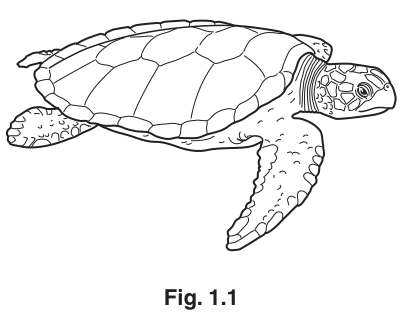
Fig. 1.1 shows a flatback turtle.
Each female lays approximately 50 eggs per nest, which is a smaller number than all other species of marine turtle. The eggs are buried in the sand and when the hatchlings emerge each has a mass of approximately . Unlike most marine turtles, flatback turtles spend most of their time in coastal waters. This is where they feed and mate.
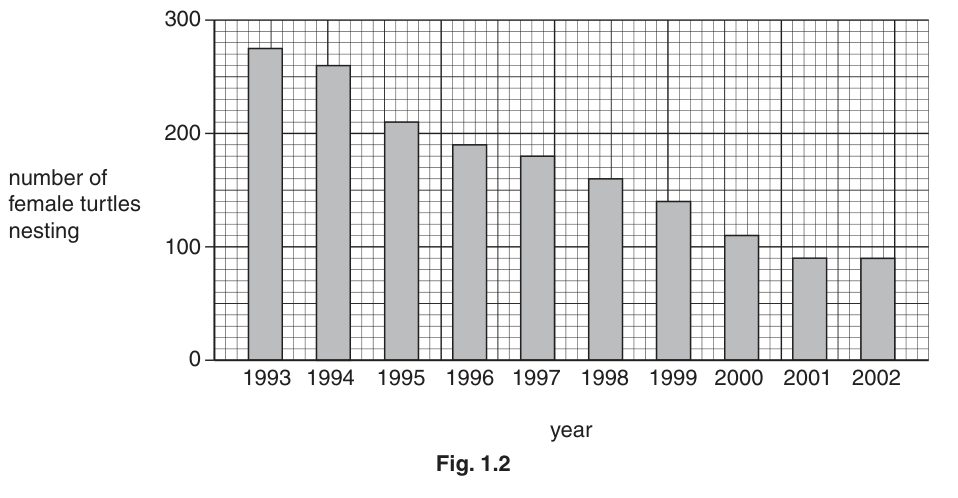
Fig. 1.2 shows the numbers of female flatback turtles nesting on a beach in northern Australia between 1993 and 2002.
Calculate the mean rate of decrease in the numbers of females nesting between 1993 and 2002.
Show all the steps in your calculation.
Answer = ______
Working
- Reading from Fig. 1.2: 1993 ≈ 275 females; 2002 ≈ 90 females
- Decrease in number of females =
- Time period (1993 to 2002) = years
- Mean rate of decrease =
Answer
females per year
18.5 females per year
Background Concept
When a population is in decline, ecologists describe the change using a rate of change — how much the population size has changed per unit time. The mean (average) rate of change is calculated as:
This gives a single number (here, females per year) that summarises a trend shown across multiple time-points in a graph. A mean rate of decrease that is large and sustained is a warning sign that a population is heading towards local extinction.
Understanding the Question
Fig. 1.2 is a bar chart of the number of female flatback turtles recorded nesting on one beach each year from 1993 to 2002. The question asks for the mean rate of decrease — that is, on average, how many fewer females nested each year over that 10-year period. The mark scheme treats the period from 1993 to 2002 as 10 years (treating 1993 as year 0 and 2002 as year 10, with 10 data points in between).
Approach
- Read the bar heights for the first and last years (1993 and 2002).
- Subtract to find the total decrease.
- Divide by the number of years.
Step-by-Step Reasoning
- From Fig. 1.2, the bar for 1993 reaches 275 on the y-axis, and the bar for 2002 reaches 90.
- Total decrease: females.
- The interval from 1993 to 2002 spans years (10 data points: 1993, 1994, …, 2002).
- Mean rate of decrease:
- The mark scheme accepts 18.5 (or 19) and rejects 18 (rounding the wrong way). The unit is "females per year".
Key Takeaways
- A mean rate of change collapses a multi-year trend into one interpretable number.
- Always read bar/line values carefully — small reading errors here change the final answer.
- The "per year" unit matters; an answer with no unit is incomplete.
Common Mistakes
- Using 9 instead of 10 in the denominator because the calendar gap is 9 years. The mark scheme here uses 10 (the convention of "year 0 → year 10"), giving 18.5. A 9-year calculation would give ≈ 20.6, which is not credited.
- Reading the 2002 bar as 80 or 100 (it sits at 90).
- Forgetting the unit "females per year" or "per year".
- Dividing the wrong way round (the smaller value subtracted from the larger).
Things to Be Careful About
- The question asks for the rate of decrease, not the percentage decrease or the total decrease.
- Show your working — the mark scheme awards 1 mark for the substitution and 1 mark for the final numerical answer.
- Note that 2001 and 2002 are both at 90, so the decline has plateaued in the last two years, but the question still asks for the mean rate across the whole period.
Suggest ways in which the flatback turtle could be protected.
Answer
Any five of the following:
- Avoid disturbance to nest sites / nesting females (e.g. limit human access to nesting beaches).
- Protect nest sites and young from predators (e.g. predator control, nest cages).
- Avoid sea pollution, e.g. do not discharge rubbish into the sea and reduce light pollution on nesting beaches.
- Take care when fishing — use turtle-excluder devices in nets / avoid drift nets in turtle feeding areas.
- Stop hunting of adults and ban trade in turtle products (e.g. shells, meat, eggs).
- Captive breeding programmes to boost numbers for release.
- Establish conservation areas / nature reserves on nesting beaches and key feeding grounds (or keep turtles in zoos/aquaria for breeding).
- Education programmes and eco-tourism to raise public awareness and provide alternative income for local communities.
See working — five protection measures are listed.
Background Concept
An endangered species is one whose population has fallen to such low levels, or is declining at such a rate, that it is at serious risk of extinction. Effective conservation has to tackle every life stage and every habitat the animal uses. For the flatback turtle this means:
- the nesting beach (eggs laid in sand; hatchlings cross the beach to the sea)
- the open sea (adults feed and mate in coastal waters)
The four most common reasons marine turtles decline are: (1) loss or disturbance of nesting beaches, (2) predation of eggs and hatchlings, (3) incidental capture in fishing gear ("bycatch"), and (4) direct exploitation (hunting for meat, eggs, shell). Conservation therefore uses a mixture of habitat protection, legislation, in-situ and ex-situ breeding, and education.
Understanding the Question
Part (b) is an open "suggest" question worth 5 marks. The mark scheme offers 9 distinct creditable points and caps the score at 5. The candidate should think about every threat a marine turtle faces (on the nesting beach and in the sea) and propose a corresponding protective measure. A good answer links each suggestion to a real, specific threat mentioned or implied in the stem.
Approach
- Identify the threats implied by the stem: nesting-beach disturbance, predators, sea pollution, fishing nets, hunting.
- For each threat, name a sensible, biologically realistic protection method.
- Pick the five strongest, most distinct points.
Step-by-Step Reasoning
The mark scheme credits any 5 of the 9 points below (max 5):
- Avoid disturbance to nest sites / nesting females — restrict human access to the beach during the nesting season; do not allow vehicles or bright lights on the beach.
- Protect nests and young from predators — fox/dingo control around nesting beaches, or covering nests with protective cages so hatchlings are not eaten as they emerge.
- Avoid sea pollution — keep rubbish, plastics, oil and chemical discharge out of coastal waters where flatbacks feed.
- Example of pollution — concrete example: do not throw rubbish into the sea, prevent boat discharge, or reduce light pollution on the beach (artificial light disorients hatchlings).
- Take care when fishing (with nets) — use turtle-excluder devices (TEDs) in shrimp trawls, or ban drift nets in known turtle feeding areas, to prevent bycatch.
- Stop hunting of adults — and/or a trading ban on turtle products (shells, meat, eggs, leather).
- Captive breeding programmes — breed adults (or rear eggs) in captivity and release hatchlings/juveniles to boost wild numbers.
- Conservation areas / zoos — designate protected areas on nesting beaches and in coastal feeding waters; or hold a breeding stock in zoos/aquaria as a safeguard.
- Education / ecotourism — run public-awareness programmes and develop ecotourism so local people have an economic incentive to protect rather than kill turtles.
Note that the mark scheme specifically rejects references to "mating" as a thing to be protected (point 1 — mating is in the sea and not what the question is about). The solution gives 5 well-distributed, mark-scheme-creditworthy points.
Key Takeaways
- Conservation must protect the whole life cycle: eggs on the beach, hatchlings crossing the beach, juveniles and adults at sea.
- Different threats need different solutions: legislation (hunting bans), technology (TEDs in nets), habitat protection (reserves), and ex-situ methods (captive breeding) all have a role.
- "Suggest" questions reward breadth — one well-articulated point per threat is stronger than five vague points on the same theme.
Common Mistakes
- Vague answers such as "protect the environment" or "stop pollution" — these are not specific enough to score. The mark scheme wants the type of pollution named (rubbish, light, oil) and a concrete protective action (TEDs, predator cages, beach wardens).
- Repeating the same idea five times in different words (e.g. "stop hunting", "ban hunting", "ban trade", "stop killing turtles", "protect them from humans") — only the first 1–2 will be credited.
- Mentioning "protect them while mating" — explicitly rejected by the mark scheme.
- Forgetting that the species is marine — pollution, bycatch and boat traffic are relevant, and these are the threats most candidates overlook.
Things to Be Careful About
- The command word is "suggest" — there is no single correct answer, but every point must be a plausible conservation action, not just a restatement of the threat.
- Match each suggestion to either the nesting beach or the sea so the two halves of the life cycle are covered.
- Watch for overlaps: points 3 and 4 (avoid pollution + example) are the same credit, so they only count as one. Likewise, points 7 and 8 (captive breeding + zoos) are not independent. Choose the wording that best matches what the mark scheme lists.
The rest of this paper
9 more questions- Q2(outdated) Biotechnology · Control and Coordination · Energy and Respiration15M
- Q3(outdated) Aspects of Human Reproduction8M
- Q4(outdated) Crop Plants · Photosynthesis15M
- Q5Selection and Evolution8M
- Q6Inheritance · Homeostasis8M
- Q7Energy and Respiration16M
- Q8Inheritance · Genetic Technology8M
- Q9Photosynthesis15M
- Q10Homeostasis15M