Biology 5090/12 — October/November 2025
Cambridge O-Level · Multiple Choice · answer key with instant marking and worked solutions
Topics Inheritance · Respiration · Organisms and Their Environment · Biological Molecules · Plant Nutrition · Transport in Humans · +14 more
Tap an option under each question to check it — your score builds as you go.
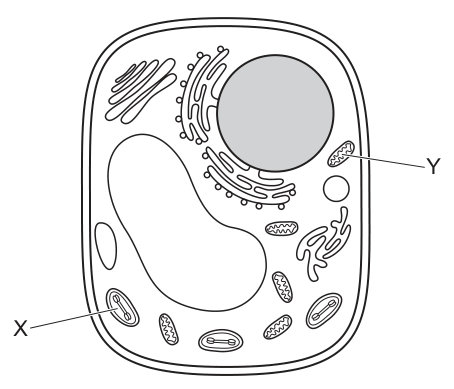
Which row identifies structures X and Y on the plant cell diagram?
Options
| structure X | structure Y | |
|---|---|---|
| A | chloroplast | mitochondrion |
| B | chloroplast | ribosome |
| C | nucleus | chloroplast |
| D | mitochondrion | ribosome |
Answer
Structure X is a chloroplast. It is identified by the internal stacks of disc-like structures called thylakoids (arranged as grana), which contain chlorophyll for photosynthesis.
Structure Y is a mitochondrion. It is identified by the folded inner membrane (cristae) which increases surface area for aerobic respiration.
Matching these to the table:
- Structure X: chloroplast
- Structure Y: mitochondrion
This corresponds to row A.
Answer
A
A
Walkthrough
- Analyze Structure X: The label X points to an organelle near the cell membrane. Inside, there are distinct stacks of disc-like structures. In plant cell diagrams, these stacks represent grana (stacks of thylakoids), which are the site of the light-dependent reactions of photosynthesis. This identifies X as a chloroplast.
- Analyze Structure Y: The label Y points to a smaller organelle. It has a smooth outer membrane and a highly folded inner membrane. These folds are called cristae, which increase the surface area for the enzymes needed for aerobic respiration. This identifies Y as a mitochondrion.
- Evaluate Options:
- Row A: X = chloroplast, Y = mitochondrion. (Correct)
- Row B: Y is not a ribosome (ribosomes are tiny dots, often on the rough ER).
- Row C: X is not the nucleus (the large grey circle is the nucleus). Y is not a chloroplast.
- Row D: X is not a mitochondrion.
Key Takeaways
- Chloroplasts contain thylakoids arranged in stacks (grana).
- Mitochondria have a folded inner membrane (cristae).
- Ribosomes appear as tiny dots, often attached to the endoplasmic reticulum.
- The nucleus is typically the largest, roundest organelle, often with a nucleolus inside.
Common Mistakes
- Confusing mitochondria and chloroplasts: Both are double-membraned organelles with internal structures. However, chloroplasts have stacks of discs (grana), while mitochondria have wavy, folded inner membranes (cristae).
- Confusing mitochondria with ribosomes: Ribosomes are much smaller and do not have complex internal membrane systems. They appear as small dots.
- Misidentifying the nucleus: The large, prominent grey circle in the diagram is the nucleus, not a chloroplast or mitochondrion.
Things to Be Careful About
- Look closely at the internal structures of the organelles. The presence of grana (stacks) is the key feature for chloroplasts.
- The folded inner membrane is the key feature for mitochondria.
- Ensure you are reading the columns correctly: structure X is the first column, structure Y is the second.
Viruses can only replicate inside cells.
A single Herpes simplex virus replicates rapidly inside a living cell and produces 4000 copies in 12 hours.
What is the maximum number of viruses that could be produced in 36 hours from a single Herpes simplex virus?
Options
A
B
C
D
Working
Each 12-hour period, every virus produces 4000 copies, so the total is multiplied by 4000.
Answer
C
C
Walkthrough
This question is about how viruses replicate. The key statement is that a single Herpes simplex virus produces 4000 copies in 12 hours. The word "copies" means new viruses. The crucial point is that this happens for every virus — so after the first 12 hours we have 4000 viruses, and each of those 4000 viruses can itself produce 4000 copies in the next 12 hours, and so on. This is exponential growth, not linear growth.
36 hours contains three 12-hour periods: 36 ÷ 12 = 3. So the number multiplies by 4000 three times:
- After 12 hours: 4000 = 4 × 10³
- After 24 hours: 4000 × 4000 = 1.6 × 10⁷ (this is option B — a distractor)
- After 36 hours: 4000 × 4000 × 4000 = 6.4 × 10¹⁰
So the correct option is C.
Key Takeaways
- Viruses can only replicate inside living cells; they are not independent living organisms.
- Replication is exponential when every new virus can replicate in turn — each round multiplies the total by the same factor.
- 36 hours equals three 12-hour periods, so the factor 4000 is applied three times.
Common Mistakes
- Treating the growth as linear (4000 × 3 = 12 000): the virus replicates inside each cell, so each of the 4000 new viruses replicates too.
- Stopping after two periods (option B, 16 × 10⁶) or going one period too far (option D, 2.6 × 10¹⁴, which is 4000⁴).
- Arithmetic slips with powers of ten: 4000³ = 64 × 10⁹ = 6.4 × 10¹⁰, not 6.4 × 10⁹.
Things to Be Careful About
- Count the number of 12-hour periods in 36 hours correctly: it is 3.
- Apply the multiplication three times, not once or twice.
- Convert 64 × 10⁹ into standard form 6.4 × 10¹⁰ correctly — the decimal point moves one place, so the power of ten increases by one.
Which statement about osmosis is correct?
Options
A An animal cell immersed in distilled water will shrink.
B A plant cell immersed in distilled water will become flaccid.
C A plant cell immersed in a strong sodium chloride solution will become turgid.
D A plant cell immersed in a strong sodium chloride solution will become plasmolysed.
Working
Distilled water has a higher water potential than the cell contents, so water enters cells by osmosis. An animal cell has no cell wall, so it swells and may burst, not shrink (A false). A plant cell has a cell wall, so it becomes turgid, not flaccid (B false). A strong sodium chloride solution has a lower water potential than the cell contents, so water leaves plant cells; the cytoplasm and vacuole shrink away from the cell wall, causing plasmolysis (C false, D true).
Answer
D
D
Walkthrough
Osmosis is the net movement of water molecules from a region of higher water potential to a region of lower water potential through a partially permeable membrane. Distilled water is pure water, so its water potential is higher than the solution inside any cell. Therefore water enters both animal and plant cells placed in distilled water.
An animal cell has only a cell membrane, so it swells and can burst; it does not shrink. A plant cell has a rigid cell wall, so it becomes turgid, with the cytoplasm pressing against the cell wall, and it does not become flaccid.
A strong sodium chloride solution has a lower water potential than the cell contents, so water leaves the cell. In a plant cell, the vacuole and cytoplasm shrink and the cell membrane pulls away from the cell wall; this is plasmolysis. So D is the only correct statement.
Key Takeaways
- Osmosis always moves water from higher water potential to lower water potential through a partially permeable membrane.
- Distilled water has a very high water potential; concentrated solutions have a low water potential.
- Animal cells have no cell wall, so they swell or burst in a hypotonic solution and shrink in a hypertonic solution.
- Plant cells have a cell wall, so they become turgid in a hypotonic solution and plasmolysed in a hypertonic solution.
- Know the exact terms: turgid, flaccid, plasmolysed.
Common Mistakes
- Choosing A: thinking an animal cell in distilled water shrinks, when in fact water enters and the cell swells or bursts.
- Choosing B: thinking a plant cell in distilled water becomes flaccid, when it becomes turgid.
- Choosing C: confusing the effect of a concentrated solution; it causes water to leave, not enter, so the cell becomes plasmolysed, not turgid.
- Saying water moves from a low concentration to a high concentration without specifying water potential; the correct idea is a water potential gradient.
Things to Be Careful About
- Use the term water potential, not concentration of water, when explaining osmosis.
- Distinguish flaccid, where a plant cell is limp because it has lost some water but the membrane has not pulled away, from plasmolysed, where the membrane has pulled away from the cell wall.
- Remember the plant cell wall is fully permeable and does not stop osmosis; it only prevents the cell from bursting.
Globulin is a substance that can be detected by the biuret test.
Which type of substance is globulin?
Options
A fat
B oil
C protein
D reducing sugar
Working
The biuret test is used to detect proteins. It gives a purple/lilac colour with protein. Globulin is a protein, so the correct option is C.
Answer
C
C
Walkthrough
The question tells you that globulin can be detected by the biuret test. The key is to remember what the biuret test is for: it detects proteins. When biuret reagent is added to a solution containing protein, it changes from blue to purple/lilac.
Globulin is a type of protein, for example a protein found in blood plasma. Since it gives a positive biuret test, it must be a protein.
Now look at the options:
- A fat and B oil are lipids. Lipids are detected using the ethanol emulsion test, not the biuret test.
- D reducing sugar is detected using Benedict's solution, which changes from blue to green, yellow, orange or brick-red when heated with a reducing sugar.
- C protein is detected using the biuret test.
So the correct answer is C.
Key Takeaways
- Each major nutrient has a specific food test: iodine solution for starch, Benedict's solution for reducing sugars, biuret reagent for protein, and the ethanol emulsion test for fats and oils.
- The biuret test is the test for protein.
- A substance that gives a positive biuret test must be a protein.
Common Mistakes
- Choosing D: Benedict's solution tests for reducing sugars, not protein.
- Choosing A or B: fats and oils are tested with the ethanol emulsion test, not the biuret test.
- Saying the biuret test detects amino acids: it detects proteins (peptide bonds), not individual amino acids.
Things to Be Careful About
- The exact term required is "protein".
- You do not need to know the detailed structure of globulin; the clue is simply that it is detected by the biuret test.
- Remember the colour change for biuret: blue to purple/lilac.
Cellulose and glucose are carbohydrates.
Cellulose is a large molecule made from a long chain of smaller glucose molecules.
One cellulose molecule is long. One glucose molecule is long.
How many glucose molecules are found in this cellulose molecule?
Options
A
B
C
D
Working
Convert the cellulose length to micrometres:
Number of glucose molecules:
Answer
C
C
Walkthrough
This question is a unit conversion followed by a division. The cellulose molecule is long, but the glucose molecule is given in micrometres (). Before comparing the two lengths, convert them to the same unit.
There are in , so:
Now both lengths are in micrometres. To find how many glucose molecules fit end to end along the cellulose molecule, divide the total length by the length of one glucose molecule:
is , so the correct option is C.
Key Takeaways
- A large molecule such as cellulose is built from many smaller repeating units (here, glucose molecules).
- Before dividing quantities, always check that they are in the same unit.
- , and dividing by is the same as multiplying by .
Common Mistakes
- Dividing by without converting units gives , which is wrong because the units do not match.
- Confusing millimetres with micrometres: is , not .
- Reversing the division, i.e. dividing the glucose length by the cellulose length, would give a tiny fraction instead of a large number.
Things to Be Careful About
- The answer choices are powers of ten, so the conversion factor is the key step.
- is , and .
- Give the option letter as the final answer; the working is only to justify the choice.
Four test-tubes contain starch solution and amylase. They are placed in water-baths at different temperatures and provided with different pHs, as shown in the table. All other conditions are kept the same.
After 30 minutes, iodine solution is added to each test-tube. The contents of three of the test-tubes turns blue-black.
In which test-tube are the contents yellow-brown?
Options
| temperature / | pH | |
|---|---|---|
| A | 35 | 2.5 |
| B | 35 | 6.9 |
| C | 75 | 2.5 |
| D | 75 | 6.9 |
Working
Amylase digests starch to maltose. Iodine solution turns blue-black in the presence of starch and stays yellow-brown when starch has been digested.
Amylase works best at body temperature (about ) and at a neutral pH (about 7). Only tube B provides both of these conditions (, pH 6.9), so the starch is digested there and the contents remain yellow-brown. In tubes A, C and D the enzyme is inactive or denatured, so starch remains and the contents turn blue-black.
Answer
B
B
Walkthrough
This question tests two linked ideas: the conditions under which an enzyme works best, and how the iodine test tells us whether starch is still present.
First, recall what the iodine test does. Iodine solution is brown-yellow. If starch is present, the iodine turns blue-black. If no starch is present, the iodine stays yellow-brown. So a tube that turns blue-black still contains starch; a tube that stays yellow-brown has had its starch removed.
Second, recall what amylase does. Amylase is an enzyme that breaks down starch into maltose. Like all enzymes, it has an optimum temperature and an optimum pH. For human amylase (which is found in the mouth and in pancreatic juice), the optimum is close to body temperature, about , and a neutral pH of about 7. At pH values far from the optimum, or at very high temperatures, the enzyme is denatured — its active site changes shape and it can no longer bind to starch, so digestion stops.
Now look at the table. Tube B is at and pH 6.9 — both are very close to the optimum, so amylase works well, the starch is digested to maltose, and the iodine stays yellow-brown. In tube A the temperature is fine but the pH is 2.5, which is strongly acidic and denatures the enzyme. In tubes C and D the temperature is , which is far too hot and denatures the enzyme regardless of pH. In all three of those tubes the starch remains, so the iodine turns blue-black. The question tells us three tubes turn blue-black, which confirms that only one tube — B — has had its starch digested.
Key Takeaways
- Enzymes have an optimum temperature and an optimum pH at which they work fastest.
- Human enzymes generally work best at about and neutral pH (around 7).
- Very high temperatures and extreme pH values denature enzymes, permanently changing the shape of the active site so they can no longer catalyse the reaction.
- Iodine solution is the test for starch: blue-black means starch is present, yellow-brown means it is not.
- When a question says three tubes turn blue-black, use that information to confirm which tube is the odd one out.
Common Mistakes
- Choosing A (, pH 2.5) because the temperature is right, while ignoring that the strongly acidic pH denatures the enzyme. Both conditions must be suitable together.
- Choosing D (, pH 6.9) because the pH is right, while ignoring that is far above body temperature and denatures the enzyme.
- Confusing the iodine result: remembering that blue-black means starch is present, not that it has been digested.
- Thinking that all enzymes work best at the same conditions — the optimum depends on where the enzyme normally works in the organism.
Things to Be Careful About
- The mark scheme accepts only B. The reasoning must combine both the temperature and the pH: the enzyme needs conditions near its optimum for both.
- Note that is slightly below but still within the range where amylase works well; the question is not asking for a precise optimum, just which tube allows digestion to happen.
- Do not confuse "denatured" with "slowed down": at the enzyme is permanently denatured, not merely working slowly, so no starch is digested even after 30 minutes.
- The iodine colour change is the evidence: yellow-brown means no starch, so digestion has occurred.
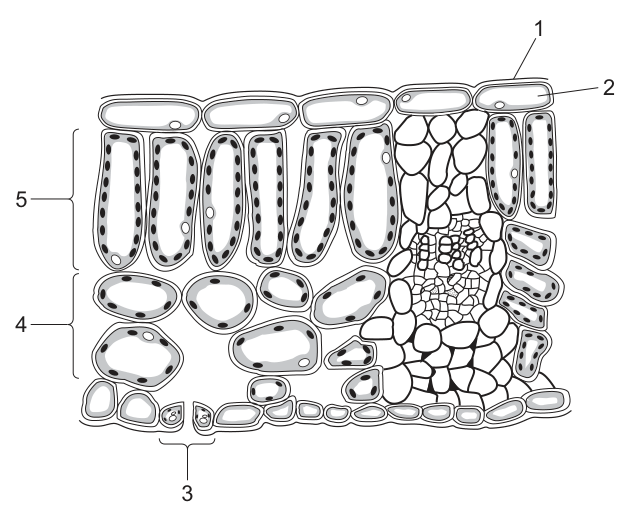
The diagram shows a section through a dicotyledonous leaf.
Which structures are almost transparent to help increase the rate of photosynthesis in the leaf?
Options
A 1 and 2
B 2 and 3
C 3 and 4
D 4 and 5
Answer
A (1 and 2)
The waxy cuticle (1) and the upper epidermis (2) are almost transparent. This allows light to pass through to the palisade mesophyll layer (5), which contains the highest concentration of chloroplasts, thereby increasing the rate of photosynthesis.
A
Walkthrough
The question asks which structures in a leaf cross-section are almost transparent to help increase photosynthesis. Photosynthesis requires light to reach the chloroplasts. In a dicotyledonous leaf, the palisade mesophyll layer (label 5) contains the most chloroplasts and is located just below the upper surface. To maximise light absorption, the layers above it must allow light to pass through without absorbing or reflecting it.
- Label 1 (waxy cuticle): A transparent, waxy layer on the upper surface that prevents water loss but allows light to penetrate.
- Label 2 (upper epidermis): A single layer of cells that is transparent and typically lacks chloroplasts (except for guard cells). Its transparency ensures light reaches the palisade mesophyll below.
- Label 3 (stomata / guard cells): Guard cells contain chloroplasts and are not transparent; they regulate gas exchange.
- Label 4 (spongy mesophyll): Cells contain chloroplasts and are involved in photosynthesis, so they are not transparent.
- Label 5 (palisade mesophyll): The main photosynthetic layer, densely packed with chloroplasts, so it is not transparent.
Therefore, the structures that are almost transparent to let light through are 1 and 2, making A the correct answer.
Key Takeaways
- The upper epidermis and waxy cuticle are transparent adaptations that allow light to reach the photosynthetic cells (palisade mesophyll) without being absorbed by the outer layers.
- Structures containing chloroplasts (guard cells, mesophyll cells) are not transparent because they need to absorb light for photosynthesis.
Common Mistakes
- Confusing transparency with protection: Students might think the cuticle is opaque because it is waxy, but it is actually transparent to light while being impermeable to water.
- Misreading the diagram: Label 3 points to the stomata and guard cells at the bottom. Guard cells contain chloroplasts, so they are not transparent. Label 4 is the spongy mesophyll, which also contains chloroplasts.
- Choosing 4 and 5: The spongy and palisade mesophyll are the photosynthetic tissues themselves; they are green and full of chloroplasts, not transparent.
Things to Be Careful About
- Always match the labels to the correct tissue in a leaf cross-section diagram. Remember that the upper epidermis (2) is transparent, whereas the mesophyll layers (4 and 5) contain chloroplasts and are not.
- The question specifically asks for structures that are "almost transparent" to "increase the rate of photosynthesis". This means we are looking for adaptations that maximise light penetration to the chloroplasts, not the chloroplasts themselves.
Oxygen is produced in leaf cells during photosynthesis and diffuses out of the leaf.
By which pathway does the oxygen diffuse?
Options
A through the upper epidermis and through the cuticle
B through the airspaces and through the stomata
C through the mesophyll and through the phloem
D through the mesophyll and through the xylem
Working
Oxygen is produced in the mesophyll cells during photosynthesis. It diffuses from these cells into the air spaces inside the leaf, then out of the leaf through the stomata.
- A is wrong — the cuticle is a waxy layer that is impermeable to gases, so oxygen cannot diffuse through it.
- C is wrong — the phloem transports sucrose and other substances, not oxygen.
- D is wrong — the xylem transports water and mineral ions, not oxygen.
Answer
B
B
Walkthrough
The question asks for the pathway by which oxygen, made in leaf cells during photosynthesis, diffuses out of the leaf.
Oxygen is a product of photosynthesis, which happens mainly in the palisade mesophyll cells near the top of the leaf. From these cells the oxygen diffuses into the air spaces that run through the spongy mesophyll. These air spaces connect to the outside of the leaf through tiny pores called stomata, found mainly in the lower epidermis. So the route is: mesophyll cell → air spaces → stomata → outside air.
Now check each option:
- A says through the upper epidermis and through the cuticle. The cuticle is a waxy waterproof layer covering the leaf surface. Gases cannot pass through it easily, so this is not a route for oxygen to leave.
- B says through the airspaces and through the stomata. This matches exactly the route described above, so it is correct.
- C says through the mesophyll and through the phloem. The phloem is a transport tissue that carries sucrose and amino acids (translocation), not oxygen. Oxygen does not diffuse through phloem.
- D says through the mesophyll and through the xylem. The xylem carries water and mineral ions from the roots upwards, not oxygen. So this is also wrong.
Key Takeaways
- During photosynthesis, oxygen is produced inside mesophyll cells and must leave the leaf by diffusion.
- The gas exchange route in a leaf is: air spaces → stomata → outside air.
- The cuticle is waxy and impermeable to gases; it prevents water loss but also blocks gas exchange.
- Xylem and phloem are transport tissues for water/minerals and sugars respectively — they are not involved in gas exchange.
Common Mistakes
- Choosing A because the upper epidermis is on top of the leaf — but the cuticle is waxy and impermeable, so oxygen cannot pass through it.
- Choosing C or D because mesophyll is where photosynthesis happens — but the mistake is pairing it with xylem or phloem, which transport substances other than gases.
- Confusing the function of xylem (water and minerals) with phloem (sucrose and amino acids).
Things to Be Careful About
- Remember that gas exchange in leaves happens through stomata, not through the cuticle.
- The stomata are mostly on the lower epidermis of the leaf, but the question does not require that detail — it only asks for the pathway.
- Match each tissue to its correct function: xylem = water and minerals, phloem = sucrose and amino acids, stomata = gas exchange.
Why do newly germinated seeds fail to grow into healthy plants if they lack magnesium ions?
Options
A Magnesium ions are a necessary component of all proteins.
B Magnesium ions are needed to convert chlorophyll to starch.
C Magnesium ions are needed to form cell walls.
D Magnesium ions are needed to form chlorophyll molecules.
Working
Magnesium ions are a component of the chlorophyll molecule. Without magnesium, the plant cannot make chlorophyll, so it cannot photosynthesise and fails to grow into a healthy plant.
- A is wrong: magnesium is not a component of all proteins — only some proteins contain it.
- B is wrong: magnesium is not involved in converting chlorophyll to starch.
- C is wrong: magnesium is not needed to form cell walls.
- D is correct: magnesium ions are needed to form chlorophyll molecules.
Answer
D
D
Walkthrough
This question tests the mineral nutrition of plants. Magnesium ions () are absorbed from the soil by root hair cells and transported to the leaves, where they are used to build chlorophyll — the green pigment that traps light energy for photosynthesis. If a germinating seed has no magnesium available, it cannot make new chlorophyll. Without chlorophyll, photosynthesis cannot happen, so the seedling cannot make its own food and fails to grow into a healthy plant.
Look at each option:
- A — Magnesium is not a component of all proteins. Proteins are built from amino acids, and only a few specialised proteins contain magnesium. So this is false.
- B — Magnesium is not needed to convert chlorophyll to starch. Chlorophyll is not converted to starch at all; starch is made from glucose produced during photosynthesis. This is false.
- C — Magnesium is not needed to form cell walls. Cell walls are made of cellulose, and the mineral involved in cell wall formation is mainly calcium. This is false.
- D — Magnesium is needed to form chlorophyll molecules. This is the correct statement.
Key Takeaways
- Magnesium ions are essential for making chlorophyll, so a deficiency causes yellowing leaves (chlorosis) and poor growth.
- Nitrate ions are needed for making amino acids and proteins; magnesium is needed for chlorophyll — these are the two most commonly examined mineral ions in 5090.
- Photosynthesis cannot occur without chlorophyll, so a magnesium-deficient plant cannot make its own food.
Common Mistakes
- Choosing A because students think magnesium is in all proteins. It is not — nitrogen (from nitrates) is the element needed for proteins.
- Choosing B or C by guessing. Remember the specific role: magnesium → chlorophyll; nitrate → proteins; calcium → cell walls.
- Confusing the role of magnesium with that of nitrate. Nitrate supplies nitrogen for amino acids and proteins; magnesium is the central ion in the chlorophyll molecule.
Things to Be Careful About
- The question asks why the seedlings "fail to grow into healthy plants" — the answer must link magnesium to chlorophyll and therefore to the plant's ability to photosynthesise and make food.
- Give the precise term "chlorophyll" — the mark scheme rewards the exact word, not a paraphrase like "green pigment" alone.
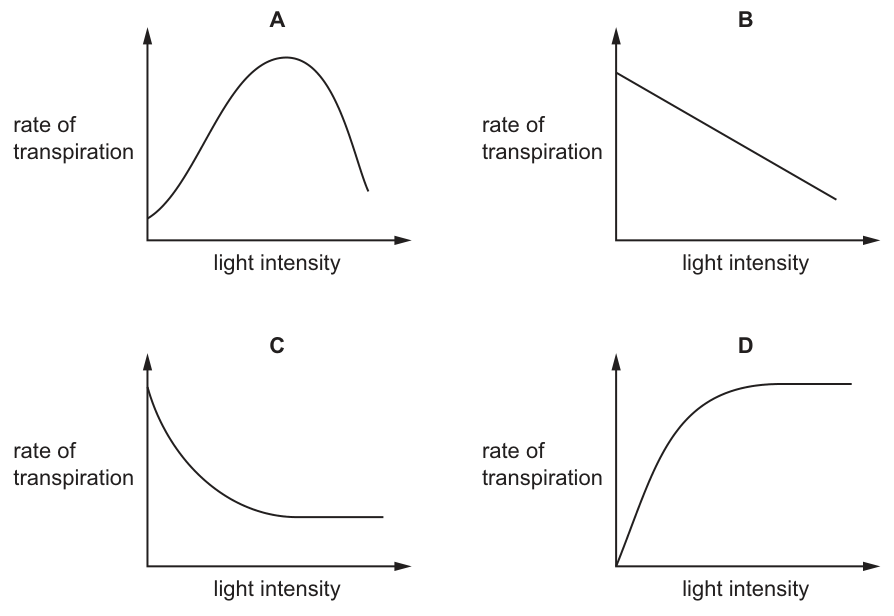
Which graph shows the effect of light intensity on the rate of transpiration?
Options
Working
Light intensity causes stomata to open. As light intensity increases, more stomata open, increasing the rate of transpiration because more water vapour can diffuse out. However, once all the stomata are fully open, the rate of transpiration cannot increase further and levels off to a constant maximum rate (plateaus). At zero light intensity, stomata are closed, so the rate of transpiration is zero. This relationship is shown by a curve that starts at the origin, rises, and then plateaus.
Graph D matches this pattern.
Answer
D
D
Walkthrough
- Understand the biological process: Transpiration is the loss of water vapour from the leaves of a plant, mainly through the stomata. The rate of transpiration depends on how open these pores are.
- Link light intensity to stomata: Stomata are pores in the leaf epidermis controlled by guard cells. In the presence of light, guard cells take up water by active transport, become turgid, and cause the stomata to open. In darkness, they lose water, become flaccid, and close the stomata.
- Relate to transpiration rate: When stomata are open, water vapour can diffuse out of the leaf. Therefore, as light intensity increases, more stomata open, and the rate of transpiration increases.
- Identify the plateau: The rate of transpiration cannot increase indefinitely. Once all available stomata are fully open, the rate reaches a maximum and levels off (plateaus), even if light intensity continues to increase. Other factors (like water availability or humidity) may become limiting.
- Match to the graph: The graph must start at or near zero (closed stomata in dark), rise as light intensity increases (stomata opening), and then level off (stomata fully open). Graph D is the only one that shows this characteristic saturation curve. Graph A is typical for enzyme activity against temperature or pH. Graphs B and C show decreasing relationships, which are incorrect here.
Key Takeaways
- Light intensity is a key environmental factor affecting the rate of transpiration because it controls stomatal opening.
- Biological rates that depend on a factor often show a saturation curve: they increase initially and then plateau when a limiting factor is reached (e.g., all stomata open).
- Graph interpretation requires linking the shape of the curve to the underlying biological mechanism.
Common Mistakes
- Choosing Graph A: Students often memorise the bell-shaped curve for enzyme activity (temperature or pH) and incorrectly apply it to transpiration. Transpiration does not have an optimum light intensity where it stops; it plateaus.
- Ignoring the starting point: Forgetting that in darkness, stomata are closed, so the rate of transpiration should start at or near zero, not at a high value (which would incorrectly match Graph C).
- Assuming a linear relationship: Believing that transpiration rate increases indefinitely with light intensity, missing the plateau caused by stomata being fully open.
Things to Be Careful About
- Ensure you are reading the axes correctly: "rate of transpiration" on the y-axis and "light intensity" on the x-axis.
- Remember the biological reason for the plateau: it is not because the plant is damaged, but because the stomata are already fully open and cannot allow more water vapour to escape.
- Distinguish this graph from the limiting factor graph for photosynthesis (which has the same shape but is driven by the light-dependent reactions reaching maximum capacity). Here, the mechanism is stomatal opening.
A woman went to the doctor with the following symptoms:
- severe joint and leg pain
- swollen and bleeding gums
- skin that bruises easily.
What should the doctor test the woman's blood for?
Options
A the concentration of vitamin C
B the concentration of vitamin D
C the concentration of iron
D the concentration of calcium
Working
The symptoms — severe joint and leg pain, swollen and bleeding gums, and skin that bruises easily — are the classic signs of scurvy, the deficiency disease caused by a lack of vitamin C.
Vitamin D deficiency causes rickets, iron deficiency causes anaemia, and calcium deficiency affects bone health, none of which match bleeding gums and easy bruising.
So the doctor should test the woman's blood for the concentration of vitamin C.
Answer
A
A
Walkthrough
The question gives three symptoms and asks what the doctor should test the woman's blood for. The correct approach is to recognise which deficiency disease these symptoms describe, then identify the nutrient that is missing.
- Severe joint and leg pain, swollen and bleeding gums, skin that bruises easily — together these are the classic description of scurvy. Scurvy is caused by a lack of vitamin C in the diet. Vitamin C is needed to make collagen, a protein that helps hold tissues together, including the walls of blood vessels and the gums. Without enough collagen, blood vessels become weak, so gums bleed and skin bruises easily, and joints and bones become painful.
Now check the other options to be sure:
- Vitamin D — deficiency causes rickets in children, with soft, weak bones that bend (bowed legs) and poor bone growth. It does not cause bleeding gums or easy bruising.
- Iron — deficiency causes anaemia, because iron is needed to make haemoglobin in red blood cells. Symptoms are tiredness, weakness and pale skin, not bleeding gums.
- Calcium — deficiency affects bone strength and can cause rickets-like problems, but again not bleeding gums or easy bruising.
So the only nutrient whose deficiency matches all three symptoms is vitamin C, and the answer is A.
Key Takeaways
- Each deficiency disease has a characteristic set of symptoms, and you should be able to match them: scurvy (vitamin C) — bleeding gums, easy bruising, joint and leg pain; rickets (vitamin D) — soft, bent bones; anaemia (iron) — tiredness and pale skin.
- The question tests recognition of scurvy from its symptoms, so learning the symptom pattern is the key skill.
- Vitamin C is needed for healthy connective tissue (collagen), which is why its deficiency shows up in the gums and skin.
Common Mistakes
- Confusing scurvy with rickets — rickets is a vitamin D deficiency causing bent, weak bones; it does not cause bleeding gums. The bleeding gums are the giveaway for scurvy.
- Choosing iron (anaemia) — anaemia causes tiredness and paleness, not bleeding gums or easy bruising.
- Choosing calcium — calcium deficiency affects bones but not gums or bruising.
- Answering with the disease name — the question asks what to test for, so the answer must be the nutrient (vitamin C), not the disease (scurvy).
Things to Be Careful About
- Read the options carefully: three of them (vitamin D, iron, calcium) are each linked to a different deficiency disease, so the distinguishing symptom — bleeding gums and easy bruising — is what points to vitamin C.
- The mark scheme accepts only option A, the concentration of vitamin C.
- Note that the question asks what the doctor should test the blood for, so the answer is the substance whose level is low, not a treatment or a disease name.
Four people do exactly the same physical exercise.
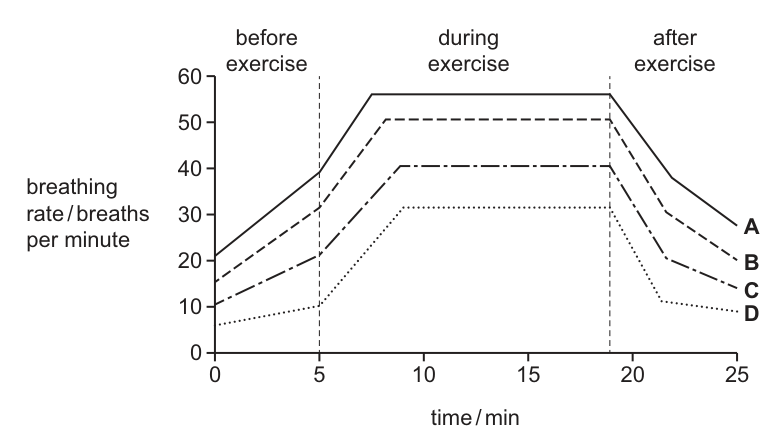
The graph shows their breathing rate in breaths per minute before, during and after the exercise.
One person is a professional athlete.
Which line shows the results for the professional athlete?
Options
A A
B B
C C
D D
Working
A professional athlete is highly fit. A fit person has a lower resting breathing rate and a lower breathing rate during the same amount of exercise compared to an unfit person, because their respiratory and circulatory systems are more efficient at supplying oxygen to the muscles and removing carbon dioxide. Looking at the graph, Line D has the lowest breathing rate before exercise (around 8 breaths per minute), the lowest peak breathing rate during exercise (around 31 breaths per minute), and the lowest breathing rate after exercise (around 9 breaths per minute). Therefore, Line D represents the professional athlete.
Answer
D
D
Walkthrough
The question asks to identify which of the four lines on the breathing rate graph belongs to a professional athlete. We know that physical fitness improves the efficiency of the respiratory and circulatory systems. A highly fit person, such as a professional athlete, will have a lower resting breathing rate because their lungs and heart do not need to work as hard to supply the body's baseline oxygen requirements. During the same physical exercise, a fit person will also have a lower breathing rate than an unfit person, because their muscles can extract more oxygen from the blood and their lungs can exchange gases more effectively. After exercise, their breathing rate will also return to resting levels more quickly and remain lower during the recovery period. Examining the graph, Line D consistently shows the lowest values: a resting rate of about 8 breaths per minute, a peak rate of about 31 breaths per minute during exercise, and a recovery rate of about 9 breaths per minute. Lines A, B, and C all show higher rates at every stage, indicating progressively less fitness. Thus, Line D is the correct answer.
Key Takeaways
- Fitness reduces breathing rate at rest and during the same workload.
- A professional athlete's respiratory system is more efficient, requiring less ventilation to meet the body's oxygen demand.
- Graph interpretation requires comparing the absolute values of multiple lines across different phases (before, during, after).
Common Mistakes
- Choosing Line A or B because they show a higher peak, mistakenly thinking a fit person can breathe faster. In reality, a fit person does not need to breathe as fast to achieve the same oxygen uptake.
- Ignoring the resting (before exercise) phase. The resting breathing rate is a strong indicator of fitness; athletes typically have a resting rate well below the average of 12-20 breaths per minute.
- Misreading the graph axes or confusing the lines (e.g., reading the y-axis values incorrectly).
Things to Be Careful About
- Remember that breathing rate is breaths per minute, not volume of air per breath. A fit person might also have a larger tidal volume, but the graph only shows rate.
- The question specifies "exactly the same physical exercise", which controls for the workload and makes the comparison valid.
- Read the graph carefully: Line D starts at ~8, peaks at ~31, and ends at ~9. These are the lowest values on the graph, matching the physiological profile of an athlete.
Villi and alveoli have certain common features.
What is not a feature of villi and alveoli?
Options
A a rich capillary network
B a single-celled layer of epithelium
C lacteals connected to the lymphatic system
D a very large total surface area
Working
Both villi and alveoli are exchange surfaces adapted for efficient transfer. They share:
- a rich capillary network (A);
- a single-celled layer of epithelium (B);
- a very large total surface area (D).
Lacteals (C) are lymph vessels found inside villi, where they absorb fatty acids and glycerol. Alveoli do not contain lacteals. Therefore C is the feature that is not common to both.
Answer
C
C
Walkthrough
This question asks you to compare two exchange surfaces: villi in the small intestine and alveoli in the lungs. Both are adapted to move substances quickly across a thin surface.
Villi and alveoli share three important features:
- A rich capillary network – blood capillaries carry away absorbed substances. In villi they carry away digested food; in alveoli they carry away oxygen and bring carbon dioxide.
- A single-celled layer of epithelium – the surface is only one cell thick, so diffusion distances are very short.
- A very large total surface area – villi are finger-like projections, and alveoli are tiny air sacs, so together they provide a huge area for exchange.
Lacteals, however, are only found in villi. A lacteal is a small lymph vessel inside each villus that absorbs fatty acids and glycerol after digestion. Alveoli have no lacteals because they are concerned with gas exchange, not with absorbing fats. So the feature that is not common to both is C.
Key Takeaways
- Exchange surfaces in the body often share the same adaptations: large surface area, thin lining, and a good blood supply.
- Lacteals are part of the lymphatic system and are specific to villi, not alveoli.
- When a question asks for what is not a feature, look for the option that is true of only one structure, not both.
Common Mistakes
- Choosing A, B or D after forgetting that the question asks for the feature that is not common to both.
- Thinking that alveoli contain lacteals because both villi and alveoli have a good blood supply. Lacteals are lymph vessels, not blood vessels.
- Confusing a lacteal with a capillary. Capillaries carry blood; lacteals carry lymph and are involved in fat absorption.
Things to Be Careful About
- Read the wording carefully: "What is not a feature of villi and alveoli?" means "which is not a feature of both?"
- Remember that a single-celled layer of epithelium means the surface is one cell thick.
- Spell "lacteal" correctly; it is the key biological term in this question.
The graph shows the concentration of substance X in a person's blood before, during and after exercise.
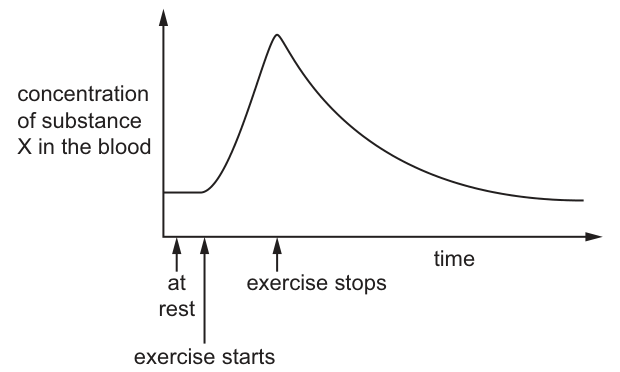
What is substance X?
Options
A alcohol
B glycogen
C lactic acid
D urea
Answer
C
C
Walkthrough
- Examine the graph: The concentration of substance X is low and constant at rest, rises during exercise, reaches a maximum (peak) exactly when exercise stops, and then gradually decreases back to resting levels during recovery.
- Consider what happens during exercise: Muscle cells increase their rate of aerobic respiration to meet the demand for energy. When the demand for oxygen exceeds the supply, muscle cells switch to anaerobic respiration.
- Identify the product: In human muscle cells, anaerobic respiration breaks down glucose to produce lactic acid. This lactic acid accumulates in the muscle tissue and diffuses into the blood, causing the blood concentration of lactic acid to rise.
- Explain the recovery phase: When exercise stops, the oxygen debt is repaid. The lactic acid in the blood is transported to the liver, where it is oxidised to carbon dioxide and water, or converted back to glucose/glycogen. This removal process causes the blood concentration of lactic acid to fall back to normal.
- Evaluate the other options:
- Glycogen (B) is an insoluble storage polysaccharide found inside liver and muscle cells; it is not a dissolved substance measured in blood concentration.
- Alcohol (A) is not produced in human cells (it is a product of yeast fermentation).
- Urea (D) is a continuous waste product of protein deamination in the liver and is excreted by the kidneys; its blood concentration does not spike sharply at the end of exercise.
Key Takeaways
- Human anaerobic respiration in muscle cells produces lactic acid.
- Lactic acid enters the blood and is transported to the liver for removal after exercise, causing a characteristic peak in blood concentration at the end of exercise.
Common Mistakes
- Choosing glycogen: Students often associate exercise with energy storage. However, glycogen is an insoluble storage carbohydrate found inside cells, so its concentration is not measured in the blood in this way.
- Choosing urea: Urea is produced continuously by the liver from amino acid deamination and is excreted by the kidneys; its blood concentration remains relatively stable and does not spike sharply at the end of exercise.
- Confusing human and yeast anaerobic respiration: Students may select alcohol if they confuse the products of human anaerobic respiration (lactic acid) with those of yeast (ethanol and carbon dioxide).
Things to Be Careful About
- The graph shows concentration in the blood, not in the muscle. Lactic acid is produced in the muscle but its blood concentration is what is plotted; the peak occurs when exercise stops because production ceases while removal by the liver continues.
- Ensure you know the exact products of anaerobic respiration in humans (lactic acid) versus yeast (ethanol and carbon dioxide). 5090 frequently tests this distinction.
The apparatus shown is used to investigate the volume of gas produced by yeast during anaerobic respiration.
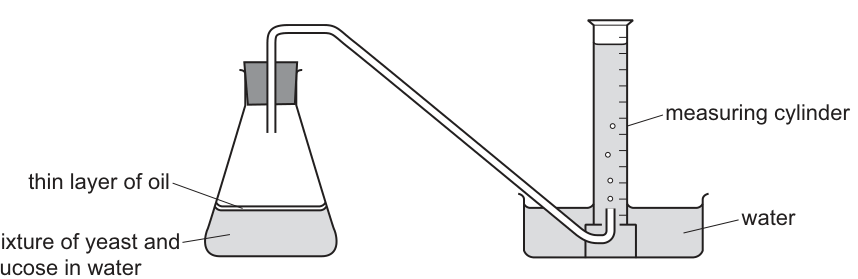
Why is the yeast mixture covered with the thin layer of oil in this investigation?
Options
A to provide energy for the yeast
B to prevent oxygen in the air from reaching the yeast
C to prevent heat loss from the mixture
D to prevent the yeast mixture from drying out
Working
The question states the investigation is into anaerobic respiration. Anaerobic respiration is respiration that occurs without oxygen.
To ensure the yeast respires anaerobically, oxygen from the air must be excluded from the yeast mixture. The thin layer of oil floats on top of the aqueous yeast and glucose mixture. Because oil is immiscible with water and less dense, it forms a seal that prevents oxygen from the air above from dissolving into the liquid and reaching the yeast.
- A is incorrect: Yeast obtains energy from the breakdown of glucose, not from oil.
- C is incorrect: While oil can reduce heat loss, the primary purpose in a gas-collection experiment for anaerobic respiration is to exclude oxygen.
- D is incorrect: The flask is sealed with a rubber bung, so evaporation and drying out are already minimised; the oil specifically blocks gas exchange.
Answer
B
B
Walkthrough
The question asks for the purpose of the thin layer of oil in an apparatus investigating anaerobic respiration in yeast.
- Identify the condition: The keyword is 'anaerobic'. Anaerobic means 'without air' or specifically 'without oxygen'. For the yeast to respire anaerobically, the environment must be free of oxygen.
- Analyze the setup: The yeast and glucose are in water. Air (containing oxygen) is above the liquid in the flask. If oxygen dissolves into the water, the yeast will respire aerobically instead.
- Function of the oil: Oil is less dense than water and immiscible (does not mix). It floats on top to form a physical barrier. This barrier prevents oxygen from the air in the headspace of the flask from entering the liquid mixture. This ensures anaerobic conditions are maintained.
- Evaluate the options:
- A (energy): Yeast digests glucose for energy. Oil is not a metabolic fuel here.
- B (prevent oxygen): This matches our reasoning. The oil blocks oxygen entry.
- C (heat loss): Temperature control is important in respiration experiments (usually done in a water bath), but the oil layer's specific role in this sealed gas-collection setup is to create an anaerobic environment.
- D (drying out): The flask is stoppered with a bung, so the mixture is sealed. Drying out is not the primary concern; gas exchange is.
Key Takeaways
- Anaerobic respiration requires an oxygen-free environment.
- In experiments involving aqueous mixtures and gas production, a layer of oil (or liquid paraffin) is often used on top of the liquid to exclude air (oxygen) and ensure anaerobic conditions.
- Yeast respire anaerobically (fermentation) to produce ethanol and carbon dioxide.
Common Mistakes
- Choosing D (prevent drying out): Students might think of oil as a preservative or moisture barrier. However, the flask is sealed with a bung, so evaporation is already prevented. The oil is specifically there to stop gas (oxygen) from entering.
- Choosing A (provide energy): Students might confuse the substrate (glucose) with the barrier (oil). Yeast breaks down glucose, not oil, for energy.
- Ignoring the word 'anaerobic': If the question said 'aerobic', the oil would not be needed (or would be removed). The word 'anaerobic' is the clue that oxygen must be excluded.
Things to Be Careful About
- Always read the type of respiration mentioned in the question stem ('anaerobic' vs 'aerobic'). The experimental setup changes depending on whether oxygen is required or must be excluded.
- Remember that oil floats on water because it is less dense and immiscible; it forms a surface seal, not a mixture.
- In gas-collection experiments, the delivery tube must be below the water level in the trough to collect gas by displacement of water, but the oil is in the reaction flask, not the collection trough.
The equation shows aerobic respiration.
What do X and Y represent?
Options
| X | Y | |
|---|---|---|
| A | ||
| B | ||
| C | ||
| D |
Working
Aerobic respiration breaks down glucose using oxygen to release energy, producing carbon dioxide and water.
The balanced equation is:
So X is glucose () and Y is water ().
Answer
B
B
Walkthrough
The equation given is the summary equation for aerobic respiration. Aerobic respiration is the release of energy from glucose using oxygen. The reactants are glucose and oxygen; the products are carbon dioxide, water and energy.
The question gives you the oxygen () and the carbon dioxide () already, and asks you to fill in X (a reactant) and Y (a product).
Looking at the balanced equation:
X must be glucose, , and Y must be water, . This matches option B.
Check the balance: on the left, 6 carbons, 12 hydrogens, and 18 oxygens (6 from glucose + 12 from 6O₂). On the right, 6 carbons, 12 hydrogens, and 18 oxygens (12 from 6CO₂ + 6 from 6H₂O). The equation balances, confirming B.
Option A has the two swapped — that would make water a reactant and glucose a product, which is the reverse of respiration (it resembles photosynthesis, where water is used and glucose is made). Option C uses sucrose, , which is not the substrate of aerobic respiration. Option D has the right glucose but only without the coefficient 6, which does not balance the equation.
Key Takeaways
- Aerobic respiration uses glucose and oxygen to release energy, producing carbon dioxide and water.
- The balanced symbol equation is:
- The word equation is: glucose + oxygen → carbon dioxide + water + energy.
- A balanced equation has the same number of each type of atom on both sides.
Common Mistakes
- Swapping reactants and products — confusing respiration with photosynthesis. In photosynthesis, carbon dioxide and water are used and glucose and oxygen are made; in respiration it is the reverse. Option A is this exact confusion.
- Choosing sucrose — option C uses . Aerobic respiration in humans and most organisms uses glucose, not sucrose, as the main respiratory substrate.
- Forgetting the coefficient 6 — water is produced as , not , to balance the 12 hydrogen atoms from glucose. Option D makes this mistake.
Things to Be Careful About
- Learn the balanced equation exactly, including the coefficient 6 in front of , and .
- The question asks what X and Y represent — the answer is the chemical formulae, not the words "glucose" and "water".
- Notice that the energy term is written as part of the products; do not let it distract you from identifying the chemical species.
What is the function of the hepatic vein?
Options
A to transport blood from the intestine to the liver
B to transport blood from the liver to the vena cava
C to transport blood to the kidney from the aorta
D to transport blood to the liver from the aorta
Working
The hepatic vein carries blood away from the liver and returns it to the inferior vena cava, so option B is correct.
- A describes the hepatic portal vein, which carries blood from the intestine to the liver.
- C describes the renal artery, which carries blood from the aorta to the kidney.
- D describes the hepatic artery, which carries oxygenated blood from the aorta to the liver.
Answer
B
B
Walkthrough
The liver receives blood from two sources: the hepatic artery brings oxygenated blood from the aorta, and the hepatic portal vein brings blood rich in absorbed nutrients from the intestine. Blood leaves the liver through the hepatic vein, which carries it to the inferior vena cava and back to the heart. The question asks for the function of the hepatic vein, so the correct answer is the one that describes blood leaving the liver towards the vena cava — option B.
Option A describes the hepatic portal vein, not the hepatic vein. Option D describes the hepatic artery, which supplies oxygenated blood to the liver. Option C describes the renal artery, which serves the kidney, not the liver.
Key Takeaways
- The liver has two incoming blood vessels (hepatic artery and hepatic portal vein) and one outgoing vessel (hepatic vein).
- The hepatic vein returns blood from the liver to the inferior vena cava, and from there to the heart.
- The hepatic portal vein is unique: it carries blood from one capillary bed (in the intestine) to another capillary bed (in the liver).
Common Mistakes
- Confusing the hepatic vein with the hepatic portal vein: the portal vein brings blood TO the liver from the intestine; the hepatic vein takes blood AWAY from the liver to the vena cava.
- Confusing the hepatic vein with the hepatic artery: the artery brings oxygenated blood to the liver; the vein carries blood away.
- Choosing option C, which describes the renal artery serving the kidney — a completely different organ.
Things to Be Careful About
- The word "hepatic" refers to the liver, so eliminate any option mentioning the kidney.
- Note the direction of blood flow: veins always carry blood TOWARDS the heart, so the hepatic vein must carry blood away from the liver towards the vena cava.
- Remember that the hepatic portal vein is the exception to the rule that veins carry blood towards the heart — it carries blood from the intestine to the liver.
A student measures the thickness of the walls of the four chambers of a heart.
The measurements are , , and .
Which row shows the correct measurements for the chambers of the heart?
Options
| A | left ventricle | right ventricle | right atrium | left atrium |
| B | left ventricle | left atrium | right ventricle | right atrium |
| C | right ventricle | left ventricle | right atrium | left atrium |
| D | right ventricle | left atrium | left ventricle | right atrium |
Working
The left ventricle pumps blood all the way around the body (systemic circulation), so it has the thickest muscular wall: .
The right ventricle pumps blood only to the lungs (pulmonary circulation), so its wall is thinner: .
The two atria only pump blood into the ventricles, so their walls are the thinnest: each.
This matches row A: left ventricle , right ventricle , right atrium , left atrium .
Answer
A
A
Walkthrough
The heart has four chambers: two atria and two ventricles. The thickness of a chamber wall depends on how much pressure that chamber must generate. The left ventricle pumps blood into the aorta and around the whole body, so it must produce the highest pressure; its wall is the thickest, . The right ventricle pumps blood only to the lungs, a much shorter circuit with less resistance, so its wall is thinner, . The atria only push blood into the ventricles immediately below them, so they need very little muscle; both have thin walls of . Comparing the rows, only row A places on the left ventricle, on the right ventricle, and on each atrium.
Key Takeaways
- Wall thickness of a heart chamber reflects the pressure it must generate.
- Left ventricle → systemic circulation → thickest wall.
- Right ventricle → pulmonary circulation → thinner wall.
- Atria → pump blood only into ventricles → thinnest walls.
- In this question both atria have the same thickness, so the two values belong to the atria.
Common Mistakes
- Choosing an option that gives the left ventricle and the left atrium (option B) — the left ventricle is the thickest, not the left atrium.
- Choosing an option that gives the right ventricle (options C and D) — the right ventricle pumps only to the lungs, so it is not the thickest chamber.
- Thinking that the right side of the heart must be stronger because it is drawn on the right of a diagram; "left" and "right" are the person's own left and right.
Things to Be Careful About
- The two values are identical; both atria have thin walls.
- Use the function of each chamber to decide wall thickness: distance blood travels and resistance it meets.
- Read the options carefully: the columns are in the order , , , , and row A is the only one that matches the correct chamber order.
There are approximately 5 million red blood cells in each of blood.
The mean diameter of red blood cells is .
Which row expresses this information correctly in standard form?
Options
| number of red blood cells / of blood | mean diameter of red blood cells / | |
|---|---|---|
| A | ||
| B | ||
| C | ||
| D |
Working
5 million =
The only row with both values correct is C.
Answer
C
C
Walkthrough
The question gives two numbers and asks which row writes both of them in standard form. Standard form means a number written as a value between 1 and 10 multiplied by a power of 10.
First, the number of red blood cells: 5 million means 5 000 000. In standard form, the decimal point sits after the 5, and the 5 is followed by six zeros, so the power of 10 is . That gives .
Second, the mean diameter: . The decimal point must move three places to the right to make the number 7, so the power of 10 is negative: .
Now check each row:
- Row A has the correct number of cells () but the diameter as , which equals 7000 mm — far too large.
- Row B has the diameter correct but the cell count as , which is a tiny fraction, not millions.
- Row C has both values correct.
- Row D has both values wrong.
So the answer is C.
Key Takeaways
- Standard form writes a number as a value between 1 and 10 multiplied by a power of 10.
- Moving the decimal point to the right gives a negative exponent; moving it to the left gives a positive exponent.
- Large numbers like 5 million use a positive power of 10; small numbers like 0.007 use a negative power of 10.
Common Mistakes
- Writing 5 million as — this is a tiny fraction, not millions. The negative sign means dividing by 10 six times.
- Writing 0.007 as — this equals 7000, which is thousands, not thousandths.
- Counting the zeros incorrectly: 5 million has six zeros after the 5, and 0.007 needs the decimal point moved three places.
Things to Be Careful About
- Match each column independently: the first column concerns the cell count, the second the diameter. One correct column does not make the row correct.
- Remember that is a million and is one thousandth — check the sign of each exponent before choosing.
What is the effect of regular excessive consumption of alcohol?
Options
A acts as a stimulant making the person more alert
B increases the risk of liver damage
C decreases the time taken to respond to a stimulus
D makes the person less likely to be aggressive
Working
Alcohol is a depressant, not a stimulant, so it slows the nervous system rather than making a person more alert — A is wrong.
It slows reaction time, so the time taken to respond to a stimulus increases, not decreases — C is wrong.
It can make a person more aggressive, not less likely to be aggressive — D is wrong.
Regular excessive consumption of alcohol damages the liver, causing conditions such as cirrhosis — B is correct.
Answer
B
B
Walkthrough
The question asks for the effect of regular excessive consumption of alcohol. The key fact from the 5090 syllabus is that alcohol acts as a depressant on the central nervous system and, when consumed in excess over a long period, damages the liver (cirrhosis).
Look at each option in turn:
- A says alcohol acts as a stimulant making the person more alert. This is the opposite of the truth — alcohol is a depressant. It slows down brain and nervous system activity, so a person becomes less alert, not more. Reject.
- B says alcohol increases the risk of liver damage. This is correct. The liver is the organ that breaks down alcohol, and regular heavy drinking damages its cells, eventually leading to cirrhosis (scarring of the liver). This is the answer.
- C says alcohol decreases the time taken to respond to a stimulus. Because alcohol is a depressant, it slows nerve transmission, so reaction time actually increases. Reject.
- D says alcohol makes the person less likely to be aggressive. In fact, alcohol can reduce self-control and make aggressive behaviour more likely. Reject.
Key Takeaways
- Alcohol is a depressant, not a stimulant — it slows down the nervous system.
- Excessive alcohol consumption damages the liver, which is the organ that detoxifies alcohol.
- Alcohol slows reaction time and can increase aggression.
Common Mistakes
- Choosing A because alcohol is often thought to "loosen up" a person — but a depressant slows the nervous system; it does not make a person more alert.
- Choosing C by confusing "depressant" with a faster response — a depressant slows responses, so reaction time goes up, not down.
- Choosing D because alcohol can relax people — but the syllabus teaches that alcohol can increase aggression, so this statement is false.
Things to Be Careful About
- Read the option wording precisely: "decreases the time taken to respond" means a faster reaction, which is the opposite of what a depressant does.
- The mark scheme requires the single letter B — no extra reasoning is needed on the answer sheet, but the reasoning above is what justifies it.
What can reduce the risk of bacteria becoming resistant to antibiotics?
Options
A allowing people to buy antibiotics without a prescription
B prescribing antibiotics for all infections: viral, bacterial and fungal
C prescribing regular doses of antibiotics to everyone
D only prescribing antibiotics for harmful bacterial infections
Working
Antibiotics should only be prescribed when they are needed, i.e. for harmful bacterial infections. Using antibiotics unnecessarily, such as for viral infections, or giving them to everyone, exposes bacteria to the drugs and increases the chance that resistant strains will be selected.
Answer
D
D
Walkthrough
This question asks which action would reduce the risk of bacteria becoming resistant to antibiotics. The key idea is that antibiotic resistance develops when bacteria are exposed to antibiotics and the resistant ones survive and multiply. So we want to limit the use of antibiotics to situations where they are genuinely needed.
- A – allowing people to buy antibiotics without a prescription would increase unnecessary use, so it would increase, not reduce, the risk of resistance.
- B – prescribing antibiotics for all infections, including viral and fungal ones, is wrong because antibiotics only work against bacteria. Giving them for viral or fungal infections is unnecessary and increases resistance.
- C – prescribing regular doses of antibiotics to everyone would expose many people to antibiotics when they do not need them, again increasing resistance.
- D – only prescribing antibiotics for harmful bacterial infections means antibiotics are used only when they can actually help. This reduces unnecessary exposure and therefore reduces the chance of resistance developing.
So the correct option is D.
Key Takeaways
- Antibiotics are only effective against bacteria, not viruses or fungi.
- Antibiotic resistance arises when bacteria are exposed to antibiotics and resistant bacteria survive and reproduce.
- To reduce resistance, antibiotics should be used only when needed, for the correct infection, and the full course should be completed.
- Overuse and misuse of antibiotics are major causes of increasing antibiotic resistance.
Common Mistakes
- Choosing B because it seems like treating all infections is thorough, but antibiotics do not work against viruses or fungi and unnecessary use increases resistance.
- Choosing C because regular doses seem to prevent infection, but giving antibiotics to everyone without need is exactly the kind of overuse that promotes resistance.
- Thinking that buying antibiotics freely (A) would help people get treatment, but it leads to overuse and incorrect use.
Things to Be Careful About
- The question asks what would reduce the risk, so look for the option that limits antibiotic use to genuine bacterial infections.
- Remember that antibiotics target bacteria, not viruses or fungi.
- The mark scheme requires the idea that antibiotics should only be prescribed for harmful bacterial infections, which is exactly option D.
Which statement about active immunity is correct?
Options
A A fetus develops active immunity when antibodies pass across the placenta.
B Active immunity develops after vaccination.
C Active immunity develops in babies when they drink breast milk containing antibodies.
D Active immunity develops after using antibiotics.
Working
Active immunity is immunity in which the body makes its own antibodies after exposure to an antigen. Vaccination introduces a weakened or killed pathogen (or its antigens), so lymphocytes produce antibodies and memory cells — this is active immunity.
- A is incorrect: antibodies passing across the placenta are ready-made antibodies from the mother, so the fetus receives passive immunity.
- C is incorrect: antibodies in breast milk are passed ready-made to the baby — passive immunity.
- D is incorrect: antibiotics kill bacteria; they do not stimulate antibody production, so no immunity develops.
Answer
B
B
Walkthrough
The question asks which statement about active immunity is correct. The key idea is the difference between active and passive immunity.
Active immunity is when the body produces its own antibodies in response to an antigen. This happens naturally after an infection, or artificially after vaccination. Because the body makes memory cells, active immunity takes time to develop but lasts a long time.
Passive immunity is when ready-made antibodies are transferred into the body. It acts immediately but is short-lived because no memory cells are made.
Now look at each option:
- A — A fetus receives antibodies from its mother across the placenta. These are ready-made antibodies, so this is passive immunity, not active. Incorrect.
- B — A vaccine contains a weakened or killed pathogen, or just its antigens. The body's lymphocytes respond by making antibodies and memory cells. This is exactly what active immunity means. Correct.
- C — Breast milk contains ready-made antibodies from the mother. The baby absorbs them without making its own, so this is passive immunity. Incorrect.
- D — Antibiotics are drugs that kill bacteria or stop them reproducing. They do not involve the immune system making antibodies, so no immunity develops. Incorrect.
So the only correct statement is B.
Key Takeaways
- Active immunity = the body makes its own antibodies, either after an infection or after vaccination; it is long-lasting because memory cells are produced.
- Passive immunity = ready-made antibodies are transferred in (across the placenta, in breast milk, or by injection of antibodies); it is immediate but short-lived.
- Vaccination is the classic example of artificially acquired active immunity.
- Antibiotics treat bacterial infections but never provide immunity.
Common Mistakes
- Confusing active with passive immunity: any transfer of ready-made antibodies — placenta, breast milk, or antibody injection — is passive, not active.
- Thinking antibiotics give immunity: they kill bacteria but do not stimulate antibody production, so they confer no immunity at all.
- Forgetting memory cells: active immunity lasts because lymphocytes make memory cells; passive immunity does not, which is why it is short-lived.
Things to Be Careful About
- The correct option is B. Read every option and classify it as active or passive before choosing.
- "Active" refers to the body's own immune response, not to being active in any everyday sense.
- Vaccination produces active immunity even though the vaccine itself is given to the body — the key is that the body then makes its own antibodies.
Which term can be used to describe the release of oxygen from plants?
Options
A breathing
B excretion
C respiration
D transpiration
Working
Photosynthesis produces oxygen as a waste product. Excretion is the removal of waste products of metabolism from the body, so the release of oxygen from plants is excretion.
- A breathing — breathing is the movement of air in and out of the lungs in animals; plants do not breathe.
- C respiration — respiration uses oxygen and releases carbon dioxide; it does not release oxygen.
- D transpiration — transpiration is the loss of water vapour from leaves, not oxygen.
Answer
B
B
Walkthrough
The question asks which term describes the release of oxygen from plants. The key idea is that oxygen is a waste product of the process of photosynthesis: the plant makes glucose and releases oxygen as a by-product. Excretion is defined as the removal of waste products of metabolism from the body of an organism. Since oxygen is a metabolic waste product (made during photosynthesis), its release counts as excretion.
Now eliminate the other options:
- Breathing is the physical movement of air into and out of the lungs — an animal process. Plants exchange gases by diffusion through stomata, not by breathing.
- Respiration is the process that uses oxygen to release energy from glucose; it produces carbon dioxide and water, not oxygen.
- Transpiration is the loss of water vapour from the leaves of a plant through the stomata.
Only excretion correctly describes the release of oxygen.
Key Takeaways
- Excretion means the removal of waste products of metabolism — not just the removal of any substance.
- Oxygen is a waste product of photosynthesis in plants, so releasing it is excretion.
- Be careful not to confuse excretion with egestion (removal of undigested food) or with secretion (release of useful substances).
Common Mistakes
- Choosing respiration: respiration is often associated with gas exchange, but respiration actually consumes oxygen and releases carbon dioxide. The oxygen released by plants comes from photosynthesis, not respiration.
- Choosing transpiration: transpiration only involves water vapour, not oxygen.
- Confusing excretion with egestion — excretion removes metabolic waste, egestion removes undigested food.
Things to Be Careful About
- The mark scheme requires the exact term excretion — do not write 'removal of waste' without naming the term.
- Remember that oxygen is a waste product even though it is useful to other organisms; from the plant's point of view it is a metabolic waste.
- This is a one-mark question, so a single clear answer is enough.
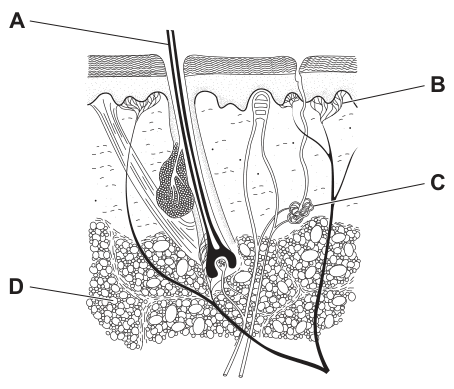
The diagram shows some structures in the skin.
Which structure increases its secretions when the body is too hot?
Options
A A
B B
C C
D D
Working
The question asks for a structure that increases its secretions when the body is too hot.
- A (Hair shaft): Provides insulation by trapping air when erector pili muscles contract (piloerection). It does not secrete substances to cool the body.
- B (Sebaceous gland): Secretes sebum (oil) to lubricate the hair and skin and kill bacteria. Secretion is not primarily increased by heat.
- C (Sweat gland): When body temperature rises, sweat glands increase the secretion of sweat (water, salts, urea). Evaporation of sweat from the skin surface removes heat, cooling the blood in the dermal blood vessels.
- D (Adipose tissue / Fat layer): Stores energy and provides insulation. It does not secrete substances.
Therefore, structure C is the correct answer.
Answer
C
C
Walkthrough
The question asks to identify a structure in the skin diagram that increases its secretions when the body temperature is too high. This is a question about thermoregulation (control of body temperature).
-
Analyze the labels in the diagram:
- Label A points to the hair shaft. Hair provides insulation. When the body is cold, erector pili muscles contract to make the hair stand up (piloerection), trapping a layer of insulating air. Hair does not secrete substances to cool the body.
- Label B points to a sebaceous gland. These glands are usually attached to hair follicles. They secrete sebum (an oily substance) which lubricates the skin and hair and has antibacterial properties. Their activity is not primarily driven by high body temperature.
- Label C points to a sweat gland (the coiled structure at the base) and its duct leading to the surface of the skin. Sweat glands are responsible for cooling the body. When the body is too hot, the hypothalamus (the body's thermostat) signals the sweat glands to secrete more sweat. Sweat is mostly water. As this water evaporates from the skin surface, it absorbs heat energy from the skin, cooling the blood in the nearby capillaries.
- Label D points to the adipose tissue (subcutaneous fat layer). This layer stores energy reserves and acts as thermal insulation to prevent heat loss. It does not secrete substances.
-
Conclusion: The structure that increases secretions (sweat) to cool the body is the sweat gland, which is label C.
Key Takeaways
- The skin plays a major role in homeostasis, specifically thermoregulation (control of body temperature).
- Sweat glands secrete sweat to cool the body down via evaporation.
- Sebaceous glands secrete sebum for lubrication and protection, not for cooling.
- Adipose tissue provides insulation and energy storage.
- Hair provides insulation (especially when erect).
Common Mistakes
- Confusing sweat glands and sebaceous glands: Students often confuse label B (sebaceous gland) with label C (sweat gland). Remember that sweat glands produce watery sweat for cooling, while sebaceous glands produce oily sebum.
- Thinking hair secretes: Label A is the hair shaft. While hair is involved in temperature control (insulation), it does not have secretions that increase when hot.
- Misidentifying the fat layer: Label D is fat. Fat insulates (keeps heat in), it doesn't secrete to cool the body down.
Things to Be Careful About
- Read the diagram labels carefully: Ensure you can distinguish the coiled sweat gland (C) from the sebaceous gland (B). In diagrams, sweat glands are often shown as a coiled tube at the bottom of the dermis with a long duct going to the surface. Sebaceous glands are often lobed and attached to the side of the hair follicle.
- Understand 'secretions': The question asks for increased secretions. Sweat glands secrete sweat. Sebaceous glands secrete sebum. Only sweat secretion is significantly increased by heat to cause cooling.
- Evaporation is key: The cooling effect comes from the evaporation of the sweat, not just the secretion itself. The mark scheme would accept 'evaporation' as a key concept if asked to explain how it cools.
Which event happens when the blood glucose concentration rises?
Options
A Less adrenaline is released.
B Less insulin is released.
C More adrenaline is released.
D More insulin is released.
Working
Insulin is the hormone that lowers blood glucose concentration. When blood glucose rises, more insulin is released to bring it back to normal. Adrenaline is released in response to stress, not to a rise in blood glucose.
Answer
D
D
Walkthrough
The question asks what happens when blood glucose concentration rises. The key hormone here is insulin, which is secreted by the pancreas and causes glucose to be removed from the blood (it is taken up by cells and used in respiration, or stored as glycogen in the liver and muscles). So a rise in blood glucose triggers the release of more insulin — this is negative feedback, because the response opposes the change.
Option A says less adrenaline is released — adrenaline is not involved in blood glucose control in this way, so this is wrong. Option B says less insulin is released — this would make blood glucose rise even further, the opposite of what should happen. Option C says more adrenaline is released — adrenaline is the 'fight or flight' hormone released in response to stress, not to high blood glucose. Option D says more insulin is released — this is correct.
Key Takeaways
- Insulin lowers blood glucose concentration and is released when glucose levels rise.
- This is an example of negative feedback: the response (more insulin) opposes the change (rising glucose).
- Adrenaline is a stress hormone and is not the answer to a blood glucose question.
Common Mistakes
- Choosing C (more adrenaline) — confusing the stress hormone adrenaline with the glucose-regulating hormone insulin.
- Choosing B (less insulin) — thinking the body responds by reducing insulin, which would actually make the problem worse.
Things to Be Careful About
- The mark scheme requires the precise term "insulin".
- Remember that insulin lowers blood glucose; glucagon (not in the options) raises it. Do not confuse the two.
What is not an example of homeostasis involving a negative feedback mechanism?
Options
A maintaining the core body temperature at around
B releasing adrenaline from the adrenal glands when frightened
C releasing glucose from liver cells into the blood after missing a meal
D releasing insulin from the pancreas after eating a meal
Working
Negative feedback mechanisms reverse a change to keep a condition steady around a set point.
- A Body temperature is kept near by mechanisms that correct any rise or fall — negative feedback.
- C After a missed meal, blood glucose falls and glucagon causes the liver to release glucose, raising it back to normal — negative feedback.
- D After a meal, blood glucose rises and insulin is released to lower it back to normal — negative feedback.
- B Adrenaline release when frightened is a rapid emergency (fight-or-flight) response, not a mechanism that reverses a change to maintain a constant internal environment.
Answer
B
B
Walkthrough
This question asks you to spot the one example that is not homeostasis involving negative feedback.
Homeostasis is the maintenance of a constant internal environment. A negative feedback mechanism works by detecting a change and then bringing about responses that reverse that change, so the condition returns to its normal level (the set point).
Go through each option:
-
A — maintaining core body temperature at around . If body temperature rises, mechanisms such as sweating and vasodilation cool the body down. If it falls, shivering and vasoconstriction warm it up. Each response opposes the original change, so this is classic negative feedback.
-
B — releasing adrenaline from the adrenal glands when frightened. Adrenaline is part of the fight-or-flight response. It prepares the body for sudden action — increasing heart rate, raising blood glucose and diverting blood to muscles. This is an emergency response to a threat, not a mechanism that reverses a change to keep a steady internal condition. It does not maintain a set point, so it is not an example of negative feedback homeostasis.
-
C — releasing glucose from liver cells into the blood after missing a meal. Missing a meal makes blood glucose fall below normal. The fall is detected, glucagon is released, and the liver converts glycogen to glucose and releases it into the blood, raising blood glucose back to normal. The response opposes the change, so it is negative feedback.
-
D — releasing insulin from the pancreas after eating a meal. Eating raises blood glucose. The rise is detected, insulin is released, and it causes cells to take up glucose and the liver to store glucose as glycogen, lowering blood glucose back to normal. Again, the response opposes the change, so it is negative feedback.
The only one that is not a negative feedback homeostatic mechanism is B.
Key Takeaways
- Homeostasis keeps the internal environment constant using negative feedback: a change is detected and reversed.
- Negative feedback always involves correcting a deviation back towards a set point — temperature, blood glucose, water content, etc.
- Adrenaline release is a rapid emergency response (fight or flight), not a homeostatic negative feedback mechanism.
- Blood glucose is controlled by two hormones acting in opposition: insulin lowers it after a meal, glucagon raises it when it falls.
Common Mistakes
- Choosing C because it seems like a response to a change — but it is actually negative feedback: the fall in glucose is reversed by releasing glucose from the liver.
- Confusing adrenaline with a homeostatic hormone. Adrenaline does raise blood glucose, but it does so as part of the stress response, not to maintain a set point.
- Thinking any response to a stimulus is negative feedback. Negative feedback specifically reverses a change to maintain a constant level.
Things to Be Careful About
- Read the question carefully: it asks what is not an example, so you are looking for the odd one out.
- Remember that both insulin and glucagon act by negative feedback, but in opposite directions.
- The mark scheme gives the single correct answer B — no other option is credited.
What is a correct example of phototropism?
Options
A A stem grows away from gravity.
B A root grows towards light.
C A root grows towards gravity.
D A stem grows towards light.
Working
Phototropism is the growth of a plant part in response to light. A stem grows towards light (positive phototropism).
- A is gravitropism, not phototropism.
- B is incorrect because roots grow away from light.
- C is gravitropism, not phototropism.
- D is correct: a stem grows towards light.
Answer
D
D
Walkthrough
Phototropism is a directional growth response to light. The question asks for a correct example, so we need to identify which option describes growth in response to light, not gravity.
- A says a stem grows away from gravity. This is a response to gravity, so it is gravitropism, not phototropism.
- B says a root grows towards light. Roots usually grow away from light, so this is not correct.
- C says a root grows towards gravity. This is gravitropism, not phototropism.
- D says a stem grows towards light. This is positive phototropism, a correct example of phototropism.
Therefore, the correct answer is D.
Key Takeaways
- Phototropism is growth in response to light.
- Stems usually grow towards light (positive phototropism).
- Roots usually grow away from light.
- Gravitropism is growth in response to gravity: roots grow towards gravity and stems grow away from gravity.
- It is important to match the stimulus (light or gravity) with the correct plant part and direction of growth.
Common Mistakes
- Confusing phototropism with gravitropism. Remember: photo means light, gravi means gravity.
- Thinking roots grow towards light. In most plants, roots grow away from light and towards gravity.
- Choosing A or C because they describe growth responses, without checking the stimulus.
Things to Be Careful About
- The mark scheme requires the precise term "phototropism" and the correct direction of growth.
- Read the stimulus carefully: light versus gravity.
- Remember that stems are positively phototropic and negatively gravitropic, while roots are positively gravitropic and negatively phototropic.
An experiment is set up to investigate the conditions necessary for seeds to germinate.
In which flask will the seeds germinate first?
Options
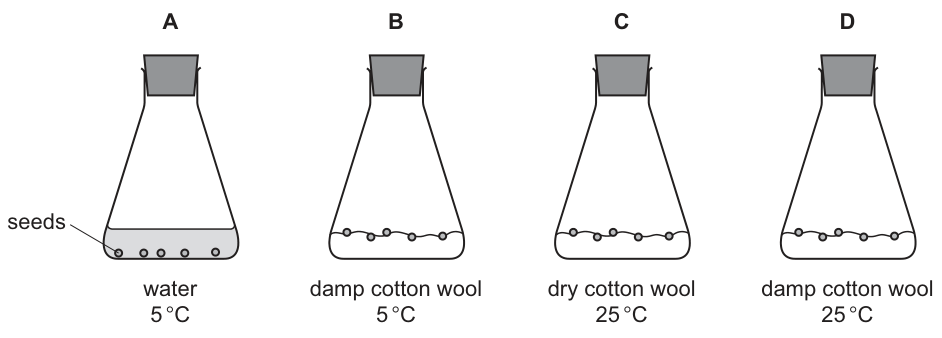
Working
Seeds require three conditions to germinate: water, oxygen, and a suitable (warm) temperature.
- Flask A: seeds are submerged in water, so no oxygen is available; the temperature () is too low.
- Flask B: water and oxygen are available (damp cotton wool), but the temperature () is too low.
- Flask C: oxygen and a suitable temperature () are present, but there is no water (dry cotton wool).
- Flask D: all three conditions are met — water from the damp cotton wool, oxygen from the air, and a suitable temperature of .
Therefore, the seeds in Flask D will germinate first.
Answer
D
D
Walkthrough
To determine which flask will see germination first, we must evaluate each setup against the three essential conditions for seed germination: water, oxygen, and a suitable (warm) temperature.
- Flask A contains water and seeds at . While water is present, the seeds are submerged, which excludes oxygen from reaching them. Seeds need oxygen for aerobic respiration to release the energy required for growth. Additionally, is too cold for the hydrolytic enzymes to work efficiently.
- Flask B contains damp cotton wool and seeds at . The damp cotton wool provides both water and oxygen (the seeds are not submerged, so air can reach them). However, the temperature is still too low (), so enzyme activity will be very slow or halted.
- Flask C contains dry cotton wool and seeds at . The temperature is suitable and oxygen is available, but the dry cotton wool means there is no water. Water is required to rehydrate the seed and activate the enzymes that break down stored food reserves.
- Flask D contains damp cotton wool and seeds at . This setup provides all three necessary conditions: water (from the damp cotton wool), oxygen (from the air in the flask), and a suitable temperature () for enzyme-controlled metabolic processes.
Because Flask D is the only setup that meets all the requirements, those seeds will germinate first.
Key Takeaways
- Seeds need water, oxygen, and a suitable temperature to germinate; light is not required.
- Water is needed to activate enzymes and rehydrate the seed.
- Oxygen is needed for aerobic respiration to provide energy for cell division and growth.
- A suitable temperature ensures enzymes function at an optimal rate; too low a temperature slows or stops enzyme activity.
- Submerging seeds in water removes the oxygen supply, preventing germination.
Common Mistakes
- Choosing Flask A: Assuming that more water is always better. Submerging seeds cuts off their oxygen supply, which is essential for respiration.
- Choosing Flask C: Forgetting that water is a strict requirement for germination. Dry conditions prevent the activation of hydrolytic enzymes.
- Confusing germination with photosynthesis: Some students think light is needed for germination because plants need light to grow. Light is only required once the seedling emerges and begins photosynthesis; germination itself occurs in the dark.
- Overlooking temperature: Failing to notice that is too cold for the enzymes to catalyse the reactions needed for germination, leading to a choice between Flask B and Flask D.
Things to Be Careful About
- Read the setup descriptions carefully: "damp" cotton wool means water is present but air (oxygen) can still reach the seeds, whereas "water" with submerged seeds means no oxygen is available.
- Remember that the temperature difference ( vs ) is the key to distinguishing between Flask B and Flask D. is too cold for efficient enzyme activity.
- Do not assume the question is about photosynthesis; the keyword is "germinate", which only requires water, oxygen, and warmth.
The diagrams show some plant and animal cells. They are not drawn to the same scale.
Which cells contain haploid nuclei?
Options
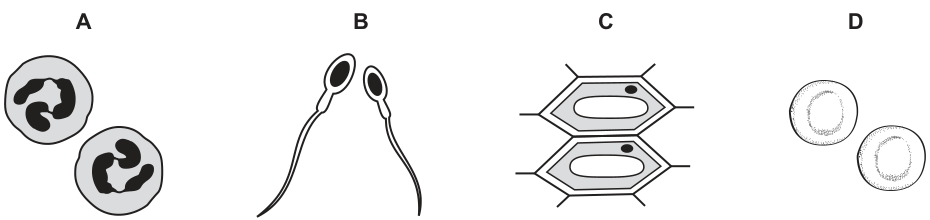
Working
- A: white blood cells — body cells with diploid nuclei.
- B: sperm cells — male gametes made by meiosis, so their nuclei are haploid.
- C: guard cells — somatic (body) cells of the leaf, diploid nuclei.
- D: red blood cells — mature red blood cells have no nucleus at all, so they cannot be haploid or diploid.
Answer
B
B
Walkthrough
A haploid nucleus contains one set of chromosomes (the symbol n); in humans that is 23 chromosomes. Haploid nuclei are found only in the gametes — sperm and egg cells — which are produced by meiosis so that fertilisation restores the diploid number (46) in the zygote.
Work through each option:
- A shows phagocytic white blood cells. These are ordinary body cells formed by mitosis, so their nuclei are diploid (2n).
- B shows sperm cells. Sperm are male gametes produced by meiosis in the testes, so each carries half the normal chromosome number — a haploid nucleus. This is the answer.
- C shows guard cells surrounding a stomatal pore. Guard cells are somatic cells of the leaf epidermis, so they are diploid.
- D shows mature red blood cells. These are a trap: they have lost their nuclei during development, so they contain no chromosomes at all and cannot be described as haploid.
Only B satisfies 'contains haploid nuclei'.
Key Takeaways
- Haploid = one set of chromosomes (n); diploid = two sets (2n).
- Only gametes (sperm, egg, pollen grain nuclei, ovum) have haploid nuclei; all body cells are diploid.
- Mature mammalian red blood cells have no nucleus, so the terms haploid and diploid do not apply to them.
- Meiosis produces haploid gametes; fertilisation restores the diploid number.
Common Mistakes
- Choosing D by thinking 'no nucleus = half the genetic material = haploid'. A cell without a nucleus is neither haploid nor diploid.
- Confusing white blood cells (diploid body cells) with gametes because they look unusual.
- Forgetting that guard cells are ordinary plant cells, not reproductive cells.
- Mixing up meiosis (produces haploid gametes) with mitosis (produces diploid body cells).
Things to Be Careful About
- The question says the cells are not drawn to the same scale, so size gives no clue — judge by cell identity only.
- The question asks which cells contain haploid nuclei; D fails on the word 'contain' as well as on the biology.
- In Paper 1, eliminate options systematically: two of these (A and C) fall immediately once you know all body cells are diploid.
Which examples show continuous variation?
- length of seedlings
- mass of bananas
- human skin colour
Options
A 1, 2 and 3
B 1 and 3 only
C 1 only
D 2 and 3 only
Working
Continuous variation shows a range of intermediate values with no distinct categories; it is usually controlled by many genes and affected by the environment. Length of seedlings, mass of bananas and human skin colour all show a full range of values, so all three are examples of continuous variation.
Answer
A
A
Walkthrough
This question asks you to recognise which of three examples show continuous variation.
Continuous variation means a characteristic that shows a complete range of values between two extremes, with no clear-cut categories. Examples are height, mass, length and skin colour. Such characteristics are usually controlled by many genes acting together (polygenic inheritance) and are also influenced by the environment.
Discontinuous variation means a characteristic that falls into distinct, separate categories with no intermediates, such as blood group, sex, or ability to roll the tongue. It is usually controlled by a single gene.
Now judge each statement:
-
Length of seedlings — seedlings grow to many different lengths, so there is a continuous range of values. This is continuous variation.
-
Mass of bananas — bananas come in many different masses, again a continuous range. This is continuous variation.
-
Human skin colour — skin colour shows a complete spectrum from very light to very dark, with every shade in between. It is controlled by several genes and is continuous variation.
All three statements are true, so the correct option is A (1, 2 and 3).
Key Takeaways
- Continuous variation shows a range of intermediate values with no distinct categories; it is usually polygenic and affected by the environment.
- Discontinuous variation shows distinct, separate categories with no intermediates; it is usually controlled by a single gene.
- Length, mass, height and skin colour are classic examples of continuous variation; blood group, sex and tongue-rolling are classic examples of discontinuous variation.
Common Mistakes
- Thinking human skin colour is discontinuous because it appears to fall into a few broad groups. In fact it is a continuous range controlled by many genes.
- Confusing the two types: a characteristic that can be measured with a ruler or balance (length, mass) is almost always continuous, because measurements can take any value.
- Choosing option B or D by incorrectly rejecting one of the three statements — check each statement independently.
Things to Be Careful About
- Judge every numbered statement on its own before reading off the option; one wrong judgement changes the answer.
- Remember that continuous variation is about the range of phenotypes in a population, not about whether the characteristic is visible or not.
- The mark scheme gives only the letter A, so the final answer must be exactly that letter.
A man has six fingers on each hand and six toes on each foot. This genetically inherited condition is caused by a dominant allele. The man's genotype is heterozygous.
His wife does not have the condition.
What is the probability that a child of this couple will be born with the condition?
Options
A 0.00
B 0.25
C 0.50
D 1.00
Working
The condition is caused by a dominant allele, so:
- The man is heterozygous: genotype (affected).
- The wife does not have the condition, so she must be homozygous recessive: genotype .
Gametes from the man: or .
Gametes from the wife: only.
Half the offspring are (affected) and half are (unaffected).
Probability of a child with the condition .
Answer
C
C
Walkthrough
This is a monohybrid inheritance question. The key is to work out both parents' genotypes from the information given.
The man. The condition is caused by a dominant allele. A dominant allele only needs to be present once (in one copy) for the condition to show. The man has the condition and we are told his genotype is heterozygous, meaning he carries one copy of the dominant allele and one copy of the recessive allele. If we call the dominant allele and the recessive allele , his genotype is .
The wife. She does not have the condition. Because the allele is dominant, anyone with even one copy of would show the condition. Since she does not show it, she cannot have a allele at all — she must have two recessive alleles, genotype .
The cross. Each parent passes on one allele to each child.
- The man can pass on either or .
- The wife can only pass on .
Putting these into a Punnett square:
- from father + from mother = → affected
- from father + from mother = → unaffected
Both outcomes are equally likely, so the ratio of affected to unaffected children is . That means the probability of any one child being born with the condition is , which is option C.
Key Takeaways
- A dominant allele shows its effect even when only one copy is present; a recessive allele only shows its effect when two copies are present.
- A person who does not show a dominant condition must be homozygous recessive ().
- A cross between a heterozygote () and a homozygous recessive () always gives a phenotypic ratio.
- Probability can be expressed as a fraction (), a percentage (50%), or a decimal (0.50) — this question asks for the decimal form.
Common Mistakes
- Assuming the man is homozygous dominant (). The question explicitly states he is heterozygous, so his genotype is . Using would give 100% affected children, which is option D — a trap.
- Choosing 0.25. This would be the probability from a cross between two heterozygotes (), where only the offspring are unaffected. Here the wife is , not .
- Forgetting that not having a dominant condition forces the genotype . If you wrongly give the wife a allele, the whole cross changes.
- Confusing the dominant allele with being more common or more likely to be passed on. Dominance is about how the allele is expressed, not about its frequency in offspring.
Things to Be Careful About
- Read the phrase "caused by a dominant allele" and "genotype is heterozygous" together — they fix the man's genotype as .
- The wife "does not have the condition" is the clue that she is ; there is no other possibility for a dominant condition.
- The Punnett square has four equally likely boxes, so each box represents a probability of 0.25. Here two of the four boxes are , giving .
- The options are given as decimals, so give the answer as 0.50, not as a fraction or percentage.
The diagram shows a family tree for the inheritance of eye colour. The allele for brown eyes is dominant and the allele for blue eyes is recessive.
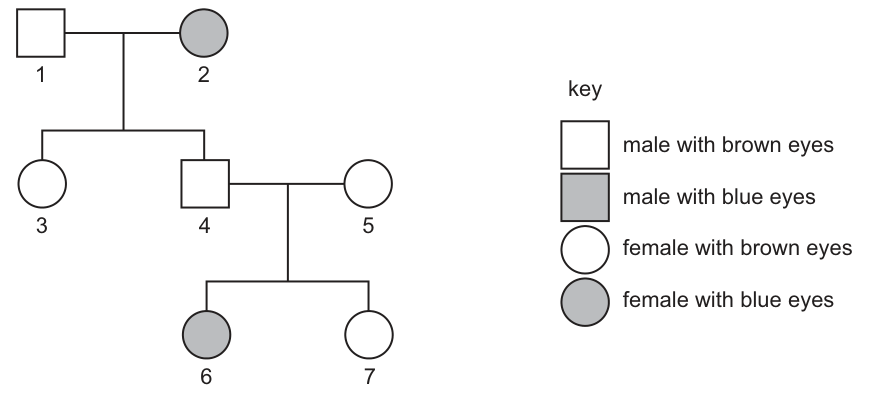
Which people must be heterozygous for eye colour?
Options
A 1, 3 and 7
B 2 and 6
C 3, 4 and 5
D 4 and 5 only
Working
Let = brown (dominant) and = blue (recessive).
- Individual 2 is blue-eyed, so genotype .
- Individuals 3 and 4 are brown-eyed offspring of 1 and 2, so each must have received from parent 2 and from parent 1 → genotype .
- Individuals 4 and 5 (both brown-eyed) have a blue-eyed child, 6 (), so each parent must carry → both are .
- Individual 7 is brown-eyed and could be or , so not must be heterozygous.
Therefore 3, 4 and 5 must be heterozygous.
Answer
C
C
Walkthrough
The question asks who must be heterozygous — not who might be. That word is the key to the whole item.
Step 1: assign allele symbols. Brown is dominant, so write for brown and for blue. Anyone with blue eyes has genotype — there is no other possibility for a recessive phenotype. Anyone with brown eyes is either or — you cannot tell which from the phenotype alone.
Step 2: look at the first generation. Individual 2 is blue-eyed, so she is definitely . Every child gets one allele from each parent, so children 3 and 4 each received a from their mother. Both 3 and 4 are brown-eyed, so they must also carry a from their father (individual 1). That forces 3 and 4 to be — heterozygous, no doubt about it.
Step 3: look at the third generation. Individuals 4 and 5 are both brown-eyed, yet they have a blue-eyed daughter, individual 6, who must be . A child can only get a from each parent, so both 4 and 5 must carry . Since they are brown-eyed, they must also carry — so both are . This confirms 4 and independently proves 5.
Step 4: individual 7 is brown-eyed. She could be or — nothing in the pedigree forces her to be heterozygous, so she does not count.
So the people who must be heterozygous are 3, 4 and 5, which is option C.
Key Takeaways
- A recessive phenotype reveals the genotype completely: blue eyes means , always homozygous.
- A dominant phenotype is ambiguous: or — you need extra information (a parent or child with the recessive phenotype) to decide.
- Two brown-eyed parents with a blue-eyed child must both be heterozygous — this is the classic 'hidden recessive' deduction.
- In a pedigree, every child receives one allele from each parent, so a homozygous recessive parent passes to every child.
Common Mistakes
- Including individual 7: she is brown-eyed but could be , so she is not a 'must' — this is the trap behind option A.
- Including individual 1: he is brown-eyed and fathered brown-eyed children with a mother, but the pedigree does not force him to be heterozygous — he could be (all children would still be and brown-eyed). Option B's individual 6 is blue-eyed, so definitely homozygous recessive, not heterozygous.
- Confusing 'must be heterozygous' with 'could be heterozygous' — the question demands certainty.
- Assuming a shaded symbol means heterozygous; shading shows the recessive phenotype (), which is homozygous.
Things to Be Careful About
- Read the key carefully: shaded = blue eyes (recessive), clear = brown eyes (dominant) — some pedigrees shade for the dominant trait, so never assume.
- Answer the exact question asked: 'must be heterozygous', not 'is heterozygous' or 'may be heterozygous'.
- Check each option against your list: only option C (3, 4 and 5) matches the three people you proved are .
- Write the allele symbols with the recessive as lower case () — using the same letter for both alleles is incorrect notation.
A karyotype is a photograph showing the chromosomes of an individual.
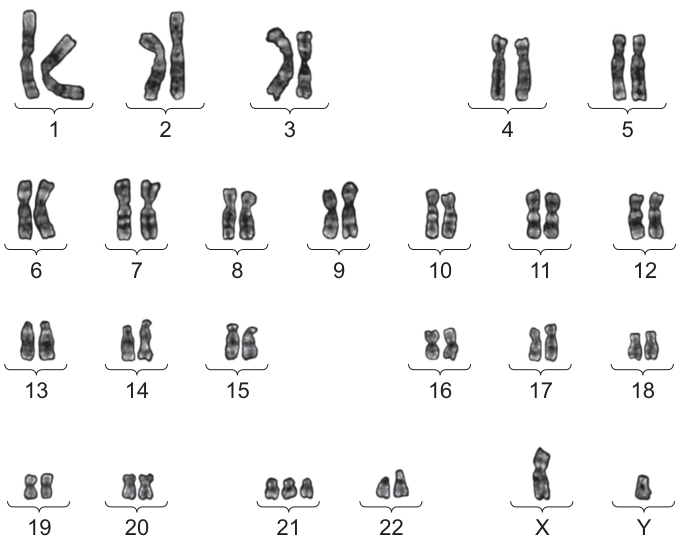
Which description matches an individual who has this karyotype?
Options
A female without Down's syndrome
B male without Down's syndrome
C female with Down's syndrome
D male with Down's syndrome
Working
The karyotype shows three chromosomes at position 21 instead of two — trisomy 21, which causes Down's syndrome.
The sex chromosomes are one X and one smaller Y, so the individual is male.
Answer
D
D
Walkthrough
A karyotype is an ordered photograph of an individual's chromosomes, arranged in homologous pairs from largest (chromosome 1) to smallest. To read it, you check two things.
Step 1: Count the sex chromosomes. The last two positions are labelled X and Y. This karyotype shows one large X chromosome and one much smaller Y chromosome. An XX pair would mean female; an X and a Y means male. So this is a male — that eliminates options A and C.
Step 2: Look for an abnormal number of autosomes. Every autosome (1–20 and 22) appears as a normal pair. But at position 21 there are three chromosomes instead of two. Having three copies of a chromosome is called a trisomy, and trisomy 21 is the chromosome mutation that causes Down's syndrome. It arises when meiosis goes wrong and a gamete receives an extra copy of chromosome 21; after fertilisation the zygote has 47 chromosomes instead of 46. That eliminates option B.
Combining both: male + trisomy 21 = male with Down's syndrome, which is option D.
Key Takeaways
- A karyotype lets you count chromosomes and spot numerical abnormalities such as trisomy 21 (Down's syndrome).
- Sex is read directly from the sex chromosomes: XX = female, XY = male, with the Y visibly smaller than the X.
- Down's syndrome is caused by a chromosome mutation (an extra whole chromosome), not by a change within a gene.
Common Mistakes
- Confusing the small Y with a missing or extra chromosome and miscounting the total.
- Assuming Down's syndrome can be identified without checking chromosome 21 specifically — you must see three copies at position 21.
- Reading the sex chromosomes wrongly: some candidates think any two sex chromosomes mean female. Here they are clearly different sizes, so it is XY = male.
- Choosing C by spotting only the trisomy and forgetting to check the sex chromosomes.
Things to Be Careful About
- Check both features independently: first the sex chromosomes, then whether any autosome has three copies. Each observation eliminates half the options.
- Remember the Y chromosome is always noticeably smaller than the X — that size difference is your cue for 'male'.
- Trisomy means three copies; do not confuse it with a normal pair.
Three statements about natural selection are listed.
- An organism with an advantageous inherited feature does not always pass this to its offspring.
- Many organisms in a population die before they interbreed and produce any offspring.
- Organisms with more advantageous inherited features are more likely to survive and produce offspring.
Which statements are correct?
Options
A 1, 2 and 3
B 1 and 2 only
C 1 and 3 only
D 2 and 3 only
Working
Statement 1 is correct. An advantageous inherited feature depends on alleles passed from parents. Because each offspring receives only one allele from each parent during sexual reproduction, a parent with the advantageous feature does not necessarily pass the allele to every offspring.
Statement 2 is correct. Organisms produce many more offspring than can survive, so large numbers die before they reach maturity and reproduce.
Statement 3 is correct. Natural selection means that organisms with inherited features that are more advantageous are more likely to survive, reproduce and pass on those features.
Since all three statements are correct, the answer is A.
Answer
A
A
Walkthrough
This question is a numbered-statement MCQ, so work through each statement in turn, deciding it is true or false, then see which option matches.
Statement 1 — True. Even an organism with an advantageous inherited feature does not always pass this feature on to its offspring. This is because the feature is controlled by alleles. In meiosis, an organism's gametes receive only one allele from each pair, and which one goes into a particular gamete is random. Also, during fertilisation two gametes combine, so an offspring inherits one allele from each parent, not a complete set. Consequently a parent that itself shows the advantageous feature might be heterozygous, and in some crosses only some offspring inherit the advantageous allele. So the statement is correct.
Statement 2 — True. Populations naturally produce many more eggs, seeds and young than could ever survive. There are not enough resources for all of them, and many are eaten, die from disease or fail to compete with rivals before they reach breeding age. Therefore many organisms die before they have a chance to reproduce. This is the "overproduction" that creates the competition that natural selection acts on.
Statement 3 — True. This is the central idea of natural selection. Within a population there is variation, and the organism with an advantageous inherited feature is more likely to survive, reach maturity and reproduce, so it passes that feature to its offspring. Over many generations the advantageous feature becomes more common in the population.
Since all three statements are correct, the correct option is A. Each wrong option leaves out one correct statement: B leaves out 3, C leaves out 2, D leaves out 1.
Key Takeaways
- Natural selection rests on three connected ideas: overproduction of offspring, variation within a population, and the improved survival and reproduction of organisms with advantageous inherited features.
- For natural selection to change a population, the advantageous feature must be inherited — only then can it be passed to offspring.
- An individual can survive while not passing its traits on, so natural selection acts at the level of surviving to reproduce, not just surviving.
Common Mistakes
- Thinking that an advantageous feature is always passed to every offspring. The benefit is only in terms of probability: the offspring may or may not inherit the alleles, especially from a parent that is heterozygous for that a feature.
- Believing that "survival of the fittest" means the strongest or fastest. In O Level terms it means the organism whose features make it most likely to survive in its particular environment and reproduce.
- Confusing natural selection with evolution. Evolution is the long-term change over many generations that results from natural selection acting on inherited variation.
- Choosing option B or D because a candidate thinks a statement that is slightly "less important" than the others is false. All three statements are correct and the option combines them.
Things to Be Careful About
- Arguments are judged individually, not grouped. Read each statement on its own and decide true or false, then find the matching option.
- For natural selection to count, the controlling feature must be inherited, not acquired during the lifetime of the organism.
- No data or graph is used here; the reasoning is to get the process of natural selection right from the O Level description: overproduction and death before reproduction, inherited variation, and differential survival and reproduction of the better adapted. Choose the option that includes all three correct statements.
Bread is made from a mixture of flour, sugar, water and yeast.
The mixture is left in a warm place to allow it to rise before being baked.
Which process makes the bread rise?
Options
A The yeast feeds on the flour and grows.
B The yeast reproduces to make the loaf bigger.
C The yeast uses sugar to respire and produces carbon dioxide.
D The yeast produces alcohol which it excretes.
Working
In the dough, oxygen is limited, so the yeast carries out anaerobic respiration using the added sugar:
The carbon dioxide gas forms bubbles that get trapped in the dough, making it rise. The alcohol is also produced but evaporates during baking and does not cause the rising.
- A is wrong — the yeast feeding and growing does not itself produce the gas that lifts the dough.
- B is wrong — reproduction does not make the loaf bigger; the rise is due to trapped gas.
- C is correct — the yeast respires the sugar and produces carbon dioxide.
- D is wrong — alcohol is a product of the same reaction, but it is the carbon dioxide, not the alcohol, that makes the bread rise.
Answer
C
C
Walkthrough
This question is about why bread dough rises. The key biology is anaerobic respiration in yeast.
When the dough is left in a warm place, the yeast cells are in an environment with very little oxygen (the dough is thick and not well aerated). Under these conditions yeast respires anaerobically — this is also called fermentation. The word equation is:
The carbon dioxide is a gas. As it is produced, it forms small bubbles inside the elastic dough, and these bubbles get trapped, causing the dough to swell and rise. This is exactly what the question describes.
Now look at each option:
- A — Yeast does feed on sugar (and can use flour), and it does grow. But growth alone does not produce gas. The rising is caused by a gas, so this option misses the point.
- B — Reproduction makes more yeast cells, but more cells do not make the loaf physically bigger. The increase in size comes from trapped carbon dioxide bubbles.
- C — This is correct. The yeast uses the sugar in anaerobic respiration and produces carbon dioxide, which makes the bread rise.
- D — Yeast does produce alcohol (ethanol) in anaerobic respiration, but it is the carbon dioxide gas, not the alcohol, that lifts the dough. The alcohol mostly evaporates during baking.
So the answer is C.
Key Takeaways
- Yeast carries out anaerobic respiration when oxygen is limited, producing ethanol and carbon dioxide.
- The carbon dioxide gas is what makes bread dough rise.
- This same reaction is used in brewing to produce alcohol.
- Know the word equation: glucose → ethanol + carbon dioxide.
Common Mistakes
- Choosing D because the yeast does produce alcohol — the alcohol is not the leavening agent; the gas is.
- Choosing A or B because yeast does feed, grow and reproduce — these are true but do not explain the rising, which requires gas production.
- Confusing aerobic and anaerobic respiration in yeast: with plenty of oxygen, yeast would respire aerobically and produce carbon dioxide and water, but in dough the conditions are anaerobic.
Things to Be Careful About
- The question asks for the process that makes the bread rise — that is the production of carbon dioxide gas.
- Remember the precise word equation for anaerobic respiration in yeast; it is a common exam point.
- Note that the alcohol is a product of the same reaction, so option D contains a true fact but gives the wrong reason for rising.
Some stages in the production of human insulin are listed.
- Genetically modified E. coli bacteria are grown in large fermenters.
- The gene for human insulin is inserted into the DNA of an E. coli bacterium.
- The gene for human insulin is obtained from human pancreas cells.
- Human insulin is extracted and purified.
What is the correct sequence of these stages?
Options
A 3 → 1 → 2 → 4
B 4 → 3 → 2 → 1
C 3 → 2 → 4 → 1
D 3 → 2 → 1 → 4
Working
The gene for human insulin must be obtained from human pancreas cells first (stage 3), because the gene has to exist before it can be inserted. Next, the gene is inserted into the DNA of an E. coli bacterium (stage 2). Only then can the genetically modified bacteria be grown in large fermenters to produce the insulin (stage 1). Finally, the human insulin is extracted and purified from the culture (stage 4).
So the correct sequence is 3 → 2 → 1 → 4.
- A is wrong: the bacteria are grown before the gene is inserted, so they would not yet carry the insulin gene.
- B is wrong: insulin is extracted and purified before the gene is even obtained or inserted.
- C is wrong: insulin is extracted before the bacteria have been grown to produce it.
Answer
D
D
Walkthrough
This question asks for the correct order of the four stages in producing human insulin using genetically modified E. coli bacteria. The key is to think about what must happen first, second, third and fourth.
Stage 3 — obtain the gene. You cannot insert a gene that you do not yet have. The gene for human insulin is first cut out of human pancreas cells (the cells that normally make insulin). This is the starting point.
Stage 2 — insert the gene. The isolated human insulin gene is inserted into the DNA of an E. coli bacterium. This makes the bacterium genetically modified — it now carries a human gene and is able to make human insulin. This is the step that transfers the genetic information.
Stage 1 — grow the bacteria. Once the bacteria carry the gene, they are grown in large fermenters. As the bacteria reproduce, every new bacterium inherits a copy of the inserted gene, so the whole population makes the insulin. The fermenter provides the right conditions — warmth, nutrients, oxygen and the correct pH — for rapid growth and maximum insulin production.
Stage 4 — extract and purify. The insulin is finally extracted from the culture and purified, so that it is safe and pure enough to be used as a medicine by people with diabetes.
So the order is 3 → 2 → 1 → 4, which is option D.
Each wrong option places a stage in an impossible position:
- A (3 → 1 → 2 → 4) grows the bacteria before inserting the gene — the bacteria would have no insulin gene and could not make insulin.
- B (4 → 3 → 2 → 1) extracts and purifies insulin at the very start, before the gene has even been obtained. There is nothing to extract.
- C (3 → 2 → 4 → 1) extracts the insulin before the bacteria have been grown in the fermenters, so there would be no insulin produced yet.
Key Takeaways
- Genetic modification of bacteria follows a fixed logical order: obtain the gene → insert the gene → grow the modified organism → extract and purify the product.
- The gene must be obtained before it can be inserted, and the bacteria must be grown before there is any product to extract.
- E. coli is useful in biotechnology because it reproduces quickly, so a single modified bacterium can quickly produce a large population, each making human insulin.
- This is the standard industrial method for producing human insulin — the bacteria act as tiny insulin factories.
Common Mistakes
- Choosing A by thinking the bacteria are grown first to get them ready — but they must already carry the gene before fermentation, or they will not make insulin.
- Choosing C by confusing "extract and purify" with an early step — extraction can only happen after the bacteria have produced the insulin.
- Thinking the gene is obtained from the E. coli bacterium rather than from human pancreas cells — the gene comes from humans; E. coli is just the host that receives it.
Things to Be Careful About
- Read the stages carefully and ask "what has to exist before this step can happen?" for each one.
- The correct answer is the letter D, not the sequence itself — the question asks "What is the correct sequence?" and the options are labelled A–D.
- Remember the mark scheme gives only the option letter; in the exam, write the letter clearly.
The diagram shows a food chain.
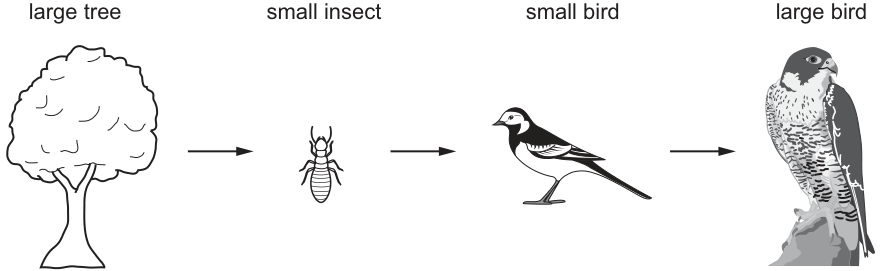
Which pyramid of numbers is based on the food chain shown?
Options
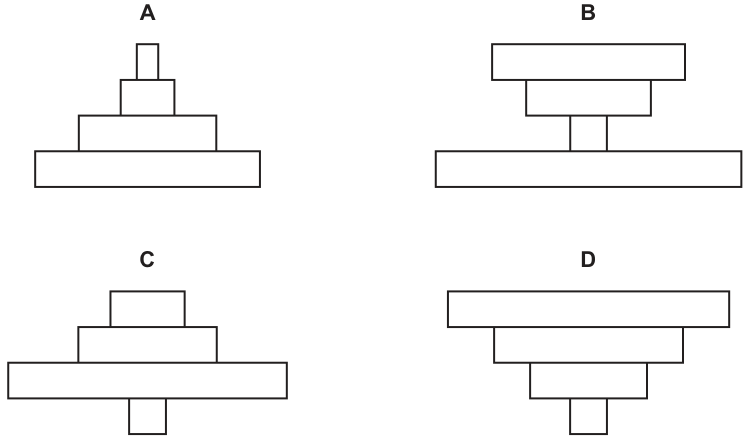
Answer
The food chain is: large tree small insect small bird large bird.
A pyramid of numbers represents the number of individual organisms at each trophic level, not their size or total mass.
- Producers (Level 1): The producer is a large tree. There is typically only one tree supporting the rest of the chain. Therefore, the number of organisms at this level is low (e.g., 1). The bottom bar of the pyramid must be narrow.
- Primary Consumers (Level 2): Small insects feed on the tree. Many insects can live on a single tree. Therefore, the number of organisms is high. The second bar must be wide.
- Secondary Consumers (Level 3): Small birds eat the insects. There are fewer birds than insects. The third bar is narrower than the second.
- Tertiary Consumers (Level 4): Large birds eat the small birds. There are very few large birds. The top bar is narrow.
This results in a pyramid with a narrow base, a wide second tier, and narrowing tiers above. This matches diagram C.
Pyramid A is a standard pyramid (correct for grassland food chains like grass rabbit fox, where there are many grass plants).
Pyramid D is an inverted pyramid (incorrect here as the top level does not have more individuals than the level below it in a way that fits this chain).
Answer
C
C
Walkthrough
The question asks to identify the correct pyramid of numbers for the food chain: large tree small insect small bird large bird.
Step 1: Understand the difference between pyramids.
- A pyramid of numbers counts the number of individual organisms at each trophic level. The width of the bar is proportional to the count.
- A pyramid of biomass measures the total dry mass of organisms at each level. This is almost always upright (wide base) because energy is lost at each step.
- A pyramid of energy is always upright.
Step 2: Analyze the trophic levels in the given food chain.
- Trophic Level 1 (Producer): The diagram shows a large tree. In terms of numbers, a tree is a single individual (or a small number of trees). So, the count is low (e.g., 1). The bar representing producers should be narrow.
- Trophic Level 2 (Primary Consumer): The next organism is a small insect. A single large tree can support thousands of insects. So, the count is high. The bar representing primary consumers should be very wide.
- Trophic Level 3 (Secondary Consumer): Small birds eat the insects. There are fewer birds than insects (e.g., 10 birds vs 1000 insects). The bar narrows.
- Trophic Level 4 (Tertiary Consumer): Large birds (predators) eat the small birds. There are even fewer of these (e.g., 1 or 2 falcons). The top bar is narrow.
Step 3: Match to the options.
- A: Wide base, narrowing to the top. This would be correct if the producer was grass (many grass plants). Incorrect for a tree.
- B: Wide base, narrow middle, wide top. Does not fit the decreasing numbers of birds.
- C: Narrow base (1 tree), wide second tier (many insects), narrowing upwards (fewer birds). This fits the data perfectly.
- D: Narrow base, widening to the top. This would imply the top predator level has the most individuals, which is biologically impossible for this chain.
Therefore, C is the correct answer.
Key Takeaways
- Pyramid of numbers can have irregular shapes. If the producer is a large organism (like a tree or a large bush), the base of the pyramid is narrow because there are few producers, but the primary consumer level is wide because there are many small consumers feeding on it.
- Pyramid of biomass and pyramid of energy are almost always upright (triangular) because total mass/energy decreases at higher trophic levels due to energy loss (respiration, waste, uneaten parts).
- Always read the label: "pyramid of numbers" counts individuals, not size or weight.
Common Mistakes
- Choosing A (Standard Pyramid): Students often assume all ecological pyramids are upright triangles. This is true for biomass and energy, and for numbers in grassland ecosystems (many grass plants), but false for numbers in woodland ecosystems with large trees.
- Confusing Numbers with Biomass: A large tree has a huge biomass, so a pyramid of biomass would have a wide base (like A or D's bottom part). But a pyramid of numbers has a narrow base (1 tree).
- Misreading the chain: Assuming the tree is just "vegetation" and counting it as many plants. The diagram specifies "large tree" (singular concept) and "small insect", highlighting the size difference which dictates the number difference.
Things to Be Careful About
- Command word "Which": This is a multiple-choice question. You must select the single correct option.
- Terminology: Ensure you use "pyramid of numbers" correctly. Do not say "the tree is small so the base is small"; say "the tree is a single large organism, so the number of producers is low".
- Image interpretation: In diagram C, the bottom square is small (representing 1 tree), the long rectangle above it is wide (representing many insects), and the tiers above get smaller (representing fewer birds). This matches the biological reality of a tree-based food chain.
The diagram shows the movement of carbon in the carbon cycle in gigatonnes per year.
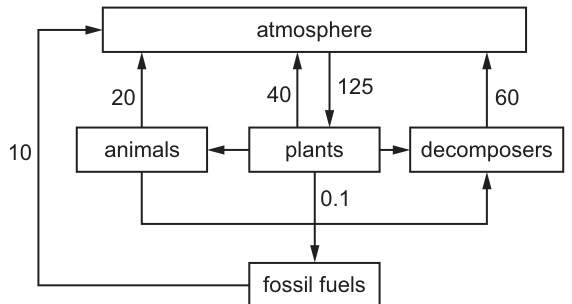
How many gigatonnes of carbon are moved by respiration each year?
Options
A 120
B 125
C 130
D 255
Working
Respiration is the process by which living organisms (plants, animals, and decomposers) break down organic molecules and release carbon dioxide into the atmosphere.
From the diagram, the flows representing respiration are:
- Plants to atmosphere: 40 gigatonnes per year
- Animals to atmosphere: 20 gigatonnes per year
- Decomposers to atmosphere: 60 gigatonnes per year
Total carbon moved by respiration = 40 + 20 + 60 = 120 gigatonnes per year.
(Note: 125 represents photosynthesis, and 10 represents combustion of fossil fuels.)
Answer
A
A
Walkthrough
The question asks for the total amount of carbon moved by respiration each year, based on the provided carbon cycle diagram. Respiration is a metabolic process in living organisms that releases carbon dioxide back into the atmosphere. In the carbon cycle, this is represented by arrows pointing from biological pools (plants, animals, decomposers) to the atmosphere.
-
Identify respiration flows: Look for arrows originating from living organisms and pointing to the atmosphere. These are:
- From plants to atmosphere: 40 Gt/year
- From animals to atmosphere: 20 Gt/year
- From decomposers to atmosphere: 60 Gt/year
-
Calculate the total: Add these values together:
- Check other flows to avoid confusion:
- The arrow from the atmosphere to plants (125) represents photosynthesis, not respiration.
- The arrow from fossil fuels to the atmosphere (10) represents combustion (burning of fossil fuels), which is not a biological respiration process.
Adding the photosynthesis value (125) or the combustion value (10) would lead to incorrect options.
Key Takeaways
- Respiration in the carbon cycle is represented by the flow of carbon dioxide from living organisms (plants, animals, decomposers) to the atmosphere.
- Photosynthesis is the flow from the atmosphere to plants.
- Combustion is the flow from fossil fuels to the atmosphere.
- Total fluxes must be calculated by summing the relevant individual flows.
Common Mistakes
- Including photosynthesis: Adding the 125 Gt/year value (atmosphere to plants) instead of the respiration values.
- Forgetting decomposers: Only summing plant (40) and animal (20) respiration to get 60, missing the 60 from decomposers.
- Including combustion: Adding the 10 Gt/year from fossil fuels, which represents human-induced burning, not biological respiration.
Things to Be Careful About
- Ensure all three biological sources of respiration (plants, animals, decomposers) are included in the sum.
- Do not confuse the direction of the arrows: respiration always goes from organisms to the atmosphere, while photosynthesis goes from the atmosphere to plants.
- Read the values carefully from the diagram; the 125 figure is for photosynthesis, not respiration.
Energy is lost from a food chain from one trophic level to the next.
How is energy lost from a food chain?
- by egestion
- by respiration
- by photosynthesis
- by excretion
Options
A 1, 2, 3 and 4
B 1, 2 and 4 only
C 1 and 2 only
D 3 only
Working
Energy is lost from a food chain when organisms respire (energy leaves as heat), when they egest undigested food, and when they excrete waste products containing energy. Photosynthesis is not a loss: it is how producers take energy in from sunlight.
So the correct statements are 1, 2 and 4.
Answer
B
B
Walkthrough
This question asks which processes remove energy from a food chain between trophic levels.
- Respiration: every living organism respires to release energy from glucose. Most of this energy is eventually lost as heat to the surroundings, so it is a major energy loss between trophic levels.
- Egestion: when an organism cannot digest some food, it passes out as faeces. That undigested material still contains chemical energy, so this energy is lost from the organism and does not pass to the next trophic level.
- Excretion: waste products such as urea and excess water are removed from the body. These wastes contain some chemical energy, so excretion also removes energy from the food chain.
- Photosynthesis: this is the process by which producers convert light energy into chemical energy in glucose. It adds energy to the food chain rather than removing it, so it cannot be a way energy is lost.
Therefore statements 1, 2 and 4 are correct, which is option B.
Key Takeaways
- Energy is not recycled in a food chain; it flows from the Sun through producers to consumers and is gradually lost.
- The main losses between trophic levels are through respiration (as heat), egestion of undigested food, and excretion of waste products.
- Only a small fraction of the energy eaten is converted into new biomass and passed on to the next trophic level.
- Photosynthesis is an energy input, not an energy loss.
Common Mistakes
- Choosing option C (1 and 2 only) because excretion is forgotten. Excretion removes waste products that still contain chemical energy, so it is also a loss.
- Choosing option D (3 only) if photosynthesis is confused with energy loss. Photosynthesis is the entry point of energy into the food chain.
- Confusing egestion with excretion. Egestion is the removal of undigested food as faeces; excretion is the removal of metabolic waste such as urea.
Things to Be Careful About
- Read the numbered statements carefully and decide each one true or false before looking at the options.
- Remember that respiration is not only a way of releasing energy for useful work; most of the energy is lost as heat, which is why it counts as a loss from the food chain.
- The question asks how energy is lost from a food chain, not how energy enters it, so photosynthesis should be rejected.
The diagram shows the nitrogen cycle.
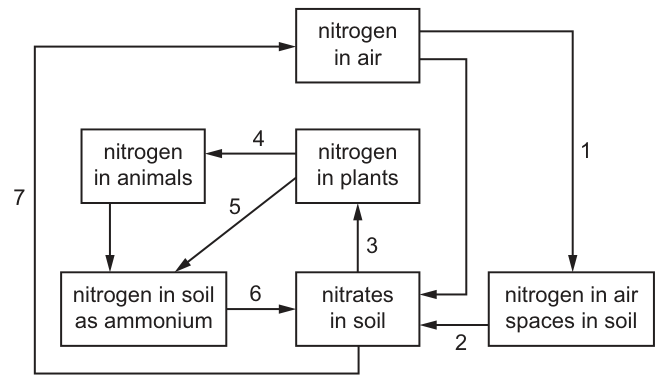
Which stages involve bacteria?
Options
A 1, 2, 5 and 6
B 2, 5, 6 and 7
C 3, 5, 6 and 7
D 3, 4, 5 and 6
Working
Evaluate each numbered stage in the nitrogen cycle diagram to determine whether bacteria are involved:
- Stage 1: Physical movement of nitrogen gas from the atmosphere into soil air spaces. This is diffusion/dissolution; no organisms are involved.
- Stage 2: Conversion of nitrogen gas in the soil to nitrates. This requires nitrogen-fixing bacteria (to convert N₂ to ammonia) and nitrifying bacteria (to convert ammonia to nitrates). Bacteria are involved.
- Stage 3: Absorption of nitrates from the soil into plant roots via active transport. No bacteria involved.
- Stage 4: Consumption of plants by animals (feeding). No bacteria involved.
- Stage 5: Decomposition of plant material into ammonium in the soil. Involves decomposer bacteria (and fungi). Bacteria are involved.
- Stage 6: Conversion of ammonium to nitrates in the soil. This is nitrification, carried out by nitrifying bacteria. Bacteria are involved.
- Stage 7: Decomposition of animal waste and dead animal bodies into ammonium. Involves decomposer bacteria. Bacteria are involved.
The stages that involve bacteria are 2, 5, 6 and 7.
Answer
B
B
Walkthrough
The question asks to identify which stages in the nitrogen cycle involve bacteria. We evaluate each numbered arrow in the diagram:
- Arrow 1 shows nitrogen gas moving from the atmosphere into the air spaces in the soil. This is a physical process of diffusion and dissolution into soil water; no organisms are involved.
- Arrow 2 shows the conversion of nitrogen from soil air spaces to nitrates in the soil. This requires nitrogen-fixing bacteria (such as Rhizobium or free-living Azotobacter) to convert N₂ to ammonia, and then nitrifying bacteria (such as Nitrosomonas and Nitrobacter) to convert ammonia to nitrites and then to nitrates. Bacteria are involved.
- Arrow 3 shows nitrates moving from the soil into plants. This is the absorption of mineral ions by root hair cells via active transport. No bacteria are involved.
- Arrow 4 shows nitrogen moving from plants to animals. This represents feeding or consumption of plant tissue by herbivores. No bacteria are involved.
- Arrow 5 shows nitrogen from plants returning to the soil as ammonium. This is the decomposition of plant matter (e.g., dead leaves, roots, or plant waste) by decomposer bacteria (and fungi) through a process called ammonification. Bacteria are involved.
- Arrow 6 shows ammonium in the soil being converted to nitrates. This is nitrification, carried out exclusively by nitrifying bacteria. Bacteria are involved.
- Arrow 7 shows nitrogen from animals returning to the soil as ammonium. This is the decomposition of animal waste (faeces) and dead animal bodies by decomposer bacteria. Bacteria are involved.
Therefore, the stages that involve bacteria are 2, 5, 6 and 7, which corresponds to option B.
Key Takeaways
- The nitrogen cycle relies on specific groups of bacteria for key chemical transformations: nitrogen fixation, nitrification, and ammonification (decomposition).
- Physical processes (gas movement), plant absorption, and animal feeding do not involve bacterial action.
- Decomposition of both plant and animal organic matter by decomposer bacteria releases ammonium ions.
- Nitrifying bacteria convert ammonium ions to nitrate ions, making them available to plants for assimilation.
Common Mistakes
- Confusing nitrification with plant absorption: Stage 3 is often mistakenly thought to involve bacteria because it relates to soil nitrogen, but it is simply root absorption of already-converted nitrates via active transport.
- Forgetting animal decomposition: Students sometimes assume that only plant matter is decomposed by bacteria. Stage 7 (animal waste and dead bodies to ammonium) is also mediated by decomposer bacteria.
- Misreading the gas phase: Assuming stage 1 involves nitrogen-fixing bacteria; nitrogen-fixing bacteria act on dissolved nitrogen in soil water, not on the physical movement of gas through air spaces.
Things to Be Careful About
- Read the diagram labels carefully: "nitrogen in air spaces in soil" refers to N₂ gas, not ammonium or nitrates.
- Distinguish between the physical movement of substances (stages 1, 3, 4) and the biochemical transformations mediated by microorganisms (stages 2, 5, 6, 7).
- In 5090, decomposers are often specified as bacteria and fungi, but the conversion to ammonium (ammonification) and nitrification are strictly bacterial processes. The question asks where bacteria are involved, and they are involved in all of 2, 5, 6, and 7.
- Option C includes stage 3 (plant absorption), which is biological but not bacterial. Option D includes stages 3 and 4 (absorption and feeding), which are also not bacterial. Option A includes stage 1, which is purely physical. Only option B correctly identifies all and only the bacterial stages.
Your score so far
Answer a question to start scoring
Your marks add up here as you work through the paper.