Biology 5090/22 — May/June 2025
Cambridge O-Level · Theory · worked solutions for every part, with the mark scheme
Topics Organisms and Their Environment · Inheritance · Respiration · Sexual Reproduction in Plants · Coordination and Response in Plants · Human Nutrition · +10 more
A pea seed is planted in a pot containing soil and provided with the ideal conditions for germination. The pot is left in a dark room for 10 days.
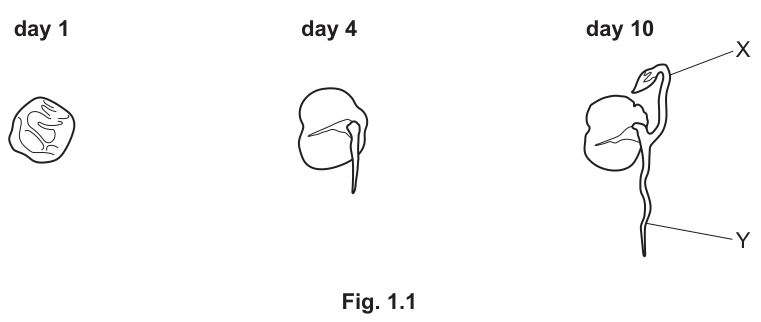
Fig. 1.1 shows the appearance of the germinating seed on different days.
Answer
- warm (or suitable temperature)
- water
- oxygen
warm, water, oxygen
Walkthrough
The question asks for the conditions required for seeds to germinate. Recall the three standard conditions taught in the syllabus: a warm temperature to allow enzyme activity, water to rehydrate the seed and activate enzymes, and oxygen for aerobic respiration to provide energy for growth. These three points directly earn the 3 marks allocated.
Key Takeaways
Seeds require specific environmental conditions to germinate. Water rehydrates the tissues and activates enzymes, a suitable warm temperature ensures enzymes work at an optimal rate, and oxygen is needed for aerobic respiration to release the energy required for cell division and growth.
Common Mistakes
- Stating "light" as a requirement. Most seeds, including pea seeds, do not require light to germinate; the experiment is explicitly left in a dark room to show this.
- Stating "soil" or "nutrients". The seed has its own stored food reserves (in the cotyledons) and only needs water, oxygen, and warmth to begin germination.
Things to Be Careful About
- Give exactly three points as the question is worth 3 marks.
- Use the precise term "oxygen" rather than "air" to ensure the mark is awarded, as the specific gas is required for respiration.
Fig. 1.1 shows that the seed changes between day 1 and day 4.
Describe these changes and explain how they happen.
______
Answer
- The seed absorbs water and increases in size / volume.
- This activates enzymes within the seed.
- The enzymes hydrolyse (break down) stored food such as starch, protein and lipids.
- The breakdown products are used in respiration to release energy.
- The testa (seed coat) softens and splits.
- The radicle (root) grows out.
See working
Walkthrough
The question asks to describe the changes between day 1 and day 4 and explain how they happen. We must link the physical observations to the biochemical processes.
First, the dry seed absorbs water (imbibition), causing it to swell and increase in volume. This rehydration is crucial because it activates the enzymes stored within the seed. Once active, these enzymes hydrolyse (break down) the large, insoluble stored food molecules (starch, proteins, lipids) into small, soluble molecules that can be transported. These soluble products are then used in aerobic respiration to release energy (ATP). This energy fuels the rapid cell division and growth needed for the radicle (root) to push through the testa (seed coat), which softens and splits as the seed swells.
Key Takeaways
Germination is not a passive process; it is driven by active metabolism. Water uptake triggers enzyme activation, which releases energy from stored food via respiration, powering the physical growth of the radicle and the splitting of the seed coat.
Common Mistakes
- Describing only the physical changes (swelling, splitting) without explaining the biochemical reasons (enzyme activation, respiration). The question explicitly asks to "explain how they happen".
- Stating that the seed "eats" its food or "uses food to grow" without mentioning enzymes, hydrolysis, or respiration.
- Confusing the radicle (root) with the plumule (shoot). The radicle always emerges first.
Things to Be Careful About
- The mark scheme allows a maximum of 5 marks from 7 listed points. Ensure your answer is a logical sequence covering water uptake, enzyme activation, food breakdown, respiration, and radicle emergence.
- Use the term "hydrolyse" or "break down" for the action of enzymes on stored food.
- The testa is the seed coat; ensure you use correct botanical terminology.
Fig. 1.1 shows that after 10 days the structures labelled X and Y have developed from parts of the seed.
Answer
embryo
embryo
Walkthrough
Structure X is the shoot (plumule) that has grown upwards. Both the shoot (plumule) and the root (radicle, structure Y) are parts of the embryo, which is the immature plant contained within the seed. Therefore, X has developed from the embryo.
Key Takeaways
A seed contains an embryo (the young plant), a food supply (stored in the cotyledons or endosperm), and a protective seed coat (testa). The embryo consists of the plumule (future shoot) and radicle (future root).
Common Mistakes
- Naming "plumule" or "shoot" instead of "embryo". The question asks for the part of the seed that X developed from; the plumule is a part of the embryo, but the embryo is the entire embryonic axis within the seed.
- Naming "cotyledon". The cotyledons provide the food but do not develop into the shoot or root.
Things to Be Careful About
- Read the question carefully: it asks for the part of the seed, not the name of structure X.
The seed is germinating in darkness.
Explain what causes X and Y to grow in opposite directions.
______
Answer
- X (the shoot / plumule) exhibits negative gravitropism, growing against gravity (upwards).
- Y (the root / radicle) exhibits positive gravitropism, growing towards gravity (downwards).
See working
Walkthrough
The seed is germinating in darkness, so light cannot be influencing the direction of growth (phototropism). Instead, the directional growth is controlled by gravity. This response to gravity is called gravitropism (or geotropism).
Roots (Y) grow downwards, towards the pull of gravity. This is positive gravitropism. Shoots (X) grow upwards, against the pull of gravity. This is negative gravitropism. This ensures that roots can anchor the plant and absorb water/minerals from the soil, while shoots can reach light for photosynthesis.
Key Takeaways
Plants respond to gravity through gravitropism. Roots show positive gravitropism (growing with gravity), and shoots show negative gravitropism (growing against gravity). This is crucial for survival, ensuring roots go down into the soil and shoots go up towards the light.
Common Mistakes
- Attributing the growth direction to light (phototropism). The question explicitly states the pot is in a dark room, so phototropism cannot be the cause.
- Using the wrong prefix: saying roots have "negative" gravitropism or shoots have "positive" gravitropism.
- Simply stating "roots grow down and shoots grow up" without using the scientific term "gravitropism" or explaining that it is a response to gravity.
Things to Be Careful About
- Always link the structure (X/shoot, Y/root) to the correct type of gravitropism.
- Use the term "gravitropism" (or "geotropism") as the mark scheme requires this specific terminology for the response to gravity.
Scientists have been thinking about how to feed the human population of the planet in a healthy and sustainable way.
They have produced a model called the planetary health plate. This is shown in Fig. 2.1.
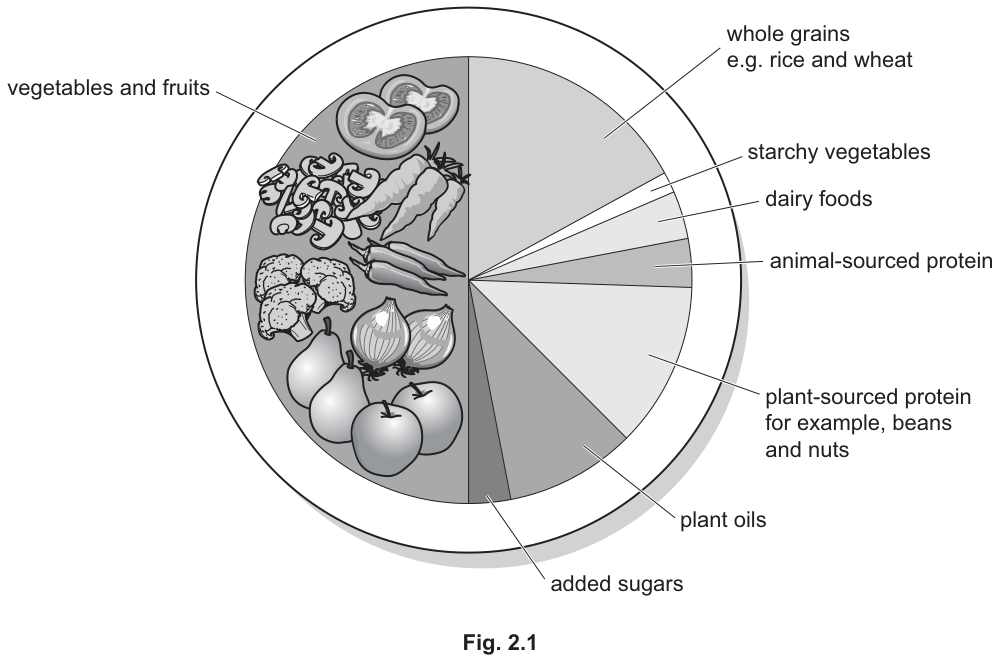
The vegetables and fruits provide some of the protein, carbohydrates and lipids needed in a balanced diet.
Name three other components of a balanced diet that can be obtained from vegetables and fruits.
- ______
- ______
- ______
Answer
- minerals
- vitamins
- fibre
(water is also accepted; any three from these four)
minerals, vitamins, fibre (or water) — any three
Walkthrough
A balanced diet contains seven components: carbohydrates, proteins, lipids, vitamins, minerals, fibre (roughage) and water. The stem tells you that vegetables and fruits already provide some protein, carbohydrates and lipids, so the three marks must come from the remaining components: vitamins (e.g. vitamin C in citrus fruits), minerals (e.g. iron in spinach), fibre (cellulose from plant cell walls) and water.
Key Takeaways
- Learn the seven components of a balanced diet; exam questions often name some and ask for the rest.
- Vegetables and fruits are the classic sources of vitamins, minerals, fibre and water.
Common Mistakes
- Repeating a component already named in the stem (protein, carbohydrates, lipids) — these score zero because the question asks for other components.
- Writing a specific food instead of a diet component (e.g. "oranges" instead of "vitamin C").
- Confusing fibre with a mineral, or writing "roughage" without realising it is accepted as fibre.
Things to Be Careful About
- The mark scheme lists four options (minerals, vitamins, fibre, water) for a maximum of 3 — give exactly three, and do not pad with anything else.
- Use the plural forms the scheme uses: "minerals", "vitamins".
State two reasons why plant oils and other lipids are important in the human diet.
- ______
- ______
Answer
- a source of energy / an energy store
- thermal insulation (also accepted: electrical insulation in neurones, mechanical protection, components of cell membranes)
energy source/energy store; thermal insulation (or any two of the listed functions)
Walkthrough
Lipids (fats and oils) have several roles in the body: they are a concentrated energy store, they insulate under the skin to reduce heat loss, they protect organs mechanically, they form part of cell membranes (phospholipids), and myelin sheaths electrically insulate neurones. Any two of these score.
Key Takeaways
- Lipids: energy store, insulation (thermal and electrical), protection, membranes.
Common Mistakes
- Writing "provides energy" but then repeating the same idea as the second point (e.g. "stores energy") — the two points must be different functions.
- Confusing lipids with carbohydrates as the main immediate energy source; lipids are the store.
Things to Be Careful About
- The scheme lists five options for max 2 — give exactly two distinct functions.
- "Energy store" and "energy source" are treated as the same point, so they cannot both be used.
Table 2.1 shows the recommended daily average intake of sources of protein, from animals and plants, in the planetary health plate model.
Table 2.1
| food | protein source | recommended average intake / per day |
|---|---|---|
| red meat | animal | 14 |
| poultry | animal | 29 |
| eggs | animal | 13 |
| fish | animal | 28 |
| legumes | plant | 75 |
| nuts | plant | 50 |
Use Table 2.1 to calculate the percentage that plant protein sources contribute to the recommended average daily protein intake for humans.
______ %
Working
Plant protein sources:
Animal protein sources:
Total:
Answer
(accept 60, 59.8 or 59.81)
59.8 %
Walkthrough
First add the plant sources (legumes 75 g + nuts 50 g = 125 g), then the animal sources (14 + 29 + 13 + 28 = 84 g). The total daily protein intake is 209 g. The percentage contributed by plants is plant ÷ total × 100 = 125/209 × 100 = 59.8%.
Key Takeaways
- Percentage = (part ÷ whole) × 100 — always identify the whole (total) correctly.
Common Mistakes
- Dividing by the animal total (84 g) instead of the combined total (209 g).
- Adding only one plant source, or forgetting one of the four animal sources.
- Rounding too early; the scheme accepts 60, 59.8 or 59.81.
Things to Be Careful About
- The answer needs the % sign on the answer line; the unit is printed, so just give the number.
- The scheme awards 2 marks for the correct value alone (both marks on the value), so accuracy matters more than shown working.
The global average daily human intake of red meat is approximately 300% of the recommended amount.
Calculate how much red meat an average human eats in a year (365 days).
Give your answer in kilograms.
average yearly intake = ______
Working
Recommended intake:
Actual intake: of
Yearly intake:
Answer
(accept 15, 15.3 or 15.33)
15.33 kg
Walkthrough
300% means three times the recommended amount, so the average person eats 3 × 14 = 42 g of red meat per day. Over 365 days that is 42 × 365 = 15 330 g. Converting to kilograms (divide by 1000) gives 15.33 kg.
Key Takeaways
- "300% of" means ×3, not +300 g or 3 g.
- Always convert g to kg by dividing by 1000 at the end.
Common Mistakes
- Interpreting 300% as 300 g per day.
- Forgetting to convert to kilograms, leaving the answer as 15 330 g.
- Using 300 days instead of 365.
Things to Be Careful About
- The scheme accepts 15, 15.3 or 15.33 — but the answer line asks for kg, so the unit is already printed.
- Both marks sit on the correct value; show the working to protect against arithmetic slips.
Answer
Eating plants involves fewer energy transfers (plants are producers, at the first trophic level), and energy is lost at each transfer because transfers are not 100% efficient — energy is lost to the environment, for example through respiration (heat loss) and egestion of faeces.
Fewer energy transfers when eating plants; energy is lost at each transfer (e.g. as heat from respiration), so less energy reaches the consumer.
Walkthrough
Energy enters food chains through producers (plants) capturing sunlight in photosynthesis. Each time energy moves up a trophic level — from plant to herbivore, herbivore to carnivore — much of it is lost: it is used in respiration and released as heat, lost in egested faeces and excreted material, and in uneaten parts. Only about 10% passes to the next level. So eating plants directly (one transfer from the Sun) delivers far more of the original energy to humans than eating animals (at least two transfers). The mark scheme wants both halves: fewer transfers, AND energy lost at each transfer, with an example of the loss.
Key Takeaways
- Energy decreases along a food chain; shorter chains waste less.
- Losses occur via respiration (heat), egestion, excretion and uneaten material.
Common Mistakes
- Saying only "plants have more energy" without explaining why (the losses at each transfer).
- Writing "energy is destroyed" — energy is lost to the environment, usually as heat, not destroyed.
- Confusing energy loss with nutrient loss; the question is about energy.
Things to Be Careful About
- The scheme gives max 2 from three points; the strongest pairing is "fewer transfers" + "energy lost, e.g. heat from respiration".
- The ORA (reverse argument) is accepted: eating animals involves more transfers, so more energy is lost.
If humans reduce the amount of animal protein they eat, then less agricultural land is required.
Suggest three environmental benefits of reducing the amount of land used for agriculture.
- ______
- ______
- ______
Answer
Any three of:
- less deforestation / more land and habitat left for wildlife
- more biodiversity / less monoculture
- less extinction of species
- reduced pollution from insecticides, herbicides and fertilisers
- less soil erosion / loss of soil
- less flooding
- less methane production from livestock, reducing global warming / climate change
Any three of: less deforestation/more habitat, more biodiversity/less monoculture, less extinction, reduced pesticide/fertiliser pollution, less soil erosion, less flooding, less methane/greenhouse gas production
Walkthrough
Agriculture affects the environment in many ways, so the question asks you to suggest benefits of shrinking it. Think through each impact of farming and reverse it:
- Land is cleared by deforestation to make fields — less farmland means forests and habitats survive, supporting more species and biodiversity, and avoiding extinction.
- Farms apply fertilisers, insecticides and herbicides — these wash into rivers causing eutrophication and kill non-target organisms, so less farmland means less chemical pollution.
- Ploughing exposes soil to rain and wind, causing erosion and, with fewer trees to absorb water, flooding.
- Livestock (cattle) produce methane, a greenhouse gas, contributing to global warming — less animal farming means less methane.
Key Takeaways
- Agriculture's main environmental impacts: habitat loss/deforestation, biodiversity loss, chemical pollution, soil erosion, flooding, greenhouse gas (methane) emissions.
- 'Suggest' questions reward applying known biology to a new scenario.
Common Mistakes
- Giving human benefits ("more food", "cheaper land") instead of environmental benefits.
- Vague answers like "less pollution" without naming the pollutant (the scheme requires the pollutant to be named: insecticides, herbicides or fertilisers).
- Repeating the same idea three times (e.g. "more trees", "less deforestation", "more forest" count as one point).
Things to Be Careful About
- The scheme lists seven options for max 3 — give exactly three distinct points.
- For the pollution and methane points, the scheme uses a '+' structure: you must name both the reduced pollution AND its source (or methane AND global warming) for the mark.
Staphylococcus aureus is a pathogen which infects humans. It can be destroyed by antibodies and antibiotics.
The cells of this bacterium are spherical and about in diameter.
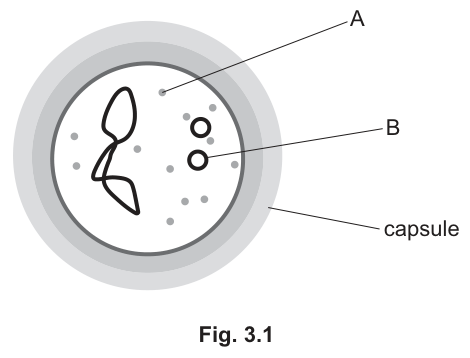
Fig. 3.1 shows a diagram of an S. aureus cell.
Answer
A: ribosome
B: plasmid
A: ribosome, B: plasmid
Walkthrough
In Fig. 3.1, a generalised bacterial cell (Staphylococcus aureus) is shown:
- A points to small, scattered dots throughout the cytoplasm, which represent ribosomes (responsible for protein synthesis).
- B points to small, circular rings of double-stranded DNA separate from the main chromosomal loop, which are plasmids.
- The large tangled loop in the cytoplasm is the main bacterial chromosome (nucleoid DNA), and the outer protective layers are the cell membrane, cell wall, and capsule.
Key Takeaways
- Bacterial cells contain ribosomes (which are non-membrane-bound and found in all cell types) and plasmids (small, circular DNA molecules carrying non-essential or accessory genes such as antibiotic resistance).
Common Mistakes
- Confusing structure A with other organelles (e.g. naming it cytoplasm instead of the specific granules/ribosomes pointed to).
- Confusing plasmid (B) with a vacuole or nucleus; bacteria do not have a membrane-bound nucleus or large central vacuoles.
Things to Be Careful About
- Notice the pointer lines carefully: A clearly touches one of the small circular dots (ribosome), and B touches one of the distinct small circles (plasmid).
Part A can also be found in animal and plant cells.
State two other components of this bacterial cell that can also be found in animal and plant cells.
- ______
- ______
Answer
Any two from:
- cytoplasm
- cell membrane
- DNA / genetic material
- cytoplasm
- cell membrane
Walkthrough
The question notes that structure A (ribosome) is present in bacteria, plants, and animals, and asks for two other components of the bacterial cell that are also found in animal and plant cells:
- Cytoplasm — the jelly-like substance where metabolic reactions take place, present in all cells.
- Cell membrane — the partially permeable membrane enclosing the cytoplasm in all cells.
- DNA / genetic material — all cells possess genetic material to direct cellular activities and inheritance.
Note that while plant cells have a cell wall, animal cells do not, so "cell wall" cannot be credited because it is not found in animal cells.
Key Takeaways
- All cells (prokaryotic and eukaryotic: bacterial, animal, and plant) share four fundamental components: cell membrane, cytoplasm, ribosomes, and DNA (genetic material).
Common Mistakes
- Stating "cell wall" (animal cells do not have a cell wall).
- Stating "nucleus" or "mitochondria" (bacterial cells lack membrane-bound organelles).
Things to Be Careful About
- Ensure the components stated are present in both animal and plant cells, as requested.
Antibodies can destroy bacterial cells without destroying human cells.
Explain how this is possible.
______
Answer
- Bacteria have specific antigens on their surface.
- These bacterial antigens are recognised as foreign / not present on human cells.
- Antibodies have a complementary shape and bind specifically to the bacterial antigens (without binding to human cells).
Bacteria have specific foreign antigens on their surface that antibodies bind to specifically, without binding to human cells.
Walkthrough
To explain how antibodies selectively destroy bacteria without damaging host human cells:
- Antigens on surface: Bacteria carry distinct surface molecules (usually proteins or glycoproteins) known as antigens.
- Foreign recognition: These bacterial antigens have shapes different from human self-antigens and are recognised as foreign (non-self).
- Antibody specificity: Antibodies produced by lymphocytes have specific binding sites that are complementary in shape to only these bacterial antigens. Therefore, antibodies attach specifically to the bacterial cells and target them for destruction, while leaving human cells unaffected.
Key Takeaways
- Antibodies are specific proteins that bind to complementary antigens on foreign pathogens.
- The distinction between 'self' and 'non-self' antigens prevents healthy human tissue from being targeted under normal immune function.
Common Mistakes
- Giving vague descriptions like "antibodies know which cells are bad" instead of explaining the molecular mechanism of specific antigen-antibody binding.
- Confusing antigens (surface markers on pathogens) with antibodies (protective proteins produced by lymphocytes).
Things to Be Careful About
- Use the precise terms: antigen, specific, and foreign.
There are different types or strains of S. aureus cells and some can resist antibiotics better than others.
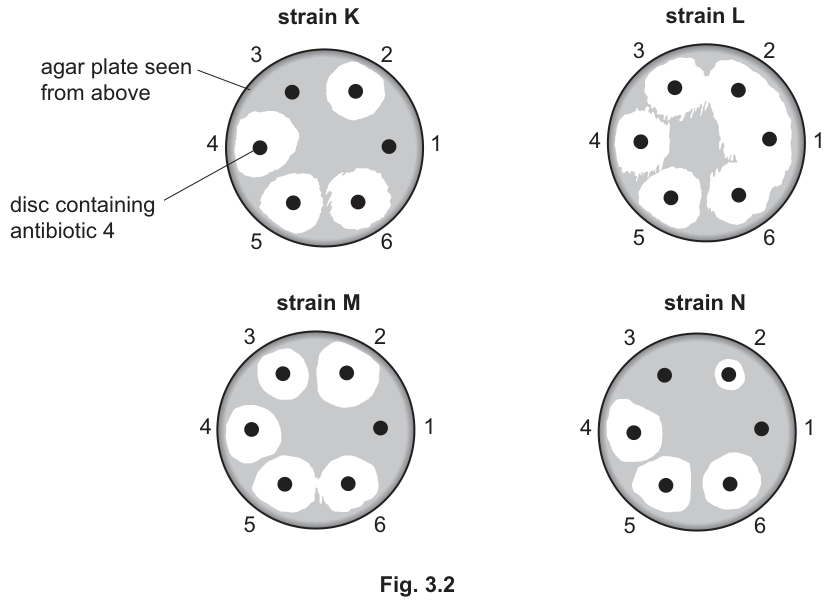
A disc diffusion test is carried out to investigate the resistance of four strains of S. aureus (K, L, M and N) to different antibiotics. The four strains are first grown to cover the surface of separate agar plates. Then discs containing six different antibiotics (1–6) are placed on the agar plates.
Fig. 3.2 shows the results of the investigation after several days.
Any clear zones indicate where S. aureus has died.
Answer
The antibiotic diffuses / moves from the paper disc into the agar gel.
The antibiotic diffuses into the agar.
Walkthrough
In this investigation, paper discs impregnated with antibiotic solutions are placed on the surface of nutrient agar. The antibiotic dissolves in the moisture and diffuses outwards through the agar gel down a concentration gradient. As it spreads through the agar, it inhibits or kills susceptible bacteria surrounding the disc, producing a clear zone of inhibition.
Key Takeaways
- A disc diffusion test is named after the physical process of the antibiotic diffusing through the agar matrix away from the paper disc.
Common Mistakes
- Stating that bacteria diffuse (bacteria grow on the surface; the antibiotic diffuses through the agar).
Things to Be Careful About
- Mention the movement/diffusion of the antibiotic into the agar.
Describe what these results show about the effectiveness of antibiotics 1 and 5.
antibiotic 1 ______
antibiotic 5 ______
Answer
- antibiotic 1: not effective against strains K, M, and N / only effective against strain L (or ineffective against all except L)
- antibiotic 5: effective against all four strains (K, L, M, and N)
antibiotic 1: only effective against strain L; antibiotic 5: effective against all four strains
Walkthrough
To describe the effectiveness, inspect discs 1 and 5 across all four plates in Fig. 3.2:
- Antibiotic 1:
- Strain K: no clear zone around disc 1 (ineffective).
- Strain L: clear zone extends to disc 1 / covers area of disc 1 (effective).
- Strain M: no clear zone around disc 1 (ineffective).
- Strain N: no clear zone around disc 1 (ineffective).
- Therefore, antibiotic 1 is only effective against strain L (or ineffective against three of the strains).
- Antibiotic 5:
- There is a distinct clear zone around disc 5 on all four plates (strains K, L, M, and N).
- Therefore, antibiotic 5 is effective against all four strains.
Key Takeaways
- The presence of a clear zone indicates bacterial death/inhibition (effective antibiotic).
- The absence of a clear zone indicates bacterial growth right up to the disc (resistant bacteria / ineffective antibiotic).
Common Mistakes
- Overlooking strain L when evaluating antibiotic 1, or failing to state that antibiotic 5 works on all four strains.
Things to Be Careful About
- Provide a clear statement for each named antibiotic separately.
Over time the percentage of each strain in the S. aureus population will change.
Suggest which strain, K, L, M or N, in Fig. 3.2 is likely to become the largest percentage of the population.
______
Answer
N
N
Walkthrough
To determine which strain will become the largest percentage of the population, look for the strain with the greatest antibiotic resistance (i.e. killed by the fewest antibiotics / having the fewest and smallest clear zones):
- Strain K: affected by discs 2, 4, 5, 6 (4 antibiotics killed it).
- Strain L: affected by discs 2, 3, 4, 5, 6 and zone reaches 1 (most antibiotics killed it).
- Strain M: affected by discs 2, 3, 4, 5, 6 (5 antibiotics killed it).
- Strain N: only affected by discs 4, 5, 6 (and very slightly 2/3), having clear zones around the fewest antibiotics, meaning it is resistant to more antibiotics than the others.
Therefore, Strain N is the most resistant and most likely to survive in environments where antibiotics are present.
Key Takeaways
- The strain with the fewest clear zones possesses resistance to the highest number of antibiotics.
Common Mistakes
- Choosing strain L (which has the largest clear area and is therefore the least resistant).
Things to Be Careful About
- Make sure to identify resistance by the lack of clear zones.
Explain why the strain named in (c)(i) is likely to become the largest percentage of the population over time.
______
Answer
Any five from:
- there is genetic variation within the bacterial population
- strain N has the greatest resistance to antibiotics
- strain N is the best adapted to an environment containing antibiotics
- bacteria of strain N are more likely to survive
- the surviving bacteria reproduce (asexually by binary fission)
- they pass on the alleles for antibiotic resistance to their offspring
- this process is natural selection (increasing the frequency of strain N over time)
Strain N has the greatest antibiotic resistance due to genetic variation. It is best adapted, survives antibiotic exposure, reproduces, and passes on the resistance alleles to offspring by natural selection.
Walkthrough
This is a classic explanation of evolution by natural selection applied to antibiotic resistance:
- Variation: Mutations produce genetic variation within the S. aureus population, creating different strains.
- Selective advantage: Strain N has alleles giving it resistance to the most antibiotics.
- Selection pressure & survival: When antibiotics are used, susceptible strains (K, L, M) are killed, but strain N is better adapted and survives.
- Reproduction: The surviving bacteria of strain N reproduce.
- Inheritance: They pass their resistance alleles/genes to the next generation.
- Population change: Over time and repeated antibiotic use, the frequency of strain N and its resistance alleles increases, so it becomes the dominant strain in the population.
Key Takeaways
- Natural selection involves: variation selective advantage survival reproduction passing on beneficial alleles to offspring increase in allele frequency over generations.
Common Mistakes
- Saying "bacteria become immune" (bacteria develop resistance, not immunity; immunity involves antibodies in higher organisms).
- Saying "antibiotics cause the mutation/resistance" (mutations occur randomly; antibiotics act only as a selective agent that kills non-resistant bacteria).
Things to Be Careful About
- Mention both survival and reproduction, as well as passing on alleles/genes to offspring.
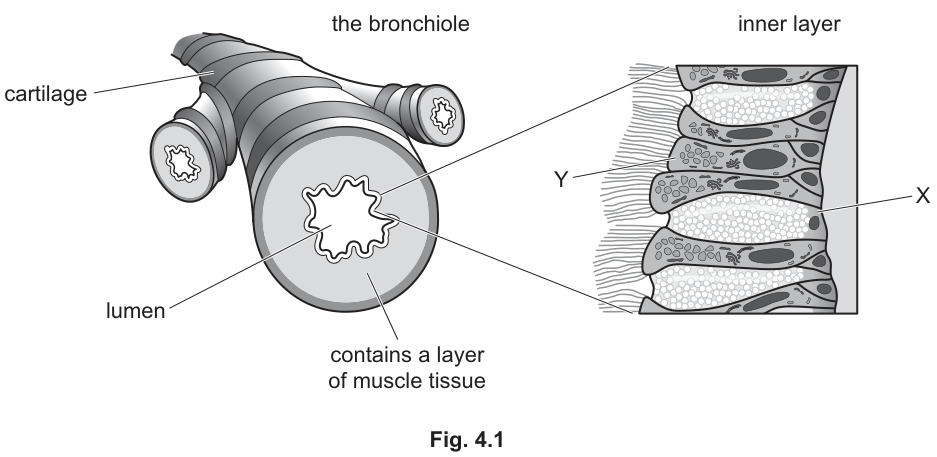
Fig. 4.1 shows a human bronchiole and some of the specialised cells from the inner layer that surrounds the lumen.
Answer
X: goblet cell
function:
- produces / secretes mucus
- mucus traps bacteria / pathogens / dust / particles
X: goblet cell; function: produces/secretes mucus which traps bacteria/pathogens/dust/particles
Walkthrough
- Identify cell X: Look at the enlarged view of the inner layer in Fig 4.1. Cell X is filled with small, circular granules. In the respiratory epithelium, these granules represent mucus stored in the cytoplasm. This identifies cell X as a goblet cell.
- State the function: Goblet cells have a two-part function that scores marks. First, they produce and secrete mucus. Second, this mucus is sticky and traps inhaled particles such as bacteria, pathogens, dust, and dirt, preventing them from reaching the delicate gas exchange surfaces in the lungs.
Key Takeaways
- The inner lining of the respiratory tract contains specialised cells. Goblet cells are flask-shaped and secrete mucus to trap foreign particles.
- Protection of the respiratory system relies on both physical barriers (mucus) and mechanical clearance (cilia).
Common Mistakes
- Naming the cell incorrectly: Students sometimes write "mucus cell" or "secretory cell" instead of the precise term goblet cell.
- Giving only one part of the function: The mark scheme awards marks for both the production of mucus AND what the mucus does (trapping particles). Stating only "traps dust" without mentioning mucus production may lose a mark.
- Confusing X and Y: Ensure you are looking at the correct label. X points to the granule-filled cell (goblet), while Y points to the cell with hair-like projections (ciliated).
Things to Be Careful About
- Use the exact biological term goblet cell. Vague terms like "mucus cell" are not accepted.
- The function has two distinct creditable points separated by a semicolon in the mark scheme: (1) produces/secretes mucus, and (2) mucus traps bacteria/pathogens/dust/particles. Provide both to secure full marks.
- Do not describe the function of cilia here; that is for cell Y.
Answer
Y: ciliated cell
function:
- moves mucus away from the lungs (towards the throat / to be swallowed)
Y: ciliated cell; function: moves mucus away from the lungs
Walkthrough
- Identify cell Y: In the enlarged diagram, cell Y has hair-like projections extending from its surface into the lumen of the bronchiole. These projections are cilia. Therefore, cell Y is a ciliated epithelial cell.
- State the function: The cilia beat in a coordinated, rhythmic fashion. Their function is to move the layer of mucus (which contains the trapped dust and pathogens from part a(i)) away from the lungs and upwards towards the pharynx, where it is either swallowed or coughed out. This mechanical clearance keeps the lower respiratory tract clean.
Key Takeaways
- Ciliated epithelial cells work in tandem with goblet cells. Goblet cells secrete the trap (mucus), and ciliated cells operate the elevator (moving the mucus away).
- The direction of mucus movement is crucial: it must move away from the lungs (upwards), not into the lungs.
Common Mistakes
- Naming the cell: Writing "cilia cell" or "hair cell" instead of the correct term ciliated cell or ciliated epithelial cell.
- Describing the wrong action: Saying cilia "trap" particles (that is mucus's job) or "absorb" mucus. The correct action is moves or sweeps.
- Wrong direction: Stating that cilia move mucus into the lungs. It must move away from the lungs to prevent infection.
Things to Be Careful About
- The mark scheme specifically accepts "moves mucus away from lungs". Ensure the directional aspect is clear.
- Only one mark is allocated for this part, so one clear, accurate statement of function is sufficient.
The muscle layer in the walls of the bronchi and bronchioles sometimes contracts causing the lumens to narrow. This is called bronchoconstriction. One substance that triggers contraction is nicotine.
Answer
Any three of the following:
- lower volume of air / oxygen into lungs / alveoli
- reduced oxygen into blood
- decrease in oxygen reaching cells / tissues / muscles
- aerobic respiration is limited / reduced
- (more) anaerobic respiration occurs
- reduced ability to exercise / do physical activities
See working (any three linked points from reduced air volume to reduced exercise ability)
Walkthrough
This question requires a causal chain of events, starting from the physical change in the bronchiole and ending with a physiological effect on the body.
- Physical effect: Bronchoconstriction means the smooth muscle contracts, narrowing the lumen. This directly causes a lower volume of air (and therefore oxygen) to pass into the lungs and reach the alveoli.
- Gas exchange effect: With less oxygen in the alveoli, the concentration gradient is reduced, leading to less oxygen diffusing into the blood.
- Transport effect: The blood carries less oxygen, so there is a decrease in oxygen reaching the cells, tissues, and muscles throughout the body.
- Cellular respiration effect: Cells need oxygen for aerobic respiration to produce ATP. With reduced oxygen, aerobic respiration is limited. To meet energy demands, cells switch to anaerobic respiration.
- Systemic effect: Anaerobic respiration produces less ATP and accumulates lactic acid, leading to muscle fatigue. This results in a reduced ability to exercise or perform physical activities.
Any three logical, linked points from this chain will score the 3 marks.
Key Takeaways
- Physiology questions often require tracing a pathway from a structural change to a functional outcome.
- Oxygen is the link between gas exchange (lungs) and respiration (cells). Reduced supply at one end limits output at the other.
- The body's response to oxygen shortage is a shift from aerobic to anaerobic metabolism.
Common Mistakes
- Stopping the chain too early: Stating only "less air enters the lungs" without explaining the downstream effects on oxygen delivery and respiration. The mark scheme wants the full chain to the systemic effect.
- Confusing bronchoconstriction with bronchodilation: Remember, constriction means narrowing, which reduces flow.
- Incorrect respiration terminology: Saying "cells die" or "cells stop working" instead of specifying the shift to anaerobic respiration and the limitation of aerobic respiration.
- Forgetting the final effect: The ultimate impact on the person is a reduced ability to exercise or fatigue. Don't stop at the cellular level if you can go further.
Things to Be Careful About
- The mark scheme allows "max 3" from a list of 6 points. You must provide exactly three distinct, logical points. Providing more does not gain extra marks, but ensuring the three you provide are clearly linked is important.
- Use precise terminology: alveoli, aerobic respiration, anaerobic respiration, oxygen debt (if mentioned, though not strictly required here).
- Do not mention carbon dioxide buildup as the primary cause of the exercise limitation; the prompt focuses on oxygen delivery and respiration types.
Answer
Any one of the following:
- increased blood pressure
- artery constriction (vasoconstriction)
- increased heart rate
- increased clotting tendency
- contributes to atherosclerosis
See working (any one accepted effect, e.g., increased blood pressure)
Walkthrough
Nicotine is a stimulant drug found in tobacco smoke. It acts on the autonomic nervous system and has several direct effects on the cardiovascular system, making it a significant risk factor for coronary heart disease (CHD).
- Vascular effect: Nicotine causes artery constriction (vasoconstriction), which narrows the blood vessels and increases resistance to blood flow.
- Hemodynamic effect: This constriction, along with the stimulant effect on the heart, leads to increased blood pressure and an increased heart rate.
- Long-term effects: Chronic exposure to nicotine and other tobacco chemicals damages the endothelium of arteries, promoting atherosclerosis (build-up of fatty plaques) and increasing the clotting tendency of the blood.
The question asks for one effect. Any single, accurate statement from the list above is sufficient to score the mark.
Key Takeaways
- Nicotine is a major risk factor for coronary heart disease, alongside smoking-related carbon monoxide, high-fat diets, and lack of exercise.
- Its immediate physiological effects include vasoconstriction, increased heart rate, and elevated blood pressure.
- Long-term effects include accelerated atherosclerosis and increased risk of thrombosis (clotting).
Common Mistakes
- Vague answers: Saying "it is bad for the heart" or "causes heart disease" without specifying the mechanism (e.g., increased blood pressure, artery constriction). The mark scheme requires a specific physiological effect.
- Confusing nicotine with carbon monoxide: Carbon monoxide reduces oxygen-carrying capacity of haemoglobin. Nicotine primarily affects vascular tone and heart rate. Do not mix these up.
- Saying "increases oxygen": Nicotine does not increase oxygen; if anything, by increasing metabolic demand (heart rate) and constricting vessels, it worsens oxygen delivery.
Things to Be Careful About
- The question asks for an effect on the circulatory system. Do not give respiratory effects (like bronchoconstriction, which was part b(i)).
- Only one mark is allocated, so provide exactly one clear, accurate point. Giving multiple points does not gain extra marks but ensures you hit the correct one if unsure.
- Acceptable terms include vasoconstriction (as a synonym for artery constriction), but stick to the mark scheme's primary terms if possible.
Rhizomucor pusillus is a fungus found in piles of dead plant vegetation. It has an optimum growth rate between and .
Identify the name of the kingdom and genus of this organism.
kingdom ______
genus ______
Answer
kingdom: fungi
genus: Rhizomucor
kingdom: fungi, genus: Rhizomucor
Walkthrough
The organism's name is given as Rhizomucor pusillus. In binomial nomenclature, the first word is the genus and the second is the species. Therefore, the genus is Rhizomucor. The question states it is a fungus, so the kingdom is Fungi.
Key Takeaways
Binomial names always have two parts: the genus (capitalised) and the species (lowercase), both italicised. Knowing which kingdom an organism belongs to is the first step in classification.
Common Mistakes
- Writing the genus with a lower-case letter or not italicising it.
- Confusing the species name (pusillus) with the genus name.
- Writing 'fungus' instead of 'Fungi' for the kingdom (though 5090 often accepts 'fungi' as the kingdom name, 'Fungi' is the formal taxon).
Things to Be Careful About
The question asks for the 'kingdom' and the 'genus'. Ensure you do not swap them or provide the species name instead of the genus.
Give two of the main features of organisms classified in the kingdom named in (a)(i).
- ______
- ______
Answer
- Cell walls made of chitin.
- Heterotrophic (saprotrophic) nutrition.
(Any two from: cell walls made of chitin; heterotrophic / saprotrophic / saprophytic; filamentous / hyphae / mycelium; eukaryotic.)
Cell walls made of chitin; heterotrophic / saprotrophic nutrition.
Walkthrough
The question asks for two main features of the kingdom Fungi. From the syllabus, fungi are eukaryotic organisms with cell walls made of chitin (unlike plants, which have cellulose). They cannot make their own food, so they are heterotrophic. Specifically, because this fungus grows on dead vegetation, it is saprotrophic (absorbing nutrients from dead organic matter). They also typically grow as filamentous structures called hyphae, which form a mycelium.
Key Takeaways
Fungi are distinct from plants and animals. Their chitin cell walls, heterotrophic saprotrophic nutrition, and filamentous hyphal growth are their defining characteristics.
Common Mistakes
- Stating that fungi have cellulose cell walls (that is plants).
- Saying fungi are autotrophic (they are heterotrophic).
- Providing more than two features when only two are asked for, though extra correct points usually do not penalise, it is best to give exactly what is requested.
Things to Be Careful About
The mark scheme gives 'max 2', so provide exactly two clear points. 'Saprotrophic' is more precise than 'heterotrophic' for organisms feeding on dead matter, but both are accepted.
Explain how piles of dead plant vegetation can have temperatures much higher than the surrounding environment.
______
Answer
- The fungi (and bacteria) decompose the dead plant vegetation.
- Decomposition involves respiration.
- Respiration releases energy, some of which is lost as heat.
- The outer layers of the vegetation pile act as an insulator, trapping the heat inside.
Decomposition by fungi and bacteria releases heat via respiration, and the vegetation insulates the pile.
Walkthrough
The question asks why piles of dead vegetation (like compost) get hot. First, the dead vegetation is broken down by decomposers, which in this case are the fungus Rhizomucor pusillus and bacteria. Decomposition is a series of chemical reactions that rely on cellular respiration. Respiration is an exothermic process that releases energy. While some energy is used for the organisms' life processes, a significant portion is released as heat. Finally, a large pile of vegetation is a poor conductor of heat; the outer layers insulate the inner layers, trapping the generated heat and causing the temperature to rise well above the ambient environment.
Key Takeaways
Decomposition is driven by respiration, which releases heat. Physical structure (insulation) can cause this heat to accumulate in large masses like compost piles.
Common Mistakes
- Saying 'decomposition produces heat' without mentioning respiration as the mechanism.
- Forgetting the insulation point; heat is generated, but it only accumulates if it cannot escape.
- Attributing the heat solely to the fungus without mentioning bacteria, which are also major decomposers.
Things to Be Careful About
The mark scheme requires four distinct points: the decomposers, decomposition/respiration, heat/energy release, and insulation. Ensure all four are covered to get the full 4 marks.
This fungus produces an enzyme called pectinase. Scientists extracted pectinase from the fungus and investigated the effect of pH on its activity at .
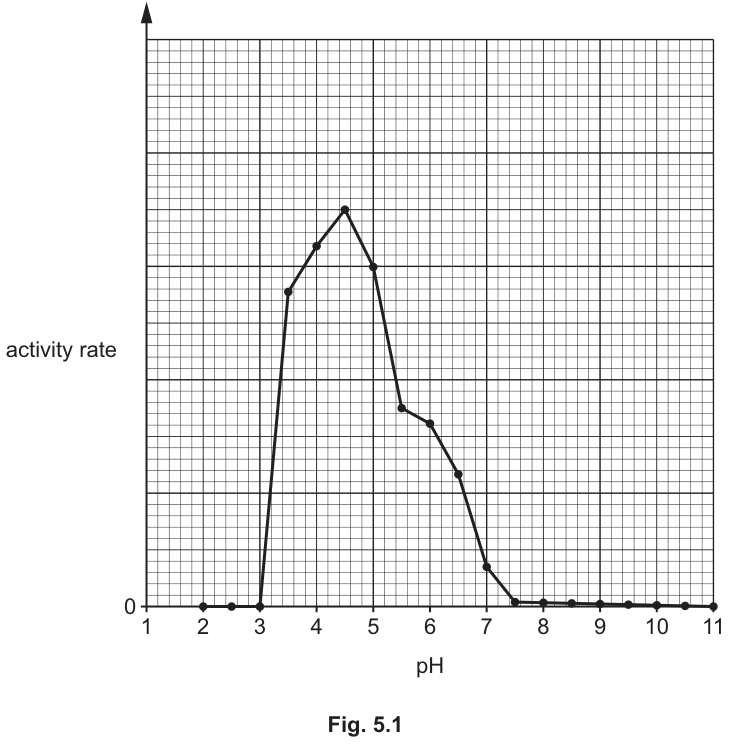
Fig. 5.1 shows a graph of their results.
Answer
- At pH 2–3, the enzyme is denatured because the active site has changed shape (deformed).
- The substrate no longer fits the active site, so no enzyme-substrate complexes form and activity is zero.
- The optimum pH is 4.5, where the active site and substrate are complementary and enzyme-substrate complexes form most rapidly, giving maximum activity.
- Above pH 4.5, the enzyme starts to denature again, changing the active site shape and reducing activity until it stops at pH 7.
See working.
Walkthrough
The graph shows pectinase activity from pH 2 to 7. At pH 2–3, activity is zero. According to the lock-and-key model, an enzyme's active site has a specific shape that fits the substrate. Extreme pH levels (like pH 2–3) disrupt the ionic and hydrogen bonds holding the enzyme's tertiary structure together, causing the enzyme to denature. This deforms the active site, so the substrate can no longer fit, and no enzyme-substrate (ES) complexes can form.
As pH increases towards 4.5, the enzyme's shape is restored to its optimal conformation. At pH 4.5 (the optimum), the active site and substrate are perfectly complementary, ES complexes form at the highest rate, and activity peaks.
Above pH 4.5, the environment becomes too alkaline. The enzyme begins to denature again, the active site changes shape, substrate binding decreases, and activity falls until the enzyme is fully denatured at pH 7, where activity is zero again.
Key Takeaways
Enzyme activity is highly dependent on pH. Deviations from the optimum pH disrupt the enzyme's 3D structure (denaturation), altering the active site and preventing substrate binding.
Common Mistakes
- Saying the enzyme is 'destroyed' or 'broken' instead of 'denatured'. Denaturation is the precise biological term.
- Forgetting to mention the active site changing shape or the substrate no longer fitting.
- Not explaining why activity is zero at the extremes (no ES complexes form).
Things to Be Careful About
The mark scheme gives 'max 4'. You need to cover the low pH (denaturation, active site change, no fit), the optimum (complementary shapes, ES complexes), and the high pH (starts to denature above optimum). Do not just describe the curve; explain the mechanism.
The experiment was repeated at a temperature of .
On Fig. 5.1, draw a graph to suggest the results expected at .
Answer
Draw a new curve on the same axes with the same peak position at pH 4.5, but with the entire curve drawn above the original 20 °C curve, indicating a higher activity rate at 55 °C.
See working.
Walkthrough
The question asks to draw the expected results at 55 °C. The stem states that Rhizomucor pusillus has an optimum growth rate between 60 °C and 70 °C. Enzyme activity generally increases with temperature up to the organism's optimum because molecules have more kinetic energy, leading to more frequent and successful collisions between enzyme and substrate. Since 55 °C is much closer to the optimum (60–70 °C) than 20 °C, the pectinase will have a higher activity rate at all pH values where it is not denatured.
However, pH affects the enzyme's shape through charge interactions, which is independent of temperature. Therefore, the optimum pH remains 4.5, and the enzyme will still be denatured at the same extreme pH values (around pH 3 and above pH 7). The new curve should have the same x-axis range and peak position, but be scaled higher on the y-axis.
Key Takeaways
Temperature affects the rate of reaction (kinetic energy) but does not change the optimum pH. An enzyme from a thermophilic organism will have higher activity at higher temperatures.
Common Mistakes
- Shifting the peak of the curve to a different pH (e.g., pH 5 or 6). Temperature does not change the optimum pH.
- Drawing the new curve below the original, which would imply 55 °C is worse than 20 °C.
- Forgetting to draw the curve on the same axes or not starting/ending at the same pH values where denaturation occurs.
Things to Be Careful About
The mark scheme requires the line to have 'optimum activity at pH 4.5' and be 'drawn above the original'. Ensure your drawn curve peaks at exactly pH 4.5 and is entirely above the 20 °C curve between pH 3 and 7.
Answer
fruit juice production
fruit juice production
Walkthrough
Pectinase is an enzyme that breaks down pectin, a structural polysaccharide found in plant cell walls. In the food industry, it is widely used in fruit juice production. By adding pectinase to crushed fruit, the cell walls are broken down, releasing more juice and making the juice clearer (as pectin causes cloudiness). It is also used in making fruit purees and in the brewing industry.
Key Takeaways
Enzymes have many industrial applications. Pectinase specifically targets pectin, making it valuable in juice extraction and clarification.
Common Mistakes
- Saying 'cheese making' (which uses rennet/chymosin, not pectinase).
- Saying 'bread making' (which uses amylase and protease, or yeast for fermentation).
- Giving a vague answer like 'food industry' without specifying the process.
Things to Be Careful About
The question asks to 'name an industrial process'. 'Fruit juice production' or 'juice clarification' are the standard accepted answers. Be specific.
The nucleus of a cell contains DNA molecules that control cell function.
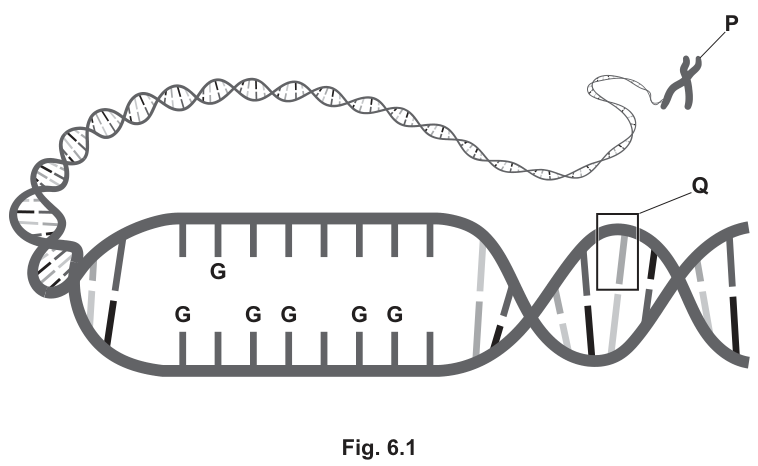
Fig. 6.1 is a diagram showing one of these DNA molecules.
Using information from Fig. 6.1:
Answer
chromosome
chromosome
Walkthrough
The question asks for the name of the structure labelled P in Fig. 6.1. The diagram shows a long DNA molecule unwinding from a larger, condensed, X-shaped structure. In the nucleus of a eukaryotic cell, DNA is tightly coiled around histone proteins to form chromosomes. Therefore, P is a chromosome.
Key Takeaways
DNA in the nucleus is packaged into chromosomes. A chromosome is made up of a single, very long DNA molecule coiled around proteins to save space and protect the genetic information.
Common Mistakes
Candidates often write "gene" or "DNA molecule" for P. The diagram clearly shows the entire condensed structure from which the DNA strand is unwinding, which is the chromosome. Furthermore, the question text already states "Fig. 6.1 is a diagram showing one of these DNA molecules", so P must be the larger structure containing it. Writing "chromatid" is also incorrect here as the diagram shows the whole chromosome before replication or unwinding.
Things to Be Careful About
Use the exact term "chromosome". Do not write "chromatin" or "chromatid" unless specifically asked for a sub-part of the chromosome. 5090 is strict about biological nomenclature; a vague paraphrase will score zero.
Answer
nucleotide
nucleotide
Walkthrough
The question asks for the name of the unit of DNA labelled Q. The box Q encloses a single repeating unit of the DNA strand, which consists of a phosphate group, a sugar (deoxyribose), and a nitrogenous base. This repeating monomer unit is called a nucleotide.
Key Takeaways
DNA is a polymer (polynucleotide) made up of monomers called nucleotides. Each nucleotide contains a phosphate group, a pentose sugar (deoxyribose in DNA), and a nitrogenous base (A, T, C, or G).
Common Mistakes
Candidates sometimes write "nucleoside" (which lacks the phosphate group) or "base pair" (which involves two complementary nucleotides). The box Q clearly encloses only one strand's unit, so it is a single nucleotide. Another common error is writing "DNA" or "gene", which are incorrect levels of organisation.
Things to Be Careful About
Ensure you spell "nucleotide" correctly. Do not add "acid" or "monomer" unless the question asks for the full chemical name. The mark scheme accepts exactly "nucleotide".
Answer
C
C
Walkthrough
The question asks for the letter of the base that pairs with G (guanine) in the DNA molecule. According to the base pairing rules in DNA, guanine (G) always pairs with cytosine (C) via three hydrogen bonds. Therefore, the complementary base is C.
Key Takeaways
DNA base pairing follows strict rules: adenine (A) pairs with thymine (T) via two hydrogen bonds, and guanine (G) pairs with cytosine (C) via three hydrogen bonds. Remember the mnemonic "G-C is a good pair" or simply memorise the A-T and G-C pairings.
Common Mistakes
Candidates sometimes write "T" (confusing G with A) or write out the full word "cytosine" when only the letter is required. The question specifically asks for "the letter", so writing "C" is the correct and safest response.
Things to Be Careful About
The question asks for "the letter", so provide just "C". Do not write "cytosine" or "Cytosine" as this may be rejected if the mark scheme is strictly looking for the single character. Also, remember that in RNA, guanine pairs with cytosine as well, but thymine is replaced by uracil; here we are dealing with DNA, so C is correct.
Explain how this DNA molecule controls cell function.
Include an example in your answer.
______
Answer
- DNA codes for proteins / polypeptides.
- The order of bases (or base sequence) determines the sequence of amino acids.
- This determines the structure and function of the protein.
- Example protein: insulin / haemoglobin / keratin / any specific protein.
See working
Walkthrough
The question asks to explain how a DNA molecule controls cell function and to include an example. This requires tracing the flow of genetic information from DNA to functional proteins.
- DNA codes for proteins: The primary function of DNA is to store the instructions for making proteins (or polypeptides), which carry out most functions in a cell.
- Base sequence determines amino acid sequence: The sequence of bases (A, T, C, G) along the DNA strand acts as a code. The specific order of these bases determines the sequence of amino acids that will be linked together to form a protein.
- Protein structure determines function: The sequence of amino acids dictates how the protein folds into its specific three-dimensional shape, which in turn determines its function (e.g., as an enzyme, structural component, or hormone).
- Example: Provide a specific example of a protein to illustrate the point, such as insulin (a hormone that controls blood glucose), haemoglobin (transports oxygen in red blood cells), or keratin (a structural protein in hair and nails).
Key Takeaways
DNA controls cell function by providing the instructions (code) for building proteins. The sequence of bases in a gene determines the sequence of amino acids in a polypeptide. The polypeptide then folds into a specific protein with a specific function. This is the central dogma of molecular biology: DNA → RNA → Protein.
Common Mistakes
- Vague explanations: Writing "DNA makes proteins" without explaining how (via the base sequence determining the amino acid sequence) will not score full marks.
- Missing the example: The question explicitly asks for an example. Forgetting to include a specific protein (e.g., just writing "a protein") will cost a mark.
- Confusing DNA with RNA: Candidates sometimes write that DNA codes for RNA and stops there. While true, the explanation must link back to proteins to explain cell function control.
- Biochemical pathway overspill: Do not mention transcription, translation, ribosomes, or the Krebs cycle. 5090 only requires the conceptual link: base sequence → amino acid sequence → protein → function.
Things to Be Careful About
- Mark scheme alignment: The mark scheme awards 4 marks for: (1) codes for proteins/polypeptides, (2) order of bases/base sequence, (3) determines sequence of amino acids, (4) example protein. Ensure all four points are covered clearly.
- Wording: Use the precise terms "base sequence" or "order of bases" and "sequence of amino acids". Avoid vague terms like "DNA tells the cell what to do".
- Example selection: The example must be a protein. Do not give an example of a carbohydrate or lipid. Insulin, haemoglobin, amylase, or keratin are all excellent, safe choices.
Photosynthesis and transpiration are two processes that take place in a plant leaf.
Answer
- Large surface area so that maximum light is absorbed.
- Thin so that there is a short diffusion distance for gases (carbon dioxide in, oxygen out).
- Stomata allow gaseous exchange (carbon dioxide in, oxygen out).
- Air spaces / spongy mesophyll allow diffusion of gases through the leaf.
- Chloroplasts / chlorophyll absorb light energy.
- Palisade mesophyll in the upper leaf receives the most light, and chloroplasts are most dense there.
- Xylem brings water for photosynthesis.
- Transparent epidermal cells allow light to reach the palisade cells.
Large surface area, thin, stomata, air spaces, palisade layer with chloroplasts, xylem, transparent epidermis
Walkthrough
This question asks you to link the structures of a leaf to the job they do in photosynthesis. The mark scheme rewards pairs: a structure plus the function it performs. For example, simply writing 'large surface area' earns nothing unless you add 'so maximum light is absorbed'.
Start with the overall shape. A leaf is broad and flat, giving a large surface area. This is the first point: more surface means more light can hit the leaf, and more light means more photosynthesis.
Next, think about gas exchange. Photosynthesis needs carbon dioxide in and produces oxygen out. The leaf is thin, so gases only have a short distance to diffuse to reach the cells. The stomata are the pores in the epidermis that let gases in and out. Inside the leaf, the spongy mesophyll has air spaces, which allow carbon dioxide and oxygen to diffuse freely between cells.
Now think about light capture. The palisade mesophyll cells are packed with chloroplasts, and they are positioned in the upper part of the leaf, so they receive the most light. The upper epidermis is transparent (it has no chloroplasts), which lets light pass straight through to the palisade layer.
Finally, photosynthesis needs water. The xylem vessels bring water up from the roots to the leaf cells.
You only need six points for full marks, so choose the clearest six. The mark scheme allows any six from the nine listed.
Key Takeaways
- A leaf is adapted for photosynthesis in three main ways: maximising light capture, maximising gas exchange, and supplying water.
- Every adaptation must be paired with its function to score the mark (e.g. 'thin + short diffusion distance').
- The palisade layer is at the top because that is where light intensity is highest.
- The xylem is essential because water is a raw material of photosynthesis.
Common Mistakes
- Writing 'stomata for water loss' – the mark scheme wants 'gaseous exchange' (carbon dioxide in, oxygen out). Water loss is transpiration, not photosynthesis.
- Writing 'thin' without explaining that it gives a short diffusion distance for gases.
- Writing 'xylem for support' – the required function here is bringing water for photosynthesis.
- Confusing spongy mesophyll with palisade mesophyll. The spongy layer has air spaces for gas diffusion; the palisade layer has the most chloroplasts.
- Giving only three or four points when six are needed for full marks.
Things to Be Careful About
- The mark scheme lists nine points but the maximum is six. Give exactly six well-chosen points, not a shorter list and not a longer one that wastes time.
- Use the exact terms from the mark scheme: 'large surface area', 'diffusion', 'chloroplasts', 'palisade', 'xylem'.
- Make sure each point is a structure plus its function – the '+' in the mark scheme means both halves are needed for the mark.
Transpiration is both necessary for plants and a problem for plants.
Discuss this statement.
______
Answer
Necessary:
- Provides (leaves with) water for photosynthesis.
- Provides plant cells with support / turgidity / turgor.
- Transports mineral ions from the roots to the leaves.
- Cools the leaf / plant.
Problem:
- Too much water is lost (through stomata / leaf).
- Water loss leads to wilting / death.
- Plants may close stomata to prevent transpiration, which slows down photosynthesis.
Necessary: water for photosynthesis, support/turgidity, mineral transport, cooling. Problem: water loss, wilting/death, stomata closure slows photosynthesis.
Walkthrough
The command word is 'Discuss', which means you must give a balanced answer covering both sides of the statement. The mark scheme gives a maximum of 2 marks for the 'necessary' side and a maximum of 2 marks for the 'problem' side, so you should aim for two clear points on each side.
For the 'necessary' side, think about what transpiration does for the plant. Transpiration is the loss of water vapour from the leaves, and this loss creates a pull that draws water up the xylem from the roots. This water is used in photosynthesis, so transpiration indirectly provides the raw material for photosynthesis. The water also carries dissolved mineral ions from the roots to the leaves. As water is lost, the remaining water in the cells keeps them firm and turgid, giving the plant support. Evaporation of water from the leaf surface also has a cooling effect.
For the 'problem' side, think about the cost. The plant loses a large amount of water through the stomata. If the water loss is too great, the cells lose turgor and the plant wilts, and severe water loss can kill the plant. To reduce water loss, the plant may close its stomata. However, closing the stomata also stops carbon dioxide from entering the leaf, which slows down photosynthesis.
Write two points for 'necessary' and two for 'problem' to score the full 4 marks.
Key Takeaways
- Transpiration is a trade-off: it is essential for water and mineral transport, support and cooling, but it costs the plant water and can lead to wilting.
- The same process (stomata opening for gas exchange) causes water loss, so the plant must balance photosynthesis against water conservation.
- 'Discuss' questions require points on both sides of the argument.
Common Mistakes
- Writing 'transpiration transports food' – that is translocation in the phloem, not transpiration.
- Writing 'transpiration stops' without explaining the consequence. The mark scheme wants 'closing stomata slows down photosynthesis'.
- Giving three points for 'necessary' and only one for 'problem' – the mark scheme caps each side at 2 marks.
- Using 'support' without the precise term 'turgidity' or 'turgor'.
- Saying 'wilting' without linking it to water loss or death.
Things to Be Careful About
- The mark scheme states 'necessary (max 2)' and 'problem (max 2)', so structure your answer into two clear sections and give exactly two points in each.
- Use the exact wording from the mark scheme: 'water for photosynthesis', 'turgidity', 'wilting', 'closing stomata slows down photosynthesis'.
- Do not confuse transpiration with translocation. Transpiration is water loss and water movement in the xylem; translocation is the movement of sugars in the phloem.