Biology 5090/21 — May/June 2025
Cambridge O-Level · Theory · worked solutions for every part, with the mark scheme
Topics Inheritance · Organisms and Their Environment · Enzymes · Biological Molecules · Respiration · Coordination and Control · +7 more
Large molecules in cells are made from smaller molecules.
Complete Table 1.1 to show which small molecules make up each large molecule.
Choose the small molecules from this list.
Table 1.1
| large molecule | small molecules |
|---|---|
| protein | |
| cellulose | |
| lipid |
Answer
| large molecule | small molecules |
|---|---|
| protein | amino acids |
| cellulose | glucose |
| lipid | fatty acids + glycerol |
protein = amino acids; cellulose = glucose; lipid = fatty acids + glycerol
Walkthrough
This question tests whether you know the small units (monomers) that join together to form the large molecules (polymers) found in cells.
- Protein – Proteins are made of long chains of amino acids joined together. So the small molecules are amino acids.
- Cellulose – Cellulose is a carbohydrate. It is a polysaccharide built from many glucose molecules joined in a long chain.
- Lipid – A lipid (fat or oil) is not a polymer in the same way, but it is built from smaller molecules. One molecule of lipid is made from one molecule of glycerol joined to three molecules of fatty acids. The mark scheme requires both parts for this mark: "fatty acids + glycerol".
Key Takeaways
- Large biological molecules are built from repeating smaller units.
- Proteins are polymers of amino acids.
- Carbohydrates like cellulose and starch are polymers of glucose.
- Lipids are made of glycerol and fatty acids.
- This is the basis of condensation reactions where water is removed to join units together.
Common Mistakes
- Forgetting glycerol: For the lipid row, writing only "fatty acids" loses the mark because the mark scheme explicitly requires "fatty acids + glycerol".
- Confusing cellulose with nucleotides: Cellulose is a carbohydrate, so it is made of glucose, not nucleotides (which make up nucleic acids like DNA).
- Writing "sugar" instead of "glucose": The list provides specific options; you must choose the exact term given.
Things to Be Careful About
- Use the exact words from the list provided. Do not invent alternatives.
- The lipid row is the only one requiring two terms. Make sure both are present.
- Each correct row scores 1 mark, so there are 3 marks available here.
DNA is found in the nucleus of each cell.
Put a tick (✓) next to any statements that correctly describe the structure of DNA.
| A DNA molecule has four strands coiled together to form a helix. | ______ |
| Each strand is made up of a chain of nucleotides. | ______ |
| Each nucleotide contains a base, a sugar and an amino acid. | ______ |
| The bases always pair up in the same way, A with T, and C with G. | ______ |
| Bonds between sugar molecules hold the strands together. | ______ |
Answer
| Statement | Correct? |
|---|---|
| A DNA molecule has four strands coiled together to form a helix. | |
| Each strand is made up of a chain of nucleotides. | ✓ |
| Each nucleotide contains a base, a sugar and an amino acid. | |
| The bases always pair up in the same way, A with T, and C with G. | ✓ |
| Bonds between sugar molecules hold the strands together. |
Statements 2 and 4
Walkthrough
You need to recall the key facts about the structure of DNA and judge each statement one by one.
- "A DNA molecule has four strands coiled together to form a helix." – This is false. DNA is a double helix, meaning it has two strands coiled together. The number four refers to the four different bases (A, T, C, G), not the number of strands.
- "Each strand is made up of a chain of nucleotides." – This is true. A nucleotide is the repeating unit of DNA, and each strand is a long chain of these nucleotides.
- "Each nucleotide contains a base, a sugar and an amino acid." – This is false. A nucleotide contains a base, a sugar (deoxyribose), and a phosphate group, not an amino acid. Amino acids are the building blocks of proteins.
- "The bases always pair up in the same way, A with T, and C with G." – This is true. This is the complementary base pairing rule: adenine pairs with thymine, and cytosine pairs with guanine.
- "Bonds between sugar molecules hold the strands together." – This is false. The two strands are held together by hydrogen bonds between the paired bases, not by bonds between sugar molecules.
So the correct statements are the second and the fourth.
Key Takeaways
- DNA is a double helix made of two strands.
- Each strand is a chain of nucleotides.
- Each nucleotide has three parts: a phosphate group, a sugar (deoxyribose), and a base.
- Base pairing is specific: A always pairs with T, and C always pairs with G.
- The strands are held together by hydrogen bonds between the bases.
Common Mistakes
- Confusing the number of strands with the number of bases: DNA has two strands, not four. The four bases are A, T, C, and G.
- Thinking nucleotides contain amino acids: Nucleotides contain a phosphate group, not an amino acid. Amino acids are for proteins.
- Thinking sugar bonds hold the strands together: The strands are held by hydrogen bonds between bases, not by sugar-to-sugar bonds.
Things to Be Careful About
- Read each statement slowly and check it against the known structure.
- The mark scheme gives 1 mark for each correct tick, up to a maximum of 2 marks. Ticking a wrong statement does not lose a mark, but you should still be precise.
- The correct answers are exactly the second and fourth statements.
Answer
The sequence of bases codes for proteins.
It determines the order of amino acids in the protein.
The order of amino acids determines the structure and function of the protein.
These proteins may act as enzymes, controlling the cell's reactions.
See working
Walkthrough
This is a classic 3-mark explanation question. You need to build a chain of reasoning from the DNA base sequence to the actual functioning of the cell.
- The base sequence codes for proteins – The order of bases along the DNA molecule is a code. This code carries the instructions for making proteins. This is the first mark.
- It determines the order of amino acids – When a protein is made, the sequence of bases is read in groups of three (codons). Each group codes for a specific amino acid. So the base sequence directly sets the order in which amino acids are joined together. This is the second mark.
- The order of amino acids determines the structure and function of the protein – The sequence of amino acids determines how the protein folds up into its final 3D shape. The shape of a protein determines what it can do. For example, an enzyme's active site shape is determined by this folding. This is the third mark.
- These proteins may act as enzymes – Many proteins are enzymes, which speed up and control the chemical reactions inside the cell. By controlling which enzymes are made, the DNA controls which reactions happen, and therefore how the cell functions. This is an additional valid point (AVP) that can be used if the first three are not all given, but it is also a good way to complete the explanation.
So the full chain is: base sequence → order of amino acids → protein structure → protein function (e.g. as an enzyme) → controls cell reactions.
Key Takeaways
- DNA contains the genetic code.
- The code is a sequence of bases.
- This code determines the order of amino acids in a protein.
- The order of amino acids determines the protein's shape and function.
- Many proteins are enzymes, which control the cell's metabolism.
Common Mistakes
- Saying "codes for characteristics" without mentioning proteins: The mark scheme specifically wants "codes for proteins". Characteristics are a result, but the direct product of the code is a protein.
- Missing the amino acid order link: Just saying "codes for proteins" is not enough for the second mark. You must state that the sequence determines the order of amino acids.
- Forgetting the function link: Saying the sequence makes a protein is not the end. You must explain that the order of amino acids determines the protein's structure and function.
Things to Be Careful About
- The mark scheme has a maximum of 3 marks. Give the full chain of reasoning to be safe.
- Use the precise term "amino acids" and "proteins".
- The final point about enzymes is a valid alternative, but the first three points are the most direct route to full marks.
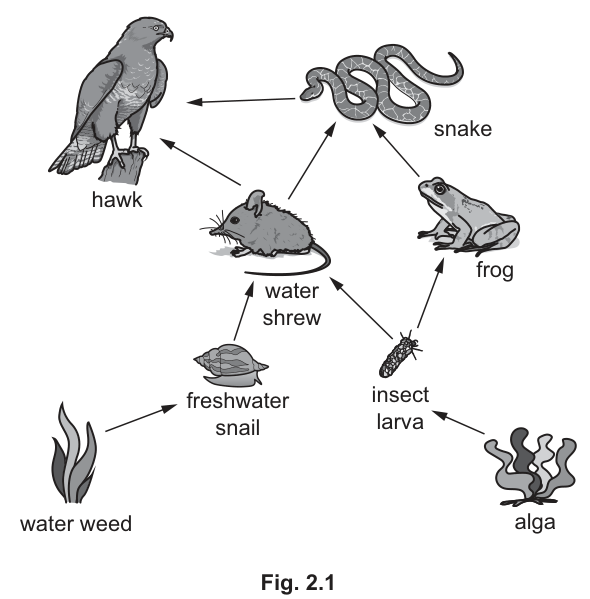
Fig. 2.1 shows a food web from a pond.
Answer
Sun / sunlight
Sun
Walkthrough
In any food web, the energy originates from the sun. Producers (plants and algae) capture this light energy and convert it into chemical energy via photosynthesis. All subsequent consumers obtain their energy by eating the producers or other consumers. Therefore, the ultimate source of energy for this pond food web is the sun.
Key Takeaways
All food chains and webs are powered by solar energy captured by autotrophs (producers). Without the sun, there would be no energy input to sustain the ecosystem.
Common Mistakes
Candidates often write 'food' or 'plants' as the energy source. While plants contain energy, they do not create it; they convert solar energy. The question asks for the source of energy for the web, which is external to the biological components: the sun.
Things to Be Careful About
The command word is 'State'. A single word or short phrase is required. 'Sunlight' or 'Sun' are both acceptable. Do not write 'photosynthesis' as that is the process, not the source.
Complete Table 2.1 by writing the number of different organisms in this food web that fit each description.
The first one has been done for you.
Table 2.1
| description | number of different organisms |
|---|---|
| producers | 2 |
| secondary consumers | |
| carnivores |
Answer
| description | number of different organisms |
|---|---|
| producers | 2 |
| secondary consumers | 2 |
| carnivores | 4 |
Secondary consumers: 2; Carnivores: 4
Walkthrough
We need to classify the organisms in Fig. 2.1.
- Producers (Trophic Level 1): Water weed and alga. (Given as 2).
- Primary Consumers (Herbivores, Trophic Level 2): Freshwater snail (eats water weed and alga) and insect larva (eats alga).
- Secondary Consumers (Carnivores/Omnivores eating primary consumers, Trophic Level 3):
- Water shrew: Eats freshwater snail and insect larva (both primary consumers). So, water shrew is a secondary consumer.
- Frog: Eats insect larva (primary consumer). So, frog is a secondary consumer.
- Note on Snake: The snake eats the frog and water shrew. Since the frog and water shrew are at level 3, the snake is at level 4 (tertiary consumer). There is no direct arrow from insect larva to snake, so the snake is not a secondary consumer here.
- Count: Water shrew and Frog = 2.
- Carnivores (Organisms that eat other animals):
- Water shrew: Eats snail and insect larva. (Yes)
- Frog: Eats insect larva. (Yes)
- Snake: Eats water shrew and frog. (Yes)
- Hawk: Eats water shrew and snake. (Yes)
- Note: Freshwater snail and insect larva eat plants/algae, so they are herbivores, not carnivores.
- Count: Water shrew, Frog, Snake, Hawk = 4.
Key Takeaways
- Secondary consumers feed directly on primary consumers (herbivores). In this web, they are at the third trophic level.
- Carnivores are organisms that eat meat (other animals). An organism can be a secondary, tertiary, or quaternary consumer and still be a carnivore.
- Always trace the arrows: arrows point from the food to the feeder.
Common Mistakes
- Counting the snake as a secondary consumer. The snake eats the frog (level 3) and water shrew (level 3), making the snake a tertiary consumer (level 4). It only becomes a secondary consumer if it ate the insect larva directly, which the diagram does not show.
- Missing the hawk as a carnivore. The hawk eats the water shrew and the snake, both animals.
- Confusing 'secondary consumer' with 'carnivore'. All secondary consumers in this web are carnivores, but not all carnivores are secondary consumers (snake and hawk are higher up).
Things to Be Careful About
- The table asks for the number of organisms. Ensure you count unique species/organisms, not the number of arrows or paths.
- 'Carnivores' includes any animal that eats other animals, regardless of whether it is a secondary, tertiary, or quaternary consumer.
The hawk feeds at two different trophic levels.
Use Fig. 2.1 to explain this statement.
Answer
- When the hawk feeds on water shrews, the food chain is: alga/water weed → snail/insect larva → water shrew → hawk. The hawk is the fourth trophic level (tertiary consumer).
- When the hawk feeds on snakes, the food chain is: alga → insect larva → frog → snake → hawk. The hawk is the fifth trophic level (quaternary consumer).
Therefore, the hawk occupies two different trophic levels (fourth and fifth) depending on which prey it eats.
Hawk is 4th trophic level when eating water shrews, and 5th trophic level when eating snakes.
Walkthrough
To determine trophic levels, we count the steps from the producer.
Path 1 (Hawk eats Water Shrew):
- Producer: Alga or Water weed
- Primary Consumer: Insect larva or Freshwater snail
- Secondary Consumer: Water shrew
- Tertiary Consumer: Hawk
In this chain, the hawk is at the fourth trophic level.
Path 2 (Hawk eats Snake):
The snake eats the frog (or water shrew, but let's look at the longer chain to get the 5th level).
- Producer: Alga
- Primary Consumer: Insect larva
- Secondary Consumer: Frog
- Tertiary Consumer: Snake
- Quaternary Consumer: Hawk
In this chain, the hawk is at the fifth trophic level.
Since the hawk eats both water shrews (making it a tertiary consumer) and snakes (making it a quaternary consumer), it feeds at two different trophic levels.
Key Takeaways
- An organism can occupy multiple trophic levels in a food web if it has multiple food sources at different levels.
- Trophic level = number of steps from the producer + 1 (Producer is level 1).
- Alternatively, count the number of organisms the food has passed through. If food passes through 3 organisms (Producer → Primary → Secondary → Hawk), Hawk is 4th level.
Common Mistakes
- Only finding one food chain. Look for all paths leading to the hawk.
- Miscounting the levels. Remember producers are level 1.
- Not explaining why. The question asks to 'explain', so you must mention the two different prey (snakes vs. water shrews) and the resulting trophic levels.
Things to Be Careful About
- The mark scheme accepts 'fifth trophic level / quaternary consumer' and 'fourth trophic level / tertiary consumer'. Use precise terminology.
- Ensure you mention both scenarios (feeding on snakes and feeding on water shrews).
Scientists have studied how water shrews feed on freshwater snails and insect larvae. The shrews dive under water to collect food.
Answer
- Shrews are mammals and regulate their body temperature (homeothermic/endothermic).
- In cold water, they lose heat faster, so they need to increase respiration to produce more heat / energy to maintain body temperature.
- Respiration requires oxygen; therefore, increased respiration leads to a higher oxygen requirement.
Shrews are mammals that regulate body temperature; increased respiration in cold water releases more heat, requiring more oxygen.
Walkthrough
The question asks why shrews need more oxygen in cold water.
- Identify the organism type: Shrews are mammals. Mammals are endotherms (homeotherms), meaning they maintain a constant internal body temperature regardless of the environment.
- Effect of cold environment: Cold water conducts heat away from the body much faster than air. The shrew will lose body heat rapidly.
- Response: To maintain constant body temperature, the shrew must increase heat production. Heat is a by-product of respiration (chemical energy released as heat).
- Link to oxygen: Aerobic respiration equation: Glucose + Oxygen → Carbon dioxide + Water + Energy. To increase the rate of respiration (and thus heat production), the shrew must consume oxygen at a faster rate.
- Additional factor: Diving involves muscle activity. Muscle contraction requires ATP from respiration. The mark scheme also accepts 'more energy/respiration needed for increased muscle contraction', but the thermoregulation point is the primary biological reason for 'cold water' specifically.
Key Takeaways
- Mammals maintain constant body temperature.
- In cold environments, metabolic rate (respiration rate) increases to generate heat.
- Respiration is an aerobic process requiring oxygen; higher rate = higher oxygen demand.
Common Mistakes
- Saying 'shrews get cold'. They don't; they regulate their temperature. They lose heat faster.
- Forgetting the link to respiration. Cold -> Heat loss -> Need heat -> Respiration produces heat -> Respiration needs oxygen.
- Not mentioning that shrews are mammals/endotherms. This justifies why they regulate temperature.
Things to Be Careful About
- The mark scheme gives max 2 marks. Two clear points are needed: (1) Mammals regulate body temperature / need to stay warm, (2) Respiration releases heat / needs oxygen.
- Avoid saying 'shrews need oxygen to stay warm'. Be precise: 'Respiration releases heat, and respiration requires oxygen'.
Scientists have found that shrews contain high levels of a special protein that can store oxygen. This allows the shrews to stay under water for longer to collect food.
Explain how the ability of shrews to store oxygen may have developed by natural selection.
Answer
- Variation: There is natural variation in the population; some water shrews have a mutation/genes for higher levels of this oxygen-storing protein.
- Selection Pressure: Shrews compete for food underwater; staying longer allows access to more food.
- Survival: Shrews with the protein can stay underwater longer, collecting more food and thus are more likely to survive (not starve).
- Reproduction & Inheritance: Surviving shrews are more likely to reproduce and pass the alleles (genes) for the protein to their offspring.
- Evolution: Over generations, the frequency of the allele for the protein increases in the population.
Natural selection: variation exists, protein allows longer dives/more food, better survival and reproduction, alleles passed to next generation.
Walkthrough
This question asks for an explanation of evolution by natural selection. We must use the standard Darwinian steps: Variation, Selection, Survival/Reproduction, Inheritance.
- Variation (Mutation): In any population, there is genetic variation. A random mutation occurred (or exists) in some water shrews that produces this special oxygen-storing protein. (Mark scheme: 'some water shrews have more protein / a mutation occurred').
- Selection Pressure (Competition): Food is limited. Shrews need to dive to get food. The ability to stay underwater longer is advantageous. (Mark scheme: 'water shrews are competing for food').
- Differential Survival: Shrews with the protein can store more oxygen, stay down longer, and collect more food. Shrews without it might run out of oxygen and starve or fail to get enough energy. Thus, those with the protein are more likely to survive. (Mark scheme: 'shrews that have the protein can collect more food... survive').
- Reproduction: Survivors live long enough to reproduce. (Mark scheme: 'reproduce').
- Inheritance: They pass the alleles (genetic code) for the protein to their offspring. (Mark scheme: 'pass on the alleles').
- Result: Over time, the next generation will have a higher proportion of individuals with the protein. (Mark scheme implies this with 'max 4' points covering the chain).
Key Takeaways
- Natural selection requires pre-existing variation (mutation).
- The environment creates a selection pressure (need for food/oxygen).
- Individuals with the advantageous trait survive and reproduce better (fitness).
- The trait is genetic (alleles) and is passed on.
Common Mistakes
- Lamarckian evolution: Saying 'shrews developed the protein because they needed it' or 'shrews used the protein so it grew'. Evolution does not work by need or use; it works by selection of existing variation. Use 'mutation' and 'variation'.
- Forgetting inheritance: Stopping at 'they survive'. Must mention passing genes/alleles to offspring.
- Vague language: 'They are better'. Say 'more likely to survive/reproduce'.
Things to Be Careful About
- The mark scheme has 5 potential points but max 4 marks. Cover the main chain: Mutation/Variation → Advantage (more food) → Survival → Reproduction → Inheritance.
- Use the word 'alleles' or 'genes'. 'Hereditary material' is okay, but 'alleles' is precise 5090 terminology.
- Do not say 'the shrews evolved the protein'. Say 'the protein arose via mutation and was selected for'.
Fig. 3.1 shows the human digestive system.
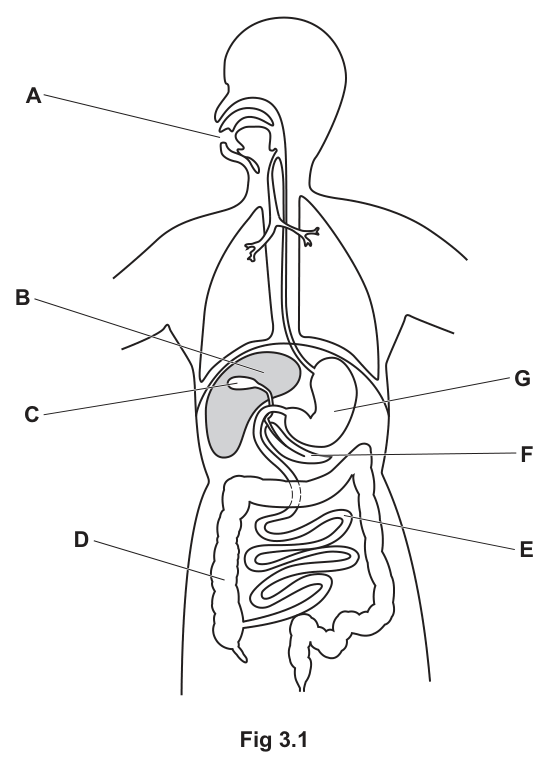
In each box write the letter that has been used to label these parts of the digestive system.
The part where starch digestion starts. ______
The part where protein digestion starts. ______
Answer
The part where starch digestion starts: A
The part where protein digestion starts: G
A; G
Walkthrough
The question asks for the starting points of starch and protein digestion. We look at Fig. 3.1 and recall the digestive pathway.
- Starch digestion: Chemical digestion of starch begins in the mouth (label A). Salivary glands secrete saliva containing the enzyme salivary amylase, which breaks down starch into maltose. Although digestion continues in the small intestine, it starts here.
- Protein digestion: Chemical digestion of proteins begins in the stomach (label G). The stomach lining secretes pepsinogen, which is activated to pepsin by hydrochloric acid. Pepsin breaks proteins into polypeptides.
The oesophagus (not labelled, between A and G) only transports food. The small intestine (E) is where most digestion is completed, but not where it starts for these macronutrients.
Key Takeaways
- Starch digestion starts in the mouth (salivary amylase).
- Protein digestion starts in the stomach (pepsin in acidic conditions).
- Always distinguish between where digestion starts and where it is completed.
Common Mistakes
- Saying digestion starts in the small intestine for everything. While the small intestine is the main site, starch and protein digestion have earlier starting points.
- Confusing the mouth (A) with the salivary glands (also A, but the question asks for the part where digestion starts, which is the oral cavity/mouth).
- Writing "stomach" instead of the letter G when the question asks for the letter.
Things to Be Careful About
- The question asks for letters, not names. Write A and G.
- Starch digestion begins in the mouth, not the stomach. Protein digestion begins in the stomach, not the mouth or small intestine.
Answer
- Organ B (liver): Produces bile.
- Organ C (gall bladder): Stores bile.
- Role in digestion: Bile emulsifies lipids (fats), breaking large fat globules into smaller droplets. This increases the surface area available for lipase enzymes to act on, speeding up lipid digestion.
Liver produces bile; gall bladder stores bile; bile emulsifies lipids to increase surface area for lipase.
Walkthrough
We need to describe the roles of organs B and C (liver and gall bladder) specifically in lipid (fat) digestion.
- Organ B is the liver. The liver is a large organ that synthesises bile. Bile is not an enzyme; it is a mixture of salts and pigments.
- Organ C is the gall bladder. The liver produces bile continuously, but the body doesn't always need it. The gall bladder acts as a reservoir, storing and concentrating bile between meals.
- Mechanism: When fatty food enters the small intestine, bile is released. Bile contains bile salts which act as detergents. They break large fat droplets into smaller ones. This process is called emulsification. Emulsification does not chemically break bonds; it increases the surface area of the fat, allowing the enzyme lipase (from the pancreas) to work much faster.
Key Takeaways
- Liver = production of bile.
- Gall bladder = storage of bile.
- Bile = emulsification (physical change, not chemical), increasing surface area for lipase.
Common Mistakes
- Saying the liver or gall bladder produces digestive enzymes. Bile is not an enzyme; it has no active site.
- Saying bile digests fat. Bile only emulsifies (physically breaks up) fat. Lipase does the chemical digestion.
- Forgetting to mention surface area. Emulsification's main purpose is to increase surface area for enzymes.
Things to Be Careful About
- Use the correct organ names: liver (B) and gall bladder (C).
- The mark scheme specifically looks for the word emulsifies or emulsification.
- Ensure you link emulsification to a faster rate of digestion (surface area increase).
Coeliac disease affects several million people in the world. It is linked to a substance called gluten that is found in some foods.
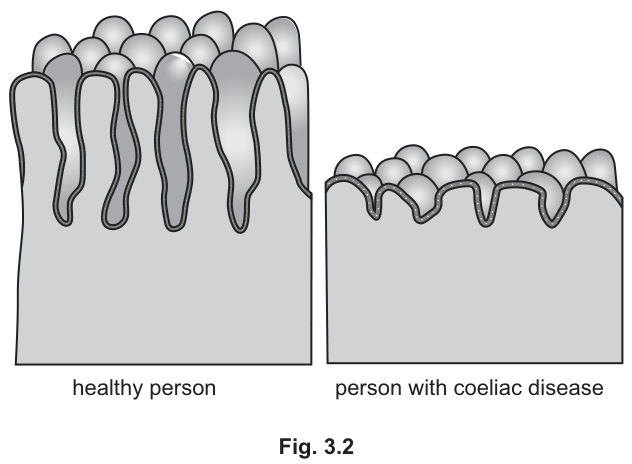
Fig. 3.2 shows a section through organ E in a healthy person and in a person with coeliac disease.
If a child with coeliac disease is not treated, their growth may be reduced.
Use Fig. 3.2 to explain why.
Answer
- Structural change (from Fig. 3.2): In a person with coeliac disease, the villi are shorter / smaller / blunted compared to a healthy person. This results in a lower surface area for absorption.
- Functional consequence: Because of the reduced surface area, less food material / fewer nutrients (such as amino acids and glucose) are absorbed into the bloodstream.
- Physiological outcome: Growth requires the synthesis of new proteins and tissues, which needs a supply of amino acids (from digested proteins). With less absorption, there is a shortage of amino acids, leading to reduced growth.
Villi are smaller/shorter reducing surface area; less nutrients absorbed; less amino acids available for protein synthesis and growth.
Walkthrough
The question asks to explain reduced growth in untreated coeliac disease using Fig. 3.2. We must build a logical chain from structure to function to outcome.
- Observe Fig. 3.2: The left diagram (healthy) shows tall, finger-like villi. The right diagram (coeliac) shows villi that are flattened, blunted, and shorter.
- Relate structure to function: The function of villi in the small intestine (organ E) is absorption of nutrients. The tall, numerous villi provide a large surface area. Flattened villi mean a lower surface area.
- Consequence of lower surface area: With less surface area, the rate and total amount of nutrient absorption (into the blood) decreases. Less glucose, amino acids, fatty acids, etc., enter the blood.
- Link to growth: The question mentions a child. Children are growing, which requires building new cells and tissues. This process (anabolism) needs amino acids to make new proteins. If absorption is poor, the child is starved of amino acids, so growth is reduced (stunted growth or failure to thrive).
Key Takeaways
- Villi increase surface area for absorption.
- Damage to villi (as in coeliac disease) reduces absorption.
- Growth requires building blocks (amino acids) from digested food.
Common Mistakes
- Saying "less food is digested". Digestion may still happen, but absorption is the problem. The villi are for absorption, not digestion (though brush border enzymes are on them, the primary issue here is surface area for uptake).
- Forgetting to mention amino acids or proteins in the final step. Growth is specifically linked to protein synthesis.
- Not referring to Fig 3.2. You must mention that the villi are smaller/shorter.
Things to Be Careful About
- The mark scheme awards marks for: (1) villi smaller/shorter/lower surface area, (2) less absorption of nutrients, (3) less amino acids/proteins for growth. Ensure all three are covered.
- Do not say "the child does not eat enough". The problem is absorption, not intake.
Scientists are investigating a new treatment for coeliac disease. They have produced an enzyme that will digest gluten when it reaches organ E. They plan to put the enzyme into a tablet which can be swallowed.
To make this treatment work, the tablet must have a coating that will dissolve in alkaline conditions but not in acid conditions.
Explain why.
Answer
- Stomach environment (Organ G): The stomach contains hydrochloric acid, creating a highly acidic environment (low pH).
- Risk to enzyme: If the coating dissolved in the stomach, the enzyme would be released into the acid. Most enzymes (unless adapted to acid, like pepsin) would be denatured (their active site shape would change) and lose function in these conditions, or the acid could damage the enzyme structure.
- Target environment (Organ E): The small intestine (organ E) has alkaline conditions (due to bile and pancreatic secretions).
- Coating function: The coating must resist acid to keep the enzyme safe in the stomach. It must dissolve in alkaline conditions so the enzyme is released in the small intestine (organ E) where it can work to digest gluten and where it is not denatured.
Coating resists stomach acid to prevent enzyme denaturation; dissolves in alkaline small intestine to release enzyme.
Walkthrough
The scientists want to deliver an enzyme to organ E (small intestine) to digest gluten. The enzyme is in a tablet. The coating dissolves in alkali but not acid. Why?
- Path of the tablet: Swallowed tablet goes to the stomach (organ G) first, then to the small intestine (organ E).
- Stomach conditions: The stomach lining secretes hydrochloric acid (HCl). The pH is very low (around 1-2), making it highly acidic.
- Enzyme sensitivity: Enzymes are proteins. Their function depends on the shape of their active site (lock-and-key model). Extreme pH levels (too acidic or too alkaline) can break the bonds holding the protein shape together, causing denaturation. If the enzyme is denatured, gluten cannot be digested.
- Why resist acid? If the coating dissolved in the stomach (acidic), the enzyme would be exposed to HCl. Unless this specific enzyme is adapted to work in acid (which the question implies it isn't, as it needs to be protected), it would be denatured or damaged before reaching its target.
- Small intestine conditions: Organ E (small intestine) receives bile from the liver/gall bladder and pancreatic juice, which are alkaline (basic). The pH is around 7-8.
- Why dissolve in alkali? The coating is designed to break down in alkaline conditions. Once the tablet reaches the small intestine (organ E), the alkaline environment dissolves the coating, releasing the enzyme. The enzyme is now in its optimal pH environment and can digest the gluten.
Key Takeaways
- Stomach = acidic (HCl). Small intestine = alkaline (bile/pancreatic juice).
- Enzymes can be denatured by incorrect pH.
- A coating can protect an enzyme until it reaches the correct pH environment.
Common Mistakes
- Saying "the acid would kill the enzyme". Enzymes are not alive; they are denatured or damaged.
- Saying "the coating protects the stomach from the enzyme". The goal is to protect the enzyme from the stomach.
- Not mentioning that the small intestine is alkaline. The question states the coating dissolves in alkaline conditions, so you must link this to the environment of organ E.
Things to Be Careful About
- Use the word denatured or denaturation.
- Refer to hydrochloric acid or acid in the stomach.
- Refer to alkaline conditions in organ E (small intestine).
- The explanation must cover both parts: why it doesn't dissolve in acid (protection) and why it does dissolve in alkali (release).
Transmissible diseases are caused by pathogens.
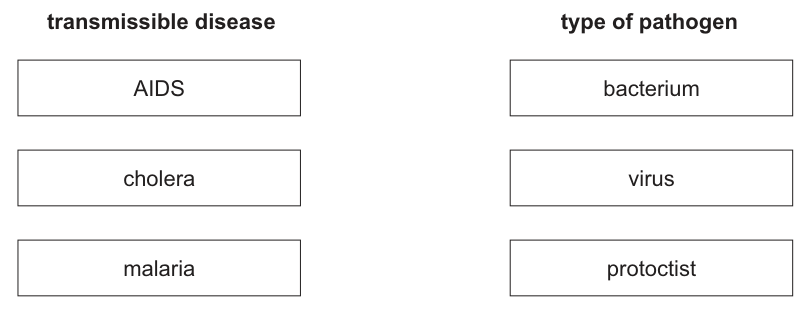
Draw a line from each transmissible disease to the type of pathogen that causes the disease.
Answer
| transmissible disease | type of pathogen |
|---|---|
| AIDS | virus |
| cholera | bacterium |
| malaria | protoctist |
AIDS – virus; cholera – bacterium; malaria – protoctist
Walkthrough
Each disease is caused by a different type of pathogen, and the syllabus names all three explicitly. AIDS is caused by HIV, the human immunodeficiency virus, so it matches virus. Cholera is caused by the bacterium Vibrio cholerae, so it matches bacterium. Malaria is caused by Plasmodium, a single-celled eukaryote placed in the kingdom Protoctista, so it matches protoctist. The lines cross over because cholera (second box) links to bacterium (first box) while AIDS (first box) links to virus (second box) — do not be put off by the crossing lines.
Key Takeaways
- Know the pathogen type for the named diseases in the syllabus: AIDS/HIV (virus), cholera (bacterium), malaria (protoctist), plus examples like influenza (virus) and salmonella (bacterium).
- Plasmodium is a protoctist, not a bacterium or virus — a very common confusion.
Common Mistakes
- Matching malaria to 'bacterium' because it is treated with some antibacterial-sounding drugs, or because mosquitoes 'carry germs' — the pathogen is a protoctist.
- Matching AIDS to 'bacterium' — HIV is a virus.
- Leaving one line undrawn; the scheme scores arithmetically, so each correct line earns its mark.
Things to Be Careful About
- Draw all three lines clearly; three correct = 2 marks, and partial credit is given for fewer.
- Write the pathogen name as the mark scheme prints it: 'protoctist' (not 'protist').
Complete these sentences about cholera by writing words in the gaps.
When the cholera pathogen is inside the small intestine it produces a ______ .
This results in the secretion of ______ ions into the small intestine.
The water potential inside the small intestine will ______ , causing water to move into the intestine.
Answer
When the cholera pathogen is inside the small intestine it produces a toxin.
This results in the secretion of chloride ions into the small intestine.
The water potential inside the small intestine will decrease, causing water to move into the intestine.
toxin; chloride; decrease
Walkthrough
The cholera bacterium does not damage the intestine directly; it secretes a toxin that makes the cells lining the small intestine secrete chloride ions (Cl⁻) into the lumen. Adding dissolved ions lowers the water potential of the gut contents, so water moves by osmosis from the blood and tissues (higher water potential) into the intestine (lower water potential). This is why cholera causes severe watery diarrhoea and dehydration. Each gap is one mark, and the mark scheme's exact words are 'toxin', 'chloride' and 'decrease / reduce'.
Key Takeaways
- The cholera toxin → chloride ion secretion → lowered water potential → osmotic water loss chain is a standard 5090 sequence.
- Water always moves from the higher water potential to the lower water potential across a partially permeable membrane.
Common Mistakes
- Writing 'poison' or 'acid' instead of toxin — the precise term is required.
- Writing 'sodium' instead of chloride ions.
- Writing 'increase' for the water potential — adding ions decreases water potential; confusing this reverses the direction of osmosis.
- Saying 'water moves in by diffusion' — it moves by osmosis, through a partially permeable membrane.
Things to Be Careful About
- The mark scheme accepts 'decrease / reduce' for the third gap — use one of those exact verbs.
- Keep the causal chain in order; each gap is marked independently, so a wrong word in one gap does not affect the others.
In 2017 the World Health Organization estimated that people die from cholera each year.
The World Health Organization set up a project to reduce this number of deaths by by 2030.
If the project is successful, calculate the maximum number of cholera deaths in 2030.
maximum number of cholera deaths = ______
Working
A 95% reduction means only 5% of the deaths remain.
Answer
maximum number of cholera deaths = 4750
4750
Walkthrough
The project aims to reduce deaths by 95%, so 5% of the original number would remain — that is the maximum if the project succeeds. 5% of 95 000 is 95 000 ÷ 100 × 5 = 4750. The double semicolon in the mark scheme means the correct answer alone carries both marks, so the arithmetic must be right.
Key Takeaways
- 'Reduce by 95%' leaves 5% remaining — a classic percentage trap.
- Percentage of a quantity = (percentage ÷ 100) × quantity.
Common Mistakes
- Calculating 95% of 95 000 (= 90 250) instead of the 5% that remains — this is the number saved, not the number of deaths.
- Subtracting 95 from 95 000, or other misreads of the percentage.
Things to Be Careful About
- Read carefully: the question asks for the number of deaths after the reduction, not the number prevented.
- No unit is needed on the answer line — it is a number of people.
The World Health Organization recommends vaccines to protect people from cholera.
Describe how vaccination can make people immune to a disease.
Answer
- A weakened / harmless form of the pathogen (or its antigens) is introduced into the body.
- The antigens stimulate lymphocytes to produce antibodies specific to the pathogen.
- Memory cells are produced that remain in the blood.
- If the live pathogen is later encountered, the memory cells allow antibodies to be produced rapidly, destroying the pathogen before it causes disease — so the person is immune.
See working
Walkthrough
Vaccination produces active immunity — the body makes its own antibodies. The sequence is: (1) the vaccine contains a weakened or harmless form of the pathogen, so it cannot cause the disease but still carries antigens on its surface; (2) the antigens are recognised as foreign and stimulate lymphocytes (white blood cells) to divide and secrete antibodies with a shape complementary to the antigen — the lock-and-key idea; (3) some lymphocytes become memory cells, which persist long after the antibodies have gone; (4) on a real infection the memory cells respond immediately, producing antibodies so quickly that the pathogen is destroyed before it multiplies enough to cause symptoms. That rapid secondary response is what 'being immune' means. Each of the four mark-scheme points is one mark.
Key Takeaways
- Active immunity: antigen → lymphocytes → antibodies + memory cells → faster, stronger secondary response.
- Antibodies are specific — each fits only one antigen.
- Memory cells are the reason immunity lasts and the reason the second encounter is fought off quickly.
Common Mistakes
- Saying the vaccine 'kills the pathogens in the body' — it prevents disease; it is not a cure for an existing infection.
- Writing 'white blood cells' alone without naming lymphocytes — the precise cell type is the marking point.
- Omitting memory cells — a very commonly dropped mark.
- Confusing antibodies (proteins made by lymphocytes) with antigens (molecules on the pathogen surface).
- Saying antibodies 'eat' pathogens — antibodies bind to antigens; phagocytes engulf pathogens.
Things to Be Careful About
- The command word is describe, so give the sequence of events; the final 'rapidly produced' idea is a separate mark, so make the speed explicit.
- Four marks = four distinct points; write them as separate statements so the examiner can award each one.
Table 4.1 shows details of a vaccine used by the World Health Organization to protect people from cholera.
Table 4.1
| doses needed | how taken | storage temperature for vaccine |
|---|---|---|
| two doses, one to six weeks apart | vaccine added to a glass of water |
Discuss the practical problems of using this vaccine in different parts of the world.
Answer
- Two doses are needed one to six weeks apart, so it may be difficult to find or persuade people to return for the second dose (e.g. people who move around or live far from clinics).
- The vaccine is added to a glass of water, but a safe (clean) water supply may not be available in some areas.
- The vaccine must be stored at 2–8 °C, so refrigeration (and a reliable power supply) is needed, which may not be available in some parts of the world.
See working
Walkthrough
'Discuss the practical problems' means use each row of Table 4.1 and ask what could go wrong in the real world. Row 1: two doses one to six weeks apart — people must come back a second time; in remote areas, or with mobile populations, many will not return, so they are not fully protected. Row 2: vaccine added to a glass of water — the water must be clean; in regions without a safe water supply the water itself could contain pathogens (ironically, including cholera) or make people ill. Row 3: storage at 2–8 °C — the 'cold chain' needs refrigerators and a reliable electricity supply; without them the vaccine may spoil and be ineffective. Each of these is one mark, and each problem must be tied to the specific feature of the vaccine, not a generic complaint.
Key Takeaways
- A good evaluation answer always links the problem back to the specific data given (doses, route, storage temperature).
- Vaccination programmes fail practically, not just biologically — logistics, infrastructure and compliance matter.
Common Mistakes
- Giving generic answers like 'it is expensive' or 'people may refuse it' — the marks are tied to the three features in the table.
- Saying 'the water may be dirty' without linking it to the oral route of this vaccine.
- Saying 'it needs to be kept cold' but not mentioning refrigeration / power supply — the mark wants the practical consequence.
- Writing about how the vaccine works immunologically — the question asks about practical problems, not mechanism.
Things to Be Careful About
- Three marks = three distinct problems; take one from each row of the table so you do not repeat yourself.
- Use the data: quote 'two doses', 'glass of water' and '2–8 °C' in your reasoning to anchor each point.
Air pollution by carbon dioxide is contributing to global warming.
Explain how the increasing concentration of carbon dioxide in the atmosphere is causing global warming.
Answer
- Carbon dioxide is a greenhouse gas.
- Energy from the Sun can penetrate the atmosphere.
- Heat (radiation) is absorbed / trapped by the carbon dioxide.
- This prevents heat (energy) escaping from the atmosphere into space.
Carbon dioxide is a greenhouse gas: solar energy penetrates the atmosphere but heat radiation is absorbed and trapped by CO2, preventing it escaping into space.
Walkthrough
The question asks you to explain a mechanism, so each point needs its reason. The chain is:
- Carbon dioxide is a greenhouse gas — this names the property that matters. Other greenhouse gases (methane, water vapour) exist, but here it is carbon dioxide in question.
- Energy from the Sun can penetrate the atmosphere — incoming short-wave solar radiation passes through the air largely unimpeded and warms the Earth's surface.
- The warm surface re-radiates energy as heat (long-wave radiation). Carbon dioxide absorbs / traps this heat — this is the key step; the gas does not block sunlight coming in, it blocks heat going out.
- Therefore heat cannot escape from the atmosphere into space, so the atmosphere warms — global warming.
Notice the asymmetry: light comes in easily, heat goes out with difficulty. That one-way behaviour is the whole greenhouse effect. The mark scheme allows up to four listed points for a maximum of three, so any three clear points score.
Key Takeaways
- Carbon dioxide is a greenhouse gas because it absorbs outgoing heat (long-wave) radiation.
- Solar energy enters the atmosphere more easily than heat leaves it.
- Global warming is the enhanced retention of heat energy in the atmosphere.
Common Mistakes
- Writing only "carbon dioxide causes global warming" — that restates the stem and earns nothing; the mechanism is required.
- Saying carbon dioxide "blocks the Sun's rays" or "reflects sunlight" — the scheme credits the trapping of outgoing heat, not incoming light.
- Confusing global warming with ozone depletion — different problem, different gases.
- Giving an observation without the reason for an "explain" command word.
Things to Be Careful About
- Use the word heat or radiation when describing what is trapped — vague wording like "it gets hotter" scores poorly.
- Three marks means three distinct creditable points; write them as separate statements so the examiner can see them.
- The mark scheme lists four acceptable points (max 3), so any three of: greenhouse gas, solar energy penetrates, heat absorbed/trapped, heat prevented from escaping.
Scientists are planning to reduce the concentration of carbon dioxide in the atmosphere.
They plan to grow large areas of seaweed that float in the ocean.
The seaweed will take in carbon dioxide for photosynthesis and grow larger.
Answer
6CO2 + 6H2O → C6H12O6 + 6O2
Walkthrough
Photosynthesis has two raw materials — carbon dioxide and water — and two products — glucose and oxygen. The stem already gives , so the first blank is water, , and the product blanks are glucose, , and oxygen, .
Balancing: glucose contains 12 hydrogens, so six waters are needed on the left ( gives 12 H). Those six waters also supply six oxygens, which together with the twelve oxygens from make eighteen oxygens in total; glucose holds six, leaving twelve to form . Hence the fully balanced equation:
Key Takeaways
- Learn the photosynthesis equation as a fixed item: .
- One mark is for the correct formulae, one for correct balancing — both are needed.
Common Mistakes
- Writing instead of (hydrogen peroxide is a completely different substance).
- Forgetting the coefficient 6 on water or oxygen — the formulae mark may still score but the balancing mark is lost.
- Writing the word equation when the symbol equation is asked for.
- Reversing the equation (respiration direction).
Things to Be Careful About
- Subscripts must be written correctly: , not C6H12O6 typed loosely if precision is expected.
- Check every atom balances before moving on — count C, H and O on each side.
The scientists estimate that the seaweed will double in biomass every 10 days.
If they start with 2 tonnes of seaweed, calculate the biomass expected after 40 days of growth.
biomass = ______
Working
40 days ÷ 10 days = 4 doublings.
Answer
biomass = 32 tonnes
32 tonnes
Walkthrough
The seaweed doubles every 10 days. Over 40 days there are doubling periods. Starting at 2 tonnes:
- after 10 days: 4 tonnes
- after 20 days: 8 tonnes
- after 30 days: 16 tonnes
- after 40 days: 32 tonnes
Equivalently, . The common error is treating 40 days as 40 doublings, or halving instead of doubling, or stopping one interval early.
Key Takeaways
- Doubling problems: first find the number of doubling intervals, then apply the doubling that many times.
- grows fast — exponential growth is exactly why growing seaweed is attractive for removing carbon dioxide.
Common Mistakes
- Dividing 40 by 10 incorrectly or counting only three doublings (giving 16 tonnes).
- Multiplying 2 by 40 (giving 80 tonnes) — linear instead of exponential thinking.
- Omitting the unit "tonnes" on the answer line.
Things to Be Careful About
- Write out each doubling step so an arithmetic slip is visible and may earn error-carried-forward credit.
- The answer line asks for biomass in tonnes — include the unit.
The scientists need to supply the seaweed with the minerals needed for growth.
Nitrates are one of the minerals that will be supplied to the seaweed.
Explain the importance of nitrates to plants.
Answer
- Nitrates are used to make amino acids.
- Amino acids are used to make proteins (for growth).
Nitrates are used to make amino acids, which are used to make proteins.
Walkthrough
Plants absorb nitrate ions () from the soil (or, here, supplied to the seaweed in water). Nitrogen is an essential element in amino acids, and amino acids are joined together to make proteins. Proteins are needed for growth and for making enzymes, so without nitrates the plant cannot build new tissue.
The two marks map onto the two steps: (1) nitrates → amino acids, (2) amino acids → proteins. Both links must be present.
Key Takeaways
- Nitrate ions supply nitrogen for making amino acids and then proteins.
- Magnesium ions, the other standard mineral, are needed for chlorophyll — do not mix the two up.
Common Mistakes
- Saying nitrates are "used for photosynthesis" or "give energy" — they are building blocks for proteins, not fuel.
- Stopping at "amino acids" without linking on to proteins — that loses the second mark.
- Confusing nitrate with magnesium (chlorophyll).
Things to Be Careful About
- Give the full chain: nitrate → amino acid → protein. Each arrow is a marking point.
As the seaweed grows, the scientists plan to send bundles of it to the bottom of the ocean. The seaweed in the bundles dies on the ocean floor.
Fig. 5.1 shows the process.
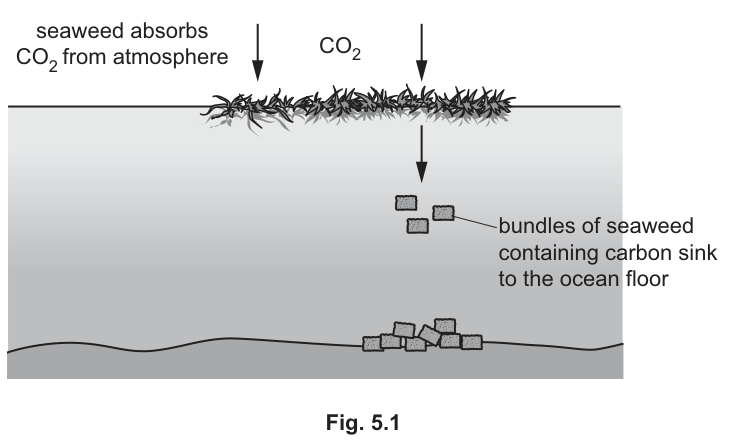
There is very little oxygen in the water at the bottom of the ocean.
Explain how this will help the carbon to stay trapped in the dead seaweed.
Answer
- With very little oxygen there is no decomposition, because decomposers (bacteria and fungi) need oxygen for aerobic respiration.
- So no aerobic respiration occurs, and the carbon stays locked in the dead seaweed instead of being released as carbon dioxide.
No decomposition occurs because decomposers need oxygen for aerobic respiration, so the carbon remains trapped in the dead seaweed.
Walkthrough
Normally, when an organism dies, decomposers (bacteria and fungi) break down its body. Decomposers respire aerobically — they need oxygen — and respiration releases the carbon in the dead material back to the atmosphere as carbon dioxide:
carbon compounds in dead seaweed + oxygen → carbon dioxide + water (+ energy)
At the bottom of the ocean there is very little dissolved oxygen. Without oxygen the decomposers cannot carry out aerobic respiration, so decomposition effectively stops. The carbon compounds in the dead seaweed are therefore not broken down and no carbon dioxide is released — the carbon stays trapped in the bundles on the ocean floor. This is why sinking the seaweed removes carbon from the atmosphere long-term.
Both halves are needed for the marks: (1) no decomposition because decomposers require oxygen, (2) therefore no aerobic respiration and the carbon is not released.
Key Takeaways
- Decomposers respire aerobically; their respiration returns carbon from dead organic matter to the atmosphere as carbon dioxide.
- Removing oxygen blocks decomposition, locking carbon away — the principle behind carbon sequestration schemes like this one.
Common Mistakes
- Writing only "the seaweed cannot decay" without explaining why (no oxygen for decomposers' respiration) — an "explain" question needs the reason.
- Saying the seaweed itself needs oxygen — the point is about the decomposers' respiration.
- Suggesting anaerobic decomposition releases lots of carbon dioxide quickly — anaerobic breakdown is slow and incomplete here.
- Confusing respiration with photosynthesis in the explanation.
Things to Be Careful About
- Name the decomposers (bacteria and fungi) and name aerobic respiration explicitly — these precise terms carry the marks.
- Make the final link explicit: no respiration by decomposers → no carbon dioxide released → carbon stays trapped.
Sycamore trees (Acer pseudoplatanus) grow throughout most of Europe.
Sycamore trees produce flowers in the spring.
The flowers have these characteristics:
- small and green coloured
- produce large quantities of small, light pollen grains
- contain nectar.
Explain why scientists think that the flowers can be pollinated by wind and by insects.
Answer
- Small, green flowers are characteristic of wind pollination — they do not need to attract insects.
- Large quantities of light pollen increase the chance of pollen being carried by the wind to another flower.
- Nectar attracts insects, which can carry pollen from flower to flower.
Small green flowers suit wind pollination (no need to attract insects); large amounts of light pollen are carried by wind; nectar attracts insects.
Walkthrough
The question gives three features and asks you to explain why each suggests wind OR insect pollination. The trick is that sycamore shows features of BOTH mechanisms, so you must pair each feature with the mechanism it serves.
- Small and green coloured — showy, brightly coloured petals exist purely to advertise the flower to insects. A small green flower has no such advertisement, which is exactly what you expect if the wind is doing the pollinating: there is no point spending energy on petals no insect needs to see.
- Large quantities of small, light pollen grains — wind pollination is wasteful; most grains never reach another flower. So wind-pollinated plants compensate by making enormous numbers of very light grains that stay airborne and drift far. Heavy sticky pollen would fall straight down and be useless on the wind.
- Contains nectar — nectar is a sugary reward that lures insects into the flower. While feeding, the insect brushes against anthers and stigma, carrying pollen between flowers. This is the classic insect-pollination feature.
So two points score here: one linking the small/green flowers or the abundant light pollen to wind pollination, and one linking nectar to insect attraction.
Key Takeaways
- Wind-pollinated flowers: small, dull, no nectar, huge quantities of light pollen, feathery stigmas.
- Insect-pollinated flowers: large, colourful, scented, nectaries, smaller amounts of heavier sticky pollen.
- Every structural feature of a flower can be argued as an adaptation for its pollination method.
Common Mistakes
- Writing "the flowers are pollinated by both" without explaining WHICH feature suits WHICH agent — the marks sit in the pairing plus reason.
- Saying nectar "attracts pollinators" vaguely instead of naming insects.
- Saying light pollen "travels further" without mentioning it being carried by the wind.
Things to Be Careful About
- This is an "Explain" question: every point needs its because-clause, not just the observation.
- The mark scheme accepts either the small/green feature OR the large/light pollen for the wind mark — one is enough, but give the clearest.
The flowers of the sycamore tree are cross-pollinated.
State an advantage of cross-pollination rather than self-pollination.
______
Answer
Cross-pollination produces increased variation, giving the offspring a greater capacity to respond to changes in the environment.
Increased variation / greater ability to respond to environmental change
Walkthrough
Self-pollination is essentially inbreeding: the offspring receive very similar alleles from both parents, so variation is low and harmful recessive alleles can be made homozygous. Cross-pollination mixes alleles from two different plants, so the offspring are genetically more varied. Variation matters because if the environment changes — a new disease, a drought — some individuals in a varied population are likely to carry combinations of alleles that let them survive and reproduce.
The mark scheme wants the key word variation: 'increased variation' or the equivalent idea of a better capacity to respond to environmental change.
Key Takeaways
- Cross-pollination → gametes from different plants → more genetic variation in offspring.
- Variation is the raw material that lets a population survive environmental change (and underpins natural selection).
Common Mistakes
- Writing vague answers like 'healthier plants' or 'stronger offspring' — the scheme wants variation specifically.
- Confusing cross-pollination with cross-fertilisation terminology or drifting into hybrid vigour arguments beyond the syllabus wording.
Things to Be Careful About
- One mark only — one clean sentence is enough; do not pad.
The sentences describe the processes that occur in a sycamore flower after pollination.
Complete the sentences by writing words in the gaps.
The pollen grain grows a ______ which allows the male gamete to reach the female gamete.
After fertilisation, the ovule becomes a ______ and the ______ will develop into a fruit.
Answer
The pollen grain grows a pollen tube which allows the male gamete to reach the female gamete.
After fertilisation, the ovule becomes a seed and the ovary will develop into a fruit.
pollen tube; seed; ovary
Walkthrough
After a pollen grain lands on a compatible stigma, it germinates and grows a pollen tube down through the style to the ovule. The male gamete travels down this tube and fuses with the female gamete (the egg cell) inside the ovule — this is fertilisation.
After fertilisation the flower's parts are reorganised:
- the fertilised ovule becomes the seed, containing the embryo plant and a food store;
- the ovary surrounding the ovule swells and develops into the fruit (in sycamore, the winged fruit in Fig. 6.1);
- petals, sepals and stamens usually wither and fall off.
So the three gaps, in order, are: pollen tube, seed, ovary.
Key Takeaways
- Pollen tube = the route by which the male gamete reaches the female gamete without free water.
- Ovule → seed; ovary → fruit. Keep these two pairings straight — they are examined constantly.
Common Mistakes
- Writing 'ovule' where 'ovary' is required (or vice versa) — the ovule becomes the SEED, the ovary becomes the FRUIT.
- Writing 'style' or 'stigma' for the first gap instead of 'pollen tube'.
- Spelling errors like 'polen' — use the exact term.
Things to Be Careful About
- Each gap is worth one mark; all three must be filled with the exact biological term, not a description.
Fig. 6.1 shows two sycamore fruits.
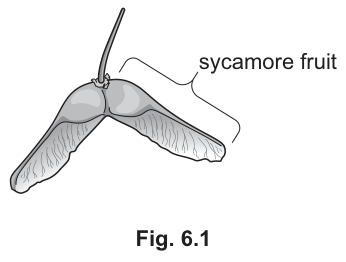
The wings on the fruits cause them to spin as they fall to the ground. This slows their fall so that they can be blown away by the wind.
Explain why this is an advantage to the parent tree and any young trees that are produced from these fruits.
Answer
- The young trees grow away from the parent tree.
- This prevents competition between them.
- Competition would be for a named resource such as light, water or mineral ions.
Young trees grow away from the parent, preventing competition for resources such as light, water or minerals.
Walkthrough
Fig. 6.1 shows the sycamore fruit: a seed with a papery wing on each side. As the fruit falls, the wings make it spin like a helicopter propeller, slowing its descent so that even a light breeze carries it sideways away from the tree before it lands.
Why does the parent tree benefit from having its offspring scattered?
- If every fruit landed directly beneath the parent, the ground below would be crowded with seedlings all trying to grow in the same patch of soil.
- Seedlings crowded together compete with each other AND with the huge parent tree for the same limited resources: light (the parent's canopy shades the ground), water and mineral ions from the soil.
- Most of those shaded, starved seedlings would die. By flinging its fruits away, the parent gives each seedling its own space and resources, so more survive — and the species colonises new areas too.
The mark scheme wants three linked points: young trees grow away from the parent; this prevents competition; competition for a NAMED resource (light, water or minerals). Naming the resource is what turns a generic answer into full marks.
Key Takeaways
- Dispersal advantages: reduces competition between offspring and parent, spreads the species to new areas, increases survival chances.
- Always name the resource when asked about competition — light, water, minerals (for plants) or food, space (for animals).
- Structure–function link: wing shape → spinning → slow fall → wind dispersal.
Common Mistakes
- Saying 'so seeds spread' without stating the CONSEQUENCE (less competition) — the advantage is the mark.
- Forgetting to name the resource, writing only 'compete for resources'.
- Writing 'nutrients' loosely instead of naming light/water/minerals — any of the named ones scores.
- Describing the mechanics of the wings again instead of answering WHY dispersal helps.
Things to Be Careful About
- Three marks, three distinct points — keep them as separate statements.
- The question asks about BOTH the parent tree and the young trees; frame the answer around reduced competition, which covers both.
The inheritance of ABO blood groups in humans is an example of codominance.
The blood groups are controlled by three different alleles, , , and .
Answer
blood group A
blood group A
Walkthrough
The question asks for the blood group (phenotype) of a person with the genotype . In the ABO blood group system, the and alleles are codominant, meaning that if both are present, both A and B antigens are expressed (blood group AB). The allele is recessive to both and . Therefore, in the genotype , the dominant allele determines the phenotype, and the individual will have blood group A.
Key Takeaways
- and are codominant alleles.
- is a recessive allele.
- Genotype results in blood group A; genotype results in blood group B.
Common Mistakes
- Writing "A" instead of "blood group A". The question asks for the blood group, so the full phrase is safer.
- Confusing with and answering blood group AB.
Things to Be Careful About
- Ensure you use the exact terminology "blood group A" rather than just "A" to match the mark scheme.
Answer
Walkthrough
Blood group O is the phenotype expressed only when neither the nor the allele is present. Since is recessive to both and , an individual must inherit an allele from both parents to show blood group O. Therefore, the only possible genotype for blood group O is homozygous recessive: .
Key Takeaways
- Blood group O is always homozygous recessive ().
- You cannot have a heterozygous genotype that results in blood group O.
Common Mistakes
- Writing with a lowercase 'o'. The standard notation uses (capital I, capital O) or (capital I, lowercase o) consistently, but is the most widely accepted form in 5090.
- Suggesting or results in blood group O.
Things to Be Careful About
- The mark scheme accepts , but writing is standard. Ensure the superscripts are clear.
Fig. 7.1 is a family tree showing the ABO blood groups of eight different people, numbered (1) to (8).
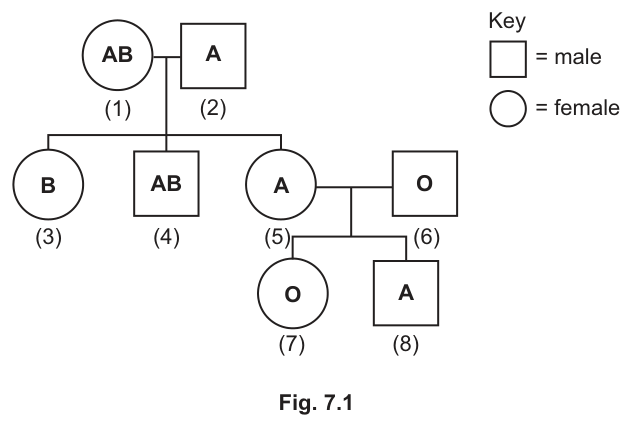
The parents (5) and (6) in Fig. 7.1 are expecting another child.
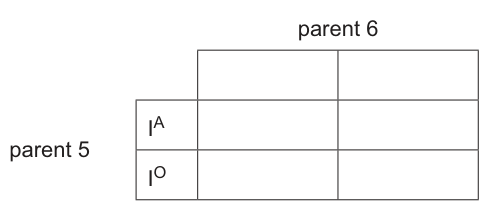
Complete this Punnett square to show the possible genotypes of the child.
Answer
See working
Walkthrough
First, determine the genotypes of parents (5) and (6) from the family tree (Fig. 7.1).
- Parent (6) has blood group O, so their genotype must be . The gametes they produce will all carry the allele. This is already provided in the top row headers of the Punnett square.
- Parent (5) has blood group A. They could theoretically be or . However, parent (5) and (6) have a child (7) with blood group O (). Child (7) must have inherited one from each parent. Therefore, parent (5) must carry an allele, making their genotype . The row headers in the Punnett square confirm this, showing gametes and .
Now, complete the Punnett square by combining the gametes:
- Top-left: (from parent 5) + (from parent 6) =
- Top-right: (from parent 5) + (from parent 6) =
- Bottom-left: (from parent 5) + (from parent 6) =
- Bottom-right: (from parent 5) + (from parent 6) =
Key Takeaways
- A child with blood group O () proves that both parents carry at least one allele.
- Punnett squares for ABO blood groups use the same 2x2 grid format as monohybrid crosses, but with three alleles.
Common Mistakes
- Forgetting to fill in the top row headers with and (though the question provides the row headers, candidates sometimes leave the column headers blank or write the wrong allele).
- Writing and as different genotypes; order does not matter in genotype notation.
Things to Be Careful About
- The mark scheme specifically shows the completed table. Ensure all four inner cells are filled.
- Use the exact allele notation (, ) as given in the question.
What is the probability that this child is male with blood group A?
probability = ______
Working
From the Punnett square in (b)(i), the possible blood groups for the child are:
- Blood group A (): 2 out of 4 =
- Blood group O (): 2 out of 4 =
The probability of the child being male is (assuming a 1:1 sex ratio at fertilisation).
Probability of male with blood group A = Probability of male Probability of blood group A
Answer
(or 25% or 0.25)
1/4
Walkthrough
The question asks for the probability that the child is male AND has blood group A. These are two independent events.
- Probability of blood group A: Look at the completed Punnett square. Two of the four boxes contain , which results in blood group A. So, the probability of blood group A is .
- Probability of being male: In humans, the sex of the child is determined by the sperm from the father. Half the sperm carry an X chromosome and half carry a Y chromosome, giving a probability of a male child.
- Combined probability: Multiply the two independent probabilities: .
Key Takeaways
- Blood group and sex are inherited independently.
- To find the probability of two independent events both occurring, multiply their individual probabilities.
Common Mistakes
- Forgetting to include the probability for the child being male. Many candidates just read from the Punnett square and stop.
- Calculating the probability as of the children rather than the probability for this specific child. (Though numerically the same, the reasoning must be clear).
Things to Be Careful About
- The mark scheme accepts , 25%, 0.25, "one in four", or 1:3 (odds). Any of these is correct, but or 25% is the standard way to express probability.
How many people in the family tree in Fig. 7.1 are homozygous for the ABO blood group alleles?
______
Answer
two
2
Walkthrough
We need to determine the genotype of each person in the family tree and count how many are homozygous (have two identical alleles).
- (1) Female, blood group AB: Genotype must be . (Heterozygous)
- (2) Male, blood group A: Genotype is . They have a child (3) with blood group B. Child (3) must be (since parent (1) is , child (3) got from (1), so must get from (2)). Thus, parent (2) must carry . Genotype of (2) is . (Heterozygous)
- (3) Female, blood group B: Got from (1) and from (2). Genotype is . (Heterozygous)
- (4) Male, blood group AB: Genotype must be . (Heterozygous)
- (5) Female, blood group A: Got from (2) (since (1) is , she could get or ; but she has an O child, so she must have ). Genotype is . (Heterozygous)
- (6) Male, blood group O: Genotype must be . (Homozygous)
- (7) Female, blood group O: Genotype must be . (Homozygous)
- (8) Male, blood group A: Got from parent (6). Genotype is . (Heterozygous)
Counting the homozygous individuals: (6) and (7). Total = 2.
Key Takeaways
- Blood group O is always homozygous ().
- You can deduce hidden alleles by looking at the phenotypes of offspring. If a child is homozygous recessive (O), both parents must carry at least one recessive allele.
Common Mistakes
- Assuming blood group A or B individuals are homozygous. Blood group A can be or ; blood group B can be or . You must use the pedigree to decide.
- Forgetting that blood group AB () is heterozygous.
Things to Be Careful About
- The question asks for the number of people, not the genotypes. Ensure you count correctly.
- Double-check your deductions. For example, person (5) is blood group A, but because she has a blood group O child, she must be heterozygous ().
Pectinase is an enzyme that is produced by fungi.
In the large-scale industrial production of pectinase, fungi are grown in fermenters.
Fig. 8.1 shows a fermenter.
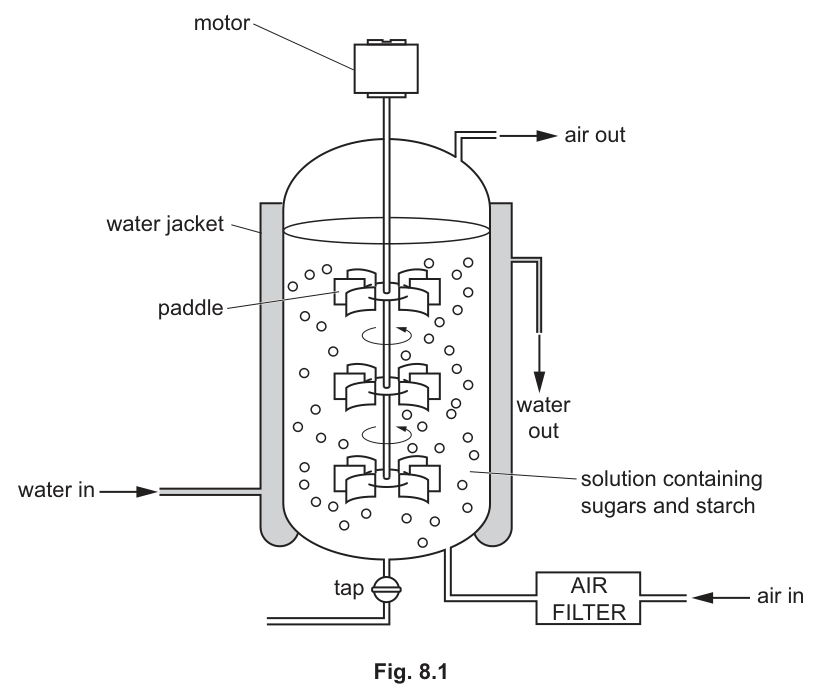
Explain how the features of the fermenter shown in Fig. 8.1 provide suitable conditions for the growth of fungi.
Answer
- Motor / paddle: mixes the solution, so food, heat, waste products and air are evenly distributed.
- Water jacket / water in: cools the fermenter contents, preventing high temperatures from killing the fungus or denaturing its enzymes.
- Air in: provides oxygen so the fungi can respire aerobically.
- Air filter: prevents entry of other microorganisms, preventing contamination of the solution and reducing competition with the fungi.
Paddle mixes the solution so food, heat, waste and air are evenly distributed; water jacket cools the contents preventing enzymes being denatured; air in provides oxygen for aerobic respiration; air filter prevents contamination by other microorganisms.
Walkthrough
The question asks you to take each labelled feature of the fermenter in Fig. 8.1 and explain how it helps the fungi grow. Work through the diagram feature by feature.
The motor and paddles. In a large vessel, if nothing stirs the liquid, the fungi near the bottom run out of food while the top layers stay unused. The paddles mix the solution, so the food supply (the sugars and starch), the dissolved oxygen, the heat generated by the respiring fungi and their waste products are all evenly distributed. Even distribution of heat matters because fungal metabolism releases heat, and in a big vessel that heat would otherwise build up locally.
The water jacket. Respiration by millions of fungi releases a lot of heat, and the fermenter would overheat. Water flowing through the jacket around the vessel carries heat away, cooling the contents. Why does this matter? Enzymes have an optimum temperature; above it they are denatured — their active sites lose their shape — and the fungi die. So the water jacket prevents high temperatures from killing the fungus or denaturing its enzymes.
The air inlet. Fungi need oxygen for aerobic respiration, which releases the energy they need for growth. Pumping air in keeps the oxygen supply high. Note the mark scheme underlines aerobically — the word 'aerobic' is the marking point.
The air filter. The air coming in carries microorganisms from the surroundings. The filter sterilises the air, preventing other microorganisms from entering. If contaminants got in, they would grow in the sugar solution too, competing with the fungi for food and space, and would contaminate the pectinase product. So the filter prevents contamination and reduces competition.
Key Takeaways
- A fermenter controls four things for the microorganism: mixing (even distribution of food, heat, waste and air), temperature (water jacket), oxygen supply (air inlet) and asepsis (air filter).
- Enzymes are denatured above their optimum temperature, so cooling is essential in large-scale culture.
- Aerobic respiration requires oxygen; the word 'aerobic' is usually the credited term.
- Contamination matters because other microbes compete for the same food supply.
Common Mistakes
- Saying the paddle 'adds oxygen' — mixing distributes the air already supplied; the air inlet provides the oxygen.
- Saying the water jacket 'keeps the fermenter warm' — its job here is cooling; overheating, not cold, is the risk.
- Writing 'the filter kills germs' without saying what the contamination would do — the mark needs the consequence: contamination of the solution / competition with the fungi.
- Omitting the word 'aerobic' when explaining the air supply.
- Giving only the feature name without its effect — each mark needs the link to fungal growth.
Things to Be Careful About
- This is a 6-mark question with four features listed; the scheme allows a maximum of 6, so you can gain marks on more than one point per feature — but always give the feature AND its effect.
- Use the exact vocabulary: 'denatured', 'aerobically respire', 'contamination', 'competition'.
- Do not invent features not shown in Fig. 8.1 (e.g. pH probes) — the question says 'shown in Fig. 8.1'.
In an experiment, scientists added pectinase made by the fungi to a sample of crushed fruit.
They measured changes in:
- the sugar content of the sample of crushed fruit
- the thickness of the sample of crushed fruit.
The scientists' results are shown in Fig. 8.2.
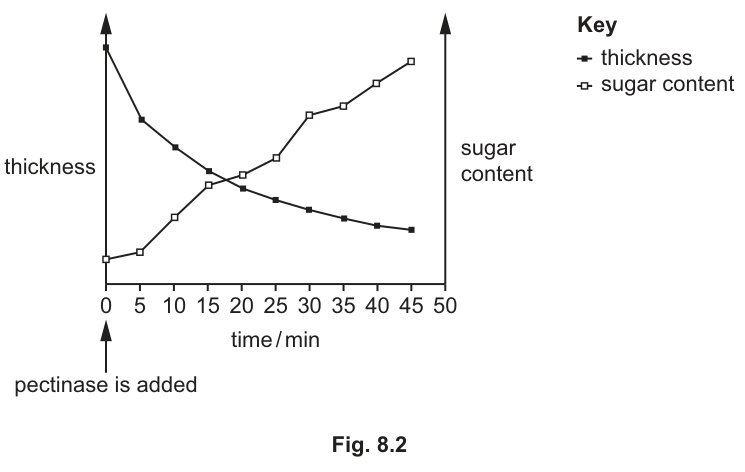
Use your knowledge of the action of pectinase to explain the scientists' results.
Answer
- Pectinase digests / breaks down pectin.
- This releases sugars (from the pectin / from the cells), so the sugar content increases.
- Pectin makes the solution thicker, so when it is digested the thickness decreases.
Pectinase breaks down pectin, releasing sugars so sugar content rises; pectin makes the fruit thick, so digesting it decreases the thickness.
Walkthrough
Fig. 8.2 shows two curves after pectinase is added at time 0: thickness falls steadily while sugar content rises. Your job is to explain both trends with one piece of biology.
Pectin is a substance in the cell walls of fruit that holds the cells together and makes crushed fruit thick and jelly-like. Pectinase is an enzyme whose substrate is pectin — by the lock-and-key model, the pectin molecule fits the active site of pectinase and is broken down.
This one reaction explains both curves:
-
Sugar content rises. Breaking down the pectin (and the cell walls it holds together) releases sugars that were locked up in the pectin and inside the fruit cells. These dissolved sugars add to the sugar content of the sample, so the curve climbs.
-
Thickness falls. It is the pectin that makes the crushed fruit thick. Once the pectinase has digested it, the thickening agent is gone, so the sample becomes runnier — the thickness curve falls.
Both changes begin only when the pectinase is added, which is why both curves start moving at time 0 — evidence that the enzyme, not anything else, is causing the changes.
Key Takeaways
- Pectinase digests pectin in fruit cell walls; this is why it is used in fruit juice production to make juice flow more freely and yield more juice.
- One enzyme reaction can explain two observations: substrate breakdown releases soluble sugars AND removes the substance causing thickness.
- Graph questions on enzymes usually want: what the enzyme acts on, what is released, and the link to the measured change.
Common Mistakes
- Saying pectinase 'digests the fruit' or 'digests sugar' — the substrate is pectin, and naming it is the first mark.
- Explaining only one curve — the question asks for both the sugar increase and the thickness decrease; each carries marks.
- Saying the sugars are 'made' by the enzyme — they are released from the pectin/cells, not synthesised.
- Describing the graph ('thickness goes down, sugar goes up') without explaining why — an 'explain' question needs the reason in every point.
Things to Be Careful About
- Use 'digests / breaks down pectin' — the mark scheme credits the substrate by name.
- Link each observation to its cause: sugars released → sugar content increases; pectin digested → thickness decreases.
- Four marks, four points in the scheme — cover the substrate, the release of sugars, the rising sugar content, and the thickness link.