Biology 5090/21 — October/November 2024
Cambridge O-Level · Theory · worked solutions for every part, with the mark scheme
Topics Organisms and Their Environment · Human Nutrition · Transport in Flowering Plants · Enzymes · Coordination and Control · Excretion · +8 more
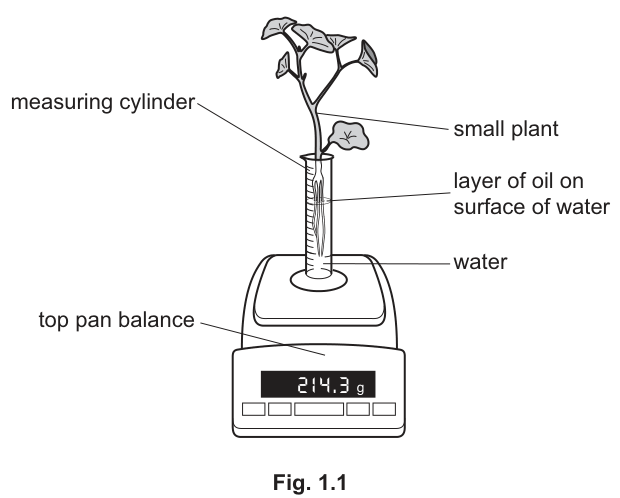
Fig. 1.1 shows an experiment to measure the water loss from a small plant in 24 hours.
Answer
transpiration
transpiration
Walkthrough
The question asks for the name of the process by which a plant loses water from its cells to the atmosphere. This is the definition of transpiration: the loss of water vapour from the leaves (and stems) of a plant, mainly through the stomata. Water evaporates from the surfaces of the mesophyll cells inside the leaf, diffuses out through the stomata, and passes into the surrounding air.
Key Takeaways
- Transpiration = loss of water vapour from a plant, mainly through stomata in the leaves.
- The word 'transpiration' is the exact term the mark scheme requires — a paraphrase such as 'evaporation' alone would not score.
Common Mistakes
- Writing 'evaporation' or 'diffusion' — these are parts of the process but not the name of the whole process.
- Writing 'condensation' or 'guttation', which are different processes entirely.
Things to Be Careful About
- Spell the word correctly: 'transpiration', not 'transperation' or 'perspiration' (perspiration is sweating in humans).
Answer
The oil prevents water evaporating directly from the surface of the water in the measuring cylinder, so all the water loss measured is from the plant.
to prevent evaporation of water from the measuring cylinder
Walkthrough
The apparatus measures water loss from the plant. But the cylinder also contains an exposed water surface, and water would evaporate from it anyway. If that happened, the mass or volume change would include water the plant never lost, making the measurement wrong.
Oil is less dense than water and floats on top, forming a barrier between the water and the air. Water molecules cannot escape through it, so evaporation from the cylinder surface is stopped. The only route for water to leave the apparatus is now through the plant — up the xylem and out of the stomata — which is exactly what the experiment is meant to measure.
Key Takeaways
- An oil layer is a standard control in transpiration experiments: it seals the water surface so evaporation occurs only from the plant.
- This keeps the measurement valid — any change in mass or volume is due to transpiration alone.
Common Mistakes
- Saying the oil 'feeds' the plant or 'protects the roots' — no such function.
- Saying the oil stops the plant losing water — it is the opposite: it stops the water in the cylinder evaporating so that only the plant's loss is measured.
Things to Be Careful About
- The mark scheme wants 'prevent water loss / evaporation of water' — name the water in the cylinder, and make clear the oil prevents its evaporation.
Describe one way in which a student could use this apparatus to obtain a value for the amount of water the plant loses in 24 hours.
______
Answer
- Record the reading on the balance (or the volume of water in the measuring cylinder) at the start.
- Record it again after 24 hours.
- Subtract the final value from the starting value; the difference is the mass (or volume) of water lost in 24 hours.
measure mass/volume at start and after 24 hours, then subtract the end value from the start value
Walkthrough
The apparatus offers two ways to measure the water lost, and either scores:
- Using the balance. The whole set-up sits on a top pan balance. As the plant transpires, water leaves the apparatus, so the total mass falls. Read the balance at the start (214.3 g in the diagram) and again exactly 24 hours later. The fall in mass equals the mass of water lost.
- Using the measuring cylinder. The cylinder has a scale, so the volume of water can be read at the start and again after 24 hours. The fall in volume is the volume of water lost.
Either way, the amount lost is the difference between the two readings:
Both halves are needed for the two marks: taking the two readings (start and after 24 hours) is one mark, and subtracting to find the difference is the other.
Key Takeaways
- Water lost can be measured as a loss of mass (balance) or a loss of volume (measuring cylinder scale).
- The amount lost in a time period = start reading − end reading.
Common Mistakes
- Describing only one reading — both the start and the 24-hour readings are needed for the first mark.
- Forgetting to state that the values must be subtracted — the difference is the actual answer.
- Adding the values instead of subtracting.
Things to Be Careful About
- The mark scheme joins the steps with '+': 'measure mass / volume at start + at end / after 24 hours' is one mark, and 'subtract end value from start value' is the second. State both readings and the subtraction explicitly.
Water is lost mainly through the plant's stomata.
Name three types of cell that the water passes through before it reaches the stomata in the leaves.
Write the names of the types of cell in the correct order in the boxes.

Answer
| box 1 | box 2 | box 3 | box 4 |
|---|---|---|---|
| root hair cell | cortex cell | xylem vessel | stomata |
Water enters through the root hair cell, passes cell to cell across the root cortex, travels up the xylem vessel in the stem, moves into the leaf mesophyll, and finally evaporates and diffuses out through the stomata.
root hair cell → cortex cell → xylem vessel → stomata
Walkthrough
Water taken up by a plant follows a fixed route from soil to air:
- Root hair cell — the root hairs are thin extensions of epidermal cells that greatly increase the surface area for absorbing water from the soil. Water enters by osmosis, because the cell sap has a lower water potential than the soil water.
- Cortex cells — water then passes across the root cortex, from cell to cell, moving down a water potential gradient towards the xylem.
- Xylem vessel — water enters the xylem and is drawn up the stem to the leaves in the transpiration stream. Xylem vessels are hollow tubes with no end walls, ideal for carrying water.
- Leaf mesophyll cells — in the leaf, water leaves the xylem and passes into the spongy or palisade mesophyll cells, from whose surfaces it evaporates into the air spaces.
- Stomata — the water vapour diffuses out of the leaf through the stomata, which is where the printed flowchart ends.
The mark scheme accepts palisade, spongy or mesophyll cell as the third cell, but since only three boxes are given before 'stomata', the cleanest sequence is root hair cell → cortex cell → xylem vessel.
Key Takeaways
- Pathway of water: soil → root hair cell → root cortex cells → xylem → leaf mesophyll cells → air spaces → stomata → atmosphere.
- The order matters: all three marks depend on the cells being in the correct sequence.
Common Mistakes
- Putting 'phloem' instead of 'xylem' — phloem transports sucrose, not water.
- Putting 'guard cell' in the sequence — guard cells surround the stoma but are not on the water pathway before it.
- Omitting the cortex and jumping from root hair to xylem.
- Reversing the order — the sequence must run root → stem → leaf.
Things to Be Careful About
- The mark scheme says 'any three in correct sequence' — a correct set of cells in the wrong order will not earn the marks. Write them in order, left to right, in the boxes.
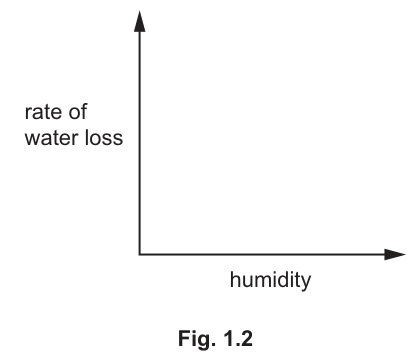
The experiment shown in Fig. 1.1 was repeated many times to investigate the effect of humidity on the rate of water loss.
All environmental conditions were kept constant except for humidity which was gradually increased.
Fig. 1.2 shows the axes for a graph.
Answer
Draw a line that starts high on the y-axis at low humidity and falls steadily as humidity increases, reaching its lowest value at the highest humidity.
A falling line: rate of water loss highest at low humidity, lowest at high humidity
Walkthrough
Humidity is the amount of water vapour in the air. The more humid the air, the smaller the difference in water concentration between the inside of the leaf (saturated with water vapour) and the outside air. A smaller difference means a slower rate of diffusion of water vapour out of the stomata, so the rate of water loss falls.
So the expected graph is a falling line: highest rate of water loss at low humidity, decreasing steadily as humidity rises, lowest at high humidity.
Key Takeaways
- High humidity → small water vapour concentration gradient → low transpiration rate.
- Low humidity → steep gradient → high transpiration rate.
- The sketch only needs the shape of the trend; no numbers are required.
Common Mistakes
- Drawing a rising line — that would mean humidity increases water loss, which is the opposite of the true relationship.
- Drawing a flat line — humidity does affect the rate.
Things to Be Careful About
- The mark scheme wants the line 'at its highest at a low humidity and at its lowest at a high humidity' — make sure the line clearly starts high on the left and ends low on the right.
Answer
- The lower the humidity, the higher the rate of water loss.
- Water is lost from the leaf by diffusion (of water vapour through the stomata).
- When humidity is low, the concentration of water vapour in the air outside the leaf is lower than inside the leaf, so there is a steep concentration gradient and water vapour diffuses out quickly.
The lower the humidity, the higher the rate of water loss, because water is lost by diffusion down a concentration gradient, which is steeper when the air is drier.
Walkthrough
This is an 'explain' question, so each point needs its reason:
- The trend (1 mark). State the relationship shown by the graph: as humidity increases, the rate of water loss decreases — or, as the mark scheme words it, 'the lower the humidity, the higher the rate of water loss'.
- The mechanism (1 mark). Water leaves the leaf by diffusion — water vapour moves from where it is more concentrated (inside the leaf, in the air spaces) to where it is less concentrated (the outside air), through the stomata.
- The gradient (1 mark). Diffusion only happens down a concentration gradient. When the air is dry (low humidity), the concentration of water vapour outside is much lower than inside the leaf, so the gradient is steep and diffusion is fast. When the air is already nearly saturated with water vapour (high humidity), the gradient is shallow, so diffusion is slow.
All three parts together give the full explanation: the observation, the process responsible, and why the process depends on humidity.
Key Takeaways
- Transpiration rate depends on the water vapour concentration gradient between the leaf's air spaces and the atmosphere.
- Humidity is one of the four main factors affecting transpiration, along with temperature, wind (air movement) and light intensity.
- Diffusion is always down a concentration gradient — naming the process and the gradient is what earns the marks.
Common Mistakes
- Giving only the trend without the explanation — 'explain' needs the because-clause.
- Saying water is 'sucked out' or 'pulled by the roots' instead of naming diffusion.
- Saying the leaf 'dries out' rather than describing the concentration gradient.
- Confusing humidity with temperature — they have opposite effects on transpiration rate.
Things to Be Careful About
- The mark scheme requires the word 'diffusion' — 'evaporation' alone describes water leaving the mesophyll cell surfaces but not its movement out of the leaf.
- Phrase the trend in the mark scheme's own direction: 'the lower the humidity, the higher the rate of water loss'.
- All three marks are separate points; make sure each appears as its own statement.
Maltase is an enzyme found in the intestines of vertebrates, including humans.
Complete Table 2.1, which provides descriptions of words related to the activity of maltase.
The first row has been completed for you.
Table 2.1
| word | how it relates to the activity of maltase |
|---|---|
| maltase | an enzyme that is found in vertebrate intestines |
| the substrate of maltase | |
| glucose | |
| part of the maltase molecule which fits the substrate | |
| specific |
Answer
| word | how it relates to the activity of maltase |
|---|---|
| maltase | an enzyme that is found in vertebrate intestines |
| maltose | the substrate of maltase |
| glucose | the product / what is produced when maltose is broken down |
| active site | part of the maltase molecule which fits the substrate |
| specific | maltase only acts on (its own) substrate, maltose |
maltose; product; active site; maltase only acts on maltose
Walkthrough
This question tests whether you can use the vocabulary of enzymes correctly with a concrete example. Maltase digests maltose, a disaccharide, into two glucose molecules.
- The substrate is the molecule an enzyme acts on. For maltase, that is maltose — the '-ase' ending on the enzyme's name usually tells you its substrate.
- The product is what the reaction makes. Maltose is split by hydrolysis into glucose, so glucose is the product.
- The active site is the region of the enzyme molecule whose shape fits (is complementary to) the shape of the substrate. This is the lock-and-key model: only a substrate with the matching shape can fit into the active site and be catalysed.
- Specific means the enzyme will only catalyse one reaction — maltase only works on maltose, not on any other sugar, because no other molecule has the right shape to fit its active site.
Key Takeaways
- Enzyme names often end in -ase and hint at their substrate (maltase → maltose).
- Substrate → enzyme → products: maltose → (maltase) → glucose + glucose.
- The active site has a shape complementary to the substrate; this explains specificity.
Common Mistakes
- Writing 'starch' as the substrate — starch is digested by amylase to maltose; maltase then acts on maltose.
- Confusing substrate and product: glucose is made BY the reaction, not broken down by it.
- Describing 'specific' vaguely as 'works well' — the mark needs the idea that maltase acts only on maltose because of the fit at the active site.
Things to Be Careful About
- The last row carries the idea of 'only' — say maltase acts only on maltose, not just 'acts on maltose'.
- Keep each table cell short and precise; these are one-mark cells.
Vampire bats live in South America and feed entirely on blood.
They are the only known vertebrates which do not have maltase in their intestines.
Suggest an explanation for this.
Answer
Any two from:
- Blood contains little or no maltose (blood contains glucose, not starch), so there is no substrate for maltase.
- Maltase is therefore not produced / released by the intestine.
- Energy is not wasted making an unnecessary enzyme.
- A mutation arose so vampire bats do not have a functional gene for maltase, and this was selected for / evolved.
No maltose in blood (blood contains glucose, not starch); maltase not produced; energy not wasted on an unnecessary enzyme; mutation/evolution or no functional gene. Any two.
Walkthrough
Vampire bats feed entirely on blood. Think about what enzymes blood would need digesting:
- Blood does not contain starch, and it contains almost no maltose — its sugar is glucose, already small enough to be absorbed and used directly. So there is nothing for maltase to act on.
- An organism gains no advantage from making an enzyme with no substrate, so over time the bats stopped producing maltase — either through mutation removing a functional gene, or simply because energy spent making an unnecessary protein is wasted and natural selection favours those that do not make it.
The command word 'suggest' means you apply known biology (substrate determines whether an enzyme is needed) to a new situation (a blood-feeding mammal) rather than recalling a fact.
Key Takeaways
- Enzymes are only useful if their substrate is present in the diet or body fluids.
- Making proteins costs energy; organisms do not waste energy on unnecessary enzymes.
- Loss of an unused trait can be explained by mutation plus natural selection.
Common Mistakes
- Saying 'they don't eat maltose' without linking it to blood composition — the mark wants the idea that blood contains glucose, not starch/maltose.
- Writing 'they don't need it' alone, which is too vague unless tied to no substrate or wasted energy.
- Giving only one point when two are required.
Things to Be Careful About
- The mark scheme lists five acceptable points but awards max 2 — give exactly two clear ones.
- Use precise wording: 'no maltose in blood', 'does not contain starch', 'energy not wasted', 'mutation / evolution', 'no functional gene'.
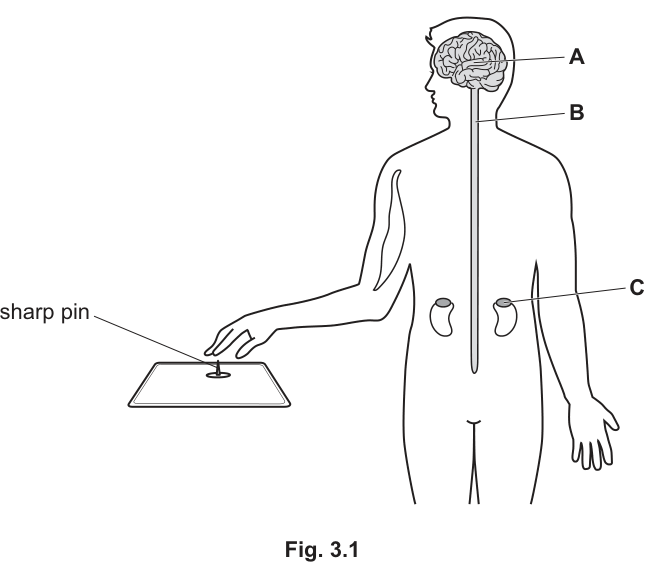
Fig. 3.1 shows the central nervous system and some other parts of a man's body.
Answer
A = brain
B = spinal cord
A = brain; B = spinal cord
Walkthrough
The central nervous system (CNS) consists of exactly two organs: the brain, housed in the skull, and the spinal cord, running down inside the vertebral column. On Fig. 3.1 label A points to the brain in the head and label B points to the long cord running down the back. All you need is the correct name for each.
Key Takeaways
- The CNS = brain + spinal cord.
- Nerves outside the brain and spinal cord belong to the peripheral nervous system — do not confuse them with the CNS.
Common Mistakes
- Writing 'nervous system' or 'nerve' for A or B — these are not the names of the parts.
- Swapping the labels: A points to the brain (in the head), B to the spinal cord (down the back).
Things to Be Careful About
- Give the exact terms 'brain' and 'spinal cord'; the mark scheme awards one mark per named part.
The man accidentally touches his hand on a sharp pin and immediately lifts his lower arm away from the pin in a reflex action.
This reflex action involves a receptor and an effector.
On Fig. 3.1, draw a label line to the location of:
- the receptor and label it R
- the effector and label it E.
Answer
R drawn with a label line pointing to the hand (the skin touching the pin).
E drawn with a label line pointing to a muscle in the lower arm.
R on the hand; E on a muscle in the arm
Walkthrough
In a reflex arc, the receptor is the structure that detects the stimulus. Here the stimulus is the sharp pin, so the receptor is in the skin of the hand — draw your R label line to the hand. The effector is the structure that carries out the response: the response is lifting the lower arm away, which is done by muscles contracting, so E must point to a muscle in the arm, not to the bone, the pin or the spinal cord.
Key Takeaways
- Receptor = detects the stimulus; effector = carries out the response.
- In limb-withdrawal reflexes the effectors are always muscles.
Common Mistakes
- Pointing E at the hand or at the spinal cord — the effector is the muscle that moves the arm.
- Pointing R at the pin itself — the pin is the stimulus, not the receptor.
Things to Be Careful About
- Each correctly placed label line earns its own mark: R to the hand, E to a muscle.
Answer
Sensory neurone: receives impulses / is stimulated by the receptor in the hand, and carries impulses to the spinal cord (CNS).
Motor neurone: carries impulses from the relay neurone / spinal cord (CNS) to the effector (muscle), causing it to contract and lift the arm away.
Sensory neurone: stimulated by the receptor, carries impulses to the spinal cord; motor neurone: carries impulses from the CNS/relay neurone to the muscle
Walkthrough
A withdrawal reflex uses three types of neurone. The sensory neurone starts at the receptor in the skin of the hand: it is stimulated by the receptor and carries nerve impulses into the spinal cord. Inside the spinal cord a relay neurone passes the impulses from the sensory neurone across to the motor neurone. The motor neurone then carries impulses out of the spinal cord to the effector — the muscle in the arm — which contracts and pulls the arm away. The question asks for TWO named neurones with their roles described, so pick any two (sensory and motor are the easiest) and give each a 'from ... to ...' statement. Note the mark scheme's rule: if no neurones are named, no marks are awarded at all.
Key Takeaways
- Reflex arc order: receptor → sensory neurone → relay neurone (in CNS) → motor neurone → effector.
- Each neurone's role is best expressed as where it carries impulses FROM and TO.
Common Mistakes
- Describing neurones without naming them — the scheme gives zero marks if none are named.
- Saying the sensory neurone goes 'to the brain' — this reflex is coordinated in the spinal cord; the brain is only informed afterwards.
- Confusing the roles: the motor neurone goes to the effector, not from it.
- Writing 'message' instead of 'impulse' — use the precise term.
Things to Be Careful About
- Four marks = four creditable points: each named neurone needs both its input (from receptor/relay/CNS) and its output (to CNS/muscle). Give both halves for each neurone you describe.
The part of the body labelled C is a gland in the endocrine system.
Answer
adrenal gland
adrenal gland
Walkthrough
Label C points to the small triangular glands sitting on top of the kidneys. These are the adrenal glands, endocrine glands that secrete adrenaline. One mark for the name.
Key Takeaways
- Adrenal glands sit above the kidneys and secrete adrenaline into the blood.
Common Mistakes
- Naming the kidney instead of the gland on top of it.
- Spelling errors such as 'adernal' — write 'adrenal'.
Things to Be Careful About
- 'Adrenal (gland)' is the accepted answer; just 'adrenaline' would be wrong because adrenaline is the hormone, not the gland.
Explain the role of gland C in triggering an increase in heart rate in response to a sudden shock.
Answer
- Gland C produces the hormone adrenaline.
- Adrenaline travels in the blood to the heart and prepares the body for action / increased activity, increasing heart rate.
Produces adrenaline, which travels in the blood and prepares the body for action
Walkthrough
When a person receives a sudden shock, the adrenal glands secrete the hormone adrenaline into the bloodstream. Hormones are chemical messengers carried in the blood plasma to target organs — here the heart. Adrenaline prepares the body for 'fight or flight': it increases heart rate so more oxygen and glucose reach the muscles, readying the body for increased activity. Any two of these ideas score: produces adrenaline, travels in blood, prepares body for action.
Key Takeaways
- Endocrine glands secrete hormones directly into the blood.
- Adrenaline is the 'fight or flight' hormone: raises heart rate, breathing rate and blood glucose.
Common Mistakes
- Saying nerves carry the signal to the heart — this question is about the endocrine system, so the answer must involve a hormone in the blood.
- Naming the hormone but omitting that it travels in the blood — that link is a separate mark.
Things to Be Careful About
- Two marks, any two points from the scheme list; make sure at least one mentions adrenaline (the hormone) and one mentions the blood or preparation for action.
Living organisms excrete carbon dioxide.
Answer
- removal of waste products from the body
- removal of toxic materials
Removal of waste products from the body; removal of toxic materials
Walkthrough
Excretion means getting rid of waste products that are made by the body's own chemical reactions, called metabolism. The mark scheme wants two ideas: the word "removal" and what is removed. A good answer is "removal of waste products from the body" and "removal of toxic materials". These are two separate points and each earns one mark.
It is important to understand that excretion is not the same as egestion. Egestion is the removal of undigested food from the gut as faeces. That food was never made by the body, so it is not a metabolic waste product and is not excretion.
Key Takeaways
- Excretion is the removal of metabolic waste products from the body.
- Carbon dioxide and urea are examples of excretory products.
- Egestion of faeces is not excretion.
Common Mistakes
- Saying "removal of faeces" or "removal of undigested food" — this is egestion, not excretion.
- Giving only one point when two marks are available.
- Missing the word "removal", which is a key part of the definition.
Things to Be Careful About
Use the exact word "removal" and name what is removed, such as waste products or toxic materials. Give two distinct points for the two marks. Do not confuse excretion with egestion.
Name the process which produces carbon dioxide in living organisms and state how carbon dioxide is excreted by humans.
Answer
respiration
breathed out / exhaled at the lungs (alveoli)
Respiration; breathed out / exhaled at the lungs (alveoli)
Walkthrough
The process that produces carbon dioxide in living organisms is respiration. In humans, aerobic respiration uses glucose and oxygen and produces carbon dioxide and water. This carbon dioxide is carried in the blood to the lungs and is breathed out.
The mark scheme accepts "breathed out", "exhaled", or "removed at the lungs / alveoli". So a full answer is: respiration; breathed out at the lungs.
Key Takeaways
- Respiration is the process that releases carbon dioxide.
- The lungs are the organ through which carbon dioxide is excreted in humans.
- Breathing is the movement of air in and out; respiration is the chemical process that releases energy.
Common Mistakes
- Writing "breathing" instead of "respiration" — breathing is not the process that produces carbon dioxide.
- Saying carbon dioxide is excreted in urine — carbon dioxide leaves through the lungs, not the kidneys.
- Giving only the process and forgetting the route of removal.
Things to Be Careful About
Use the precise term "respiration". For the second mark, say "breathed out", "exhaled", or "removed at the lungs / alveoli". Do not write "breathing" as the process.
The volume of carbon dioxide excreted varies over a 24-hour period and the factors that affect this are different for animals and plants.
Suggest and explain reasons why the volume of carbon dioxide excreted varies for both animals and plants.
animals ______
plants ______
Answer
Animals: activity varies, for example during exercise, so the rate of respiration is higher at some times, producing more carbon dioxide.
Plants: respiration is constant / ongoing, but in daylight photosynthesis uses carbon dioxide, so less carbon dioxide is released during the day; at night more is released.
Animals: activity varies, so respiration rate varies. Plants: respiration is constant, but photosynthesis uses CO2 in daylight, so net CO2 release varies between day and night.
Walkthrough
For animals, the volume of carbon dioxide produced depends on the rate of respiration, and the rate of respiration changes with activity. When an animal is exercising, its muscles need more energy, so respiration increases and more carbon dioxide is produced and excreted. When it is resting, less carbon dioxide is produced. This gives the two animal points: activities vary, so more respiration occurs at some times.
For plants, the situation is different because plants both respire and photosynthesise. Respiration is constant and ongoing — plants respire all the time, day and night. However, photosynthesis only happens in daylight. In daylight, photosynthesis uses carbon dioxide, so some of the carbon dioxide produced by respiration is used up and less is released. At night, photosynthesis stops, so more carbon dioxide is released. The mark scheme allows a maximum of two marks for plants, so the key points are: respiration is constant/ongoing, and in daylight photosynthesis uses carbon dioxide.
Key Takeaways
- Both animals and plants respire continuously.
- Animal respiration rate changes with activity.
- Plants also photosynthesise in daylight, using carbon dioxide, so their net release of carbon dioxide varies between day and night.
Common Mistakes
- Saying plants only photosynthesise and do not respire.
- Saying plants release carbon dioxide only at night — they respire all the time, but net release is higher at night.
- Saying animals respire only when active — the process is continuous, but the rate changes.
- Forgetting to mention that photosynthesis uses carbon dioxide in daylight.
Things to Be Careful About
For animals, give an example of changing activity such as exercise. For plants, include both "respiration is constant/ongoing" and "photosynthesis uses carbon dioxide in daylight". Use the word "net" to make clear that plants still respire in daylight but release less carbon dioxide because some is used in photosynthesis.
Answer
Carbon dioxide is a greenhouse gas; it traps heat energy in the atmosphere, causing global warming and climate change.
Carbon dioxide is a greenhouse gas; traps heat energy, causing global warming and climate change.
Walkthrough
Increasing the concentration of carbon dioxide in the atmosphere strengthens the greenhouse effect. Carbon dioxide acts as a greenhouse gas, meaning it traps thermal (heat) energy in the atmosphere. This extra trapped heat leads to global warming, which in turn causes climate change, such as rising sea levels, changing weather patterns, and effects on organisms and habitats.
The mark scheme accepts any two of: carbon dioxide acts as a greenhouse gas; it traps thermal/heat energy or causes global warming; it causes climate change or a specific effect on land or organisms. A full answer combines these points.
Key Takeaways
- Carbon dioxide is a greenhouse gas.
- Greenhouse gases trap heat energy in the atmosphere.
- Increased carbon dioxide leads to global warming and climate change.
Common Mistakes
- Saying carbon dioxide causes acid rain — acid rain is mainly caused by sulfur dioxide and oxides of nitrogen.
- Saying carbon dioxide is directly toxic to humans — the main environmental effect is the greenhouse effect.
- Giving only one point when two marks are available.
Things to Be Careful About
Use the exact terms "greenhouse gas", "traps heat energy", "global warming", and "climate change". Give at least two of the credited points. Do not confuse the greenhouse effect with acid rain.
The castor oil plant is a flowering plant which produces seeds.
The seeds have an additional structure called an oil body that contains oil.
Fig. 5.1 shows a castor oil seed with its oil body.
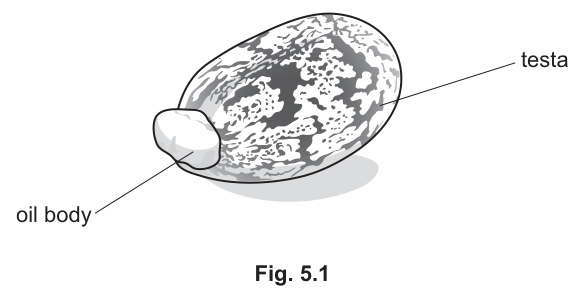
The testa protects the seed contents from environmental damage.
Name parts of the seed protected by the testa and describe their functions.
Answer
Any four of:
- cotyledons — store food / energy for germination;
- embryo — grows into a new plant;
- radicle — grows into the root;
- plumule — grows into the shoot / stem.
Cotyledons (food storage), embryo (grows into new plant), radicle (grows into root), plumule (grows into shoot)
Walkthrough
The testa is the tough outer coat of the seed. Inside it lie the parts of the embryo plant and its food store. The question asks you to name parts AND give each one's function — the mark scheme pairs them with '+', so naming alone scores nothing.
The parts inside a seed are:
- Cotyledons — the seed leaves, which store food (starch or, in the castor oil seed, oil) to supply energy for germination.
- Embryo — the young plant itself, which grows into the new plant when the seed germinates.
- Radicle — the embryonic root; it is the first part to emerge and grows down into the soil, absorbing water.
- Plumule — the embryonic shoot; it grows upwards and eventually makes leaves for photosynthesis.
The scheme lists five points and asks for any four, so give four clean pairs and stop.
Key Takeaways
- A seed contains the embryo (radicle + plumule) and cotyledons, all enclosed by the testa.
- Every named structure must carry its function — structure-and-function pairing is the recurring 5090 demand.
- The radicle is always the root, the plumule always the shoot; do not swap them.
Common Mistakes
- Naming a part without its function (or vice versa) — the '+' in the mark scheme means both halves are needed for the mark.
- Confusing radicle and plumule.
- Writing 'endosperm' when the scheme credits cotyledons — stick to the credited structures.
- Giving more than four points; extra wrong statements can cancel a mark.
Things to Be Careful About
- 'Any four from' means exactly four — choose the clearest pairs.
- Say 'grows into the root' for the radicle, not just 'root'.
Answer
Add ethanol to the oil body, then pour the ethanol into water — a white emulsion forms, showing that oil (a lipid) is present.
Ethanol emulsion test: ethanol added, then mixed with water, giving a white (cloudy) emulsion
Walkthrough
This is the standard ethanol emulsion test for lipids. The oil dissolves in the ethanol; when this mixture is added to water, the lipid comes out of solution as tiny droplets that scatter light, giving a cloudy white emulsion.
The two marks are: (1) add ethanol, and (2) add to water and describe the white/cloudy emulsion — the '+' in the scheme means the second mark needs both the water and the colour change.
Key Takeaways
- Lipid test = ethanol emulsion test: ethanol, then water, white emulsion.
- No heating is needed (unlike Benedict's test for reducing sugars).
Common Mistakes
- Using Benedict's solution or iodine — those test for reducing sugars and starch respectively.
- Omitting the water step — ethanol alone gives no emulsion.
- Saying only 'it changes colour' without naming the white/cloudy emulsion.
Things to Be Careful About
- Give the full sequence in order: ethanol first, then water, then the observation.
When the fruits of the castor oil plant are ripe, they burst open, scattering the seeds onto the soil.
Ants feed on the oil bodies, but not the rest of the seeds. They either remove the oil bodies where the seeds have fallen or they take the seeds and oil bodies back to their nest.
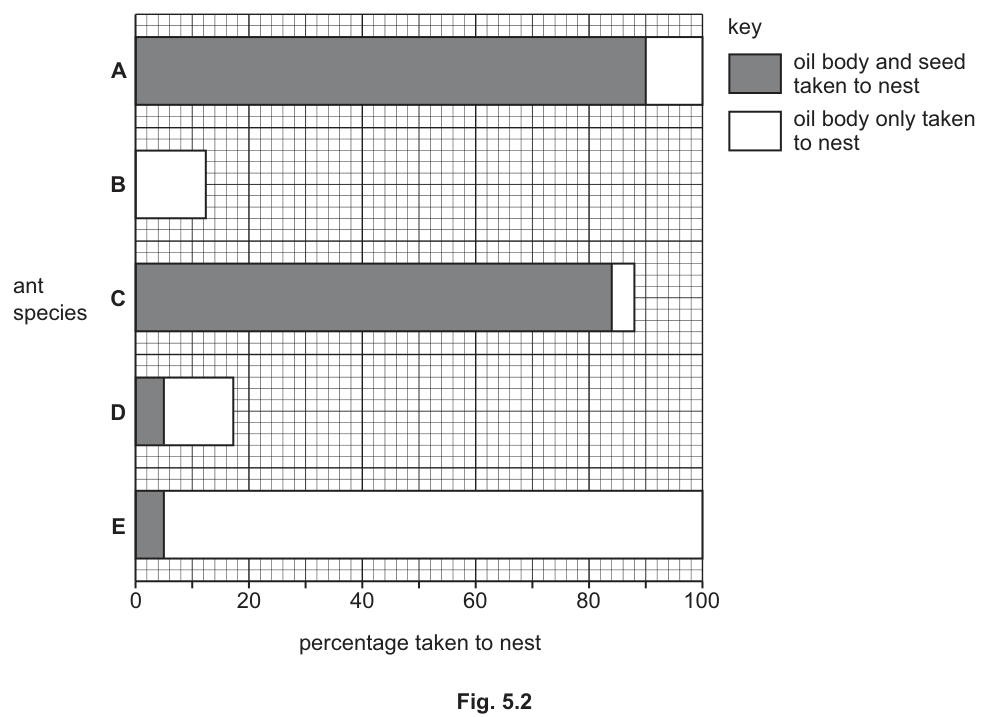
Colonies of five different ant species, A – E, were supplied with the same number of castor oil seeds near to their nests.
Fig. 5.2 shows the results of this experiment into the behaviour of these different ant species.
Only a small number of flowering plant species produce seeds with oil bodies.
Suggest one advantage and one disadvantage to the castor oil plant of producing seeds with oil bodies.
advantage ______
disadvantage ______
Answer
Advantage: the oil bodies attract ants, which carry the seeds away, increasing seed dispersal.
Disadvantage: the plant must use extra energy / nutrients to synthesise the lipid for the oil bodies.
Advantage: increased seed dispersal; disadvantage: extra energy/nutrients needed to make the oil
Walkthrough
This is a 'suggest' question — the answer is not printed in the stem, but the context gives you the clues.
Advantage: the stem tells you ants take seeds (with their oil bodies) back to their nests. Moving seeds away from the parent plant is seed dispersal — it reduces competition between parent and offspring and colonises new areas. So the oil body is a reward that buys the plant dispersal by ants.
Disadvantage: making oil costs the plant. Lipids are energy-rich molecules, so the plant must divert extra products of photosynthesis and nutrients into lipid synthesis instead of growth or making more seeds.
Key Takeaways
- Animal-dispersed seeds often offer a food reward (fleshy fruits, oil bodies, elaiosomes).
- Every advantage in biology usually has a cost — here, the cost of synthesising the lipid.
Common Mistakes
- Giving an advantage that is not about dispersal (e.g. 'protects the seed') — the ants eat the oil body, they do not protect it.
- Vague disadvantages like 'it is a waste' — name the resource: energy, nutrients, or products of photosynthesis.
Things to Be Careful About
- One advantage AND one disadvantage — exactly one of each, each worth one mark.
Use information from Fig. 5.2 to explain how useful the different ant species are to the castor oil plant.
Answer
- Species A and C are the most useful: about 90% (A) and about 84% (C) of seeds had the oil body and seed taken to the nest, so the whole seed is dispersed.
- Species B, D and E are not useful: very few seeds are taken whole (about 0%, 5% and 5% respectively) — mostly only the oil body is taken, so the seed is left behind.
- Dispersal only benefits the plant when the whole seed is removed, not just the oil body.
A and C are most useful (about 90% and 84% of whole seeds taken to nest); B, D and E are not useful because they take only the oil body, leaving the seed behind
Walkthrough
The bar chart shows two things for each ant species: the grey portion is 'oil body AND seed taken to nest' and the white portion is 'oil body ONLY taken to nest'.
The key insight: the plant only benefits if the whole seed is carried away — that is dispersal. If the ant eats the oil body on the spot, the seed stays where it fell and nothing is gained.
So read the grey bars:
- A: about 90% whole seeds taken — very useful.
- C: about 84% whole seeds taken — very useful.
- B: 0%, D: about 5%, E: about 5% — these ants strip the oil body and leave the seed, so they are not useful.
The mark scheme credits: identifying A/C as most useful, quoting data, identifying B/D/E as not useful, and the reasoning that dispersal needs the whole seed removed.
Key Takeaways
- In stacked bar charts, read each segment separately and match it to the key.
- Always quote data to support a conclusion — 'data quoted' is an explicit mark point.
- A conclusion must be tied to the biological benefit (whole seed removed = dispersal).
Common Mistakes
- Reading the total bar length instead of the grey segment — species E has a long bar but almost all of it is 'oil body only'.
- Saying E is useful because it takes the most oil bodies — the plant gains nothing from that.
- Not quoting any figures.
Things to Be Careful About
- 'Any three from' — give three clear points; the data quote is the easiest to overlook.
The ants feed on the oil bodies and digest the oil.
Name the products of this digestion.
______
Answer
Fatty acids and glycerol.
Fatty acids and glycerol
Walkthrough
Lipids (fats and oils) are digested by lipase into two end-products: fatty acids and glycerol. This is a one-mark recall point learned with the digestive enzymes table.
Key Takeaways
- Lipase: lipid → fatty acids + glycerol.
- Compare: amylase → maltose; maltase → glucose; pepsin/protease → amino acids.
Common Mistakes
- Writing 'fatty acids and glycerol' the wrong way round is fine, but writing 'glucose' or 'amino acids' scores zero — those are carbohydrate and protein products.
- Spelling 'glycerol' correctly (not glycerine/glycerin).
Things to Be Careful About
- Both products are needed — the '+' in the scheme means one product alone does not score.
Ant species A is Solenopsis geminata.
Fig. 5.3 shows a diagram of S. geminata.
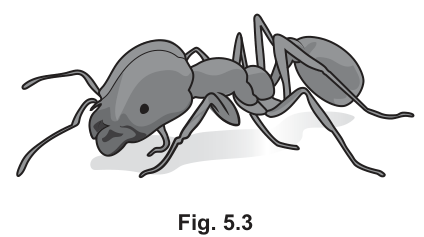
S. geminata is an arthropod.
The arthropods are classified into a number of groups.
Answer
Insect.
Insect
Walkthrough
Arthropods are divided into four main groups: insects, arachnids, crustaceans and myriapods. An ant has three pairs of legs, one pair of antennae and a body in three sections — the defining features of an insect.
Key Takeaways
- Insect: 3 pairs of legs, 1 pair of antennae, head–thorax–abdomen, usually 2 pairs of wings.
- Arachnid: 4 pairs of legs, no antennae. Crustacean: 5+ pairs of legs, 2 pairs of antennae. Myriapod: many legs, 1 pair of antennae.
Common Mistakes
- Writing 'arthropod' — that is the phylum, not the group within it; the question already states it is an arthropod.
- Writing 'invertebrate' — too broad.
Things to Be Careful About
- The question says 'the group of arthropods', so the answer must be one of the four arthropod classes.
State two visible features used to classify S. geminata in this group of arthropods.
- ______
- ______
Answer
Any two of:
- Three pairs (six) of jointed legs;
- Body divided into three sections — head, thorax and abdomen;
- One pair of antennae.
Three pairs of legs; three body sections (head, thorax, abdomen); one pair of antennae — any two
Walkthrough
The mark scheme wants visible features from Fig. 5.3 that place the ant in the insects. The credited features are: three pairs of legs, legs attached to the thorax, three body sections (head, thorax, abdomen), and one pair of antennae. Pick any two and state them precisely — 'three pairs of legs' scores, 'has legs' does not, because all arthropods have legs.
Key Takeaways
- Diagnostic features must distinguish the group from other arthropods — leg NUMBER and body SEGMENTS are the discriminators.
- 'Visible' means you must be able to point to it on the drawing.
Common Mistakes
- Saying 'has jointed legs' or 'has an exoskeleton' — true of ALL arthropods, so it does not identify the insect group.
- Saying 'wings' — ants shown here have none visible, and it is not a credited feature.
- Giving only one feature when two are asked for.
Things to Be Careful About
- 'Any two from' — give exactly two, stated with numbers (three pairs, one pair, three sections).
Lake Victoria, in Africa, is one of the largest fresh water lakes in the world.
It is an important ecosystem for people living around the lake who catch fish as part of their diet.
Fig. 6.1 shows part of a food web for the lake.
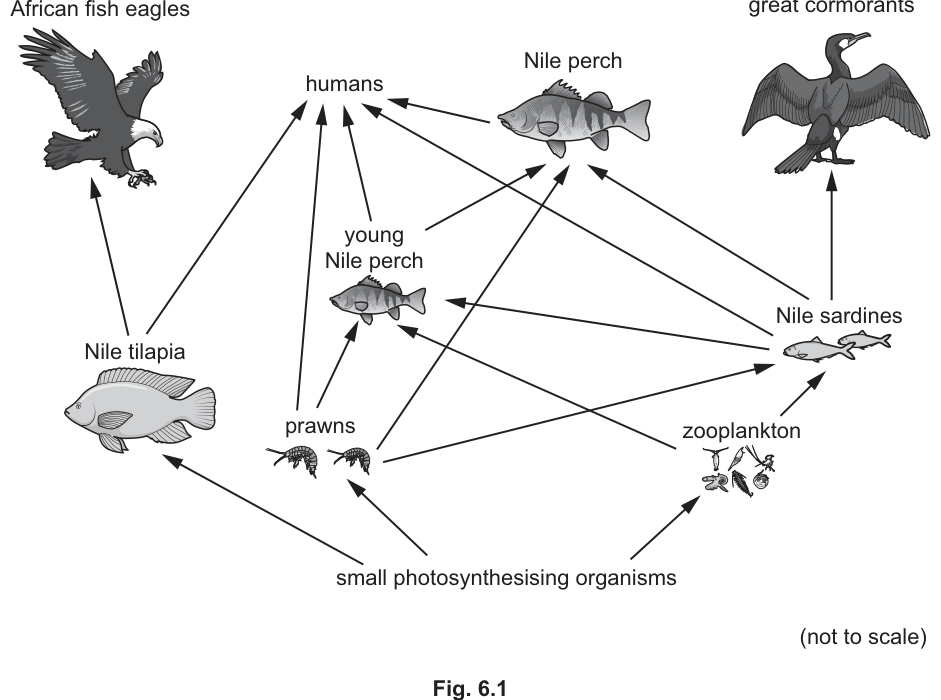
State the name of an organism shown in Fig. 6.1 that is:
a primary consumer
______
both a secondary consumer and a tertiary consumer.
______
Answer
Primary consumer: zooplankton
Both a secondary and a tertiary consumer: Nile perch
Primary consumer: zooplankton; secondary and tertiary consumer: Nile perch
Walkthrough
A primary consumer eats the producers — here, the small photosynthesising organisms. Following the arrows out of the producers, zooplankton, prawns and Nile tilapia all feed on them, so any one of these is a valid primary consumer.
An organism that is both a secondary and a tertiary consumer must occupy different trophic levels in different food chains within the web. Nile perch eats young Nile perch (which are themselves primary/secondary consumers) and also eats Nile sardines and prawns, so depending on the chain it is a secondary consumer (e.g. producer → prawn → Nile perch) and a tertiary consumer (e.g. producer → zooplankton → Nile sardine → Nile perch). Humans and young Nile perch also fit; one named organism is enough.
Key Takeaways
- Arrows in a food web point from the organism being eaten to the eater, showing the direction of energy flow.
- The same organism can occupy different trophic levels in different food chains of a web.
- Primary consumers feed directly on producers.
Common Mistakes
- Naming a producer (small photosynthesising organisms) as a primary consumer.
- Naming an organism that is only ever a secondary consumer (e.g. African fish eagles, which only eat Nile tilapia) for the second blank.
- Giving more than one organism when one is asked for.
Things to Be Careful About
- Trace the arrows carefully; the mark scheme accepts Nile tilapia, prawns or zooplankton for the first blank and young Nile perch, Nile perch or humans for the second — one name each is sufficient.
Humans eat Nile tilapia, prawns, Nile sardines and Nile perch.
Use information from Fig. 6.1 to state which of these is the least energy efficient for humans to eat and explain why.
Answer
Nile perch. It is at the highest trophic level (a tertiary/quaternary consumer), so energy has passed through the most trophic transfers, and at each transfer much energy is lost to the environment, e.g. in respiration (heat), excretion and egestion, leaving less energy available to humans.
Nile perch — highest trophic level, so most energy has been lost between trophic levels
Walkthrough
The question asks which of the four fish humans eat gives them the least energy. Energy is lost at every step along a food chain — through respiration (released as heat), excretion, egestion and uneaten parts — so the shorter the chain from producer to human, the more energy reaches the human.
Compare the chains: Nile tilapia can be eaten straight after feeding on producers (producer → Nile tilapia → human), a short chain. Nile perch, however, sits at the top of long chains — it eats young Nile perch, Nile sardines and prawns, which themselves may have eaten other consumers — so it is a tertiary/quaternary consumer at the fourth or fifth trophic level. By the time energy reaches Nile perch, most of it has been lost, so humans gain least energy from eating Nile perch.
The mark scheme joins two ideas with '+': naming Nile perch AND giving the reason (highest number of links / highest trophic level, plus energy lost to the environment). Both halves are needed for full marks.
Key Takeaways
- Only about 10% of the energy at one trophic level passes to the next; the rest is lost in respiration (heat), excretion, egestion and uneaten material.
- The longer the food chain, the less energy reaches the top consumer.
- This is why food chains rarely have more than four or five trophic levels.
Common Mistakes
- Naming Nile perch but omitting the explanation — the mark needs both the organism and the reason.
- Saying energy is 'destroyed' — energy is transferred to the environment, mostly as heat from respiration.
- Choosing an organism on a short chain (e.g. Nile tilapia) because it looks small.
Things to Be Careful About
- Use the phrase 'energy is lost to the environment' or name a specific loss (respiration, heat, excretion, egestion, uneaten parts) rather than a vague 'energy is used up'.
Suggest the effects on this ecosystem of increasing the mass of Nile tilapia taken from the lake by human fishing.
Answer
- The population of African fish eagles will decrease (they may die), because Nile tilapia is their food.
- The population of small photosynthesising organisms will increase, because fewer Nile tilapia are eating them.
- Populations of other organisms eaten by Nile tilapia, e.g. zooplankton and prawns, will increase because there is less competition for their food.
African fish eagles decrease; photosynthesising organisms increase; other prey of Nile tilapia (e.g. zooplankton, prawns) increase
Walkthrough
Removing more Nile tilapia affects the web in two directions.
Upwards: African fish eagles eat Nile tilapia. With fewer tilapia, the eagles have less food, so their population falls and some may die.
Downwards: Nile tilapia eat the small photosynthesising organisms. With fewer tilapia eating them, the producers increase in mass. Also, tilapia compete with zooplankton and prawns for the producers, so those populations increase too — the mark scheme credits 'more + any other organisms in web' for this reason.
Each mark needs the change AND the organism; 'increase' or 'decrease' alone without naming which organism is affected does not score.
Key Takeaways
- Removing a species affects both its predators (less food) and its prey/competitors (less predation and competition).
- Changes in one population ripple through an entire food web.
Common Mistakes
- Giving a change without naming the organism, or naming an organism without saying whether it increases or decreases.
- Saying zooplankton decrease — tilapia eat producers, not zooplankton, so zooplankton face less competition and increase.
Things to Be Careful About
- 'Suggest' questions want you to apply web logic to the specific arrows in Fig. 6.1, not give generic answers about overfishing.
Suggest and explain ways in which the fish populations of the Lake Victoria ecosystem can be managed so that they provide a sustainable resource.
Answer
- Quotas — limit the mass/number of fish taken so that enough remain to breed and replace those caught.
- Closed seasons — no fishing during the breeding season so that fish can reproduce and populations recover.
- Protected areas / no-fishing zones — areas where fish are safe to breed, restocking the surrounding waters.
- Control net mesh size — small-mesh nets are banned so that young fish are not caught and can grow and breed.
- Education — teach fishers why limits are needed so they comply with the rules.
- Monitoring and enforcement — check catches and police the regulations so the rules are actually followed.
See working — any three methods, each with an explanation (methods alone score a maximum of three marks)
Walkthrough
A resource is sustainable if it is used at a rate at which it can be replaced. For fish stocks, that means the fishing rate must not exceed the rate at which fish reproduce and grow. The mark scheme lists six methods, each needing an explanation, with a maximum of three marks for methods given without explanations — so always pair each method with why it works.
- Quotas: a legal limit on the mass or number of fish caught leaves enough adults to breed and replace those removed.
- Closed seasons: banning fishing during the breeding season allows fish to spawn and populations to recover.
- Protected areas: zones where no fishing is allowed act as nurseries; fish bred there spread into fished areas.
- Net mesh size: large-mesh nets let young (small) fish escape, so they survive to grow and reproduce; small-mesh nets catch the young before they breed.
- Education: fishers who understand why limits exist are more likely to follow them.
- Monitoring/enforcement: rules only work if they are checked and enforced.
Key Takeaways
- Sustainability means harvesting no faster than the population can replace itself.
- Management methods work either by limiting how much is taken (quotas, mesh size) or by protecting when and where fish breed (closed seasons, protected areas).
- Rules need education and enforcement to be effective.
Common Mistakes
- Listing methods without explanations — the scheme caps this at three marks.
- Vague answers such as 'stop fishing' or 'don't overfish' without saying how.
- Giving 'breed fish in fish farms' — restocking is not among the credited points here.
Things to Be Careful About
- The question says 'suggest and explain', so every method must carry its reason. Three fully explained methods score all five marks.
Fig. 6.2 shows a diagram of the Nile perch gas exchange system and part of the circulatory system.
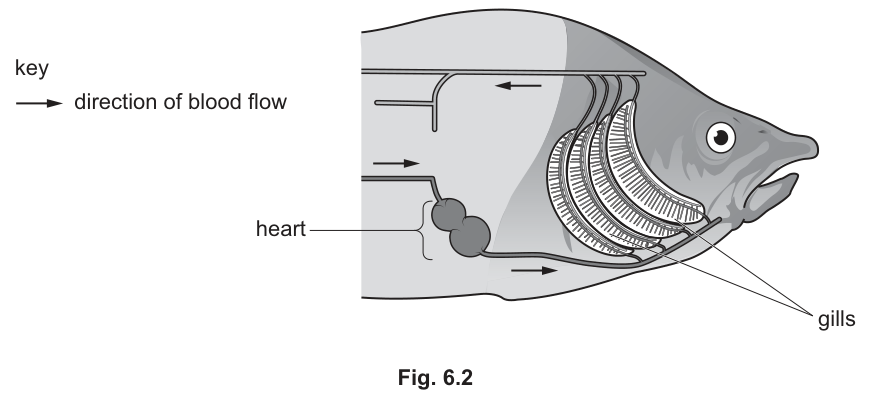
Describe the similarities and differences between the human and Nile perch circulatory and respiratory systems.
similarities ______
differences ______
Answer
Similarities (any three):
- Both have a heart that acts as a pump.
- Blood flows one way only / both have valves in the heart to prevent backflow.
- Both have a large surface area for gas exchange.
- The gas exchange surfaces have a rich blood supply.
Differences (any two):
- The human heart has four chambers; the fish heart has two chambers.
- Humans have a double circulation; fish have a single circulation.
- Human blood passes through the heart twice in one complete circuit of the body; fish blood passes through the heart only once.
- Humans have lungs with alveoli; fish have gills.
Similarities: heart as pump, one-way blood flow/valves, large gas exchange surface, rich blood supply (any three). Differences: four-chambered vs two-chambered heart, double vs single circulation, blood through heart twice vs once, lungs vs gills (any two)
Walkthrough
The mark scheme caps each side at three marks, so give up to three similarities and up to two differences.
Similarities. Both animals need to pump blood and exchange gases, so the underlying design is shared: a heart acting as a pump; blood flowing in one direction only (valves in the heart prevent backflow); a large surface area where gases are exchanged; and that surface richly supplied with blood so gases can be carried to and from it quickly.
Differences. Fig. 6.2 shows the fish heart with two chambers, while the human heart has four. The fish has a single circulation: the heart pumps blood once around a complete loop — heart → gills → body → heart — so blood passes through the heart once per circuit and loses pressure in the gills. Humans have a double circulation: the right side pumps blood to the lungs and the left side pumps it to the body, so blood passes through the heart twice in one complete circuit and is re-pressurised before reaching the body. Finally, the gas exchange organs differ: lungs with alveoli in humans, gills in fish.
Key Takeaways
- Single circulation: blood passes through the heart once per complete circuit (fish). Double circulation: blood passes through the heart twice per circuit (mammals), keeping pressure high in the systemic circulation.
- All efficient gas exchange surfaces share features: large surface area, thin, rich blood supply, ventilation.
Common Mistakes
- Writing 'fish have no heart' or confusing the number of chambers.
- Saying 'fish have single circulation' without contrasting it with double circulation in humans — each difference should name both sides.
- Confusing arteries and veins when describing flow; the credited points here are about the heart, circulation type and gas exchange organs.
Things to Be Careful About
- The scheme allows a maximum of three similarity marks and a maximum of three difference marks, but the question is worth 5 in total — three similarities plus two differences is the safe combination.
- Use the precise terms 'single circulation', 'double circulation', 'alveoli' and 'gills'.
Explain how long-term active immunity develops in the human body after infection by a pathogen.
Answer
- Pathogens carry specific proteins/chemicals on their surface — antigens.
- Lymphocytes recognise the antigens.
- Lymphocytes produce antibodies.
- Antibodies are complementary to the antigens.
- Antibodies bind to the antigens.
- Antibodies clump the pathogens together / mark them for destruction by phagocytes.
- Memory cells are produced, so on a second infection antibodies are produced faster and in greater numbers.
Seven-point explanation of active immunity covering antigens, lymphocytes, antibody production, complementarity, binding, clumping/engulfing and memory cells.
Walkthrough
This is an Explain question worth 7 marks, and the mark scheme gives 10 possible points with any seven from. So the task is to give seven distinct, correct points that together tell the story of how active immunity develops after an infection.
Work through the biology in order:
-
Antigens. Every pathogen (bacterium, virus, etc.) carries specific chemicals or proteins on its surface. These are called antigens. The word specific matters — each pathogen has its own unique antigens, which is why the immune response is specific to that particular pathogen.
-
Lymphocytes recognise the antigens. Lymphocytes are a type of white blood cell. When they meet a foreign antigen, they recognise it as "not self" and are triggered into action.
-
Antibody production. The lymphocytes respond by producing antibodies — proteins released into the blood. Each antibody is shaped to match one specific antigen.
-
Complementarity. The antibody is complementary to the antigen — its shape fits the antigen's shape, like a lock and key. This is the same idea as the lock-and-key model of enzyme action.
-
Binding. The antibody binds to the antigen on the pathogen's surface.
-
Destruction. Once bound, the antibody can destroy the pathogen directly, or it can clump the pathogens together and mark them so that phagocytes engulf and digest them.
-
Memory cells. Some of the activated lymphocytes become memory cells. These stay in the body for years. If the same pathogen infects again, the memory cells respond much faster, producing antibodies more quickly and in greater numbers. This is what makes the immunity long-term and active — the body made its own antibodies and remembers how.
For the answer, give any seven of the ten points as a numbered list, in the natural order of the response.
Key Takeaways
- Active immunity means the body makes its own antibodies after infection (or vaccination).
- The sequence is: antigen → lymphocyte → antibody → bind → destroy/clump → memory cell → faster second response.
- "Long-term" comes from memory cells.
- Antibodies are complementary to antigens and bind to them.
Common Mistakes
- Confusing active with passive immunity. Passive immunity is receiving ready-made antibodies (e.g. from mother's milk); active immunity is making your own. This question is all about active immunity.
- Saying "white blood cells" instead of "lymphocytes" — the mark scheme specifically wants lymphocytes.
- Missing the "specific" idea — each pathogen has specific antigens, and the response is specific to them.
- Forgetting memory cells — without them there is no "long-term" immunity.
- Giving vague descriptions of antibodies "killing" without the mechanism (bind, clump, engulf).
Things to Be Careful About
- Give exactly 7 points, not 10 — the scheme says "any seven from", so extra points gain no extra marks and waste time.
- Use the exact terms: antigens, lymphocytes, antibodies, complementary, bind.
- Point 1 requires "pathogens + specific + chemicals/proteins" — the "+" means BOTH halves are needed for that one mark. So say "pathogens have specific proteins/chemicals".
- Point 5 "antibodies complementary to antigens" — "complementary" is the key word (AW = alternative wording accepted, but complementary is best).
- Point 8: "mark / clump together for destruction / engulfing by phagocytes" — any one of these mechanisms scores.
In any group of humans, there is variation in how well each person's immune system responds to infections.
Suggest factors which may contribute to this variation.
Answer
Any three from:
- The number of lymphocytes a person has / their ability to produce antibodies.
- Age.
- Previous exposure to the pathogen / vaccination.
Three factors: number of lymphocytes, age, previous exposure to the pathogen/vaccination.
Walkthrough
This is a Suggest question worth 3 marks, and the mark scheme lists 7 possible factors with any three from. You just need to recall three factors that would make one person's immune response better or worse than another's.
The factors, with the biology behind each:
- Number of lymphocytes / ability to produce antibodies. Some people naturally have more lymphocytes, or lymphocytes that respond more effectively, so they produce more antibodies and clear an infection faster.
- HIV infection. HIV attacks and destroys lymphocytes, so an infected person has a weakened immune system and responds poorly to other infections.
- Age. Very young babies and elderly people tend to have weaker immune responses than healthy adults.
- Sex. Males and females can differ in immune response strength, partly because of hormones.
- Genetics. Inherited differences in the genes that control the immune system affect how well a person responds.
- Diet. Malnutrition, especially lack of protein, weakens the immune system because antibodies are proteins and need protein to be made.
- Previous exposure / vaccination. Someone who has met the pathogen before (or been vaccinated) already has memory cells, so their response is faster and stronger.
Give any three of these as your answer.
Key Takeaways
- Immune response strength varies between people for many reasons.
- The factors fall into groups: innate (genetics, age, sex), acquired (HIV, diet, previous exposure), and individual (lymphocyte numbers).
- Vaccination is a way of gaining immunity without getting the disease.
Common Mistakes
- Giving vague answers like "health" or "lifestyle" without being specific — the mark scheme wants named factors.
- Confusing "previous exposure" with "infection" — previous exposure can be via vaccination too.
- Not mentioning HIV specifically when it is a major factor that destroys lymphocytes.
Things to Be Careful About
- Give exactly 3 factors.
- "Previous exposure to pathogen / immunity / vaccination / immunisation" is ONE point — any one of these forms counts.
- Each factor is one mark; don't give two versions of the same factor (e.g. "age" and "being old" is still one point).