Biology 5090/22 — May/June 2024
Cambridge O-Level · Theory · worked solutions for every part, with the mark scheme
Topics Cell Structure and Organisation · Plant Nutrition · Inheritance · Coordination and Control · Organisms and Their Environment · Classification · +6 more
Fig. 1.1 shows two cells from the leaf of a plant observed using a light microscope.
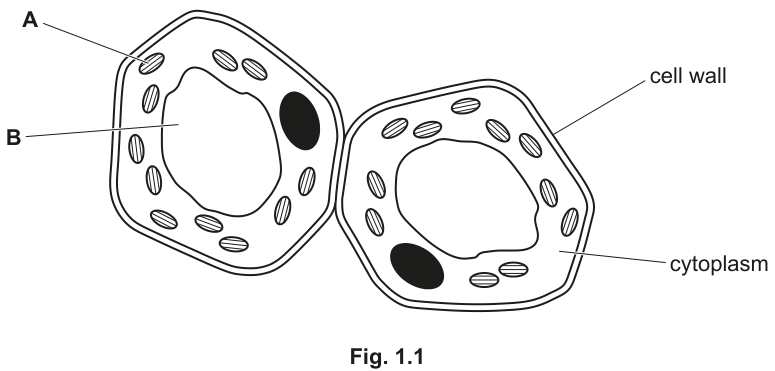
Complete Table 1.1 to identify the structures labelled A and B and to describe the function of each structure.
Table 1.1
| structure | name of structure | description of function |
|---|---|---|
| A | ||
| B |
Answer
| structure | name of structure | description of function |
|---|---|---|
| A | chloroplast | absorbs light energy for photosynthesis / makes glucose (starch) |
| B | (sap) vacuole | stores cell sap; keeps the cell turgid, giving support |
A = chloroplast, site of photosynthesis; B = (sap) vacuole, storage and turgor/support
Walkthrough
The figure shows two leaf cells under a light microscope. The cell wall and cytoplasm are already labelled, so the two lettered structures must be other plant-cell organelles.
Structure A points to one of the small oval bodies scattered in the cytoplasm. In a leaf these are chloroplasts — they contain the green pigment chlorophyll, which absorbs light energy. Their function is photosynthesis: converting light energy into chemical energy in glucose (some of which is stored as starch). The mark scheme accepts 'photosynthesis', 'light energy to chemical energy' or 'make glucose / make starch' — any one of these earns the function mark.
Structure B points to the large, clear, central space that dominates each cell. This is the sap vacuole, filled with cell sap (a solution of salts and sugars in water). Its function is storage of these dissolved substances, and — because the vacuole presses the cytoplasm against the cell wall — it keeps the cell turgid, which supports the soft leaf tissue. Either 'storage' or 'turgor / support' scores the function mark.
Key Takeaways
- A leaf cell under the light microscope shows: cell wall, cytoplasm, nucleus, chloroplasts and a large central sap vacuole.
- The chloroplast is the site of photosynthesis — light energy is converted to chemical energy in glucose.
- The sap vacuole stores cell sap and, when full of water, keeps the cell turgid so it supports the plant.
Common Mistakes
- Calling A a 'chlorophyll' — chlorophyll is the pigment inside the chloroplast; the structure itself is the chloroplast.
- Calling B the 'nucleus' — the nucleus is the dark-staining solid body (drawn black in the figure), not the large clear central space.
- Giving only the name without a function, or a vague function like 'it does photosynthesis things' — the mark needs the idea of making glucose/starch or trapping light energy.
- Writing 'cell membrane' for B — the membrane is the thin line just inside the cell wall, not the large central space.
Things to Be Careful About
- The function mark for A must mention photosynthesis, or making glucose/starch, or light-to-chemical energy conversion — 'contains chlorophyll' alone describes a feature, not a function.
- The function mark for B needs 'storage' or 'turgor / support' — one is enough, but it must be one of these ideas.
- Spell 'chloroplast' and 'vacuole' correctly; 'vacule' or 'cloroplast' may be penalised.
State one structure that is not visible in Fig. 1.1 but would be visible in the cytoplasm in an electron micrograph of the same two cells.
______
Answer
ribosomes (or mitochondria)
ribosomes
Walkthrough
A light microscope can only resolve structures down to roughly , so it shows the nucleus, chloroplasts, cell wall, vacuole and cytoplasm. An electron microscope resolves far finer detail, so much smaller organelles become visible: ribosomes, mitochondria, the endoplasmic reticulum and the Golgi apparatus. Any one of these is a correct answer; ribosomes and mitochondria are the two the mark scheme names first, and it also accepts plant-cell structures beyond the syllabus such as rough ER or the Golgi apparatus.
Key Takeaways
- The light microscope cannot resolve ribosomes or mitochondria; the electron microscope can.
- 'Visible in an electron micrograph but not a light micrograph' is the standard cue for the very small organelles.
Common Mistakes
- Naming a structure that IS visible in Fig. 1.1, such as the nucleus or chloroplast — these are already seen with the light microscope.
- Naming a non-cellular or non-existent structure.
Things to Be Careful About
- Only ONE structure is required — writing two is unnecessary, though the scheme is 'max 1' so a second wrong one alongside a right one still scores.
- 'Cell membrane' is risky: it is technically visible with a light microscope as the boundary of the cytoplasm, so avoid it here.
Organisms can be classified into groups using the features they share.
Fish are one of the main groups of vertebrates.
State three main features used to classify an organism as a fish.
- ______
- ______
- ______
Answer
- gills
- scales (or scaly skin)
- fins
gills, scales, fins
Walkthrough
The question asks for features used to classify an organism as a fish. Classification relies on shared, observable physical structures. Fish are primarily defined by having gills for breathing underwater, scales covering their skin, and fins for movement. The mark scheme also accepts physiological or reproductive traits like being cold-blooded, having external fertilisation, or laying eggs with no shell surrounded by jelly, but structural features are the most direct and reliable answers.
Key Takeaways
Vertebrates are grouped into classes (fish, amphibians, reptiles, birds, mammals) based on shared anatomical and physiological adaptations to their environments. For fish, these are gills, scales, and fins.
Common Mistakes
Candidates often list environmental or behavioural traits instead of physical features. For example, stating 'lives in water' or 'swims' does not classify an organism; a whale lives in water but is a mammal. Similarly, 'cold-blooded' is a physiological trait, not a structural feature, though the mark scheme accepts it.
Things to Be Careful About
The question asks for three features. Give exactly three distinct points. Ensure you name physical structures (gills, scales, fins) rather than general characteristics. The mark scheme explicitly accepts 'scales / scaly skin' and 'eggs with no shell', but 'gills', 'scales', and 'fins' are the primary structural answers.
Answer
- mammals
- birds
(acceptable alternatives: reptiles, amphibians)
mammals and birds
Walkthrough
The five main groups (classes) of vertebrates are fish, amphibians, reptiles, birds, and mammals. The question asks for two groups other than fish. Simply naming any two of the remaining four groups will score the marks.
Key Takeaways
All vertebrates share a backbone, but they are divided into five major classes based on their adaptations: fish (gills, scales), amphibians (moist skin, metamorphosis), reptiles (dry scales, amniotic eggs), birds (feathers, warm-blooded), and mammals (hair, milk-producing glands, warm-blooded).
Common Mistakes
A very common error is naming invertebrate groups (e.g., insects, arachnids, molluscs) or subgroups within a vertebrate class (e.g., primates, carnivores, or 'sea creatures'). The question specifically asks for main groups of vertebrates.
Things to Be Careful About
State exactly two groups. Do not write 'vertebrates' itself, as fish are already vertebrates. Use the standard class names: mammals, birds, reptiles, amphibians.
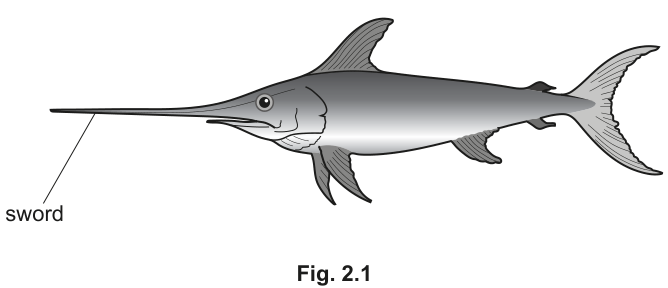
Swordfish are large fish that live in the ocean.
They have a long, bony extension to the skull, called a sword.
Fig. 2.1 is a diagram of a swordfish.
The binomial name of the swordfish is Xiphias gladius.
Answer
A species is a group of organisms that can reproduce (or breed / mate) to produce fertile offspring.
A group of organisms that can reproduce to produce fertile offspring.
Walkthrough
The biological definition of a species requires two critical conditions to be met: first, the organisms must be able to interbreed (reproduce, breed, or mate) with one another; second, the offspring they produce must be fertile (capable of reproducing themselves). Both conditions must be stated to earn full marks.
Key Takeaways
The biological species concept defines a species not by how organisms look, but by their reproductive isolation. If two populations can interbreed and produce fertile young, they belong to the same species. If they cannot, or if their offspring are infertile (like a mule from a horse and donkey), they are different species.
Common Mistakes
Candidates frequently forget the word 'fertile'. Stating 'organisms that can reproduce' is incomplete and scores zero, because a horse and a donkey can reproduce to produce a mule, but they are distinct species. Another common mistake is defining a species by physical appearance ('organisms that look similar'), which is incorrect.
Things to Be Careful About
You must include both the ability to 'reproduce / breed / mate' AND the production of 'fertile offspring' to get both marks. The word 'fertile' is underlined in the mark scheme, meaning it is a mandatory marking point.
Answer
gladius
gladius
Walkthrough
The binomial name of an organism consists of two parts: the genus name (capitalised) and the species name or specific epithet (lowercase). For the swordfish, the full binomial name is Xiphias gladius. The genus is Xiphias, and the species name is gladius.
Key Takeaways
Binomial nomenclature is the universal two-part naming system for organisms. The first word is the genus, which groups closely related species. The second word is the species identifier. Both words must be italicised when typed, or underlined when handwritten.
Common Mistakes
Candidates often write the full binomial name (Xiphias gladius) when only the species name is asked for. Others write the genus name (Xiphias) by mistake. Some fail to italicise or underline the species name, which is a formatting requirement in biological writing.
Things to Be Careful About
The question specifically asks for the 'species name', not the full binomial name. Therefore, only gladius is correct. Ensure it is written in lowercase and italicised (or underlined if handwriting).
Swordfish swim near the surface of the ocean where the water temperature is low.
During evolution, swordfish developed a muscle behind each eye that warms the eyes and the brain to a temperature above that of the ocean.
This feature gives swordfish improved vision.
Name the process that led to the evolution of the muscle behind each eye of the swordfish.
______
Answer
natural selection
natural selection
Walkthrough
The question asks for the biological process that led to the evolution of a specific adaptation (the heat-generating muscle). In evolutionary biology, the process by which organisms with advantageous inherited traits survive and reproduce more successfully in their environment is called natural selection.
Key Takeaways
Natural selection is the driving mechanism of evolution. It acts on existing genetic variation within a population. Individuals with traits better suited to their environment are more likely to survive and pass those traits to the next generation.
Common Mistakes
Candidates sometimes write 'evolution' itself, but the question asks for the process that led to evolution. Others write 'mutation'; while mutation provides the raw genetic variation, it is natural selection that acts on that variation to cause evolutionary change. 'Survival of the fittest' is a related concept but 'natural selection' is the precise scientific term required here.
Things to Be Careful About
Use the exact term 'natural selection'. Do not overcomplicate the answer; a single, precise term is all that is required for this 1-mark question.
Suggest reasons why the evolution of this feature has adapted swordfish to survive in the ocean.
Answer
- The warmed eyes and brain improve vision, allowing the swordfish to see and hunt prey (or food) more effectively.
- Catching more prey provides more food and energy, improving the fish's chances of survival.
- Better vision allows the swordfish to see and avoid predators, reducing the chance of being attacked or eaten.
- Improved vision also helps in spotting mates, leading to more successful reproduction and an increased population.
(max 4)
See working
Walkthrough
This question asks for reasons why a specific adaptation (warming the eyes and brain to improve vision in cold water) helps swordfish survive. To score the marks, you must link the anatomical feature to its function, and then to its survival and reproductive advantages.
Step 1: The adaptation improves vision. Better vision allows the swordfish to see and hunt prey (food) more effectively.
Step 2: Catching more food means the fish gets more energy and nutrients, which directly aids its survival.
Step 3: Improved vision is not just for hunting; it also allows the fish to detect threats. It can see predators and avoid them, preventing it from being eaten.
Step 4: Finally, survival leads to reproduction. Better vision helps swordfish find and see mates, ensuring they can reproduce and pass on the genes for this adaptation, increasing the population.
Any four logical points from this chain of reasoning will score.
Key Takeaways
Adaptations improve an organism's fitness, which is defined by its ability to survive and reproduce. When explaining an adaptation, always connect the physical feature to its immediate function (e.g., better vision), and then explain how that function provides a survival or reproductive advantage in the organism's specific environment.
Common Mistakes
Candidates often stop at the immediate function and forget the evolutionary consequence. For example, stating 'it helps them see' is not enough; you must explain why seeing is an advantage (e.g., 'so they can catch more food' or 'so they can avoid predators'). Another mistake is failing to mention both hunting prey and avoiding predators, or forgetting to link the advantage back to reproduction and population increase.
Things to Be Careful About
The question is worth 4 marks, and the mark scheme provides a list of 7 possible points, with 'max 4'. You must provide exactly four distinct, well-reasoned points. Each point must show a clear cause-and-effect link. Do not just list advantages; explain how the feature leads to the advantage. For instance, 'see prey' is weak; 'see prey so they can catch more food for energy' is a complete, mark-awarding point.
Complete Table 3.1, using terms from the list below to match each description to a term.
phenotype dominant gene genotype
heterozygous homozygous allele recessive
Table 3.1
| description | term |
|---|---|
| a form of a gene that codes for one of a pair of contrasting features | |
| a form of a gene that always has an effect when it is present | |
| having two different forms of a gene for a particular feature | |
| having two of the same form of a gene for a particular feature | |
| the combination of alleles that an organism has in its chromosomes |
Answer
| description | term |
|---|---|
| a form of a gene that codes for one of a pair of contrasting features | allele |
| a form of a gene that always has an effect when it is present | dominant |
| having two different forms of a gene for a particular feature | heterozygous |
| having two of the same form of a gene for a particular feature | homozygous |
| the combination of alleles that an organism has in its chromosomes | genotype |
allele; dominant; heterozygous; homozygous; genotype
Walkthrough
This is a pure definitions-matching task. Work down the table one row at a time and recall the exact syllabus meaning of each term:
- Allele — a gene can exist in different forms (versions); each form is an allele. The description says 'a form of a gene', so the answer is allele.
- Dominant — an allele that shows its effect whenever it is present, even if only one copy is inherited (e.g. in ). That is 'always has an effect when present'.
- Heterozygous — 'hetero' means different: two different alleles of the gene, e.g. .
- Homozygous — 'homo' means same: two identical alleles, e.g. or .
- Genotype — the pair (combination) of alleles an organism actually carries in its chromosomes, as opposed to the phenotype, which is the observable feature those alleles produce.
Note that recessive, gene and phenotype are distractors in the list — recessive is the allele whose effect is masked unless homozygous, and phenotype is the visible characteristic, not the allele combination.
Key Takeaways
- An allele is one form of a gene; a genotype is the combination of alleles; a phenotype is the resulting observable feature.
- Dominant alleles are expressed in the heterozygote; recessive alleles are expressed only when homozygous.
- The prefixes homo- (same) and hetero- (different) let you decode homozygous and heterozygous instantly.
Common Mistakes
- Writing phenotype for the last row — the phenotype is the observable feature; the combination of alleles is the genotype.
- Writing gene for the first row — the question asks for a form of a gene, which is an allele.
- Swapping heterozygous and homozygous — check whether the two alleles are the same or different.
- Writing recessive for the second row — a recessive allele does not always have an effect; it is masked by the dominant allele.
Things to Be Careful About
- Use the exact terms from the printed list — paraphrases such as 'stronger allele' for dominant will not score.
- Give one term per row; the list contains more terms than rows, so three terms are distractors and should not be reused.
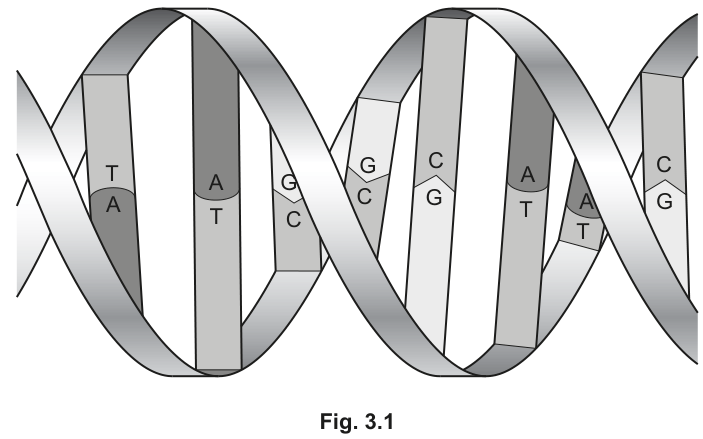
Fig. 3.1 is a diagram of part of a molecule of DNA taken from a bacterial cell.
Answer
double helix
double helix
Walkthrough
Fig. 3.1 shows two strands twisted around each other like a twisted ladder. 'Helix' is the word for a spiral or coil shape, and DNA has two strands, so the shape is a double helix. This is a one-mark recall item — the term must be exact.
Key Takeaways
- DNA consists of two strands coiled around each other: the double helix.
Common Mistakes
- Writing just 'helix' — the mark scheme wants 'double' because DNA has two strands.
- Describing the shape ('twisted ladder', 'spiral') instead of naming it.
Things to Be Careful About
- Give the precise term 'double helix'; a description of the shape does not earn the mark.
Most of the DNA in bacterial cells is found in one large loop in the cytoplasm.
Name another structure in bacterial cells which contains DNA.
______
Answer
plasmid
plasmid
Walkthrough
Bacterial cells have no nucleus. Their main DNA is the single large circular chromosome loose in the cytoplasm, but many bacteria also carry small extra rings of DNA called plasmids, also free in the cytoplasm. Plasmids are important in genetic modification because genes can be transferred into them.
Key Takeaways
- Bacteria have their main DNA as a large loop in the cytoplasm, plus plasmids — small rings of extra DNA.
- Plasmids are used as vectors in genetic modification.
Common Mistakes
- Writing 'nucleus' — bacteria are prokaryotes and have no nucleus; this is the trap the question is built on.
- Writing 'ribosome' or 'cell membrane' — these structures do not contain DNA.
Things to Be Careful About
- The question says 'another structure ... which contains DNA', so any structure other than the main loop must be named — plasmid is the expected answer.
State the name of the type of molecule that is represented by the letters A, T, G and C in Fig. 3.1.
______
Answer
(nitrogenous) base
(nitrogenous) base
Walkthrough
The letters A, T, G and C stand for adenine, thymine, guanine and cytosine. Each of these is a base (a nitrogen-containing, or nitrogenous, base). In the DNA ladder analogy, the bases form the 'rungs', paired A with T and G with C. The mark scheme accepts 'base' or 'nitrogenous base'; 'organic base' also scores.
Key Takeaways
- A, T, G and C are the four bases of DNA; they pair A–T and G–C between the strands.
Common Mistakes
- Writing 'nucleotide' — a nucleotide is a base plus a sugar plus a phosphate, which is more than the letters represent.
- Writing 'amino acid' — amino acids are the units of proteins, not DNA.
- Writing the full base names (adenine etc.) — these are correct bases but the question asks for the type of molecule, so 'base' is the required term.
Things to Be Careful About
- Distinguish base from nucleotide: the letters A, T, G, C alone denote bases, not whole nucleotides.
Answer
- the sequence of bases codes for a protein / a named type of protein
- it determines the sequence of amino acids in the protein
- it therefore determines the shape / structure / function of the protein
(max 2)
The base sequence codes for a protein and determines the sequence of amino acids, and hence the shape and function of the protein.
Walkthrough
A gene is a sequence of bases in DNA. That sequence acts as a code: the order of A, T, G and C specifies the order in which amino acids are joined together to make a protein. Because a protein's shape — and therefore its function (e.g. an enzyme's active site, or haemoglobin) — depends on its amino acid sequence, the base sequence ultimately determines what the protein does. The mark scheme offers three linked points for a maximum of 2:
- the sequence codes for a protein (or a named type of protein);
- it determines the sequence of amino acids;
- it determines the shape / structure / function of the protein.
Any two of these earn the two marks, but the cleanest full answer chains all three: base sequence → amino acid sequence → protein shape and function.
Key Takeaways
- The order of bases in DNA is a code for the order of amino acids in a protein.
- Protein shape depends on amino acid sequence, and protein function depends on shape — so DNA controls cell function through the proteins it codes for.
Common Mistakes
- Writing only 'it codes for proteins' — that earns one mark; the second mark needs the amino acid sequence or the shape/function link.
- Writing 'codes for characteristics' or 'codes for features' — too vague; the code is for proteins.
- Saying the base sequence determines the sequence of bases in the protein — proteins are made of amino acids, not bases.
Things to Be Careful About
- 'Outline' means give the key points briefly — two linked points for two marks. Name a protein (e.g. an enzyme, haemoglobin) if you use the 'named type of protein' route.
Fig. 4.1 is a simplified diagram of a nephron.
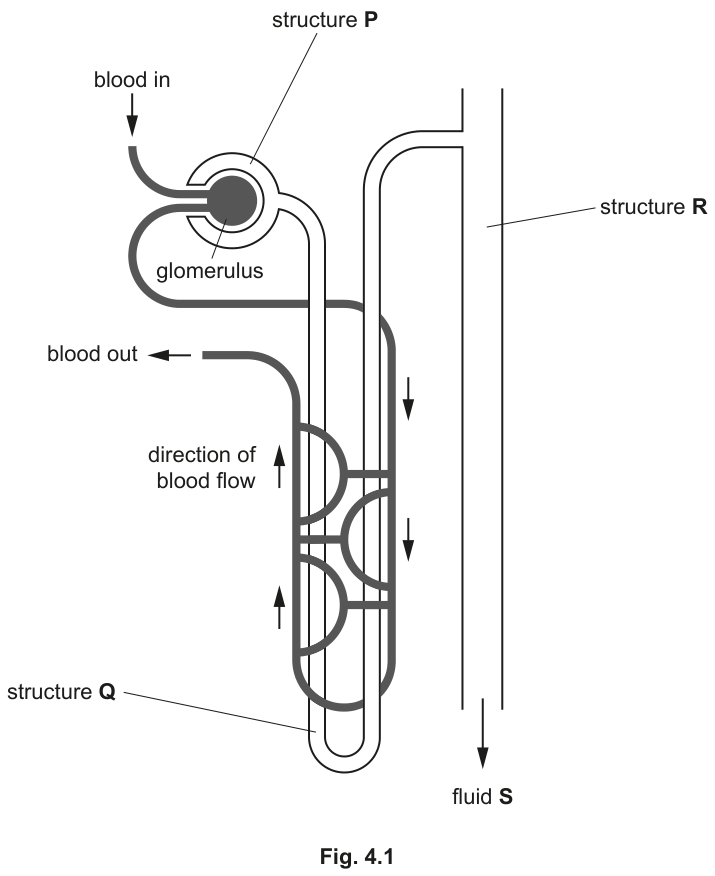
Identify each of the structures labelled P, Q and R in Fig. 4.1.
P = ______
Q = ______
R = ______
Answer
P = Bowman's capsule
Q = loop of Henle
R = collecting duct
P = Bowman's capsule, Q = loop of Henle, R = collecting duct
Walkthrough
To identify the structures in Fig. 4.1:
- Structure P surrounds the glomerulus (a knot of capillaries). This cup-shaped sac is the Bowman's capsule (or renal capsule), where ultrafiltration occurs.
- Structure Q is the hairpin-shaped U-bend of the tubule that dips down into the renal medulla. This is the loop of Henle.
- Structure R is the long, straight duct that receives filtrate from several nephrons and carries the final fluid (urine) toward the renal pelvis and ureter. This is the collecting duct.
Key Takeaways
- The main parts of a nephron are the Bowman's capsule, proximal convoluted tubule, loop of Henle, distal convoluted tubule, and collecting duct.
Common Mistakes
- Confusing Bowman's capsule with the glomerulus itself (the glomerulus is the knot of capillaries inside the capsule).
- Misnaming the collecting duct as the ureter or urethra.
Things to Be Careful About
- Use standard anatomical terms: "Bowman's capsule" (or "renal capsule"), "loop of Henle", and "collecting duct".
Answer
kidney
kidney
Walkthrough
The nephron is the microscopic functional and structural unit of the kidney. Each human kidney contains approximately one million nephrons responsible for filtering blood and forming urine.
Key Takeaways
- The kidney is the excretory organ composed of millions of nephrons.
Common Mistakes
- Naming parts of the urinary tract (e.g. bladder, ureter) instead of the kidney.
Things to Be Careful About
- Keep the distinction clear between the organ of filtration (kidney) and the organ of storage (urinary bladder).
Answer
bladder
bladder
Walkthrough
Fluid S leaving the collecting duct is urine. Urine travels via the ureters to the urinary bladder (or simply bladder), which is a muscular sac that temporarily stores urine before it is excreted from the body via the urethra.
Key Takeaways
- Urine is produced by the kidneys, transported via the ureters, stored in the bladder, and expelled through the urethra.
Common Mistakes
- Confusing the ureter (tube from kidney to bladder) or urethra (tube from bladder to outside) with the storage organ (bladder).
- Confusing the urinary bladder with the gall bladder (which stores bile).
Things to Be Careful About
- Write "bladder" or "urinary bladder" clearly.
Table 4.1 shows the composition of a sample of fluid S from a healthy person.
The person that provided the sample of fluid S eats a balanced diet.
Table 4.1
| component | concentration/arbitrary units |
|---|---|
| glucose | 0.00 |
| protein | 0.00 |
| ions | 1.50 |
| urea | 2.00 |
Answer
Urea is toxic.
Urea is toxic
Walkthrough
Urea is produced in the liver from the deamination of excess amino acids. It is a nitrogenous metabolic waste product. If it accumulates in the blood, it reaches dangerous levels and is toxic (poisonous) to cells and tissues, interfering with cellular metabolism and organ function. Therefore, it must be filtered out and removed in urine (fluid S).
Key Takeaways
- Excretion is the removal of toxic materials and substances in excess of requirements from an organism.
- Urea is toxic to body cells if allowed to accumulate.
Common Mistakes
- Giving vague answers such as "it is not needed" without mentioning that it is harmful/toxic.
Things to Be Careful About
- Use the key term toxic or poisonous.
Use your knowledge of the function of a nephron to explain the concentration of each of the following components of fluid S.
glucose
protein
Answer
glucose:
- Glucose is small enough to be filtered out of the blood / enters the Bowman's capsule (by ultrafiltration).
- All of the glucose is reabsorbed back into the blood (by active transport / diffusion in the nephron tubule), so none remains in fluid S.
protein:
- Protein molecules are too large to pass through the capillary wall / basement membrane of the glomerulus.
- Therefore, protein is not filtered into the Bowman's capsule / does not enter the nephron and remains in the blood.
Glucose is filtered into the Bowman's capsule and then completely reabsorbed into the blood; protein molecules are too large to be filtered, so they do not enter the nephron.
Walkthrough
This question asks to explain why both glucose and protein have a concentration of in fluid S (urine), despite the mechanisms being fundamentally different:
-
Glucose ( in urine):
- Glucose molecules are small and soluble. Under high pressure in the glomerulus, glucose is filtered out of the blood plasma through the capillary wall and basement membrane into the Bowman's capsule (ultrafiltration).
- As the filtrate moves along the proximal convoluted tubule, all of the glucose is selectively reabsorbed back into the surrounding blood capillaries (via active transport and facilitated diffusion).
- Therefore, in a healthy person, no glucose is left in the filtrate by the time it reaches the collecting duct (fluid S concentration = ).
-
Protein ( in urine):
- Protein molecules (such as plasma proteins like albumin) are large macromolecules.
- They are too large to pass through the pores in the glomerular capillary walls and the basement membrane.
- Therefore, proteins do not enter the Bowman's capsule / nephron; they remain in the bloodstream throughout, resulting in a concentration of in fluid S.
Key Takeaways
- Ultrafiltration separates components based on molecular size: small molecules (water, glucose, ions, urea) pass into the filtrate, while large molecules (proteins) and blood cells stay in the blood.
- Selective reabsorption takes back useful substances (all glucose, some water, some ions) into the blood against or down gradients.
Common Mistakes
- Stating that protein is filtered and then reabsorbed (proteins are never filtered in healthy kidneys).
- Stating that glucose is too large to be filtered (glucose is small and easily filtered, but completely reabsorbed).
Things to Be Careful About
- Address both substances separately with clear structure.
- Clearly mention the key processes: filtration (or ultrafiltration) and reabsorption.
Explain what would happen to the concentration of ions in fluid S if the person drank a large volume of water several hours before the sample was collected.
Answer
- The concentration of ions in fluid S would decrease.
- A higher volume of excess water is excreted in fluid S / urine (less water is reabsorbed).
- This occurs as part of homeostasis to maintain a constant water potential / water concentration in the blood.
The concentration of ions would decrease because a larger volume of water is excreted in fluid S to maintain constant blood water potential (homeostasis).
Walkthrough
When a person drinks a large volume of water:
- Water is absorbed into the bloodstream from the alimentary canal, raising the water potential of the blood (diluting the blood plasma).
- To maintain homeostasis (specifically osmoregulation—keeping the water concentration and water potential of the blood constant), the kidneys reabsorb less water from the collecting ducts back into the blood.
- As a result, a larger volume of dilute urine (fluid S) containing excess water is produced and excreted.
- Because the same amount of ions is now dissolved in a much larger volume of water, the concentration of ions in fluid S decreases.
Key Takeaways
- Osmoregulation is the homeostatic control of water and solute concentrations in body fluids.
- Increased water intake leads to a larger volume of dilute urine, which decreases the concentration of dissolved solutes (such as ions and urea) in the urine.
Common Mistakes
- Stating that the ion concentration would increase, confusing total amount of ions excreted with their concentration.
- Forgetting to mention the homeostatic role of keeping the blood water level/concentration constant.
Things to Be Careful About
- Make sure to state both the effect on ion concentration (it decreases) and the biological reason (more water excreted in urine for homeostasis/blood water potential regulation).
Fig. 5.1 is a diagram of a pineapple growing on a pineapple plant.
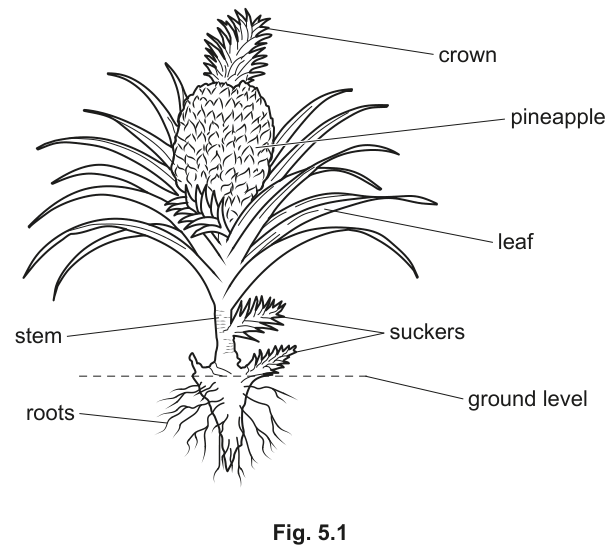
Pineapple plants can be grown on farms by removing the suckers from a parent plant and planting these in the ground to form new plants.
Answer
asexual reproduction
asexual reproduction
Walkthrough
The suckers are removed from one parent plant and planted to grow into new plants. No gametes are involved, no fertilisation occurs, and the new plants are genetically identical to the parent. That is the definition of asexual reproduction — offspring from one parent, by mitosis, without the fusion of nuclei. Growing a new plant from a sucker, a runner, a cutting or a tuber are all examples.
Key Takeaways
- Asexual reproduction uses one parent and produces genetically identical offspring (clones).
- Vegetative propagation (suckers, runners, tubers, bulbs) is asexual reproduction in plants.
Common Mistakes
- Writing just 'reproduction' or 'vegetative propagation' — the mark scheme wants the type, 'asexual'.
- Confusing with sexual reproduction, which would need pollination, gametes and seeds.
Things to Be Careful About
- The blank asks for a type, so a one-word/short-phrase answer is exactly right — no explanation is needed for 1 mark.
State two advantages and two disadvantages of producing pineapple plants in this way.
advantages
- ______
- ______
disadvantages
- ______
- ______
Answer
Advantages
- Rapid — many new plants are produced quickly, giving a greater yield.
- The new plants have the same desirable features as the parent (e.g. the same good fruit quality).
Disadvantages
- All the plants have the same undesirable features too (no genetic variation).
- If the environment changes (e.g. a new disease), all the plants are equally susceptible because none is adapted to the change.
Advantages: rapid production of many genetically identical plants with the parent's desirable features. Disadvantages: no variation, so all share undesirable features and all are vulnerable if the environment changes.
Walkthrough
Asexual reproduction makes clones, so every advantage and disadvantage flows from genetic uniformity:
- Advantages: it is fast — no need to wait for pollination, seed formation and germination, so many plants appear quickly and the yield is high. Because the offspring are genetically identical, any desirable feature of the parent (good fruit size, sweetness) is passed on exactly. The scheme also credits 'only one parent needed' and 'all ripen together so harvesting is easy' — any two of these score.
- Disadvantages: the flip side of uniformity — undesirable features are inherited too, and with no variation, if conditions change (a new pest, disease or climate shift) no plant in the crop is resistant, so the whole crop can be lost. The scheme also credits 'all ripen at once, so the market is flooded and the price falls'.
Key Takeaways
- Clones are genetically identical: uniformity is both the strength (predictable, desirable traits) and the weakness (no variation to cope with change) of asexual reproduction.
- Evaluation answers must give the point AND its consequence.
Common Mistakes
- Listing more than two points per side — the scheme says 'max 2', so extra points earn nothing.
- Giving a bare statement without its reason ('they are all the same' alone does not explain why that is a disadvantage).
- Writing 'no variation' as an advantage by mistake.
Things to Be Careful About
- The answer lines are numbered 1 and 2 under each heading — give exactly two advantages and two disadvantages.
- Each point needs the linked consequence ('+ feature' in the scheme) to earn its mark.
Pineapples are an important crop in Hawaii, USA. They were introduced to Hawaii from South America.
Birds called hummingbirds pollinate pineapple flowers. If pollinated, pineapple fruits develop and they contain hard, inedible seeds. If not pollinated, pineapple fruits develop without seeds.
Hummingbirds are not found in Hawaii.
Suggest why it is illegal to introduce hummingbirds into Hawaii.
Answer
- With hummingbirds present, the pineapple flowers would be pollinated, so fertilisation occurs and the fruits would form seeds.
- Humans do not like seeds in pineapples — the seeds are hard and inedible — so the fruit would be less valuable, reducing the income of Hawaiian growers and harming the economy.
- The hummingbird is a non-native species: it could introduce diseases to Hawaii.
- It could also compete with native species for resources (e.g. nectar, nesting sites), upsetting the existing ecosystem.
Pollinated fruits would contain hard, inedible seeds, reducing the value of the crop and growers' income; the introduced hummingbird could also bring disease and compete with native species for resources.
Walkthrough
This is a 'suggest' question — apply syllabus biology to the pineapple scenario.
The crop argument (the main chain): Pollination is the transfer of pollen to the stigma; if pollination happens, the pollen tube grows and fertilisation follows, and fertilised ovules become seeds. The stem tells you pollinated fruits contain hard, inedible seeds, while unpollinated fruits are seedless. Seedless fruit is what the market wants, so introducing the pollinator would directly damage the crop: consumers would reject seeded fruit and growers' income and the Hawaiian pineapple economy would fall.
The ecological argument: Hummingbirds are not found in Hawaii, so they are a non-native (introduced) species. Introduced species can bring new diseases, and they may compete with native species for a named resource — nectar, food or nesting sites — potentially harming native birds.
Any four points from the list score.
Key Takeaways
- Seeds form only after fertilisation, which follows pollination; seedless fruit can develop without pollination.
- Introducing a non-native species carries risks: disease, competition with native species for resources.
Common Mistakes
- Saying the birds would 'eat the pineapples' — hummingbirds pollinate flowers; they do not destroy the fruit.
- Writing only the ecological points and missing the crop/economic chain, which is the heart of the question.
- Giving vague points like 'it would be bad for the environment' without naming the mechanism (competition for a named resource, disease).
Things to Be Careful About
- 'Suggest' means reason from the data given — use the fact that seeds are 'hard, inedible' and that hummingbirds are 'not found in Hawaii'.
- Four marks are available from a list of seven possible points, so four well-expressed points are needed; each must carry its reason.
Pineapples contain a mixture of protease enzymes called bromelain.
When bromelain is added to its substrate, a product is formed.
Complete the word equation to show the substrate and product.
______ ______
(substrate) (product)
Answer
(substrate) (product)
protein → amino acids
Walkthrough
Bromelain is described in the stem as a mixture of protease enzymes. Proteases are enzymes that break down proteins. Using the lock-and-key idea, the substrate that fits the protease active site is protein, and the end-products of protein digestion are amino acids — the small soluble units that can be absorbed. So the word equation is protein → amino acids.
Key Takeaways
- Protease: substrate = protein, product = amino acids.
- Learn the enzyme/substrate/product triple: amylase (starch → maltose), protease (protein → amino acids), lipase (lipids → fatty acids and glycerol).
Common Mistakes
- Writing 'protein → peptides' — at O Level the expected end-product is amino acids.
- Confusing protease with lipase or amylase.
Things to Be Careful About
- The blanks are labelled (substrate) and (product) — put protein on the left and amino acids on the right, in that order.
The effect of changing pH on the activity of the enzymes found in bromelain was investigated. The results of this investigation are shown in Fig. 5.2.
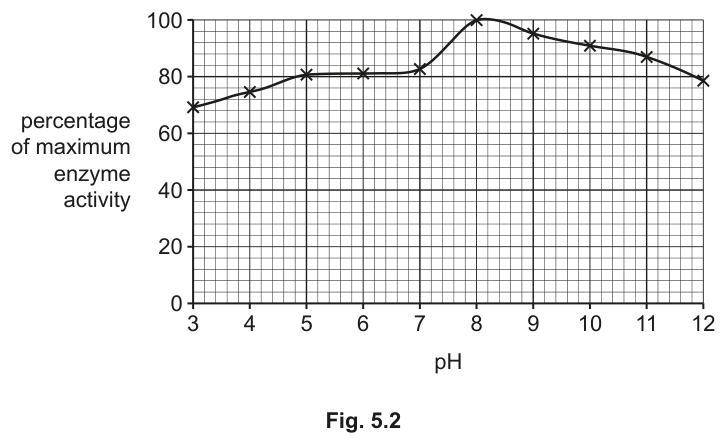
To assist digestion, some people swallow bromelain in the form of a powder with their food.
Use the information in Fig. 5.2 and your knowledge of the human digestive system to discuss the effectiveness of using bromelain in this way.
Answer
- The bromelain is a powder, so it has a large surface area; more enzyme molecules are exposed, so there are more collisions with substrate and higher activity.
- From Fig. 5.2, bromelain has its optimum (highest activity) at pH 8.
- However, it still has high activity (about 70–100%) across the whole pH range 3–12, so it is not denatured at extremes of pH.
- In the stomach the conditions are acidic (HCl, about pH 2), and in the small intestine they are alkaline.
- Bromelain remains active in both the stomach and the small intestine, so it is effective at aiding digestion of protein throughout its passage through the gut.
See working — bromelain is effective because it stays highly active across pH 3–12, so it is not denatured by stomach acid or by the alkaline small intestine.
Walkthrough
'Discuss' means weigh up the evidence from both the graph and your knowledge of the gut.
From the graph (Fig. 5.2): The curve peaks at pH 8 (100% activity), but crucially it never falls low — activity is about 70% even at pH 3 and about 80% at pH 12. So although pH 8 is the optimum, bromelain is unusual: it works well across the whole range pH 3–12 and is not denatured at acidic or alkaline pH. (Most enzymes denature far from their optimum, but the graph shows this one does not.)
From the powder form: A powder has a large surface area, so more enzyme molecules are exposed to the food — more enzyme–substrate collisions, so more activity.
From the digestive system: The stomach contains hydrochloric acid, giving a pH around 2 — strongly acidic. The small intestine is kept alkaline by bile from the liver and by pancreatic juice. A typical enzyme would be denatured by stomach acid, but the graph shows bromelain retains ~70% activity even at pH 3, so it keeps working in the stomach, and it certainly works in the alkaline small intestine. Conclusion: bromelain is effective as a digestive aid because it is active in both the stomach and the small intestine.
Any four of the eight listed points score.
Key Takeaways
- Enzyme activity depends on pH; the optimum is where activity peaks, and extreme pH denatures most enzymes by changing the shape of the active site.
- Reading the graph carefully: high activity over a wide pH range is the key feature that makes bromelain useful.
- Stomach = acidic (HCl); small intestine = alkaline.
Common Mistakes
- Saying bromelain would be denatured in the stomach — the graph shows it is not; this contradicts the data given.
- Quoting only the optimum at pH 8 and concluding it is ineffective elsewhere — the question hinges on the wide, flat, high curve.
- Vague statements like 'it helps digestion' without linking to pH or surface area.
Things to Be Careful About
- 'Discuss' needs points from BOTH sources — the graph and the digestive system. Four marks means four distinct credited points.
- Quote the graph values (about 70% at pH 3, 100% at pH 8) to show you are using the data, not general knowledge.
Flowering plants are sometimes grown in soil to provide cut flowers that can then be displayed.
A gardener watered flowering plants with a fertiliser solution containing dissolved chemicals.
Table 6.1 shows the information printed on the label of the container of fertiliser powder used to prepare this fertiliser solution.
Table 6.1
| chemical component | mass/g per 100g fertiliser powder |
|---|---|
| nitrates | 4.0 |
| phosphates | 4.0 |
| sulfur | 1.0 |
| magnesium | 0.5 |
To prepare the fertiliser solution, the gardener dissolved of the fertiliser powder in of water.
Calculate the total mass of sulfur in the fertiliser solution prepared by the gardener.
______
Working
Answer
0.2 g
Walkthrough
The label says the fertiliser powder contains 1.0 g of sulfur in every 100 g of powder — that is, sulfur makes up 1% of the powder by mass. The gardener used only 20 g of powder, so the sulfur in it is one-fifth of the amount in 100 g: . Dissolving the powder in water does not change the mass of sulfur present; the whole 0.2 g ends up in the solution.
Key Takeaways
- Percentage-by-mass problems: multiply the fraction by the total mass used.
- The unit is part of the answer — '0.2' alone would lose the second mark.
Common Mistakes
- Writing just '0.2' with no unit — the mark scheme awards separate marks for the value and for ''.
- Using 10 dm³ of water in the calculation — the volume of water is irrelevant to how much sulfur was dissolved.
- Dividing by 20 instead of multiplying the fraction.
Things to Be Careful About
- Read the table column heading carefully: the masses are per 100 g of powder, not per gram.
- Give the answer exactly as asked: a total mass, with its unit.
Explain which chemical component of the fertiliser solution is the most important to plants for:
making the leaves of the plants green in colour
the production of enzymes by cells in the leaves of the plants.
Answer
Green leaves: magnesium — it is needed to make chlorophyll, the green pigment that absorbs light for photosynthesis.
Enzyme production: nitrates — they are used to make amino acids, which are joined together to form proteins; enzymes are proteins.
Magnesium (for chlorophyll); nitrates (for amino acids/proteins, from which enzymes are made)
Walkthrough
This part asks you to match two jobs to two chemicals on the fertiliser label.
For green leaves: chlorophyll is the green pigment inside chloroplasts, and each chlorophyll molecule contains a magnesium atom at its centre. Without magnesium ions a plant cannot make chlorophyll, so the leaves turn yellow (chlorosis). So the answer is magnesium, and the reason must mention chlorophyll — naming magnesium alone does not earn the reason mark.
For enzymes: enzymes are proteins. Proteins are built from amino acids, and plant cells make their amino acids using nitrogen taken up as nitrate ions from the soil. Phosphates and sulfur are not the syllabus answer here — phosphate goes into DNA and respiration chemistry, and sulfur is needed in some proteins but the expected pairing is nitrate → amino acids → protein → enzyme.
Key Takeaways
- Magnesium → chlorophyll → green leaves and photosynthesis.
- Nitrate ions → amino acids → proteins → enzymes (and growth).
- Each mark needs both halves: the chemical AND what it does.
Common Mistakes
- Naming magnesium without mentioning chlorophyll — the '+' structure of the mark scheme means both halves are required.
- Giving phosphates or sulfur for enzyme production instead of nitrates.
- Saying nitrates make 'protein' but never linking protein to enzymes, which is what the question actually asks about.
- Confusing nitrate (an ion absorbed by roots) with nitrogen gas, which plants cannot use directly.
Things to Be Careful About
- The question has two stems ('making the leaves green', 'production of enzymes') and four marks — two marks per stem: the chemical, then its role.
- Use the exact terms 'chlorophyll' and 'amino acids'; vague phrases like 'green stuff' or 'building blocks' do not score.
The chemical components of the fertiliser solution are absorbed by the root hair cells of the plants and are then transported to the leaves.
Complete the words below to name the three main tissues in the pathway taken by the chemical components of the fertiliser solution from the root hair cells to the leaves.
The first letter of each word has been completed for you.
C ______
X ______
M ______
Answer
C — cortex
↓
X — xylem
↓
M — mesophyll
cortex, xylem, mesophyll
Walkthrough
Dissolved mineral ions enter through root hair cells, then cross the cortex — the packing tissue of the root between the epidermis and the central vascular bundle. They then travel up the stem in the xylem vessels, which carry water and dissolved minerals upwards from roots to leaves. On reaching the leaf, the xylem branches into veins and delivers the ions to the mesophyll cells, where photosynthesis happens and where the minerals are used (magnesium in chlorophyll, nitrates in amino acids).
The first letters C, X and M are given, so the task is really spelling out the tissue names correctly.
Key Takeaways
- Pathway: root hair cell → cortex → xylem → mesophyll (leaf cells).
- Xylem transports water and dissolved mineral ions upwards; phloem transports sugars (translocation) — do not mix them up.
Common Mistakes
- Writing 'cuticle' or 'cambium' for C instead of cortex.
- Writing 'phloem' for X — phloem carries sucrose, not mineral ions.
- Writing 'mesophyll' wrongly spelled, or giving 'palisade' (which starts with P, not M) — either palisade or spongy mesophyll would be biologically fine, but the letter M fixes the answer as mesophyll.
Things to Be Careful About
- Spelling counts: these are named tissues, so 'cortex', 'xylem' and 'mesophyll' must be recognisably correct.
- Keep the order given by the arrows — the pathway runs root to leaf.
When flowers from the plants are cut and used for display, the leaves are removed before each stem is placed in water.
A solution containing sucrose is often added to this water.
Sucrose is not needed in fertiliser solution used to water plants growing in soil.
Explain the benefit of providing sucrose to cut flowers.
Answer
- The leaves are removed, so the flower cannot carry out much/no photosynthesis, so no glucose is produced.
- The supplied sucrose provides the carbohydrate the flower would normally make itself.
- Sucrose travels in the phloem to the flowers, where it is used in respiration to release energy.
- With this energy supply the flowers last longer.
See working
Walkthrough
Think about what changes when a flower is cut. In the soil-grown plant, the leaves photosynthesise, making glucose, some of which is converted to sucrose and loaded into the phloem. The sucrose travels in the phloem to sinks such as the flowers, where it is respired to release energy for living processes.
Once the stem is cut and the leaves are stripped off, there are almost no leaves left to photosynthesise, so the flower can no longer make its own glucose. It still needs energy for respiration to stay alive. Adding sucrose to the vase water replaces the missing supply: the sucrose is taken up through the cut stem, transported in the phloem to the flower tissues, and respired. With a usable energy source, the flowers stay alive and fresh for longer than they otherwise would.
That also answers why sucrose is unnecessary in fertiliser solution for soil-grown plants: those plants still have their leaves and make all the sugar they need by photosynthesis.
Key Takeaways
- Leaves are the source of sucrose; flowers are sinks.
- Translocation moves sucrose in the phloem from source to sink.
- Respiration needs a carbohydrate substrate to release energy.
- Removing the leaves removes the source, so an external sugar substitutes for photosynthesis.
Common Mistakes
- Saying the sucrose is 'food for the plant' without explaining that it is respired to release energy — the mark sits in the respiration/energy point.
- Forgetting to state why the flower cannot make its own sugar (leaves removed → little or no photosynthesis) — the question asks you to explain, so the because-clause earns the marks.
- Saying sucrose travels in the xylem — xylem carries water and mineral ions; sucrose moves in the phloem.
- Suggesting the sucrose is used for growth or photosynthesis rather than respiration.
Things to Be Careful About
- Three marks from a list of six possible points — give three well-chosen linked points covering: no photosynthesis/glucose, sucrose transported in phloem, used in respiration for energy, flowers last longer.
- Use the exact terms 'photosynthesis', 'glucose', 'sucrose', 'phloem' and 'respiration' — paraphrases like 'food' or 'energy from sugar' risk losing precision marks.
Plastics are produced in very large amounts by industrial processes around the world.
These plastics can enter ecosystems as pollution.
The total mass of plastics produced globally in the year 2020 was 367 million tonnes.
It is estimated that 3% of all plastics produced globally each year enters the ocean as plastic pollution.
Calculate the total mass of plastic pollution that is estimated to have entered the ocean during the year 2020.
______
Working
Total plastic produced = 367 million tonnes = 367 000 000 tonnes.
3% enters the ocean:
Answer
11.01 million tonnes (11 010 000 tonnes)
11.01 million tonnes
Walkthrough
The question gives the total global plastic production in 2020 as 367 million tonnes and tells us that an estimated 3% of all plastics produced enters the ocean each year. To find the mass of plastic pollution, we need to calculate 3% of 367 million tonnes. Percent means 'out of 100', so 3% is the same as . Multiplying 367 000 000 tonnes by gives 11 010 000 tonnes, which is 11.01 million tonnes. The mark scheme also accepts the answer written in standard form as tonnes or tonnes.
Key Takeaways
- A percentage is a fraction out of 100, so to find 3% of a quantity you multiply by .
- Large numbers can be expressed in different ways: 11 010 000 tonnes, 11.01 million tonnes, or tonnes.
- Always include the unit (tonnes) in a calculation answer about mass.
Common Mistakes
- Forgetting to include the unit 'tonnes' – the mark scheme awards a mark for the unit.
- Thinking 3% means 3 million tonnes instead of 3% of 367 million tonnes.
- Misplacing the decimal point when multiplying by .
Things to Be Careful About
The mark scheme gives '11(.01)' as the numerical value, so both 11 million tonnes and 11.01 million tonnes are accepted, but 11.01 million tonnes is the exact value. If you write the answer in standard form, use tonnes or tonnes. The unit is essential.
Some packaging is made from biodegradable carbohydrates.
Microorganisms break down larger carbohydrate molecules into smaller molecules.
Identify this process and name one type of microorganism that is involved.
Answer
decomposition
bacteria / fungi
decomposition; bacteria / fungi
Walkthrough
Biodegradable packaging is made from carbohydrates that can be broken down by microorganisms. The process in which microorganisms such as bacteria and fungi break down dead organic matter into simpler substances is called decomposition. These microorganisms are called decomposers. They release enzymes that digest large carbohydrate molecules into smaller molecules, which they then absorb. The question asks for the process and one type of microorganism, so the answer is 'decomposition' and either 'bacteria' or 'fungi'.
Key Takeaways
- Decomposition is the breakdown of organic matter by microorganisms.
- Bacteria and fungi are the main decomposers.
- Decomposers use enzymes to break large molecules into smaller ones.
Common Mistakes
- Writing 'digestion' instead of 'decomposition' – digestion is a process inside an organism, not the breakdown of waste material in the environment.
- Naming a specific organism such as 'E. coli' when the question asks for a type of microorganism; 'bacteria' or 'fungi' is better.
- Giving only one of the two required answers.
Things to Be Careful About
The mark scheme accepts 'bacteria / fungi', so either one is enough. The process must be 'decomposition' – use the exact term rather than a vague phrase such as 'breaking down'.
Most plastics that enter ecosystems as pollution are non-biodegradable.
Describe the harmful effects of non-biodegradable plastics on both aquatic and terrestrial ecosystems.
Answer
- Non-biodegradable plastics remain in the environment for a very long time / forever.
- They break up into microplastics / small particles.
- Animals can be strangled, trapped, suffocated or injured by plastic waste.
- Animals may eat plastic, choke on it, or have their digestive systems blocked.
- Plastics enter and affect food chains / food webs.
- Plastics accumulate in top predators along the food chain.
- Plastic covers habitats / plants and blocks light, reducing photosynthesis.
Non-biodegradable plastics persist, break into microplastics, harm animals directly, enter food chains and accumulate in top predators, and block light reducing photosynthesis.
Walkthrough
Non-biodegradable plastics cannot be broken down by microorganisms, so once they enter an ecosystem they remain for a very long time, often forever. Over time, larger plastic items break into smaller pieces called microplastics. These small particles are easily spread and ingested. Aquatic animals such as turtles, fish and seabirds may be strangled by plastic rings, trapped in plastic bags, or suffocate. Animals may mistake plastic for food, choke on it, or have their digestive systems blocked, leading to starvation. When small organisms eat microplastics, the plastics enter food chains and food webs. Because plastics are not digested, they accumulate in the bodies of organisms and become more concentrated in top predators – this is bioaccumulation. On land, plastic litter can cover habitats and plants, blocking light and reducing photosynthesis, which harms producers and the rest of the ecosystem. Burning plastics is also harmful because it releases toxins, and plastics themselves can release toxic substances.
The mark scheme lists ten possible points and allows a maximum of seven marks, so a candidate only needs to give seven clear, distinct effects. The answer above gives seven points.
Key Takeaways
- Non-biodegradable means not broken down by microorganisms, so the material persists.
- Plastics cause direct physical harm: strangling, trapping, suffocation, choking and blocked digestive systems.
- Plastics enter food chains and accumulate in top predators.
- Plastics can block light and reduce photosynthesis, damaging producers.
- Burning plastics releases toxins.
Common Mistakes
- Saying plastics 'rot away' or 'decompose' – non-biodegradable plastics do not.
- Giving vague answers such as 'they harm animals' without a specific effect.
- Confusing 'enters food chains' with 'accumulates in top predators' – these are two separate marking points.
- Forgetting to mention both aquatic and terrestrial effects; the question asks for both.
- Giving more than seven points when the mark scheme says max 7 – extra correct points do not add marks.
Things to Be Careful About
The mark scheme awards separate marks for 'covers habitat / covers plants / blocks light' and 'less light for / no + photosynthesis'. If you combine them, you may only get one mark, so it is better to state both ideas clearly. Similarly, 'enters / affects food chains / webs' and 'accumulates in top predators' are separate points. The mark scheme also accepts 'burning / combustion' and 'toxins from plastics' as valid points, so you could use those instead if you prefer. Make sure your points are specific and distinct.