Biology 5090/41 — October/November 2023
Cambridge O-Level · Alternative to Practical · worked solutions for every part, with the mark scheme
Topics Experimental Contexts · Use of Techniques, Apparatus and Materials · Observations and Measurements · Analysis, Conclusions and Evaluation · Planning Experiments and Investigations · Microscopy and Biological Drawing
Hydrogen peroxide is a toxic waste product found in cells. Catalase, an enzyme present in cells, breaks down hydrogen peroxide to produce water and oxygen.
When potato tissue is added to a solution of hydrogen peroxide in a test-tube the catalase in the potato cells causes bubbles of oxygen to be produced. If some detergent is added to the hydrogen peroxide solution the oxygen bubbles are trapped to produce a layer of bubbles that rises up the test-tube. The height of this layer of bubbles indicates how much catalase activity there has been.
A student used this method to investigate the activity of the catalase in potato tissue by following these instructions:
- Label three large test-tubes A, B and C.
- Add of hydrogen peroxide solution to each test-tube. Hydrogen peroxide is an irritant that may cause damage to eyes and skin.
- Add of detergent to the hydrogen peroxide solution in each test-tube.
- Cut three pieces of potato measuring .
- Add one of the pieces of potato to test-tube A. It will sink to the bottom of the hydrogen peroxide solution.
- Immediately start your timer and observe the piece of potato. Bubbles of oxygen will rise to the surface and form a layer at the top of the hydrogen peroxide solution.
- Measure the height of this layer at 2, 4 and 6 minutes from the start and record these measurements. The height of the layer of bubbles should be measured from the top of the hydrogen peroxide solution to the top of the layer of bubbles as shown in Fig. 1.1.
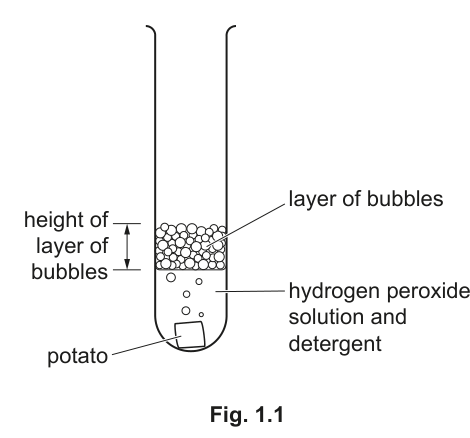
- Cut the second piece of potato into four equal parts and add them to test-tube B.
- Start your timer and repeat the measurements as for test-tube A.
- Cut the third piece of potato into eight equal parts and add them to test-tube C.
- Start your timer and repeat the measurements as for test-tube A.
State a safety precaution that the student should take while doing the investigation with hydrogen peroxide solution.
______
The student recorded the measurements in a notebook as shown in Fig. 1.2.
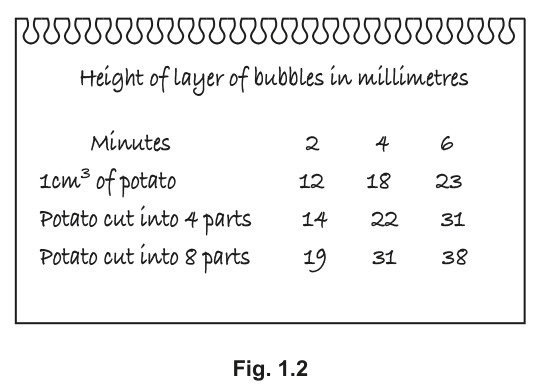
Enter the headings in Table 1.1.
Complete Table 1.1 by entering the student's results.
Table 1.1
| ______ | ______ | ||
|---|---|---|---|
| test-tube A | test-tube B | test-tube C | |
| 2 | |||
| 4 | |||
| 6 |
Cutting the potato pieces into smaller parts increases the surface area of the potato.
Describe the effect of increasing the surface area of the potato and explain what caused this effect.
description = ______
explanation = ______
The student found that the top of the layer of bubbles was not always flat when they had to measure the height of the layer.
Suggest what they could do to ensure that the measurements taken every two minutes were comparable.
______
The student noticed two unexpected problems during the investigation. Suggest how each may have affected the results.
- bubbles sometimes stuck to the potato
suggestion = ______
- some of the eight parts of potato in test-tube C stuck together
suggestion = ______
Suggest how the student can prove that it is the activity of the enzyme catalase that produces the bubbles.
______
Another student investigated the activity of catalase in potato by measuring the volume of oxygen produced. They added cubes of potato to hydrogen peroxide solution in the apparatus shown in Fig. 1.3.
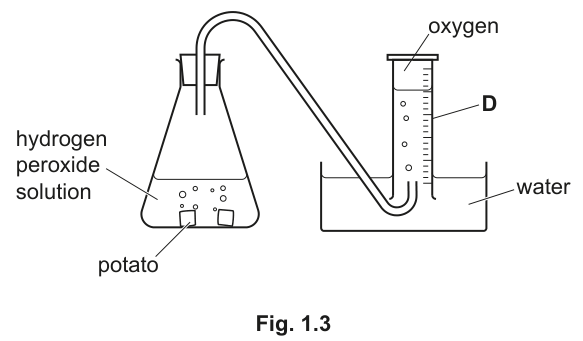
Name the piece of apparatus labelled D.
______
Design an investigation to determine the effect of temperature on the activity of catalase in potato.
Use the apparatus shown in Fig. 1.3.
The rest of this paper
2 more questions- Q2Observations and Measurements · Experimental Contexts · Analysis, Conclusions and Evaluation10M
- Q3Microscopy and Biological Drawing · Experimental Contexts · Use of Techniques, Apparatus and Materials10M