Biology 5090/32 — October/November 2023
Cambridge O-Level · Practical Test · worked solutions for every part, with the mark scheme
Topics Experimental Contexts · Observations and Measurements · Analysis, Conclusions and Evaluation · Planning Experiments and Investigations · Microscopy and Biological Drawing
Some animals that live in cold climates need to reduce the loss of heat from their bodies.
You are going to investigate the effect of an insulating material on heat loss from an animal. You will use a test-tube containing hot water to represent an animal.
You are supplied with two test-tubes, a beaker (or similar container) and cotton wool to use as the insulating material.
- Draw a line below the top of each test-tube. This indicates the level to which hot water will be added to the test-tubes.
- Arrange the cotton wool around one test-tube in the beaker as shown in Fig. 1.1.
- Support the other test-tube in a test-tube rack.
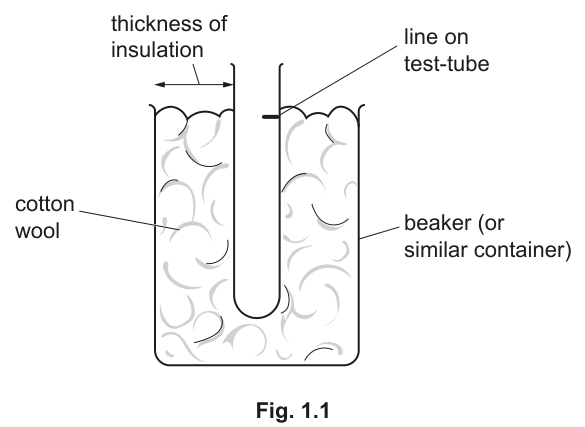
Measure and record:
- the thickness of the insulation in your apparatus
______
- the air temperature of the room you are working in.
______
Answer
- thickness of insulation = 25 mm (any value consistent with the candidate's apparatus)
- air temperature of the room = 22 (any value consistent with the candidate's laboratory)
Both a thickness of insulation in mm and an air temperature in °C recorded, consistent with the candidate's own apparatus.
Walkthrough
This part simply checks that you have set the apparatus up and can take two basic readings. Measure the thickness of the cotton wool layer around the test-tube with a ruler, from the outside of the glass to the inside wall of the beaker, and write the value in millimetres. Then read the room temperature from a thermometer and write it in degrees Celsius. The mark is awarded for both readings being present, each with the correct unit.
Key Takeaways
- Always record a measurement with its unit.
- Readings must be plausible and consistent with the apparatus you actually used.
Common Mistakes
- Writing only one of the two readings — the mark requires both.
- Omitting the units (mm and ).
- Recording an impossible value, e.g. a room temperature of 5 .
Things to Be Careful About
The blank lines tell you the form of the answer: a number followed by mm for the first, a number followed by for the second. Match that form exactly.
The two test-tubes will be filled with hot water.
You are going to measure and record the temperature of the water in each test-tube as soon as you start timing and then at two-minute intervals for 12 minutes.
When you are ready, raise your hand and the Supervisor will add hot water to each of your test-tubes up to the lines that you have marked.
Caution – the water will be hot.
- Start timing.
- Immediately (at 0 minutes) measure the temperature of the water in each test-tube to the nearest .
- Record these temperatures in Table 1.1.
- Measure and record the temperature to the nearest in each test-tube at two-minute intervals for 12 minutes.
Table 1.1
| time / minutes | water temperature / test-tube with insulation | water temperature / test-tube without insulation |
|---|---|---|
| 0 | ||
| 2 | ||
| 4 | ||
| 6 | ||
| 8 | ||
| 10 | ||
| 12 |
Answer
Complete Table 1.1 with the temperatures measured. A typical set of results:
| time / minutes | water temperature / (with insulation) | water temperature / (without insulation) |
|---|---|---|
| 0 | 80.0 | 80.0 |
| 2 | 78.5 | 76.0 |
| 4 | 77.0 | 72.5 |
| 6 | 75.5 | 69.5 |
| 8 | 74.5 | 67.0 |
| 10 | 73.5 | 64.5 |
| 12 | 73.0 | 62.5 |
Every temperature is recorded to the nearest (each written as xx.0 or xx.5), temperatures fall at each successive time, and the total fall is greater for the tube without insulation.
All seven temperatures recorded for both tubes, each to the nearest 0.5 °C, decreasing with time, with a greater overall drop in the uninsulated tube.
Walkthrough
You measure the temperature in each tube at 0, 2, 4, 6, 8, 10 and 12 minutes and write the values in Table 1.1. The mark scheme checks four things: that all the readings are there; that the temperatures go down at each successive time (hot water always cools); that the uninsulated tube shows a bigger total drop than the insulated one (that is the whole point of the insulation); and that every reading is written to the nearest — so 78.5 or 78.0, never 78.3, because the thermometer can only be read to half a degree.
Key Takeaways
- Record to the precision the instrument and the question allow — here the nearest .
- A cooling curve always falls, and falls fastest at the start when the temperature difference with the surroundings is greatest.
- Insulation slows heat loss, so the insulated tube stays hotter.
Common Mistakes
- Recording values like 78.3 — not to the nearest , losing the precision mark.
- Missing one or more time points — the completeness mark needs all of them.
- Making the insulated tube cool faster than the uninsulated tube, which contradicts the physics of insulation.
- Forgetting the 0-minute reading taken immediately after the water is added.
Things to Be Careful About
Take the 0-minute readings straight away — the water cools quickly at first. Keep the thermometer in each tube for the same length of time before reading, and read at eye level to avoid parallax error.
Use your results from Table 1.1 to describe the loss of heat from the test-tubes and the effect of the insulation.
Answer
- The temperature of the water in both test-tubes decreases with time, so heat is lost to the surroundings.
- The temperature fall is smaller in the test-tube with insulation: it dropped from 80.0 to 73.0 (a fall of 7.0 ) compared with 80.0 to 62.5 (a fall of 17.5 ) without insulation, so the insulation reduces heat loss.
- The temperature falls fastest in the first two minutes and the rate of fall then decreases, so heat loss is faster at the start.
Temperature decreases with time; the fall is less with insulation; heat loss is fastest at the start — each supported by the candidate's data.
Walkthrough
This is a 'describe' question, so you state what the data shows, not why. Three ideas earn the three marks. First, the general trend: temperature goes down as time passes in both tubes. Second, the effect of the insulation: compare the two columns — the insulated tube ends up hotter, so it lost less heat. Third, the shape of the cooling: the biggest drop is between 0 and 2 minutes, and each later drop is smaller, so heat loss is fastest at the start. The reason (the temperature difference between the water and the room is greatest at the start) is explanation, not description, but you may add it after the credited points.
Key Takeaways
- A 'describe' answer reports the pattern; an 'explain' answer adds the reason.
- Always support a comparison with actual values from your own table.
- Cooling is fastest when the temperature difference between object and surroundings is greatest.
Common Mistakes
- Writing only 'the water cooled' — that is one point; you need the insulation effect and the changing rate as well.
- Describing without using any of your own data — the scheme credits a data comparison.
- Explaining instead of describing, and never stating the observed trend.
Things to Be Careful About
Use your own readings for the comparison — the examiner checks them against your Table 1.1. State the direction of the trend clearly: temperature decreases, heat loss is greater without insulation.
Humpback whales are large aquatic mammals that maintain a constant body temperature of . They spend part of the year in cold polar water and part of the year in warm equatorial water.
Design an investigation that you could carry out to discover the effect of different surrounding water temperatures on the loss of heat by the humpback whale. Use a test-tube filled with water to represent the humpback whale.
Answer
- Fill a test-tube with water at (the body temperature of the whale) and use the same volume of water and the same start temperature for every test.
- Place the test-tube in a beaker (or water-bath) filled with water at a chosen external temperature.
- Keep the external water temperature constant during each test, e.g. with a thermostatically controlled water-bath, or by adding hot or cold water as needed.
- Test at least three different external water temperatures, all at or below , e.g. , and (cold polar, cool and warm water).
- Record the temperature of the water in the test-tube at fixed time intervals (e.g. every 2 minutes) for the same length of time in each test (at least 5 minutes).
- Compare the temperature change (heat loss) of the test-tube water at each external temperature.
See working — a planned method controlling start temperature and volume, using a water-bath at three or more external temperatures at or below 38 °C, timed temperature readings, and a comparison of temperature change.
Walkthrough
This is the planning question, and the mark scheme lists more points than there are marks, so hit every category.
- Independent variable: the external (surrounding) water temperature — you must state at least three values, and since the whale lives in water at or below its body temperature, all values should be or below (cold polar water, cooler temperate water, warm equatorial water).
- Dependent variable: the temperature change (heat loss) of the water inside the test-tube.
- Controlled variables: the same volume of water in the tube and the same starting temperature of — the whale's body temperature — for every test.
- Method: stand the test-tube in a beaker or water-bath of water at the chosen external temperature, and keep that temperature constant during the test (thermostatically controlled bath, or topping up with hot/cold water).
- Measurements: read the tube's temperature at fixed intervals for the same time in every test, for at least 5 minutes.
- Conclusion step: compare the temperature drop between tests — the bigger the drop, the greater the heat loss at that external temperature.
Key Takeaways
- A full plan names the independent variable with a stated range, the dependent variable, and the variables held constant.
- The surrounding temperature must be controlled, not just set — that is what a water-bath does.
- The model must match the biology: whale body temperature is , so start there and test external temperatures at or below it.
Common Mistakes
- Using external temperatures above — the scheme wants a minimum of three values at or below body temperature.
- Not stating the starting temperature of the test-tube water, or not keeping it the same in every test.
- Using only one or two external temperatures — at least three are needed.
- Not saying how the external temperature is kept constant.
- Forgetting to state how long readings are taken for, or taking different times in different tests.
Things to Be Careful About
Write the plan as a numbered method a candidate could follow. State actual numbers where the scheme asks for them: start, at least three external temperatures, minimum 5 minutes. 'Compare the temperature change' is the credited final step — say it explicitly.
The rest of this paper
2 more questions- Q2Experimental Contexts · Observations and Measurements · Analysis, Conclusions and Evaluation · Planning Experiments and Investigations14M
- Q3Experimental Contexts · Microscopy and Biological Drawing12M