Biology 5090/22 — October/November 2023
Cambridge O-Level · Theory · worked solutions for every part, with the mark scheme
Topics Cell Structure and Organisation · Classification · Organisms and Their Environment · Human Nutrition · Respiration · Inheritance · +13 more
Cholera is caused by a type of organism that can be passed from one host to another.
State the term used to describe
a disease-causing organism
______
the type of disease in which the disease-causing organism is passed from one host to another.
______
The disease-causing organism that causes cholera is a bacterium.
Complete Table 1.1 to list some of the structures present in a bacterial cell and the function of each structure.
Table 1.1
| structure | function |
|---|---|
| ribosomes | |
| small rings of DNA that carry genes | |
| controls the passage of substances into and out of the cell | |
| cell wall |
Fig. 1.1 shows a photograph of the bacterium that causes cholera.
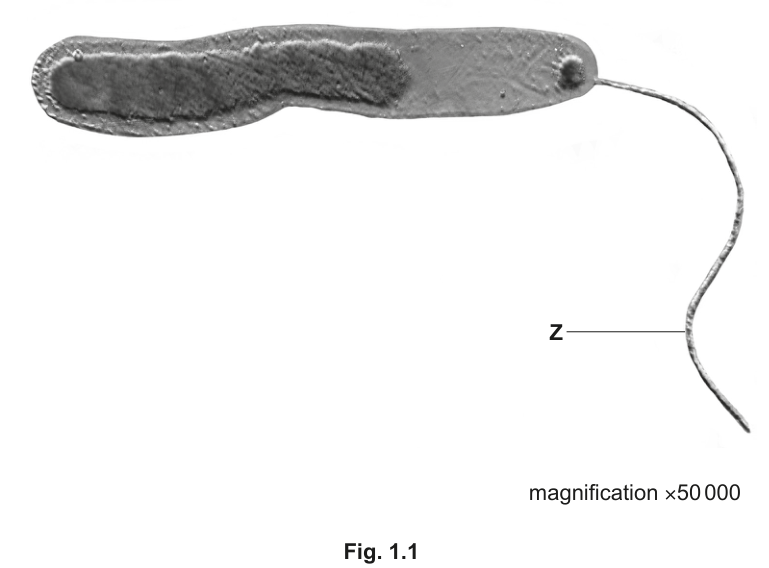
The length of the bacterium in the photograph is . Use this value to calculate the actual length of the bacterium in micrometres (µm).
______
Use your knowledge of a type of specialised human cell to suggest the name of structure Z and to state its function.
name = ______
function = ______
The binomial name of this type of bacterium is Vibrio cholerae.
State the genus of this type of bacterium and one advantage of the binomial system of naming species.
genus = ______
advantage = ______
Explain how the presence of bacteria of this type in a human causes diarrhoea, one of the symptoms of cholera.
The rest of this paper
6 more questions- Q2Organisms and Their Environment · Biological Molecules · Human Nutrition · Respiration · Inheritance · Enzymes8M
- Q3Transport in Humans · Excretion · Coordination and Control · Human Nutrition12M
- Q4Respiration · Human Gas Exchange · Cell Structure and Organisation · Cell Division and Reproduction · Inheritance15M
- Q5Biotechnology and Genetic Modification · Enzymes9M
- Q6Plant Nutrition · Transport in Flowering Plants10M
- Q7Organisms and Their Environment · Classification10M