Biology 5090/42 — May/June 2023
Cambridge O-Level · Alternative to Practical · worked solutions for every part, with the mark scheme
Topics Observations and Measurements · Analysis, Conclusions and Evaluation · Experimental Contexts · Microscopy and Biological Drawing · Planning Experiments and Investigations · Use of Techniques, Apparatus and Materials
Some students investigated the movement of water by osmosis, using potato tissue.
They were provided with:
- a balance
- five cylinders of potato tissue with equal diameters
- five different concentrations of sodium chloride (salt) solution at room temperature
- five test-tubes
- a sharp knife
- a white tile
- a marker pen/pencil
- paper towels.
They used the following method:
- label the test-tubes 0%, 2%, 4%, 6% and 8%
- cut each of the potato cylinders so that each has a mass of
- place one cylinder of potato in each test-tube
- add the matching concentration of salt solution to each test-tube so that the potato cylinder in it is covered as shown in Fig. 1.1
- note the time and leave the potato cylinders in the solutions for 40 minutes
- after 40 minutes remove the potato cylinders from the test-tubes
- dry each potato cylinder using a paper towel
- measure and record the mass of each potato cylinder.
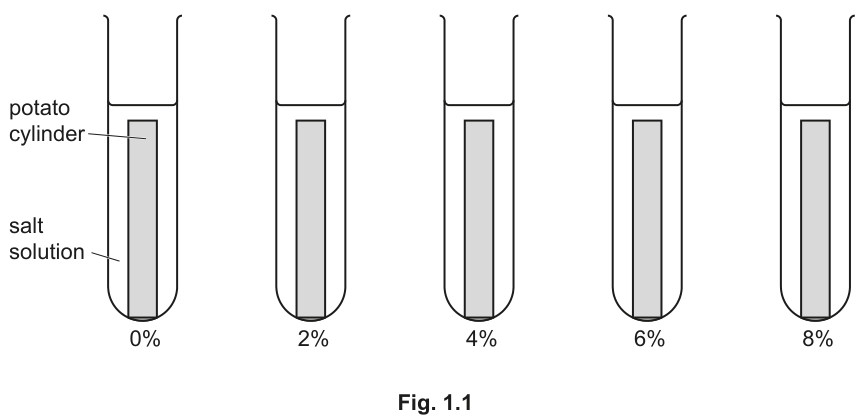
Complete the column headings in Table 1.1.
[1]
Fig. 1.2 shows the balance readings for the potato cylinders taken from the 0% and 8% salt solutions after 40 minutes.
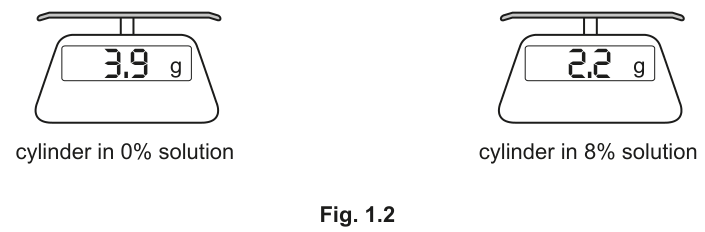
Record these masses as ‘final mass’ in Table 1.1.
Complete Table 1.1 by calculating the change in mass for each of these cylinders of potato.
Table 1.1
| percentage concentration of salt solution | starting mass / ______ | final mass / ______ | change in mass / ______ |
|---|---|---|---|
| 0 | 3.0 | ||
| 2 | 3.0 | 3.1 | +0.1 |
| 4 | 3.0 | 2.5 | –0.5 |
| 6 | 3.0 | 2.3 | –0.7 |
| 8 | 3.0 |
Water can move into and out of potato cells by osmosis. Salt cannot move into and out of potato cells.
Use this information to explain the results in the test-tube containing 6% salt solution.
______
Explain why it is important that all the potato cylinders have the same mass at the start of the investigation.
______
The concentrations of salt solution were made by using different volumes of a 10% salt solution and distilled water.
Calculate the volumes of 10% salt solution and distilled water needed to make of a 4% salt solution.
volume of distilled water = ______
volume of 10% salt solution = ______
Explain why using a measuring cylinder is better than using a beaker for measuring the volumes of distilled water and salt solution.
______
Explain why it is important that the students dried the potato cylinders before obtaining their final mass.
______
Construct a graph of percentage concentration of salt solution against change in mass. Join your points with ruled lines.
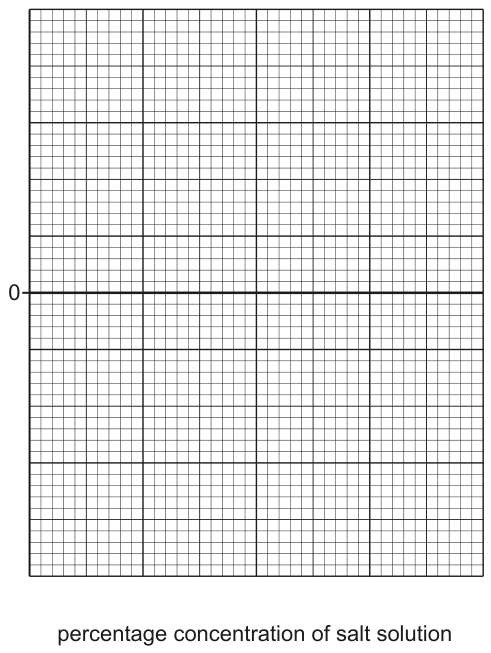
Each potato cylinder had a starting mass of .
Use your graph to determine the final mass of a potato cylinder placed in a 3% salt solution. Show your working on your graph.
final mass = ______
Design an investigation to determine the concentration of salt solution in which movement into and out of potato tissue is equal.
Your investigation should be based on the method described on page 3 but using changes in length of the potato tissue and not changes in mass.
Give full experimental details.
Identify the dependent variable in the investigation you have designed.
______
Potatoes store starch. Describe a test to confirm the presence of starch. Include the observation for a positive result.
______
The starch can be broken down into glucose for the plant to use in respiration. Name the reagent used to test for the presence of glucose.
______
The rest of this paper
1 more questions- Q2Microscopy and Biological Drawing · Experimental Contexts · Observations and Measurements · Analysis, Conclusions and Evaluation10M