Biology 5090/61 — October/November 2022
Cambridge O-Level · Alternative to Practical · worked solutions for every part, with the mark scheme
Topics Analysis, Conclusions and Evaluation · Use of Techniques, Apparatus and Materials · Planning Experiments and Investigations · Experimental Contexts · Observations and Measurements · Microscopy and Biological Drawing
Foods can be tested to determine the types of molecules that they contain.
A student decided to carry out three tests to investigate the composition of two foods, A and B.
He cut a cube of A.
He then cut that cube into three pieces each of the same size. One piece was used for each of the three tests.
He carried out the same procedure with B.
For the first test he followed these instructions:
- label a test-tube A1
- cut one of the three pieces of A into small pieces and put the small pieces into the test-tube
- pour of ethanol into the test-tube
- shake the test-tube well
- place the test-tube in a test-tube rack to allow the contents to settle at the bottom.
He repeated this procedure with one of the pieces of B with a test-tube labelled B1 and placed it in the test-tube rack.
State what you would use to produce the cubes of A and B.
______
Describe what you would do to ensure that the tests with the small pieces of A and B were comparable.
______
The student poured equal volumes of distilled water into two new test-tubes labelled A1W and B1W.
He took test-tube A1 and carefully poured the liquid into test-tube A1W.
He followed the same procedure with test-tube B1, pouring the liquid into test-tube B1W.
He observed the mixtures and recorded his observations in his notebook.
For the second test he used the second pieces of A and B, cut into small pieces. The small pieces of A were added to test-tube A2 and the small pieces of B were added to test-tube B2.
He added the same volume of distilled water to both test-tubes. He then used a glass rod to stir the contents of both test-tubes.
Explain why he cleaned the glass rod after using it in test-tube A2 and before using it in test-tube B2.
______
He then added the same volume of biuret reagent to both test-tubes.
The photograph shows a graduated measuring cylinder with the biuret reagent that he added to one of the test-tubes.
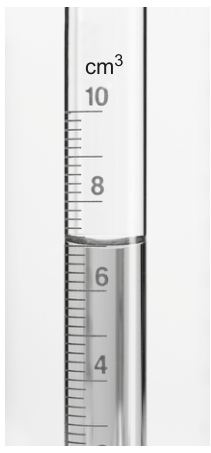
State the volume of biuret reagent that he added.
______
After adding the biuret reagent he observed the mixtures in test-tubes A2 and B2 and recorded his observations in his notebook.
For the third test, he placed the third pieces of A and B on a white tile, added some iodine solution and recorded his observations in his notebook.
The student’s notebook is shown.
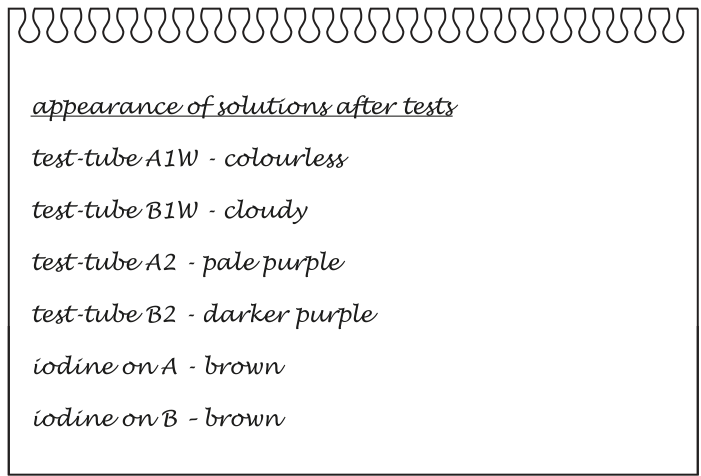
Complete the table using only the information from his experimental method and his notebook.
| test number | test solution/reagent | ______ | ______ |
|---|---|---|---|
| food A | food B | ||
| 1 | |||
| 2 | |||
| 3 |
Use the student’s observations to state what you can conclude about the composition of foods A and B.
test 1 ______
test 2 ______
test 3 ______
He found that it was easy to cut A into a cube and divide it into three equal parts. However, he found that B crumbled (easily fell apart) which made it difficult to cut to produce a cube and to ensure that the three parts were of equal size.
Suggest how this problem could have affected the results in test-tubes A2 and B2 and your conclusions.
______
Suggest a change to the method to help overcome this problem.
______
The rest of this paper
2 more questions- Q2Microscopy and Biological Drawing · Experimental Contexts · Analysis, Conclusions and Evaluation · Use of Techniques, Apparatus and Materials10M
- Q3Analysis, Conclusions and Evaluation · Planning Experiments and Investigations11M