Biology 5090/62 — October/November 2021
Cambridge O-Level · Alternative to Practical · worked solutions for every part, with the mark scheme
Topics Experimental Contexts · Observations and Measurements · Analysis, Conclusions and Evaluation · Use of Techniques, Apparatus and Materials · Planning Experiments and Investigations · Microscopy and Biological Drawing
Cells have membranes which can allow molecules to enter and leave the cell.
A student wanted to investigate the movement of glucose and protein molecules through a membrane. He decided to use Visking tubing that acts in a similar way to an actual cell membrane.
He was given two solutions, A and B.
He wanted to test both solutions A and B for the presence of glucose and protein.
State which reagents you would use to test for glucose and protein.
glucose ______
protein ______
He labelled four glass test-tubes to do these tests.
State what you would use to label glass test-tubes.
______
Suggest what you would write on each test-tube and record this in the table on page 3.
He completed the tests and recorded the resulting colours of the solutions in his notebook.
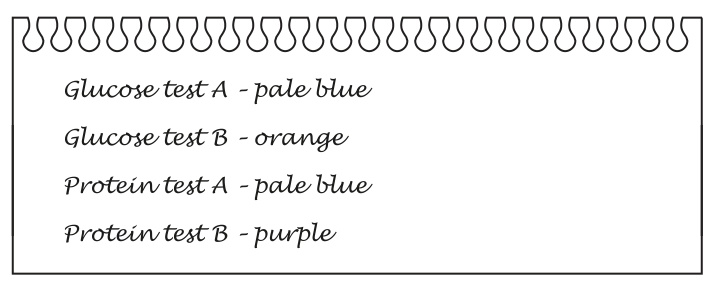
Complete the table using his observations and your conclusions.
| solution | test | test-tube label | observation | conclusion |
|---|---|---|---|---|
| A | glucose | |||
| protein | ||||
| B | glucose | |||
| protein |
The Visking tubing that he used was a hollow, flexible tube. He tied a knot in one end of the tube to make it into a test-tube shape.
He carefully added of solution B to the inside of this tube through the open end.
After checking that no solution was leaking from the knotted end of the tube, he rinsed the outside surface with distilled water.
He placed this tube containing solution B into a large glass test-tube that contained solution A as shown in the diagram.
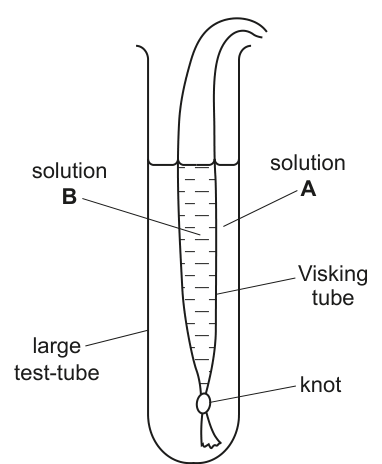
State what piece of apparatus you would use to add of solution B to the Visking tube.
______
Suggest why it was important to rinse the outside of the Visking tube before placing it in the large test-tube containing solution A.
______
After 30 minutes the student removed the Visking tube from the large test-tube.
He then tested the solution remaining in the large test-tube for glucose and protein.
State two variables he should have controlled so that these repeat tests on solution A produced results that were comparable with those in the table.
- ______
- ______
From these tests he concluded that the solution in the glass test-tube now contained glucose but not protein.
Describe and explain what this conclusion and the information in the table show about the permeability of the Visking tube.
Before the student removed the Visking tube from the large test-tube, he observed that the levels of the solutions A and B had changed as shown in the diagram.
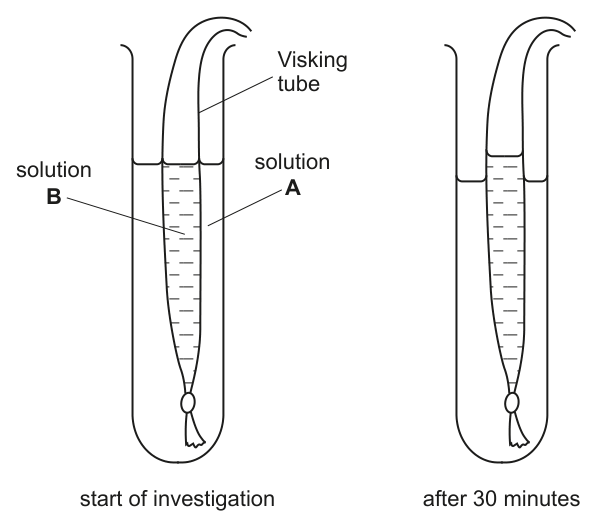
Describe the changes to the levels of solutions A and B after 30 minutes.
Suggest which process caused these changes.
______
The rest of this paper
2 more questions- Q2Experimental Contexts · Observations and Measurements · Analysis, Conclusions and Evaluation15M
- Q3Microscopy and Biological Drawing7M