Biology 5090/61 — October/November 2021
Cambridge O-Level · Alternative to Practical · worked solutions for every part, with the mark scheme
Topics Use of Techniques, Apparatus and Materials · Observations and Measurements · Experimental Contexts · Analysis, Conclusions and Evaluation · Planning Experiments and Investigations · Microscopy and Biological Drawing
The tissue of a peeled potato tuber is composed of many similar cells. A student investigated the effect of varying concentrations of sucrose solution on some potato tissue.
She was provided with:
- a potato tuber with the outer peel removed
- distilled water labelled A
- three sucrose solutions of different concentrations labelled B, C and D.
She cut four strips of tissue from the potato, each measuring in cross-section and long. This was their length at the start of the investigation.
Describe in detail how you would cut strips of potato to this size.
The student then labelled four test-tubes A, B, C and D. She placed one potato strip in each and then added distilled water to test-tube A, and the sucrose solutions B, C and D to test-tubes B, C and D. She made sure that each potato strip was fully covered by solution.
After 30 minutes, she poured away the solutions and prepared to remove the potato strips from the test-tubes to measure them.
Describe what she could do to ensure that, after they had been removed from the test-tubes, she knew which potato strip had been in which solution.
The diagram shows the four potato strips after 30 minutes in the solutions.
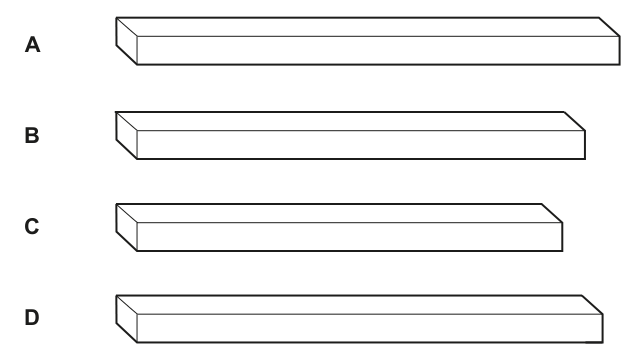
Measure the lengths of strips A, B, C and D. Record the lengths of each strip at the start and end of the investigation and calculate the changes in length. Enter your results in the table.
| solution | start length / | end length / | change in length / | flexibility of strip |
|---|---|---|---|---|
| A | ||||
| B | ||||
| C | ||||
| D |
She also assessed the flexibility of each strip by gently bending them. The more easily the strip bent, the more flexible it was. She recorded her results in her notebook:

Arrange the strips in order of decreasing flexibility and use the scale below to record this in the table. Record the most flexible strip as ++++ and the least flexible as +.
| most flexible/bendable | ++++ |
| +++ | |
| ++ | |
| least flexible/bendable | + |
Describe and explain the changes in length and flexibility in the potato strip that had been in solution A.
Identify two problems with the method used in this investigation that might have led to unreliable conclusions. Suggest a way in which each could have been improved to make the results more reliable.
problem 1 = ______
improvement 1 = ______
problem 2 = ______
improvement 2 = ______
Another student investigated the effect of varying concentrations of sucrose solution on some potato tissue by measuring changes in the mass of the tissue.
He placed five pieces of potato tissue, each with a mass of , in five separate test-tubes.
The test-tubes contained either distilled water or one of four different concentrations of sucrose solution.
Later he poured away the solutions.
State two factors, apart from the mass of tissue, that should have been kept constant when using this method.
- ______
- ______
When he removed the pieces of tissue from the test-tubes, he carefully dried them on a paper towel.
Explain why it was important to dry them.
The table shows the measurements at the end of the investigation.
| sucrose concentration / | mass at end of investigation / |
|---|---|
| 0.0 | 5.7 |
| 0.2 | 5.2 |
| 0.4 | 4.6 |
| 0.5 | 4.3 |
| 0.8 | 3.3 |
Construct a line graph of the data in the table on the grid below. Join your points with ruled, straight lines.

Use your graph to determine the concentration of sucrose which will produce no change in mass.
concentration = ______
Describe the method you used to determine this concentration of sucrose.
The rest of this paper
1 more questions- Q2Microscopy and Biological Drawing · Experimental Contexts · Observations and Measurements · Use of Techniques, Apparatus and Materials12M