Biology 5090/61 — October/November 2020
Cambridge O-Level · Alternative to Practical · worked solutions for every part, with the mark scheme
Topics Observations and Measurements · Analysis, Conclusions and Evaluation · Use of Techniques, Apparatus and Materials · Experimental Contexts · Planning Experiments and Investigations · Microscopy and Biological Drawing
When tissue from some plants is cut, the cut surface turns brown. This is because enzymes are released which cause reactions between chemicals in the plant and oxygen to produce brown substances.
The photograph below shows two slices cut from a banana. Slice A was exposed to the air for two hours and slice B was freshly cut. The freshly cut slice was a creamy yellow colour.
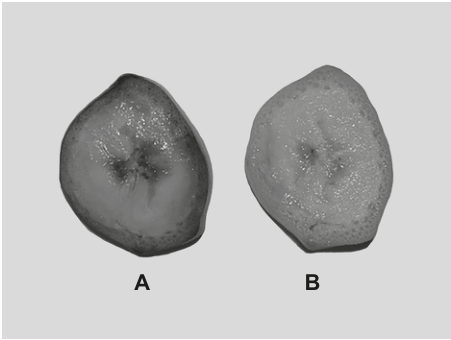
Some students decided to investigate the effect of different treatments on the rate at which a banana turns brown.
They cut three slices from the same banana, each wide.
- One slice, C, was placed in a beaker of dilute hydrochloric acid () for two minutes. It was then removed and placed on a white tile.
- One slice, D, was placed on the white tile and cut into many small pieces.
- The third slice, E, was left untreated on the white tile.
The students observed the slices and recorded the colour of each after 5, 10 and 20 minutes.
After 5 minutes, they also measured and recorded the pH of the cut surface of each slice.
Their results are shown below.
After 5 minutes: treatment – , creamy yellow; cut up slice – , very pale brown; untreated slice – , creamy yellow
After 10 minutes: treatment – creamy yellow; cut up slice – pale brown; untreated slice – very pale brown
After 20 minutes: treatment – creamy yellow; cut up slice – brown; untreated slice – pale brown
Enter the students' data in the tables.
| time / minutes | colour | ||
|---|---|---|---|
| slice dipped in (C) | slice cut into small pieces (D) | untreated slice (E) | |
| 5 | |||
| 10 | |||
| 20 |
| pH | ||
|---|---|---|
| slice dipped in (C) | slice cut into small pieces (D) | untreated slice (E) |
Answer
| time / minutes | slice dipped in HCl (C) | slice cut into small pieces (D) | untreated slice (E) |
|---|---|---|---|
| 5 | creamy yellow | very pale brown | creamy yellow |
| 10 | creamy yellow | pale brown | very pale brown |
| 20 | creamy yellow | brown | pale brown |
| pH | slice dipped in HCl (C) | slice cut into small pieces (D) | untreated slice (E) |
|---|---|---|---|
| 2 | 6 | 6 |
Both tables completed: colours creamy yellow / very pale brown / creamy yellow; creamy yellow / pale brown / very pale brown; creamy yellow / brown / pale brown, and pH 2, 6, 6
Walkthrough
The students' results are given as prose, and the task is simply to place each observation in the right cell. Read the data sentence by sentence: 'After 5 minutes: HCl treatment – pH 2, creamy yellow' gives the pH for C (2) and the colour for C at 5 minutes (creamy yellow), and so on. Take care that each time point has three colours and the pH table has exactly one value per slice.
Key Takeaways
Data presented in prose must be transferred accurately into tables; every cell must be filled, and qualitative descriptions must be copied exactly as given ('creamy yellow', not 'yellow').
Common Mistakes
Mixing up slices D and E — D was cut up and browns faster, E was untreated. Writing 'yellow' instead of the exact phrase 'creamy yellow'. Leaving a cell blank — the mark scheme requires a value in every box.
Things to Be Careful About
Copy the colour descriptions word for word; the scheme credits the exact phrases. Check each row against the corresponding time in the prose before moving on.
The untreated slice E was the control in this investigation. Explain why this was included.
______
Answer
To compare the effect of the treatments with no treatment.
To compare the effect of the treatments with no treatment
Walkthrough
A control is a setup left under normal conditions with nothing changed. Slice E was left untreated, so any colour change it shows is what happens naturally. Comparing C and D against E lets the students see whether the acid or the cutting actually made a difference — without E they would have no baseline to compare against.
Key Takeaways
Every fair test needs a control: the untreated condition against which treated results are compared.
Common Mistakes
Writing vague answers such as 'to make it fair' or 'for comparison' without saying what is compared with what. The mark scheme wants the comparison with no treatment stated explicitly.
Things to Be Careful About
Name the comparison: treated slices versus the untreated slice. 'Fair test' alone does not score.
The banana slice C was placed in a small beaker containing of dilute hydrochloric acid. Name the piece of apparatus you would use to measure accurately of dilute hydrochloric acid.
______
Answer
A measuring cylinder.
Measuring cylinder
Walkthrough
To measure of a liquid accurately you need graduated glassware. A measuring cylinder marked in is the standard O Level answer; a graduated pipette is also accepted because it measures volume precisely. A beaker has only rough graduations and is not accurate enough.
Key Takeaways
Measuring cylinder or graduated pipette for accurate volumes; a beaker is only for holding or rough measuring.
Common Mistakes
Naming a beaker — its graduations are too coarse to measure accurately. Naming a conical flask, which is not graduated for measurement.
Things to Be Careful About
The question says 'measure accurately', so the apparatus must be a graduated measuring instrument.
Describe how you would safely remove the banana slice from the hydrochloric acid.
______
Answer
Use forceps to lift the slice out of the acid.
Using forceps
Walkthrough
Dilute hydrochloric acid is corrosive/irritant, so fingers must not go into it. Forceps let you grip the banana slice and lift it out without touching the acid — this protects the skin and keeps the investigation hygienic.
Key Takeaways
Never handle acids with bare hands; use forceps or tongs to remove objects from acid.
Common Mistakes
Writing 'wear gloves' — the question asks how you would remove the slice, and the credited answer is the tool used. Writing 'pour the acid away' does not describe removing the slice safely.
Things to Be Careful About
The mark scheme credits '(using) forceps' — name the apparatus.
Describe how you would measure the pH of the surfaces of the banana slices.
______
Answer
- Touch (universal) pH paper / universal indicator solution onto the cut surface of the slice.
- Observe the colour change.
- Compare the colour with a pH colour chart to read off the pH.
Use universal indicator paper or solution on the cut surface, observe the colour change and match it to a colour chart
Walkthrough
pH is measured with an indicator. Universal indicator is the usual choice because it shows a continuous range of colours across the whole pH scale. The method has three credited steps: apply the indicator to the surface (dip the paper or drop the solution on), watch what colour it turns, and compare that colour against the printed chart to read the pH value. Each step is a separate mark, so all three must be written.
Key Takeaways
Universal indicator + colour observation + colour chart is the standard three-step description for measuring pH at O Level.
Common Mistakes
Naming litmus, which only shows acid/alkali and cannot give a pH value of 2 or 6. Describing only one step, such as 'use universal indicator', and losing the other two marks. Saying 'measure the pH' without saying how.
Things to Be Careful About
The chart comparison is the step that actually gives the number — omit it and the answer is incomplete. 'Universal' matters: ordinary indicator paper without a full-range chart cannot distinguish pH 2 from pH 6.
Describe the effect of dilute hydrochloric acid by comparing the results for slices C and E.
______
Answer
The dilute hydrochloric acid stopped the slice turning brown — slice C stayed creamy yellow while slice E turned brown.
HCl stopped browning (prevented the colour change)
Walkthrough
Compare the two columns of the table. Slice E, untreated, went creamy yellow → very pale brown → pale brown over 20 minutes. Slice C, dipped in acid, stayed creamy yellow at every reading. The comparison shows the acid prevented the browning reaction altogether.
Key Takeaways
A 'compare' answer must name both slices and state the difference in their results.
Common Mistakes
Describing only slice C ('it stayed creamy yellow') without the comparison with E. Saying the acid 'slowed' browning — the data show no browning at all.
Things to Be Careful About
The mark scheme credits 'stopped browning' or 'prevents colour change' — use the word 'stopped' or 'prevented'.
Suggest a reason for the effect of dilute hydrochloric acid.
______
Answer
The low pH denatured the enzymes, so they could no longer catalyse the browning reaction.
The enzyme was denatured (by the low pH)
Walkthrough
The browning is caused by enzymes reacting plant chemicals with oxygen. Enzymes work only over a narrow pH range; at pH 2 the shape of the enzyme's active site is permanently changed — the enzyme is denatured — so the substrate no longer fits and the reaction stops. That is why slice C never browned.
Key Takeaways
Extremes of pH (and high temperature) denature enzymes by changing the shape of the active site, so the reaction they catalyse stops.
Common Mistakes
Saying the enzyme was 'killed' — enzymes are not alive. Saying the acid 'slowed' the enzyme — denaturation stops it. Describing the acid as killing bacteria, which is not what the data show.
Things to Be Careful About
The mark scheme's single credited word is 'denatured' — that exact term must appear.
State the effect of cutting up slice D into small pieces by comparing the results with E.
______
Answer
Slice D turned brown more quickly / turned a darker brown than the untreated slice E.
D turned darker brown / browned more quickly than E
Walkthrough
At 5 minutes D was already 'very pale brown' while E was still 'creamy yellow'; by 20 minutes D was 'brown' while E was only 'pale brown'. Cutting the slice up made it brown faster and darker.
Key Takeaways
Read the table row by row to see which slice changed colour first and reached the darkest colour.
Common Mistakes
Saying D browned 'more' without the time comparison. Confusing D with E in the table.
Things to Be Careful About
State the comparison explicitly — D compared with E — as the question instructs.
Suggest a reason for this effect in slice D.
______
Answer
Cutting the slice up increased the surface area, so more enzyme was exposed and there was more contact with oxygen, so the browning reaction went faster.
Increased surface area, so more enzyme available and more contact with oxygen
Walkthrough
Browning needs three things in contact: the plant chemicals, the enzymes and oxygen from the air. A whole slice exposes only its flat faces. Cutting it into many small pieces creates many new cut surfaces, greatly increasing the surface area. That means more enzyme is released and available, and more of the tissue is in direct contact with oxygen — so the reaction happens faster and the slice darkens sooner.
Key Takeaways
Increasing surface area speeds up reactions that depend on contact between reactants — here enzyme, substrate and oxygen.
Common Mistakes
Saying 'more oxygen in the air' — the air is unchanged; it is the contact with the tissue that increases. Giving only 'more surface area' without linking it to the enzyme or the oxygen.
Things to Be Careful About
The mark scheme accepts any one of: more enzyme/substrate available, increased contact with oxygen, increased surface area — but the fullest answer links surface area to both.
The students found it difficult to describe their observations in this investigation. Suggest a reason why they found it difficult and an improvement to their method to overcome this.
reason = ______
improvement = ______
Answer
reason = the colour change was difficult to assess / subjective, and did not change uniformly
improvement = compare each slice with a standard colour chart / assess the area that had changed colour
reason: colour change difficult to assess (subjective / not uniform); improvement: compare with a colour chart / assess the area changed
Walkthrough
Describing colours like 'very pale brown' in words is subjective — two students may judge the same slice differently, and the colour does not spread evenly over the surface. The improvement must tackle the stated reason: comparing against a printed colour chart gives everyone the same standard, and recording the area that has changed turns a vague impression into something measurable. The scheme pairs reason and improvement, so the two halves must match.
Key Takeaways
Subjective observations are a classic limitation; the standard fixes are colour standards/charts or measuring an area instead of describing a whole surface.
Common Mistakes
Giving a reason and an improvement that do not match (e.g. 'colours were hard to describe' + 'repeat the experiment'). Writing vague improvements such as 'be more careful'.
Things to Be Careful About
The improvement must be 'related' to the reason — the scheme's table shows the allowed pairings. Record over a longer time is also accepted as an improvement.
Using a method similar to the one in this investigation design an experiment to determine the optimum (best) pH for a banana to turn brown.
Answer
- Use freshly cut banana slices of the same size, each 1 cm wide.
- Prepare a range of different pH solutions / buffers (e.g. pH 2, 4, 6, 8, 10).
- Keep all other variables the same: same banana, same size slices, same temperature.
- Place a freshly cut slice in each pH solution for the same time (2 minutes), then remove each slice and place it on a white tile.
- Measure and record the time taken for each slice to turn brown.
- The pH at which the slice turns brown fastest is the optimum pH.
See working — a plan using several pH buffers, controlled variables, equal treatment times, and timing browning to identify the fastest pH as the optimum
Walkthrough
This is the classic planning question. The independent variable is pH, so you need several different values — buffers or pH solutions give a controlled range. The dependent variable is how fast the slice browns, so you time it. Everything else must be controlled: same banana, same slice size, same temperature, same time in the solution. The procedure mirrors the original investigation: dip each freshly cut slice in its pH solution for a fixed time (2 minutes), remove it to a white tile, and record how long it takes to brown. Finally, state how the results answer the question: the pH that browns fastest is the optimum. The scheme lists six points for 5 marks, so hitting all six categories guarantees full credit.
Key Takeaways
A complete plan names the independent variable with a range of values, the dependent variable and how it is measured, the controlled variables, the fixed procedure, and the criterion for drawing the conclusion.
Common Mistakes
Using only two pH values — at least three are needed to find an optimum. Forgetting to control variables such as slice size or temperature. Saying 'find the best pH' without stating the criterion (fastest browning). Not timing the browning, so the dependent variable is unmeasured.
Things to Be Careful About
Use the scheme's structure: different pH solutions, freshly cut slices placed in each pH, same time (2 minutes) then removal to a white tile, measure time to turn brown, fastest = optimum. Write it as a numbered method a candidate could follow.
The rest of this paper
2 more questions- Q2Experimental Contexts · Analysis, Conclusions and Evaluation · Observations and Measurements8M
- Q3Microscopy and Biological Drawing · Observations and Measurements · Analysis, Conclusions and Evaluation · Use of Techniques, Apparatus and Materials12M