Biology 5090/12 — October/November 2020
Cambridge O-Level · Multiple Choice · answer key with instant marking and worked solutions
40
questions
40
marks
60
minutes
Topics Human Nutrition · Coordination and Control · Organisms and Their Environment · Inheritance · Plant Nutrition · Transport in Flowering Plants · +14 more
Tap an option under each question to check it — your score builds as you go.
Q11MCell Structure and OrganisationFree sample
The diagram shows part of a plant cell.
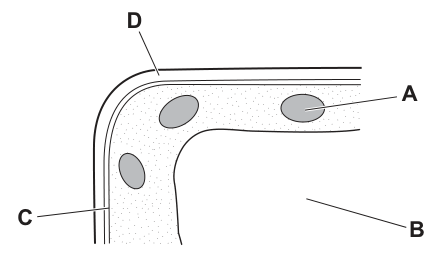
Which part controls the entry of substances into the cell?
Options
A A
B B
C C
D D
DifficultyEasy
Worked solution
Answer
The cell membrane is partially permeable and controls the entry of substances into the cell. In the diagram, label C points to the cell membrane (the inner line just inside the cell wall).
Answer
C
Final answer
C
Detailed explanation
Walkthrough
- The question asks to identify the part of a plant cell that controls the entry of substances.
- Recall the functions of plant cell structures: the cell wall is fully permeable and provides structural support; the cell membrane is partially permeable and controls what enters and leaves the cell; chloroplasts are the site of photosynthesis; the cytoplasm is the site of metabolic reactions.
- Examine the diagram to match labels to structures. Label C points to the thin line just inside the thicker outer cell wall, which is the cell membrane. (Label D points to the cell wall, A to a chloroplast, and B to the cytoplasm).
- Since the cell membrane is partially permeable, it controls the entry of substances. Thus, C is the correct answer.
Key Takeaways
- The cell membrane is partially permeable and controls the movement of substances in and out of the cell.
- The cell wall is fully permeable and provides support and shape to the plant cell.
- Carefully reading diagram labels is essential, as automated descriptions may sometimes misassign labels or misidentify lines.
Common Mistakes
- Confusing the cell wall with the cell membrane. The cell wall is fully permeable and does not control entry; the cell membrane is partially permeable and does.
- Selecting the label for the cell wall (which is fully permeable) instead of the cell membrane.
- Misreading the diagram labels, especially when multiple lines are close together (e.g., confusing C and D).
Things to Be Careful About
- Always verify the label lines against the structures. In this diagram, C points to the cell membrane (the inner line), not the cell wall (the outer line, D).
- Remember that 5090 requires precise terminology: "partially permeable" for the cell membrane, not "selectively permeable" (though both are understood, "partially permeable" is the standard 5090 term).
- The cell wall is fully permeable, allowing all substances to pass through freely without control.
Techniques used
identify cell structures from a diagramrecall the function of the cell membrane
The rest of this paper
39 more questions- Q2Movement Into and Out of Cells1M
- Q3Movement Into and Out of Cells1M
- Q4Enzymes · Human Nutrition1M
- Q5Plant Nutrition1M
- Q6Plant Nutrition · Transport in Flowering Plants1M
- Q7Plant Nutrition1M
- Q8Human Nutrition1M
- Q9Human Nutrition1M
- Q10Human Nutrition1M
- Q11Transport in Flowering Plants1M
- Q12Transport in Flowering Plants1M
- Q13Transport in Humans1M
- Q14Transport in Humans1M
- Q15Transport in Humans1M
- Q16Respiration1M
- Q17Respiration · Biotechnology and Genetic Modification1M
- Q18Human Gas Exchange1M
- Q19Excretion1M
- Q20Coordination and Control1M
- Q21Coordination and Control1M
- Q22Coordination and Control1M
- Q23Coordination and Control1M
- Q24[Legacy] Support, Movement and Locomotion1M
- Q25Disease and Immunity1M
- Q26Classification1M
- Q27Biotechnology and Genetic Modification1M
- Q28Organisms and Their Environment1M
- Q29Organisms and Their Environment1M
- Q30Organisms and Their Environment1M
- Q31Disease and Immunity1M
- Q32Organisms and Their Environment1M
- Q33Sexual Reproduction in Plants · Cell Division and Reproduction1M
- Q34Sexual Reproduction in Plants1M
- Q35Sexual Reproduction in Humans1M
- Q36Sexual Reproduction in Humans1M
- Q37Inheritance1M
- Q38Inheritance1M
- Q39Inheritance1M
- Q40Inheritance1M
Loading the full paper…