Biology 5090/11 — October/November 2020
Cambridge O-Level · Multiple Choice · answer key with instant marking and worked solutions
Topics Coordination and Control · Organisms and Their Environment · Movement Into and Out of Cells · Plant Nutrition · Transport in Flowering Plants · Human Nutrition · +13 more
Tap an option under each question to check it — your score builds as you go.
The diagram shows the structure of a cell from a leaf of a green plant.
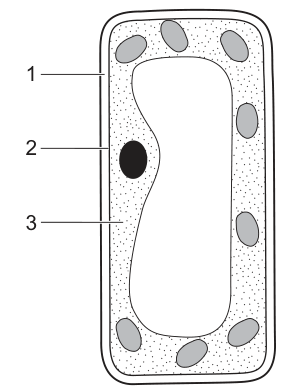
What are the numbered parts of the cell?
Options
| 1 | 2 | 3 | |
|---|---|---|---|
| A | cell membrane | cell wall | cytoplasm |
| B | cell membrane | cytoplasm | cell wall |
| C | cell wall | cytoplasm | cell membrane |
| D | cell wall | cell membrane | cytoplasm |
Working
The diagram shows a typical plant cell from a leaf, identifiable by the rigid outer cell wall, large central vacuole, and chloroplasts.
- Label 1 points to the outermost rigid layer, which is the cell wall.
- Label 2 points to the thin, partially permeable layer just inside the cell wall, which is the cell membrane.
- Label 3 points to the jelly-like fluid filling the cell and surrounding the organelles, which is the cytoplasm.
Matching these identifications to the given options:
1 = cell wall, 2 = cell membrane, 3 = cytoplasm.
This corresponds exactly to option D.
Answer
D
D
Walkthrough
The question asks to identify three labelled parts of a plant cell diagram. We can determine each part by its position and the context of a plant cell.
- Label 1 points to the outermost boundary of the cell. In plant cells, this thick, rigid outer layer is the cell wall. It is made of cellulose and provides structural support and protection. Animal cells do not have a cell wall, so its presence confirms this is a plant cell.
- Label 2 points to the thin layer immediately inside the cell wall. This is the cell membrane (also called the plasma membrane). It is partially permeable and controls the movement of substances in and out of the cell.
- Label 3 points to the general interior region of the cell, the dotted area where the chloroplasts (grey ovals) and the large central vacuole (white space) are suspended. This jelly-like fluid is the cytoplasm, where many metabolic reactions occur.
Putting it together: 1 is cell wall, 2 is cell membrane, 3 is cytoplasm. Looking at the table, row D matches this sequence perfectly.
Key Takeaways
- Plant cells have a specific layered boundary: the cell wall is always on the outside, and the cell membrane is just inside it.
- The cytoplasm is the fluid-filled matrix that fills the cell interior and holds the organelles.
- When interpreting cell diagrams, always use the outermost-to-innermost order to distinguish between the cell wall and cell membrane.
Common Mistakes
- Confusing the cell wall and cell membrane: A common error is to label the outermost layer as the cell membrane. Remember that plant cells have a cell wall outside the cell membrane.
- Misidentifying the cytoplasm: Some students might look at label 3 and think of the large white space (the vacuole) or the grey ovals (chloroplasts). However, the label line points to the dotted fluid region itself, which is the cytoplasm.
- Assuming animal cell structure: If a student forgets that plant cells have cell walls, they might choose an option starting with cell membrane for label 1.
Things to Be Careful About
- Read the label lines carefully: Ensure you are tracing the line from the number to the exact structure. Label 1 clearly touches the thick outer border. Label 2 touches the thin inner line. Label 3 points into the dotted interior.
- Plant vs. animal cells: Always check for the presence of a cell wall, large central vacuole, and chloroplasts to confirm it is a plant cell before selecting your answer. If it were an animal cell, there would be no cell wall, and label 1 would be the cell membrane.
- Option matching: The table requires matching all three labels correctly. Even if you know 1 and 3 are correct, you must verify 2 as well to select the right row.
The rest of this paper
39 more questions- Q2Movement Into and Out of Cells1M
- Q3Movement Into and Out of Cells1M
- Q4Enzymes1M
- Q5Plant Nutrition1M
- Q6Plant Nutrition · Transport in Flowering Plants1M
- Q7Plant Nutrition1M
- Q8Human Nutrition1M
- Q9Human Nutrition · Transport in Humans1M
- Q10Human Nutrition1M
- Q11Transport in Flowering Plants1M
- Q12Transport in Flowering Plants1M
- Q13Coordination and Control1M
- Q14Transport in Humans1M
- Q15Transport in Humans1M
- Q16Respiration1M
- Q17Respiration · Movement Into and Out of Cells1M
- Q18Human Gas Exchange1M
- Q19Excretion1M
- Q20Coordination and Control1M
- Q21Coordination and Control1M
- Q22Coordination and Control1M
- Q23Coordination and Control1M
- Q24[Legacy] Support, Movement and Locomotion1M
- Q25Disease and Immunity1M
- Q26Classification1M
- Q27Biotechnology and Genetic Modification1M
- Q28Organisms and Their Environment1M
- Q29Organisms and Their Environment1M
- Q30Organisms and Their Environment1M
- Q31Disease and Immunity1M
- Q32Organisms and Their Environment1M
- Q33Sexual Reproduction in Plants1M
- Q34Sexual Reproduction in Plants1M
- Q35Disease and Immunity1M
- Q36Sexual Reproduction in Humans1M
- Q37Inheritance1M
- Q38Inheritance1M
- Q39Inheritance1M
- Q40Biotechnology and Genetic Modification1M