Biology 5090/61 — May/June 2020
Cambridge O-Level · Alternative to Practical · worked solutions for every part, with the mark scheme
Topics Experimental Contexts · Observations and Measurements · Analysis, Conclusions and Evaluation · Planning Experiments and Investigations · Microscopy and Biological Drawing · Use of Techniques, Apparatus and Materials
A student used the apparatus shown below to investigate respiration in some small insects.
The apparatus was sealed with a clip so that any changes in the volume of gas in the apparatus caused the bubble of coloured liquid in the capillary tube to move.
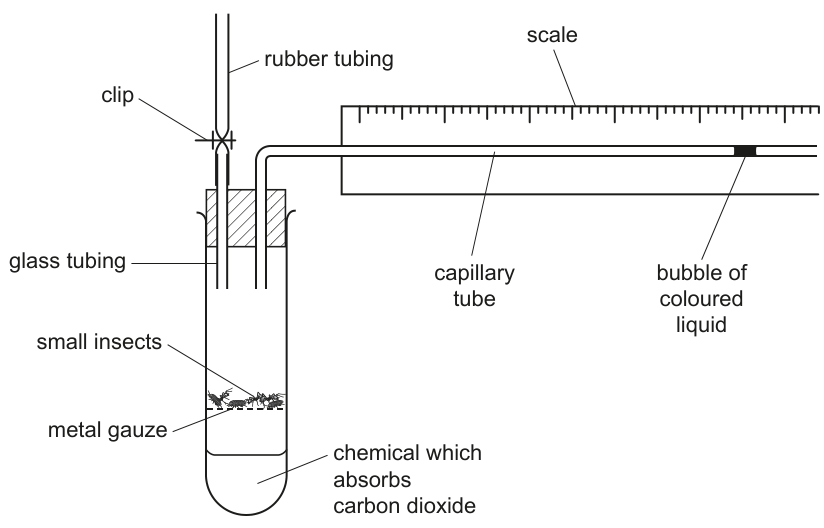
Suggest what happens to the bubble of coloured liquid as the insects in the test-tube respire.
______
Using the apparatus in the diagram, the student read the starting position of the bubble of coloured liquid. She recorded the reading from the left edge of the bubble. She left the apparatus for 60 minutes and then recorded the final position of the bubble.
The diagrams show the starting and final positions of the bubble. In the spaces provided, record the reading for the position of each bubble.
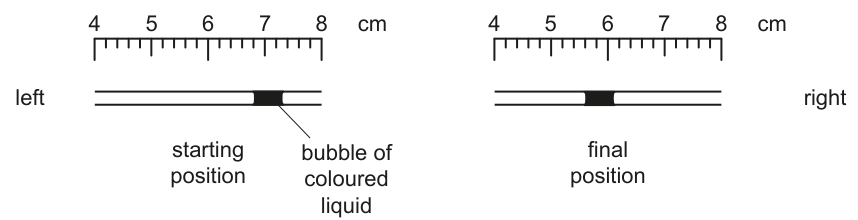
start = _____
after 60 minutes = _____
Calculate the distance the bubble moved in 60 minutes.
______
Calculate the rate of movement of the bubble in mm per minute.
rate of movement of bubble = ______
Explain why carrying out the experiment several times would improve the reliability of the results.
______
Suggest a suitable control experiment for this investigation.
______
Suggest an environmental factor outside the apparatus that might affect what happens to the bubble of coloured liquid.
______
Describe how the student might ensure that this factor has no effect on the bubble of coloured liquid.
______
The insects produce carbon dioxide as a result of respiration. Suggest and explain what would happen to the bubble of coloured liquid if the experiment was repeated with the chemical which absorbs carbon dioxide removed from the apparatus.
______
The student wanted to show that the insects produce carbon dioxide.
The diagram shows the apparatus she used.
When carbon dioxide is bubbled through limewater, it turns from clear to cloudy.
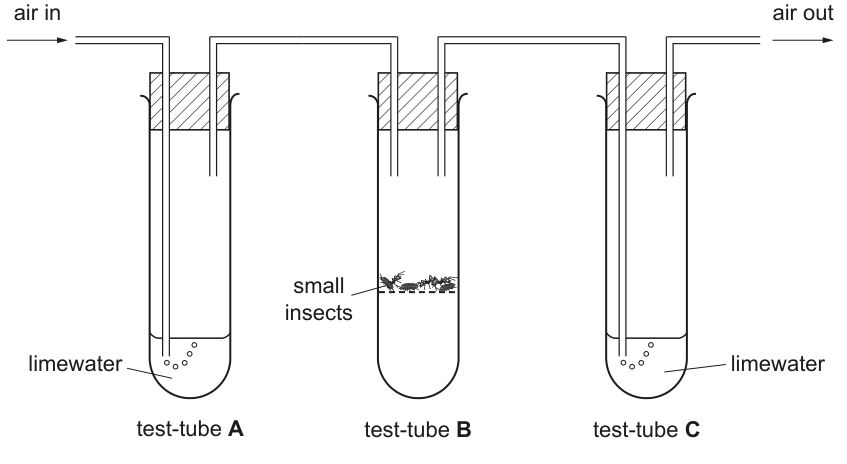
Suggest and explain the results you would expect after the apparatus was left for 30 minutes.
The rest of this paper
1 more questions- Q2Microscopy and Biological Drawing · Experimental Contexts · Use of Techniques, Apparatus and Materials · Observations and Measurements · Analysis, Conclusions and Evaluation23M