Biology 5090/22 — October/November 2019
Cambridge O-Level · Theory · worked solutions for every part, with the mark scheme
Topics Transport in Humans · Sexual Reproduction in Humans · Human Gas Exchange · Sexual Reproduction in Plants · Inheritance · Plant Nutrition · +8 more
A species of flowering plant has flowers of two types. Some of the plants of this species have flowers called pin and some of the plants have flowers called thrum. The diagrams show sections through parts of these two types of flower.
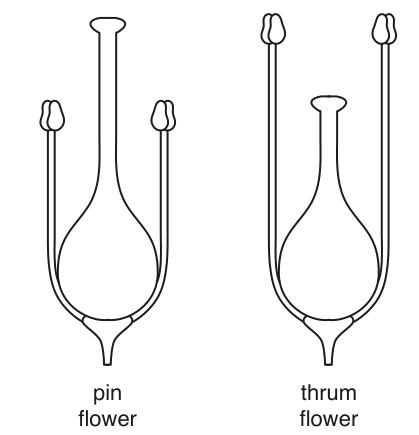
Describe how the structure of the pin type of flower differs from that of the thrum type of flower.
Answer
- The pin flower has shorter stamens (or anthers/filaments) positioned lower down.
- The pin flower has a longer style (or stigma/pistil) positioned higher up.
- In the thrum flower, the stamens (anthers) are taller/higher and the style (stigma) is shorter/lower.
| Feature | Pin flower | Thrum flower |
|---|---|---|
| Stamens (anthers) | Lower / shorter | Higher / taller |
| Pistil (stigma/style) | Higher / longer | Lower / shorter |
Pin has lower stamens/anthers and higher stigma/style; thrum has higher stamens/anthers and lower stigma/style.
Walkthrough
- Identify the structures: The question asks for a structural difference between the two flower types. Look at Fig. 1.1. The two main reproductive parts are the male part (androecium) consisting of stamens, anthers, and filaments, and the female part (gynoecium) consisting of the carpel, pistil, style, and stigma.
- Observe the pin flower: The central female structure (pistil/style) is tall, so the stigma is high. The male structures (stamens/anthers) on the sides are short, so the anthers are low.
- Observe the thrum flower: The central female structure is short, so the stigma is low. The male structures are tall, so the anthers are high.
- Formulate the comparison: To score the marks, you must name the structures (stamens/anthers and carpel/pistil/stigma) and state the correct relative height or length. For example: "Pin has shorter stamens" and "Pin has a longer style".
Key Takeaways
- Many plants have dimorphic flowers (pin and thrum) to encourage cross-pollination.
- The position of the anthers (male, pollen producer) and stigma (female, pollen receiver) is staggered in height between the two types.
- This arrangement ensures that when a pollinator visits, it picks up pollen from one height and deposits it at a different height on the next flower.
Common Mistakes
- Naming the wrong part: Students often say "male part" and "female part" without using the biological terms stamen/anther and carpel/pistil/stigma.
- Describing without comparing: Saying "the pin has a long style" is not enough; you must contrast it with the thrum (e.g., "longer than in the thrum" or "higher than the anthers").
- Confusing the types: Remember pin = stigma high (like a pin sticking up), thrum = anthers high (like a thrum/stick sticking up).
Things to Be Careful About
- The mark scheme awards points for naming the structure and the comparison. For example, just saying "stamens" is not enough; you must say "stamens are lower in pin".
- Use precise terminology: stigma, style, carpel, pistil, anther, stamen, filament.
- Do not mention colour or petal shape; the question is about the reproductive organs shown in the cross-section.
Pollination in this species of plant is not always successful in leading to fertilisation. Examples of successful pollination and of unsuccessful pollination are shown in the diagram below.
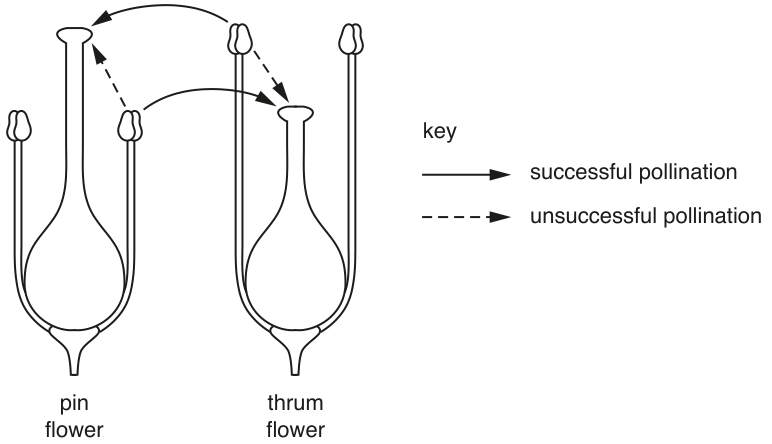
Use information from the diagram to name the type of pollination that is successful and suggest the advantage to the species of this type of pollination.
type of pollination ______
advantage ______
Answer
type of pollination: cross-pollination
advantage:
- It produces genetic variation (or variation in the offspring).
- This is because offspring inherit a different combination of genes / alleles from two different parents.
- Increased variation helps the population survive environmental changes or diseases.
Type: cross-pollination. Advantage: produces genetic variation / different alleles.
Walkthrough
- Analyze Fig. 1.2: The diagram shows arrows between two different flowers (a pin flower and a thrum flower). The solid arrows show successful pollination moving from the anthers of one type to the stigma of the other type (e.g., high anthers of thrum to high stigma of pin).
- Identify pollination type: Pollination between flowers of different plants (or different types in this dimorphic species) is cross-pollination. Pollination within the same flower or same plant would be self-pollination.
- Determine the advantage: Why is cross-pollination beneficial? Sexual reproduction mixes genetic material. Cross-pollination ensures that the offspring have a mix of genes from two parents. This leads to genetic variation.
- Explain the benefit: Genetic variation means some individuals might have traits that help them survive better (e.g., disease resistance, drought tolerance). This is the basis of natural selection.
Key Takeaways
- Cross-pollination involves the transfer of pollen from the anther of one flower to the stigma of another flower on a different plant (or a different morph like thrum/pin).
- The main advantage is genetic variation, which increases the chances of the species surviving in changing environments.
Common Mistakes
- Saying "self-pollination": The diagram clearly shows arrows between two different flowers (pin and thrum), so it is cross-pollination.
- Vague advantages: Saying "it makes more plants" or "it is better" is not enough. You must use the terms genetic variation, different alleles, or different genes.
- Confusing pollination with fertilisation: The question asks about pollination, but the advantage relates to the genetic outcome of the resulting seed.
Things to Be Careful About
- The mark scheme specifically looks for cross (not just "crossing").
- For the advantage, keywords are genetic, variation, alleles, genes. Avoid saying "stronger plants" without linking it to variation.
- The diagram shows that pollination between same-height parts (e.g., high stigma to high anther of same type) is unsuccessful (dashed arrows), forcing the pollen to go to the other type, enforcing cross-pollination.
The gene responsible for the production of the different types of flower has two alleles. One allele () is dominant to the other allele ().
A plant with flowers of the pin type has a homozygous recessive genotype.
A plant with flowers of the thrum type has a heterozygous genotype.
Use the letters and to show the genotype of each of the following:
a plant with flowers of the pin type ______
a plant with flowers of the thrum type ______
Answer
- a plant with flowers of the pin type:
- a plant with flowers of the thrum type: (or )
Reasoning:
- The allele is dominant and is recessive.
- Pin is homozygous recessive, so it must have two recessive alleles: .
- Thrum is heterozygous, so it has one dominant and one recessive allele: .
- Since (thrum) is dominant, the heterozygous plant () shows the thrum phenotype.
pin: ; thrum:
Walkthrough
- Identify alleles: The problem states is dominant and is recessive.
- Pin genotype: The text says pin is homozygous recessive. Homozygous means same alleles. Recessive means . So, genotype is .
- Thrum genotype: The text says thrum is heterozygous. Heterozygous means different alleles. So, genotype is (or ).
- Check consistency: If is dominant and causes thrum, then is thrum. is pin. This matches the description.
Key Takeaways
- Homozygous: Two identical alleles ( or ).
- Heterozygous: Two different alleles ().
- Dominant phenotype: Expressed if at least one dominant allele is present ( or ).
- Recessive phenotype: Expressed only if homozygous recessive ().
Common Mistakes
- Writing as or : Heterozygous must have one of each.
- Wrong letter case: Always use capital for dominant () and lowercase for recessive ().
- Confusing phenotype and genotype: The question asks for genotype (letters), not the flower type name.
Things to Be Careful About
- The mark scheme accepts as equivalent to , but standard convention is capital first ().
- Ensure you match the genotype to the correct flower type (pin = , thrum = ).
A plant with flowers of the pin type was successfully pollinated by a plant with flowers of the thrum type.
Complete the genetic diagram shown below and state the likely ratio of new plants being produced with flowers of the pin and thrum types.
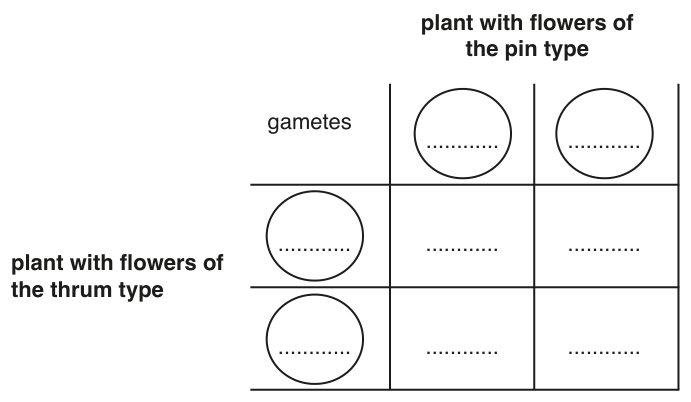
ratio of new plants with flowers of the pin and thrum types:
______
Working
Parents:
- Pin plant (homozygous recessive): genotype
- Thrum plant (heterozygous): genotype
Gametes:
- Pin () produces gametes with allele only.
- Thrum () produces gametes with allele and allele .
Punnett Square:
| (from pin) | (from pin) | |
|---|---|---|
| (from thrum) | (thrum) | (thrum) |
| (from thrum) | (pin) | (pin) |
Offspring Genotypes:
Offspring Phenotypes: 2 thrum (), 2 pin ()
Ratio: 2 pin : 2 thrum, which simplifies to 1 : 1 (or 50% each).
Answer
ratio of new plants with flowers of the pin and thrum types: (or , or 50% pin and 50% thrum)
(Note: The genetic diagram should show pin gametes as and thrum gametes as . The four boxes should contain .)
1 : 1
Walkthrough
- Identify Parental Genotypes: From part (c)(i), pin is and thrum is .
- Determine Gametes:
- The pin plant () can only pass on the allele. So both gamete circles for pin get .
- The thrum plant () can pass on or . So the gamete circles for thrum get and .
- Fill the Punnett Square:
- Top row (pin gametes): .
- Left column (thrum gametes): .
- Box 1 (top-left): (from thrum) + (from pin) = .
- Box 2 (top-right): (from thrum) + (from pin) = .
- Box 3 (bottom-left): (from thrum) + (from pin) = .
- Box 4 (bottom-right): (from thrum) + (from pin) = .
- Determine Phenotypes:
- has the dominant allele , so phenotype is thrum.
- is homozygous recessive, so phenotype is pin.
- We have 2 (thrum) and 2 (pin).
- Calculate Ratio: 2 pin : 2 thrum. Simplify to 1 : 1.
Key Takeaways
- A cross between homozygous recessive () and heterozygous () is a test cross (or backcross) that typically yields a 1 : 1 ratio.
- Always write gametes clearly in the circles outside the square.
- The ratio is usually expressed as dominant : recessive or as asked (pin : thrum). Here pin () : thrum () is 2:2 = 1:1.
Common Mistakes
- Wrong gametes: Thinking produces gametes or produces only gametes.
- Wrong offspring: Writing or (this would happen if thrum was , but it's ).
- Ratio format: Writing "50%" is usually accepted, but "1 : 1" is standard. Ensure the order matches the question (pin and thrum). Pin is (2/4), Thrum is (2/4). So 1:1.
Things to Be Careful About
- The mark scheme accepts the offspring genotypes listed in any order ().
- The ratio can be written as , , , 50%, etc.
- Ensure the diagram labels match the parents: top is pin (), side is thrum ().
The rest of this paper
8 more questions- Q2Plant Nutrition · Biotechnology and Genetic Modification10M
- Q3Sexual Reproduction in Humans · Disease and Immunity · Transport in Humans13M
- Q4Human Nutrition · Human Gas Exchange10M
- Q5Cell Division and Reproduction6M
- Q6Transport in Flowering Plants · Movement Into and Out of Cells · Transport in Humans10M
- Q7Respiration · Human Gas Exchange · Transport in Humans10M
- Q8Organisms and Their Environment10M
- Q9Sexual Reproduction in Humans · Transport in Humans10M