Biology 5090/61 — October/November 2018
Cambridge O-Level · Alternative to Practical · worked solutions for every part, with the mark scheme
Topics Experimental Contexts · Planning Experiments and Investigations · Microscopy and Biological Drawing · Use of Techniques, Apparatus and Materials · Observations and Measurements · Analysis, Conclusions and Evaluation
The banana is the fruit of a banana plant. As the fruit gets older, it ripens and becomes easy to eat. The photograph shows a cross-section of a ripe banana.
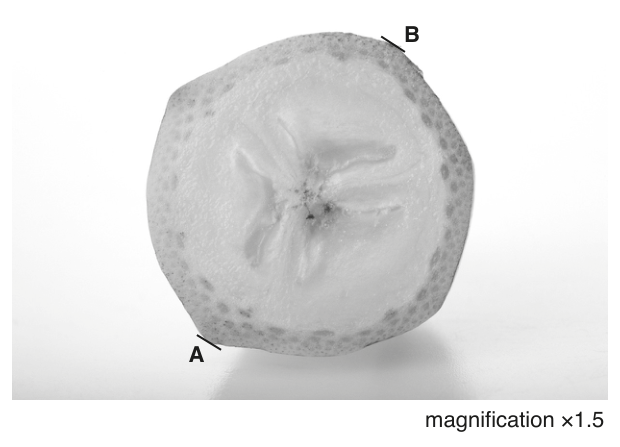
Make a large drawing of the cross-section of the banana fruit as shown in the photograph.
Draw a straight line on the photograph joining the lines labelled A and B to show the diameter of the banana. Measure your line and record the measurement.
______
Draw a straight line in the same position on your drawing. Measure this line on your drawing and record the measurement.
______
Calculate the magnification of your drawing in comparison with the actual banana shown in the photograph. Show your working.
magnification ______
In an experiment, a student cut a thin slice of banana and placed it on a white tile with the freshly cut surface facing upwards.
She covered this cut surface with iodine solution and left it for five minutes.
After five minutes she picked up the banana slice using forceps and rinsed off the excess iodine solution using water.
She observed that some of the inner parts of the banana slice were stained black.
State what conclusions she could make from her observations.
______
Suggest why the student rinsed off the excess iodine solution before observing the banana.
______
Suggest why she used forceps to hold the banana while rinsing off the excess iodine solution.
______
Describe how you would test the inner part of another slice of banana to see if it contains reducing sugar.
______
State the result of the test if reducing sugar is present.
______
Describe one way you would ensure that you carry out the reducing sugar test safely.
______
The rest of this paper
2 more questions- Q2Experimental Contexts · Observations and Measurements · Analysis, Conclusions and Evaluation · Planning Experiments and Investigations15M
- Q3Experimental Contexts · Planning Experiments and Investigations8M