Biology 5090/21 — October/November 2018
Cambridge O-Level · Theory · worked solutions for every part, with the mark scheme
Topics Sexual Reproduction in Plants · Enzymes · Respiration · Organisms and Their Environment · Human Nutrition · Cell Division and Reproduction · +7 more
The diagram shows the parts of a plant growing above ground.
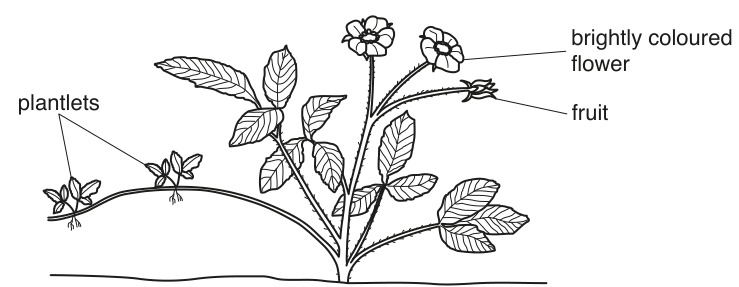
State the type of reproduction that takes place using the flower shown in the diagram.
______
Answer
sexual reproduction
sexual reproduction
Walkthrough
A flower produces gametes — pollen grains containing the male gametes and ovules containing the female gamete. Because reproduction via a flower involves the fusion of gametes, it is sexual reproduction. The diagram shows a brightly coloured flower, which is typical of an insect-pollinated plant, but the question only asks for the type of reproduction, not the pollination agent.
Key Takeaways
- Flowers are the organs of sexual reproduction in flowering plants.
- Sexual reproduction always involves gametes and fertilisation.
Common Mistakes
- Writing "pollination" — that is only one event within sexual reproduction, not the type.
- Writing "insect-pollinated" — the scheme ignores (Ig) self- or cross-pollination; the question asks for the type of reproduction.
Things to Be Careful About
- Give the exact term "sexual" — the mark scheme underlines it as the required word.
Describe the events that must take place for the flower to develop into a fruit.
Answer
- Pollen is transferred to the stigma (pollination).
- The pollen grain grows a pollen tube down through the style.
- The tube reaches the ovary / ovule.
- The male gamete passes down the tube and fuses with the female gamete / ovum — fertilisation.
- The ovary (pericarp / ovary wall) grows and develops into the fruit; the petals fall off and the stamens, stigma and style wither.
See working
Walkthrough
This is a sequence question — the marks follow the order of events from pollination to fruit.
- Pollination. Pollen must land on the stigma. The brightly coloured flower in the diagram suggests insect pollination, but the mark scheme ignores whether you say self- or cross-pollination — the credited point is simply pollen + stigma.
- Pollen tube growth. The pollen grain germinates on the stigma and grows a pollen tube. This is the structure that carries the male gamete.
- Down the style. The pollen tube grows through the tissue of the style towards the ovary. Naming the style is a separate mark.
- Fertilisation. The tube enters the ovary/ovule and the male gamete fuses with the female gamete (the ovum) inside the ovule. Saying "fertilisation" or describing the fusion both score.
- Fruit formation. After fertilisation, the ovary wall (pericarp) grows and develops into the fruit, while the parts no longer needed — petals, stamens, stigma, style — fall off or wither. That last point is why the diagram shows a fruit where the flower used to be.
Key Takeaways
- The full pathway: pollen → stigma → pollen tube → style → ovary → fertilisation → fruit.
- The fruit develops from the ovary; the seed develops from the ovule.
- Petals, stamens, stigma and style are shed after fertilisation because their job is done.
Common Mistakes
- Naming only "pollination" and "fertilisation" without the pollen tube and style — each step is a separate mark.
- Saying the seed becomes the fruit — the ovary becomes the fruit, the ovule becomes the seed.
- Omitting the female gamete/ovum — fertilisation must be described as a fusion of gametes.
- Writing "self-pollination" or "cross-pollination" as if it were a required event — the scheme explicitly ignores (Ig) this.
Things to Be Careful About
- Use the exact terms: stigma, style, ovary, ovule, ovum. "Female part" scores nothing.
- Give the events in order — a sequence question rewards a logical sequence.
The plant may also reproduce without using a flower, to produce new plants from plantlets.
State the type of reproduction that produces the plantlets.
______
Answer
asexual (vegetative) reproduction
asexual reproduction
Walkthrough
The plantlets grow from horizontal runners with no flowers, gametes or fusion involved — each plantlet is genetically identical to the parent. Reproduction without gametes is asexual reproduction; because it uses a vegetative part of the plant (the runner), "vegetative reproduction" is equally accepted.
Key Takeaways
- Asexual reproduction produces genetically identical offspring from one parent, with no gametes or fertilisation.
- Runners, tubers and bulbs are examples of vegetative (asexual) reproduction in plants.
Common Mistakes
- Writing "vegetative propagation" alone is fine, but writing just "propagation" is too vague.
- Confusing this with sexual reproduction because new plants are still being produced — the absence of gametes is what defines it.
Things to Be Careful About
- Either "asexual" or "vegetative" scores the mark; give one clean term.
Suggest the advantages to the plant of reproducing by each of the following methods:
using flowers, ______
using plantlets. ______
Answer
Using flowers (any two):
- Offspring show variation.
- The population is more likely to survive environmental change or disease.
- Seeds are dispersed more widely, reducing competition.
Using plantlets (any two):
- Quick, and only one plant is needed — no other organism or pollinator required.
- The parent supplies the plantlets with water and nutrients.
- Higher survival rate of the new plants.
- New plants grow in an environment already suited to the species.
See working
Walkthrough
This is a "suggest" question — the mark scheme lists more points than the maximum, so you choose any two for each method.
Sexual reproduction via flowers produces offspring from the fusion of gametes from (usually) two parents, so the offspring are genetically different — variation. A varied population is more likely to contain individuals resistant to a new disease or able to cope with environmental change, so the population is more likely to survive. Seeds are also enclosed in fruits that are dispersed away from the parent, so the species spreads more widely and the seedlings do not compete with the parent or each other for light, water and minerals.
Asexual reproduction via plantlets needs no gametes, no pollinator and no second plant, so it is fast and works even if the plant is isolated. The plantlet is attached to the parent by the runner, so it receives water and nutrients until it is established — giving a high survival rate. And because the parent already thrives there, the new plantlets grow in conditions known to suit the species.
Key Takeaways
- Sexual reproduction: variation, better survival of the population, wider dispersal, less competition.
- Asexual reproduction: speed, only one parent needed, parental support, high survival, offspring already suited to the environment.
- These are the standard trade-offs between the two strategies — learn them as paired lists.
Common Mistakes
- Giving more than two advantages for one method — the maximum is 2 per method, and extra points earn nothing.
- Vague answers like "it is better" or "more offspring" — each point must state the specific advantage and, where possible, its reason.
- Saying plantlets give variation — they are genetically identical to the parent, so they do not.
- Saying flowers are quicker — establishing a seedling from a seed is slower than a plantlet growing on a runner.
Things to Be Careful About
- The question asks for advantages of each method — you must cover both columns, up to 2 marks each.
- Use the scheme's own ideas: "variation", "more widely dispersed", "reduction of competition", "only one plant needed", "higher survival rate".
The rest of this paper
8 more questions- Q2Sexual Reproduction in Plants · Biological Molecules · Enzymes8M
- Q3[Legacy] Support, Movement and Locomotion · Respiration12M
- Q4Human Gas Exchange · Transport in Humans10M
- Q5Movement Into and Out of Cells · Cell Structure and Organisation10M
- Q6Organisms and Their Environment10M
- Q7Human Nutrition10M
- Q8Enzymes · Human Nutrition10M
- Q9Plant Nutrition · Organisms and Their Environment · Respiration10M