Biology 5090/22 — May/June 2018
Cambridge O-Level · Theory · worked solutions for every part, with the mark scheme
Topics Transport in Flowering Plants · Plant Nutrition · Human Nutrition · Sexual Reproduction in Plants · Transport in Humans · Respiration · +4 more
The diagrams show the bud of an insect-pollinated flower and a magnified transverse section through the same flower bud. The transverse section was taken at the position shown by the dotted line.
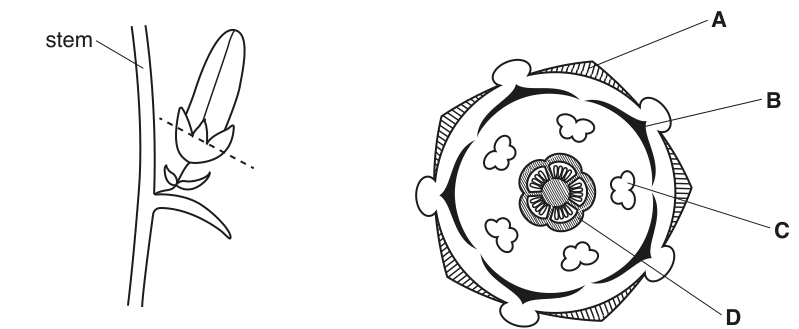
Complete the table to show the name of each of structures A to D and to state one function of each structure.
| letter | name of structure | function |
|---|---|---|
| A | ||
| B | ||
| C | ||
| D |
Answer
| letter | name of structure | function |
|---|---|---|
| A | sepal (or calyx) | protect the flower bud |
| B | petal (or corolla) | attract pollinators (or provide a landing platform) |
| C | stamen (or anther) | produces and contains pollen (or male gametes) |
| D | ovary (or carpel) | produces and contains ovules (or female gametes) |
See table above
Walkthrough
The question asks us to identify four structures in a transverse section of an insect-pollinated flower bud and state one function for each. We read the diagram from the outside in, which matches the arrangement of floral parts in a typical insect-pollinated flower: sepals, petals, stamens, and the central carpel.
- Structure A is the outermost layer. In the diagram, it is pointed and shaded, which is characteristic of a sepal (collectively the calyx). Its function is to protect the delicate inner parts of the flower while it is still a bud.
- Structure B is the next layer inward. It is rounded and unshaded, representing a petal (collectively the corolla). Petals are often brightly coloured to attract pollinators, and their broad shape provides a landing platform for insects.
- Structure C points to the structures containing the male reproductive parts. These are the stamens, with the striated, cloud-like shapes being the anthers (supported by filaments). The anther's function is to produce and contain pollen, which carries the male gametes (or male nuclei).
- Structure D is the central structure, the ovary (part of the carpel or pistil). It contains the ovules, which hold the female gametes (eggs). After fertilisation, the ovary will develop into the fruit.
Key Takeaways
- Insect-pollinated flowers have a concentric arrangement of floral parts: outermost sepals, then petals, then stamens, and finally the central carpel.
- Each floral part has a specific function related to reproduction and protection, such as protecting the bud, attracting pollinators, or producing gametes.
Common Mistakes
- Naming the wrong part: Confusing the sepal with a petal or the anther with the ovary. Always read from the outside in for a typical flower cross-section.
- Vague functions: Writing "reproduction" for the anther or ovary. The mark scheme requires specific functions like "produces pollen" or "produces ovules".
- Rejecting valid alternatives: The mark scheme accepts "stamen" or "anther" for C, and "ovary" or "carpel" for D. Giving either is fine, but don't mix them up (e.g., calling D a stamen).
Things to Be Careful About
- Matching the number of points: The question asks for "one function" per structure. Providing multiple functions is fine, but ensure at least one clear, correct function is given for each to secure the mark.
- Precision in terminology: Use exact terms like "pollen" and "ovules" rather than vague terms like "sex cells" or "dust".
- Reading the diagram: Ensure you are looking at the transverse section (right side of Fig 1.1) and not the whole bud outline (left side) when identifying the concentric layers.
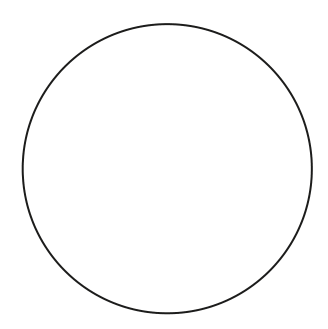
The diagram shows an incomplete transverse section through the stem of this plant.
Complete the diagram by drawing and labelling the positions of each of the following tissues:
- xylem,
- phloem.
Answer
See diagram
Walkthrough
The question provides an incomplete transverse section of a plant stem and asks us to draw and label the positions of xylem and phloem. Since the flower in part (a) is an insect-pollinated dicot flower, we assume the stem is a dicot stem.
In a dicot stem, vascular bundles are arranged in a ring around the periphery of the stem, leaving a central pith. Each vascular bundle is oval-shaped and contains two main tissues:
- Xylem: Located on the inside of the vascular bundle (towards the centre of the stem). It transports water and minerals.
- Phloem: Located on the outside of the vascular bundle (towards the edge of the stem). It transports sugars and other organic substances.
To score full marks, draw a ring of several oval vascular bundles (e.g., 5-7 bundles) inside the stem outline. Label the inner part of at least one bundle "xylem" and the outer part "phloem" with clear label lines.
Key Takeaways
- Dicot stems have vascular bundles arranged in a ring.
- Within each vascular bundle, xylem is on the inside (towards the centre) and phloem is on the outside (towards the edge).
- Monocot stems, by contrast, have scattered vascular bundles, but this question implies a dicot based on the flower type.
Common Mistakes
- Scattering the bundles: Drawing vascular bundles randomly throughout the stem instead of in a ring. This is characteristic of monocot stems, not dicots.
- Reversing xylem and phloem: Placing phloem on the inside and xylem on the outside of the vascular bundle. Remember "xylem inside, phloem outside" in a stem.
- Not drawing the bundles as ovals: Drawing them as circles or irregular shapes. The mark scheme specifically looks for "oval shaped" bundles.
- Labeling ambiguously: Drawing a single label line that points to both xylem and phloem, or not separating the labels clearly.
Things to Be Careful About
- Drawing conventions: Use a sharp pencil, draw continuous outlines, and ensure label lines do not cross each other or the outline of the stem.
- Location: Ensure the vascular bundles are placed within the stem outline, not outside it, and that they form a clear ring.
- Label placement: The label "xylem" must point specifically to the inner region of an oval bundle, and "phloem" to the outer region. Do not just write the words inside the bundle without clear pointer lines.
State one function of xylem tissue.
______
Answer
Transports water and dissolved minerals (ions) through the plant; also provides structural support to the stem.
Transports water and minerals
Walkthrough
Xylem tissue has two primary functions in plants:
- Transport: It carries water and dissolved minerals (ions) from the roots up to the rest of the plant, particularly to the leaves for photosynthesis.
- Support: The xylem vessels have thick, lignified cell walls that provide mechanical support to the plant, helping it to stand upright and keep leaves exposed to light.
The question asks for "one function", so stating either "transports water/minerals" or "provides support" will score the mark. Specifying "dissolved minerals" or "ions" alongside water is good practice and often expected in the mark scheme.
Key Takeaways
- Xylem transports water and minerals upwards from the roots.
- Xylem provides structural support due to its lignified cell walls.
- Phloem, in contrast, transports sugars and organic solutes in both directions.
Common Mistakes
- Confusing xylem and phloem: Stating that xylem transports sugars or food. That is the function of phloem.
- Vague transport statement: Writing "transports water" without mentioning minerals/ions, or writing "moves things around". Be specific: "water and dissolved minerals" or "water and ions".
- Forgetting support: While transport is the primary function, support is a valid and often overlooked function that scores marks.
Things to Be Careful About
- Precision: Use the term "minerals" or "ions" rather than just "nutrients" or "food".
- Direction: Xylem transport is unidirectional (upwards from roots), whereas phloem is bidirectional. If you mention direction, ensure it is correct for xylem.
The rest of this paper
8 more questions- Q2Transport in Humans · Respiration13M
- Q3Coordination and Control9M
- Q4Plant Nutrition · Transport in Flowering Plants · Organisms and Their Environment11M
- Q5Human Nutrition6M
- Q6Plant Nutrition · Transport in Flowering Plants10M
- Q7Inheritance10M
- Q8Biotechnology and Genetic Modification10M
- Q9Human Nutrition10M