Biology 5090/22 — October/November 2017
Cambridge O-Level · Theory · worked solutions for every part, with the mark scheme
Topics Inheritance · Coordination and Control · Organisms and Their Environment · Plant Nutrition · Respiration · Sexual Reproduction in Humans · +8 more
Fig. 1.1 shows stages in the development of human twins.
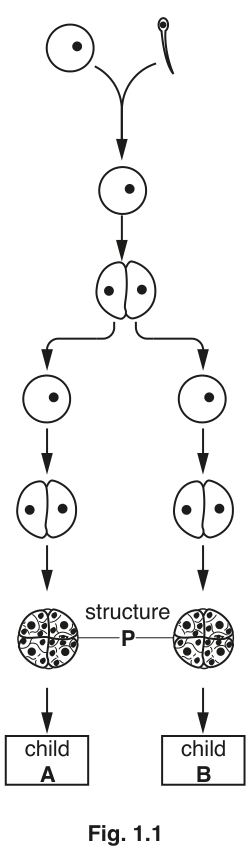
On Fig. 1.1, label and name each of the following:
- a gamete,
- a zygote.
Answer
- Label line to the egg cell (ovum) or the sperm cell at the top of Fig. 1.1, named as gamete (or egg / ovum / sperm).
- Label line to the single cell formed immediately after fertilisation (before the first division), named as zygote.
Gamete labelled at sperm/ovum; zygote labelled at single cell formed after fertilisation
Walkthrough
In human sexual reproduction, the sex cells are termed gametes. The male gamete is the sperm cell and the female gamete is the ovum (egg cell). At the very top of Fig. 1.1, the large spherical cell represents the ovum and the smaller cell with a flagellum represents the sperm cell. Either of these can be labelled and named as a gamete.
When the sperm and egg fuse during fertilisation, they form a single diploid cell known as the zygote (the third cell down from the top, where the arrows converge). This zygote then divides by mitosis to give 2 cells, which subsequently separate in this diagram to form identical twins.
Key Takeaways
- Gametes are haploid sex cells (sperm and ovum in humans).
- A zygote is the single diploid cell resulting from the fusion of gamete nuclei during fertilisation.
Common Mistakes
- Labelling the 2-cell or multi-celled embryo as a zygote.
- Confusing gamete with zygote.
Things to Be Careful About
- Ensure label lines point precisely to the correct cell and do not float ambiguously between stages.
Name the part of the female reproductive system that structure P enters.
______
Answer
Uterus (or womb / endometrium)
uterus
Walkthrough
Fertilisation occurs in the oviduct (Fallopian tube). As the resulting zygote travels down the oviduct towards the uterus, it divides repeatedly by mitosis to form a ball of cells called an embryo (labelled as structure P). Structure P enters the uterus (womb) where it embeds into the lining (endometrium) in a process called implantation.
Key Takeaways
- Fertilisation occurs in the oviduct.
- The developing ball of cells (blastocyst/embryo) enters the uterus to implant into the endometrium.
Common Mistakes
- Naming the oviduct / Fallopian tube (which the embryo leaves, rather than enters).
- Naming the vagina or ovary.
Things to Be Careful About
- The question asks for the organ that structure P enters, which is the uterus (or endometrium / womb).
If the sex chromosome in the sperm is a Y chromosome, and in the ovum (egg) is an X chromosome, state the sex of child A and of child B. Explain your answer.
child A ______
child B ______
explanation ______
Answer
child A: male (or boy / son)
child B: male (or boy / son)
explanation:
- The fertilisation of the egg () by the sperm () produces a zygote with chromosomes (male).
- The cells divide by mitosis, so both children are genetically identical (identical twins).
child A: male; child B: male; explanation: zygote is XY and divides by mitosis to form genetically identical twins
Walkthrough
- Sex Determination: Human sex is determined by the combination of sex chromosomes. An ovum carries an chromosome. If the fertilising sperm carries a chromosome, the resulting zygote has the sex chromosome combination , which determines male sex.
- Twin Development: Fig. 1.1 illustrates the formation of monozygotic (identical) twins. A single fertilised egg (zygote) divides by mitosis. Because mitosis produces genetically identical cells, both resulting embryonic cell lines carry the exact same genetic material, including the chromosome combination. Therefore, both child A and child B must be male.
Key Takeaways
- genotype results in a male; results in a female.
- Identical twins arise from a single zygote that separates after mitotic division, making them genetically identical and always of the same sex.
Common Mistakes
- Stating one child is male and the other female (impossible for identical twins formed from one zygote).
- Mentioning meiosis instead of mitosis for the division of the zygote/embryonic cells.
Things to Be Careful About
- Ensure both the genetic makeup and the role of mitosis in producing identical cells are clearly stated in the explanation.
Explain how a woman's body prevents further ova (eggs) from being released until the end of her pregnancy.
Answer
Any four from:
- The corpus luteum (yellow body / ovary) and later the placenta secrete progesterone.
- High levels of progesterone inhibit the release/secretion of FSH and LH from the pituitary gland.
- Without FSH, follicles / ova cannot mature or develop.
- Without LH, ovulation (release of an ovum) cannot occur.
Progesterone secreted by the corpus luteum and placenta inhibits FSH and LH release from the pituitary, preventing egg maturation and ovulation.
Walkthrough
During pregnancy, it is vital that no further eggs are matured or released:
- Source of Hormones: Following fertilisation, the corpus luteum (yellow body in the ovary) continues to produce progesterone (and estrogen). Later in pregnancy (around week 12 onwards), the placenta takes over the secretion of high levels of progesterone.
- Inhibition of Pituitary Hormones: Elevated progesterone levels exert negative feedback on the pituitary gland, strongly inhibiting the production and secretion of FSH (Follicle-Stimulating Hormone) and LH (Luteinising Hormone).
- Effect on Ovaries:
- FSH is required for follicle development and the maturation of ova in the ovaries. In its absence, no new follicles develop.
- LH is responsible for triggering ovulation (the release of a mature ovum from the ovary). In its absence, ovulation cannot take place.
Key Takeaways
- Progesterone maintains pregnancy and prevents the development of new follicles via negative feedback.
- FSH stimulates egg maturation; LH triggers egg release (ovulation).
- Corpus luteum provides progesterone initially; placenta takes over during later pregnancy.
Common Mistakes
- Saying estrogen or progesterone directly destroys eggs in the ovary.
- Confusing the roles of FSH (maturation) and LH (release/ovulation).
- Omitting the name of the gland producing FSH/LH (pituitary gland) or the source of progesterone (corpus luteum / placenta).
Things to Be Careful About
- Clearly state that high progesterone inhibits FSH/LH release from the pituitary gland and state the specific consequence of lacking FSH (no egg maturation) and lacking LH (no egg release).
The rest of this paper
8 more questions- Q2Coordination and Control9M
- Q3Inheritance10M
- Q4Organisms and Their Environment · Sexual Reproduction in Plants12M
- Q5[Legacy] Support, Movement and Locomotion · Coordination and Control8M
- Q6Plant Nutrition · Organisms and Their Environment10M
- Q7Human Nutrition · Biological Molecules10M
- Q8Transport in Flowering Plants · Respiration · Plant Nutrition10M
- Q9Human Gas Exchange · Respiration · Transport in Humans10M