Biology 5090/12 — May/June 2017
Cambridge O-Level · Multiple Choice · answer key with instant marking and worked solutions
Topics Plant Nutrition · Movement Into and Out of Cells · Transport in Humans · Coordination and Control · Inheritance · Organisms and Their Environment · +14 more
Tap an option under each question to check it — your score builds as you go.
The diagram shows cells from a plant leaf.
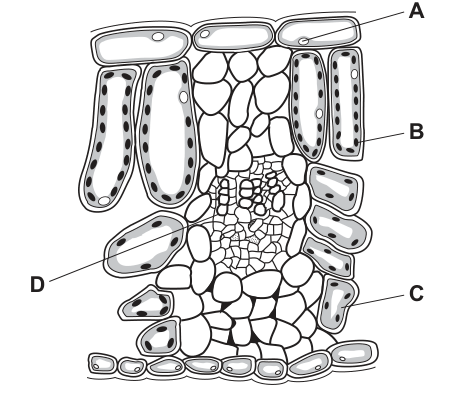
Which structure contains a high concentration of magnesium?
Options
A A
B B
C C
D D
Working
Magnesium is a mineral ion required for the synthesis of chlorophyll. Chlorophyll is the green pigment that captures light energy for photosynthesis, and it is located inside chloroplasts.
Looking at the diagram of the leaf cross-section:
- A points to the upper epidermis (and cuticle), which does not contain chloroplasts.
- B points to the dark, oval structures inside the palisade mesophyll cells. These are chloroplasts.
- C points to a spongy mesophyll cell (which contains some chloroplasts, but B specifically points to the chloroplast itself, and palisade cells have the highest concentration).
- D points to a xylem vessel in the vascular bundle, which transports water and minerals but does not store high concentrations of magnesium for photosynthesis.
Since chloroplasts contain chlorophyll, and chlorophyll requires magnesium, structure B contains a high concentration of magnesium.
Answer
B
B
Walkthrough
- Recall the function of magnesium in plants: Magnesium () is an essential mineral ion. Its primary role in plant biology is as the central ion in the chlorophyll molecule. Without magnesium, a plant cannot produce chlorophyll, leading to chlorosis (yellowing of leaves).
- Locate chlorophyll in the cell: Chlorophyll is not free-floating; it is embedded in the thylakoid membranes inside chloroplasts.
- Interpret the diagram: The image shows a cross-section of a leaf.
- Label A indicates the upper epidermal layer (and possibly the waxy cuticle). Epidermal cells are typically transparent and lack chloroplasts to allow light to reach the mesophyll below.
- Label B points directly to the numerous dark, oval organelles packed inside the columnar palisade mesophyll cells. These organelles are chloroplasts.
- Label C points to a spongy mesophyll cell. While these cells also contain chloroplasts, they are fewer in number than in the palisade layer, and the label points to the whole cell rather than a specific organelle.
- Label D points to the xylem vessel within the vascular bundle. Xylem transports water and dissolved mineral ions (including magnesium) from the roots to the leaves, but the magnesium is eventually incorporated into chlorophyll in the mesophyll cells, not stored in high concentrations in the xylem vessels themselves.
- Conclude: The structure with the highest concentration of magnesium is the chloroplast, because magnesium is a structural component of chlorophyll. This corresponds to label B.
Key Takeaways
- Mineral ion roles: Students must know the specific functions of key mineral ions. Magnesium = chlorophyll; Nitrate = amino acids/proteins; Iron = haemoglobin (in animals) / involved in enzyme function; Calcium = cell walls / bone (in animals).
- Leaf anatomy: The palisade mesophyll layer is packed with chloroplasts to maximise light absorption for photosynthesis. Recognising chloroplasts as the dark, oval bodies in a leaf cross-section is a standard skill.
Common Mistakes
- Confusing magnesium with other ions: Students might think of nitrogen (from nitrates) which is also needed for chlorophyll (and amino acids), but magnesium is the specific central atom. They might also choose xylem (D) thinking it transports the ions, forgetting that the ions are used up in the mesophyll cells to make chlorophyll.
- Misreading the diagram: Choosing C (spongy mesophyll cell) instead of B (chloroplast). The question asks for the structure containing the high concentration. While the cell contains the organelle, the organelle itself is the site of chlorophyll synthesis and storage, making B the most precise and correct answer.
Things to Be Careful About
- Precision in diagram labels: Ensure you are looking at exactly what the label line points to. B points to the organelle (chloroplast), not the whole cell. In 5090, if a label points to a specific organelle within a cell, that organelle is the intended answer, not the cell itself.
- Memorise ion functions: The link between magnesium and chlorophyll is a frequent 5090 testing point. Remember: for chlorophyll, for amino acids/proteins.
The rest of this paper
39 more questions- Q2Movement Into and Out of Cells1M
- Q3Movement Into and Out of Cells1M
- Q4Enzymes1M
- Q5Plant Nutrition1M
- Q6Plant Nutrition1M
- Q7Plant Nutrition1M
- Q8Human Nutrition1M
- Q9Human Nutrition1M
- Q10Transport in Humans1M
- Q11Movement Into and Out of Cells1M
- Q12Transport in Flowering Plants1M
- Q13Transport in Humans · Respiration1M
- Q14Transport in Humans1M
- Q15Transport in Humans1M
- Q16Human Gas Exchange1M
- Q17Respiration1M
- Q18Human Gas Exchange1M
- Q19Excretion · Movement Into and Out of Cells1M
- Q20Coordination and Control1M
- Q21Coordination and Control1M
- Q22Coordination and Control1M
- Q23Coordination and Control1M
- Q24[Legacy] Support, Movement and Locomotion1M
- Q25Disease and Immunity1M
- Q26Biotechnology and Genetic Modification1M
- Q27Cell Structure and Organisation · Classification1M
- Q28Organisms and Their Environment1M
- Q29Organisms and Their Environment1M
- Q30Organisms and Their Environment1M
- Q31Disease and Immunity1M
- Q32Sexual Reproduction in Plants · Inheritance1M
- Q33Sexual Reproduction in Plants · Inheritance1M
- Q34Cell Division and Reproduction1M
- Q35Sexual Reproduction in Humans1M
- Q36Sexual Reproduction in Humans1M
- Q37Inheritance1M
- Q38Biotechnology and Genetic Modification1M
- Q39Cell Division and Reproduction1M
- Q40Inheritance1M