Biology 5090/11 — May/June 2017
Cambridge O-Level · Multiple Choice · answer key with instant marking and worked solutions
Topics Plant Nutrition · Movement Into and Out of Cells · Coordination and Control · Human Nutrition · Transport in Humans · Organisms and Their Environment · +14 more
Tap an option under each question to check it — your score builds as you go.
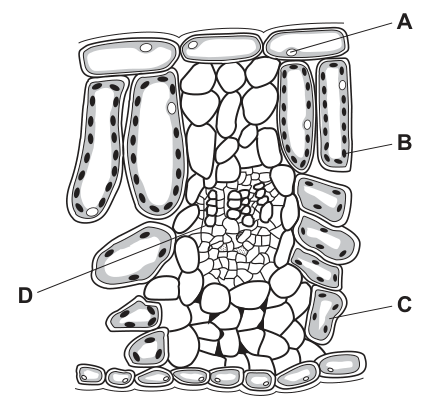
The diagram shows cells from a plant leaf.
Which structure contains a high concentration of magnesium?
Options
A A
B B
C C
D D
Answer
Magnesium is a mineral ion that is a central component of the chlorophyll molecule. Chlorophyll is the pigment responsible for absorbing light energy during photosynthesis and is located within the chloroplasts.
In the diagram:
- A points to the upper epidermis (transparent cells that typically lack chloroplasts to allow light transmission).
- B points to the chloroplasts (the dark oval structures) within the palisade mesophyll cells, which are packed with chloroplasts for maximum photosynthesis.
- C points to a cell wall (made of cellulose, not magnesium-rich).
- D points to a cell in the spongy mesophyll or a guard cell.
Since structure B represents the chloroplasts, it contains the high concentration of magnesium required for chlorophyll synthesis.
Answer
B
B
Walkthrough
- Identify the role of magnesium: The question asks for a structure with a high concentration of magnesium. In plant biology, magnesium () is the central metal ion in the porphyrin ring of the chlorophyll molecule. Without magnesium, plants cannot synthesise chlorophyll, leading to chlorosis (yellowing of leaves).
- Locate chlorophyll in the cell: Chlorophyll is not free-floating; it is embedded in the thylakoid membranes of the chloroplasts. Therefore, the structure with the highest concentration of magnesium will be the chloroplast itself (or cells packed with them).
- Interpret the diagram: The diagram shows a transverse section of a leaf.
- Label A indicates the upper epidermis. Epidermal cells are transparent and usually lack chloroplasts to allow light to pass through to the mesophyll below.
- Label B points directly to the dark, oval organelles inside the tall, columnar palisade mesophyll cells. These are chloroplasts. Palisade mesophyll cells are the primary site of photosynthesis and contain the highest density of chloroplasts.
- Label C points to the cell wall of a spongy mesophyll cell. Cell walls are primarily made of cellulose and do not concentrate magnesium.
- Label D points to a cell in the spongy mesophyll layer (or potentially a guard cell, though guard cells are at the bottom). While these may contain some chloroplasts, the palisade layer (B) is the main photosynthetic tissue and the chloroplasts here are the most concentrated source.
- Conclusion: Structure B (chloroplasts) contains the chlorophyll, and therefore the high concentration of magnesium.
Key Takeaways
- Magnesium () is essential for making chlorophyll. A deficiency causes yellowing between the veins of leaves (interveinal chlorosis).
- Chloroplasts are the organelles that contain chlorophyll and are the site of the light-dependent reactions of photosynthesis.
- Palisade mesophyll cells are adapted for photosynthesis by being columnar (packing many chloroplasts in a small volume) and located just below the upper epidermis to receive maximum light.
Common Mistakes
- Confusing magnesium with other ions: Students often confuse the role of magnesium with nitrogen (needed for amino acids/proteins/nitrates) or phosphorus (needed for ATP/DNA). Remember: Mg = Chlorophyll.
- Misidentifying structures: Pointing to the whole cell instead of the specific organelle. The question asks for the structure containing the magnesium. While the palisade cell contains magnesium, it is specifically concentrated in the chloroplasts (B). If B pointed to the cell cytoplasm, it would be less precise, but here B points to the organelles.
- Assuming all plant cells have chloroplasts: The upper epidermis (A) and root hair cells do not contain chloroplasts. Only photosynthetic cells (mesophyll, guard cells) have them.
Things to Be Careful About
- Read the label carefully: Ensure you are identifying what the letter points to. In this diagram, B points to the dark spots (chloroplasts) inside the cell, not the cell wall or cytoplasm.
- Precision of terminology: Do not just say "the leaf" or "the cell". The mark scheme requires identifying the chloroplast as the specific structure containing the chlorophyll and thus the magnesium.
- Unit/Format: This is a multiple-choice question; simply provide the correct option letter.
The rest of this paper
39 more questions- Q2Movement Into and Out of Cells1M
- Q3Movement Into and Out of Cells1M
- Q4Enzymes1M
- Q5Plant Nutrition1M
- Q6Plant Nutrition1M
- Q7Plant Nutrition1M
- Q8Human Nutrition1M
- Q9Human Nutrition1M
- Q10Human Nutrition1M
- Q11Movement Into and Out of Cells · Transport in Flowering Plants1M
- Q12Movement Into and Out of Cells · Transport in Flowering Plants1M
- Q13Transport in Humans1M
- Q14Transport in Humans1M
- Q15Transport in Humans1M
- Q16Human Gas Exchange1M
- Q17Respiration1M
- Q18Human Gas Exchange1M
- Q19Excretion1M
- Q20Coordination and Control1M
- Q21Coordination and Control1M
- Q22Coordination and Control1M
- Q23Coordination and Control1M
- Q24[Legacy] Support, Movement and Locomotion1M
- Q25Disease and Immunity1M
- Q26Classification1M
- Q27Biotechnology and Genetic Modification1M
- Q28Organisms and Their Environment1M
- Q29Organisms and Their Environment1M
- Q30Organisms and Their Environment1M
- Q31Disease and Immunity1M
- Q32Sexual Reproduction in Plants1M
- Q33Sexual Reproduction in Plants · Cell Division and Reproduction1M
- Q34Cell Division and Reproduction1M
- Q35Sexual Reproduction in Humans1M
- Q36Sexual Reproduction in Humans1M
- Q37Cell Division and Reproduction1M
- Q38Inheritance1M
- Q39Inheritance1M
- Q40Inheritance1M