Biology 5090/32 — October/November 2016
Cambridge O-Level · Practical Test · worked solutions for every part, with the mark scheme
Topics Observations and Measurements · Experimental Contexts · Analysis, Conclusions and Evaluation · Microscopy and Biological Drawing · Use of Techniques, Apparatus and Materials · Planning Experiments and Investigations
Fig. 1.1 shows a flower.
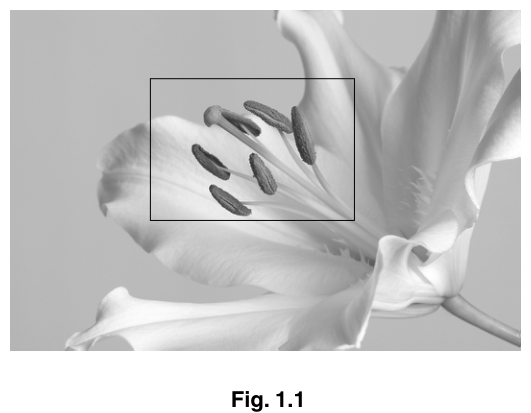
Describe two visible features of this flower that suggest it is likely to be insect-pollinated rather than wind-pollinated.
- ______
- ______
Make a large drawing of the structures of the flower shown within the box on Fig. 1.1.
On your drawing label the following structures with a label line, the appropriate letter and its biological name:
A the part of the flower in which pollen grains are produced
B the part of the flower to which the pollen grains are transferred during pollination
C the part of the flower through which the pollen tube grows after pollination.
After pollination and fertilisation have taken place in a flower, a fruit containing seeds develops.
You are provided with halves of two fruits, one ripe and the other unripe.
Cut each half fruit into two pieces.
Test a piece of the ripe fruit and a piece of the unripe fruit for starch using iodine solution.
Test a piece of the ripe fruit and a piece of the unripe fruit for reducing sugar using Benedict’s solution and a water bath.
Raise your hand to request hot water when you need it.
Record your results and state your conclusions in Table 1.1.
Table 1.1
| test | ripe fruit result | ripe fruit conclusion | unripe fruit result | unripe fruit conclusion |
|---|---|---|---|---|
| starch | ||||
| reducing sugar |
Suggest how the seed(s) in the ripe fruit may be dispersed, giving reasons for your suggestion.
______
The rest of this paper
2 more questions- Q2Observations and Measurements · Experimental Contexts · Analysis, Conclusions and Evaluation · Use of Techniques, Apparatus and Materials · Planning Experiments and Investigations15M
- Q3Observations and Measurements · Analysis, Conclusions and Evaluation9M