Biology 5090/21 — October/November 2016
Cambridge O-Level · Theory · worked solutions for every part, with the mark scheme
Topics Sexual Reproduction in Humans · Disease and Immunity · Human Gas Exchange · Sexual Reproduction in Plants · [Legacy] Support, Movement and Locomotion · Respiration · +5 more
Fig. 1.1 shows a model that a student made to represent the human breathing system.
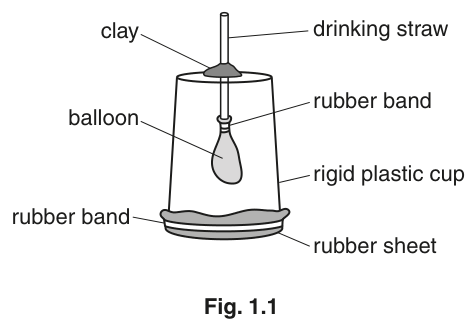
State the part of the model shown in Fig. 1.1 that represents each of the following structures.
the trachea ______
the diaphragm ______
Answer
the trachea: drinking straw
the diaphragm: rubber sheet
drinking straw; rubber sheet
Walkthrough
The question asks to map the components of a simple bell-jar breathing model to the human respiratory system. The drinking straw is the tube that carries air from the outside into the lungs, which corresponds to the trachea (windpipe). The flexible rubber sheet at the bottom is pulled down to create a pressure change, mimicking the contraction of the diaphragm muscle. Therefore, the straw represents the trachea and the rubber sheet represents the diaphragm.
Key Takeaways
Students should be able to map mechanical models to biological structures. The straw is the airway (trachea) and the rubber sheet is the muscle that drives the pressure change (diaphragm).
Common Mistakes
- Calling the straw a 'tube' or 'pipe' instead of the specific biological term 'trachea'.
- Calling the rubber sheet a 'bottom' or 'base' instead of 'diaphragm'.
- Confusing the rubber sheet with the ribs (the rigid cup represents the rib cage/thorax).
Things to Be Careful About
The mark scheme accepts 'drinking straw' and 'rubber sheet' exactly as labelled in the figure. Do not overcomplicate the answer; the question only asks to state the part of the model, not to explain why.
Describe how this model does not accurately represent the human breathing system.
Answer
- The model has only one balloon, representing only one lung, whereas humans have two lungs.
- The model lacks ribs and intercostal muscles, which in humans change the volume of the thorax.
- The rigid plastic cup does not move, but the thorax wall moves during breathing.
- The model has no bronchi, bronchioles, alveoli, blood vessels, cilia, or mucus.
- The rubber sheet is flat at rest, whereas the real diaphragm is domed.
See working
Walkthrough
To score marks here, the student must identify structural or functional differences between the simplified model and the human breathing system. The mark scheme provides a list of acceptable points, and any four will score full marks. Key differences include: the model has only one balloon (one lung) instead of two; it lacks ribs and intercostal muscles (which expand the thorax in humans); the plastic cup is rigid and does not move (the thorax wall does); it lacks branching airways (bronchi/bronchioles), gas exchange surfaces (alveoli), and protective mechanisms (cilia/mucus); and the rubber sheet is flat at rest, unlike the domed diaphragm in the human body.
Key Takeaways
Mechanical models are useful for demonstrating basic principles (like pressure changes) but omit many biological structures. Students should be able to list at least four missing features and explain why they are important in the real system.
Common Mistakes
- Stating that the model is 'inaccurate' without giving a specific biological reason.
- Saying 'it has no lungs' (the balloon represents a lung, so it's more accurate to say 'only one lung' or 'no alveoli').
- Confusing the rigid cup with the diaphragm (the cup is the thorax/rib cage, the sheet is the diaphragm).
Things to Be Careful About
The mark scheme accepts an ORA (opposite reverse argument) for all points if the student refers to the human breathing system rather than the model (e.g., 'humans have two lungs' instead of 'the model has one balloon'). Ensure you provide exactly four distinct points to get the full 4 marks.
The model can be used to demonstrate the action of breathing.
Describe what the student must do to the model to demonstrate the action of breathing in.
Answer
Pull the rubber sheet down.
pull the rubber sheet down
Walkthrough
To demonstrate breathing in (inspiration), the student must mimic the contraction of the diaphragm. In the model, the diaphragm is represented by the rubber sheet. Pulling it down increases the volume of the rigid plastic cup (thorax), which decreases the air pressure inside. Air then flows down the straw (trachea) into the balloon (lung) to equalise the pressure.
Key Takeaways
In a bell-jar model, pulling the base sheet down simulates diaphragm contraction and inspiration. Pushing it up simulates expiration.
Common Mistakes
- Saying 'blow down the straw' (this is not how the model demonstrates breathing in; blowing would force air in artificially, not via pressure changes).
- Forgetting to specify the direction ('down' is required for full marks).
Things to Be Careful About
The mark scheme explicitly rejects 'blowing down straw'. The action must be on the rubber sheet, and the direction must be 'down'.
State what the student would observe as the model is used to demonstrate the action of breathing in.
Answer
The balloon inflates (or expands / gets bigger).
the balloon inflates
Walkthrough
As the rubber sheet is pulled down, the volume inside the cup increases, causing a drop in air pressure. Atmospheric pressure pushes air down the straw and into the balloon, causing it to inflate. The observation is simply that the balloon gets bigger.
Key Takeaways
A decrease in pressure inside a closed container (relative to the outside) will cause air to flow into any connected flexible space, inflating it.
Common Mistakes
- Describing the process ('air moves into the balloon') instead of stating the observation ('the balloon inflates').
- Saying 'the balloon expands' without specifying it's the balloon that changes.
Things to Be Careful About
The question asks what the student would 'observe'. Give a direct observation: 'the balloon inflates'. Do not explain why here; that is for the next part.
The model becomes damaged by a hole being made in the side of the rigid plastic cup.
Describe and explain how this damage will change what the student would observe as the model is used to demonstrate the action of breathing in.
Answer
The balloon will no longer inflate (or expand / get bigger). Air from the outside will enter through the hole in the cup, so the pressure inside the cup is not reduced when the rubber sheet is pulled down. Consequently, less or no air is drawn through the straw into the balloon.
the balloon no longer inflates because air enters through the hole, preventing a pressure drop in the cup
Walkthrough
This part has two requirements: describe the changed observation and explain it. First, if there is a hole in the cup, pulling the rubber sheet down will simply draw outside air in through the hole rather than reducing the pressure inside the cup. Because the pressure inside is not reduced (it stays equal to atmospheric pressure), there is no pressure difference to push air down the straw. Therefore, the balloon will not inflate. The explanation must link the hole to air entering, the failure to reduce pressure, and the resulting lack of air flow into the balloon.
Key Takeaways
Models rely on a sealed system to demonstrate pressure changes. Any leak (hole) will prevent the pressure differential needed to drive airflow.
Common Mistakes
- Only describing the observation without explaining why (e.g., 'the balloon won't inflate because there is a hole').
- Saying 'the air goes out of the hole' (air goes in through the hole to fill the expanding volume).
- Failing to mention pressure (the mark scheme requires 'pressure in cup not reduced').
Things to Be Careful About
The mark scheme awards marks for: 1) observation (no longer inflates), 2) mechanism (air allowed to pass through hole), 3) pressure effect (pressure not reduced), 4) consequence (less/no air through straw). Ensure all logical steps are covered in the explanation. Do not say 'the balloon deflates' (it was never inflated in the first place during this action).
The rest of this paper
8 more questions- Q2Sexual Reproduction in Plants11M
- Q3[Legacy] Support, Movement and Locomotion · Respiration11M
- Q4Human Nutrition · Sexual Reproduction in Humans · Disease and Immunity11M
- Q5Inheritance5M
- Q6Sexual Reproduction in Humans · Disease and Immunity10M
- Q7Coordination and Control10M
- Q8Transport in Humans10M
- Q9Organisms and Their Environment10M