Biology 5090/12 — October/November 2016
Cambridge O-Level · Multiple Choice · answer key with instant marking and worked solutions
Topics Coordination and Control · Organisms and Their Environment · Plant Nutrition · Human Nutrition · Transport in Humans · Inheritance · +14 more
Tap an option under each question to check it — your score builds as you go.
The diagram shows a plant cell.
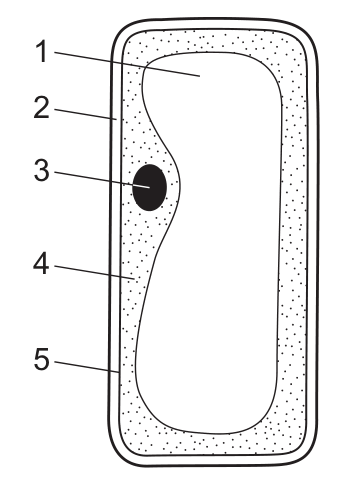
Which two structures are not found in animal cells?
Options
A 1 and 2
B 2 and 3
C 3 and 4
D 4 and 5
Working
The diagram shows a plant cell with: 1 = large central vacuole, 2 = cell membrane, 3 = nucleus, 4 = cytoplasm, 5 = cell wall.
Animal cells have a cell membrane, nucleus and cytoplasm, but they do not have:
- a cell wall (structure 5) — plant cells only;
- a large central vacuole (structure 1) — plant cells only.
Answer
A
A
Walkthrough
First, identify each numbered structure on the plant cell diagram. The outermost thick layer is the cell wall (5); just inside it is the thin cell membrane (2); the dark oval body is the nucleus (3); the stippled material filling the cell around the organelles is the cytoplasm (4); and the large clear space taking up most of the cell's volume is the central vacuole (1).
Now compare this list with an animal cell. An animal cell has a cell membrane, cytoplasm and a nucleus — so structures 2, 3 and 4 are shared by both cell types. What it lacks are the two features that give plant cells their box-like shape and firmness: the cellulose cell wall and the large central vacuole full of cell sap. These correspond to structures 5 and 1, so the option pairing them together is A.
Key Takeaways
- Plant cells uniquely possess a cellulose cell wall and a large central vacuole containing cell sap; animal cells never have these.
- Both plant and animal cells share a cell membrane, cytoplasm and nucleus.
- The cell wall gives plant cells a fixed, regular shape; the vacuole keeps cells turgid by osmosis.
Common Mistakes
- Confusing the cell wall with the cell membrane: the wall is the outermost, thicker line; the membrane lies immediately inside it and is present in ALL cells.
- Thinking animal cells have no vacuole at all — small temporary vacuoles may occur, but the large central vacuole is plant-specific, which is what the question tests.
- Misreading the label lines: check exactly where each pointer line ends before matching numbers to options.
Things to Be Careful About
- The mark scheme gives only the letter, so your identification of each numbered structure must be right for the letter to follow.
- If asked to name rather than select, use the exact terms "cell wall" and "(permanent) vacuole" — "cell sap" alone names the contents, not the structure.
The rest of this paper
39 more questions- Q2Movement Into and Out of Cells1M
- Q3Movement Into and Out of Cells1M
- Q4Enzymes1M
- Q5Plant Nutrition1M
- Q6Plant Nutrition1M
- Q7Plant Nutrition1M
- Q8Human Nutrition1M
- Q9Human Nutrition1M
- Q10Human Nutrition · Excretion1M
- Q11Transport in Flowering Plants1M
- Q12Transport in Flowering Plants · Biological Molecules1M
- Q13Transport in Humans1M
- Q14Transport in Humans1M
- Q15Transport in Humans1M
- Q16Respiration1M
- Q17Human Gas Exchange1M
- Q18Respiration1M
- Q19[Legacy] Support, Movement and Locomotion1M
- Q20Excretion1M
- Q21Coordination and Control1M
- Q22Coordination and Control1M
- Q23Coordination and Control1M
- Q24Coordination and Control1M
- Q25Disease and Immunity1M
- Q26Classification1M
- Q27Biotechnology and Genetic Modification1M
- Q28Organisms and Their Environment1M
- Q29Organisms and Their Environment1M
- Q30Organisms and Their Environment1M
- Q31Disease and Immunity1M
- Q32Organisms and Their Environment1M
- Q33Sexual Reproduction in Plants1M
- Q34Sexual Reproduction in Plants1M
- Q35Sexual Reproduction in Humans1M
- Q36Sexual Reproduction in Humans1M
- Q37Biotechnology and Genetic Modification1M
- Q38Inheritance1M
- Q39Inheritance1M
- Q40Inheritance1M