Biology 5090/61 — October/November 2015
Cambridge O-Level · Alternative to Practical · worked solutions for every part, with the mark scheme
Topics Observations and Measurements · Planning Experiments and Investigations · Microscopy and Biological Drawing · Analysis, Conclusions and Evaluation · Experimental Contexts · Use of Techniques, Apparatus and Materials
Some students investigated the effect of adding a known volume of an enzyme to some crushed apricot fruit. The mixture was stirred to mix the enzyme thoroughly with the fruit. The mixture was filtered. The volume of juice collected is shown in Fig. 1.1A.
To a second sample of fruit they added the same volume of water instead of the enzyme. This mixture was filtered. The volume of juice collected is shown in Fig. 1.1B.
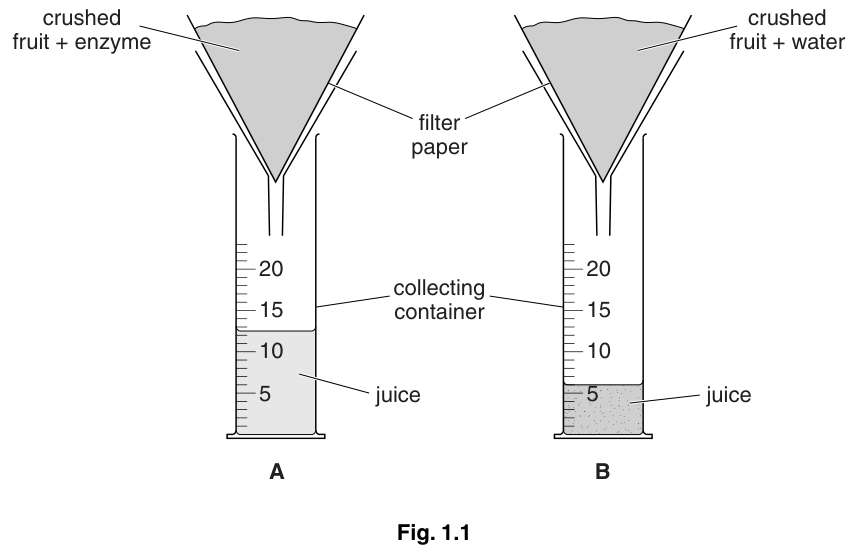
In Table 1.1, record the volumes of juice collected as shown in Fig. 1.1.
Table 1.1
| sample of juice | volume / | appearance |
|---|---|---|
| A | clear | |
| B | cloudy |
Answer
| sample of juice | volume / | appearance |
|---|---|---|
| A | 12.5 | clear |
| B | 6.0 | cloudy |
A = 12.5, B = 6.0
Walkthrough
The collecting containers are graduated measuring cylinders. In A the juice surface sits halfway between the 10 and 15 marks, so read it as 12.5 . In B the surface sits just above the 5 mark, so read it as 6.0 . Record each value in the correct row of Table 1.1; the unit is already printed in the column heading, so only the numbers go in the cells.
Key Takeaways
- Read a liquid level at the bottom of the meniscus, at eye level.
- When a scale is marked every 5 units with subdivisions, estimate to the nearest half division.
- The unit belongs in the table heading (volume / ), not repeated in every cell.
Common Mistakes
- Reading A as 15 and B as 7 — these ignore the exact position of the liquid surface; the accepted readings are 12.5 and 6.0.
- Writing units inside the cells when the heading already carries them.
- Swapping the two values between rows A and B.
Things to Be Careful About
- Give each reading to the same precision (one decimal place) so the table is consistent.
- The mark scheme allows 'A 6 alone' as partial credit, so a wrong A value still scores the B mark — but aim for both exact readings.
The enzyme is used in the production of fruit juice on a large scale. Using the information in Table 1.1, suggest two reasons why the enzyme is used.
______
Answer
The enzyme gives a larger volume of juice and the juice is clear, so more sellable juice is produced from the same amount of fruit.
Larger volume of juice and clearer juice (both needed for the mark).
Walkthrough
Compare the two columns of Table 1.1. With enzyme (A) the volume is 12.5 against 6.0 with water (B), and A is described as clear while B is cloudy. The mark scheme insists on BOTH points joined with '+': the enzyme produces more juice AND clearer juice. On an industrial scale this means a higher yield of juice that needs no extra clarification step, which is why manufacturers use the enzyme.
Key Takeaways
- 'Suggest' questions on data require you to use the data, not general knowledge.
- When a mark scheme joins two statements, both must appear in your answer.
Common Mistakes
- Giving only 'more juice' or only 'clearer juice' — one alone does not score.
- Writing a vague answer such as 'it works better' without naming the two observed differences.
Things to Be Careful About
- Anchor the answer in Table 1.1: volume and appearance are the two variables recorded there.
Suggest why water was added to the crushed fruit in B.
______
Answer
Water acts as a control, for comparison with the enzyme sample.
As a control / for comparison.
Walkthrough
Sample B is identical to sample A in every way except that water replaces the enzyme. This is a control: it shows what happens with no enzyme, so any difference in juice volume can be attributed to the enzyme rather than to filtering or the added liquid itself. The mark scheme accepts 'for comparison / control'.
Key Takeaways
- A control differs from the experimental set-up in only the factor being tested.
- Controls let you conclude that the independent variable caused the change.
Common Mistakes
- Saying 'to add volume' or 'to keep the fruit wet' — these miss the control idea.
- Saying 'fair test' without explaining comparison; the accepted idea is control/comparison.
Things to Be Careful About
- Use the word 'control' or 'comparison' explicitly — it is the marking point.
State two variables that need to be kept constant in this investigation.
- ______
- ______
Answer
- Temperature.
- Mass (or volume) of crushed fruit used.
(Other valid answers: amount of stirring / crushing, type and age of fruit, time allowed to filter, type of filter paper, type or concentration of enzyme.)
Any two of: temperature; mass/volume of fruit; stirring; fruit type/age; filtering time/filter paper; enzyme type/concentration.
Walkthrough
A fair test means only the independent variable (enzyme present or absent) differs between A and B. Everything else that could affect how much juice drains through must be the same. The mark scheme lists: temperature (enzymes are temperature-sensitive), the same amount of stirring or crushing (this affects how easily juice escapes the cells), the volume or mass of crushed fruit, the type/age/source of the fruit, the time allowed to filter and the type of filter paper, and the type or concentration of enzyme. Any two score.
Key Takeaways
- Controlled variables are all the factors, other than the independent variable, that could change the dependent variable.
- For enzyme work, temperature is always a prime candidate because enzymes denature above the optimum.
Common Mistakes
- Naming the volume of juice collected — that is the dependent variable, not a controlled one.
- Naming the enzyme itself as 'kept constant' when its presence/absence is the independent variable (its concentration or type, however, is valid).
Things to Be Careful About
- Give exactly two variables; extra incorrect ones do not lose the marks but the first two listed are the ones credited.
Suggest two ways in which the investigation could be improved to increase the reliability of the results.
- ______
- ______
Answer
- Repeat the investigation and calculate a mean volume of juice.
- Allow a longer time for filtering (or for the enzyme to act).
(Other valid answers: measure the mass/volume of fruit used before testing; use a centrifuge instead of filtering; keep the temperature constant / at the enzyme's optimum; increase the enzyme concentration.)
Any two of: repeat and take a mean; longer filtering/enzyme time; measure fruit mass/volume; centrifuge instead of filtering; constant/optimum temperature; higher enzyme concentration.
Walkthrough
Reliability means the results can be trusted to be repeatable. Each accepted improvement fixes a specific weakness of the method as described: only one trial of each condition was done, so repeat and take a mean; the filtering time is not stated, so a longer time lets all the free juice drain; the mass of fruit was not measured, so weigh it before testing; filtering is slow and lossy, so a centrifuge separates juice more completely; temperature was not controlled, so hold it at the enzyme's optimum; and a higher enzyme concentration gives a clearer, larger effect. Any two of these score.
Key Takeaways
- Reliability is improved by repeats and means, and by tightening control of variables.
- A good improvement names what is done, not just an aim ('be more careful' scores nothing).
Common Mistakes
- Writing 'human error' or 'to avoid mistakes' — explicitly rejected by mark schemes.
- Giving an improvement that changes the investigation rather than strengthens it.
Things to Be Careful About
- Pair each improvement with the limitation it addresses in your mind; that is what makes it specific enough to score.
Fig. 1.2 shows half of a fresh apricot.
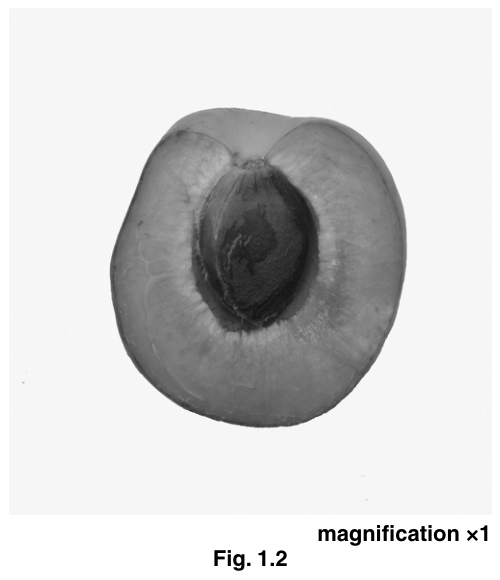
Make a drawing of this fruit, twice the size of the actual fruit.
On your drawing, indicate where the fruit was attached to the parent plant using the letter P.
Answer
Draw the half apricot in sharp pencil with a single continuous outline, no shading, at twice the size of the photograph (magnification ), showing the correct proportions: the fleshy outer part, the hollow in which the stone sat, and the 'dip' at the stalk end. Mark the point where the fruit was attached to the parent plant with the letter P at the top (stalk end) of the fruit.
Drawing of the half apricot at twice actual size, correct proportions, no shading, with P at the point of attachment.
Walkthrough
The photograph is printed at magnification , so twice the size means magnification — measure the fruit in the photograph and double every dimension. The four marks are: (1) a clear outline with NO shading, stippling or hatching — use a sharp pencil and single unbroken lines; (2) the drawing is twice the size of the photograph; (3) correct proportions, showing the stone cavity and the 'dip' at the attachment end; (4) the letter P placed at the point of attachment to the parent plant, which is the stalk end at the top of the photograph. No other labels are asked for, so add none.
Key Takeaways
- Biological drawings use continuous single lines, never shading.
- 'Twice the size' is a stated magnification you must actually achieve by measuring.
- Draw only what is asked for and label only what is asked for.
Common Mistakes
- Shading the flesh or the stone cavity with pencil — this loses the outline mark.
- Drawing the fruit the same size as the photograph instead of twice the size.
- Putting P on the skin or the stone instead of the stalk end where the fruit joined the plant.
- Using a ruler to draw the outline — outlines should be freehand.
Things to Be Careful About
- Check your drawing measures twice the photograph's dimensions before moving on; examiners measure.
- Keep proportions correct: the hollow is roughly central and the dip is at the top.
Ripe fruits contain reducing sugars.
Describe how you could test a sample of fruit to show that it contains reducing sugars.
Include one safety feature in your method.
Answer
- Crush (or cut up) a sample of the fruit to make an extract.
- Add Benedict's solution to the sample and heat it (in a water-bath).
- A positive result is a colour change from blue to brick-red (orange/red precipitate), showing reducing sugars are present.
- Safety feature: heat the tube in a water-bath (not a direct flame) and wear eye protection.
Crush sample, add Benedict's solution and heat; blue to brick-red; safety: water-bath / eye protection.
Walkthrough
Reducing sugars are detected with Benedict's solution. First prepare the sample: fruit is solid, so crush or cut it up so the sugars dissolve into the extract. Then add Benedict's solution (blue) and heat — Benedict's only reacts on heating. If reducing sugars are present, the blue solution turns green, then yellow, orange and finally brick-red as an insoluble precipitate forms; the mark scheme accepts 'blue to red'. For the safety mark, name a real precaution: heating in a water-bath instead of a direct flame (so the tube cannot crack or the contents spit) or wearing safety glasses. The question says 'one' safety feature, so give one clearly.
Key Takeaways
- Benedict's test: add Benedict's solution + heat; blue to brick-red = reducing sugar present.
- Solid foods must be crushed or cut up before testing.
- Standard safety points for heated tests: water-bath, eye protection, point the tube away from people.
Common Mistakes
- Forgetting to heat — Benedict's does not change colour cold, and 'heat' is a marking point.
- Using iodine (tests for starch) instead of Benedict's.
- Saying 'turns red' without the starting colour blue; the change blue to red is what scores.
- Giving a vague safety answer such as 'be careful' instead of naming water-bath or eye protection.
Things to Be Careful About
- The safety feature carries its own mark — write it as a separate, explicit step.
- Describe the full observation: reagent, condition (heat), colour change, conclusion.
Fruits, such as apricots, can be preserved by drying them in the sun.
Some students investigated the changes in mass of some fruits as they were left to dry over five days. The results are shown in Table 1.2.
Calculate the total loss in mass / g for days 4 and 5 and complete Table 1.2.
Table 1.2
| time / days | mass / | total loss in mass / |
|---|---|---|
| 0 | 30.0 | 0.0 |
| 1 | 22.5 | 7.5 |
| 2 | 17.0 | 13.0 |
| 3 | 12.0 | 18.0 |
| 4 | 8.5 | |
| 5 | 7.0 |
Working
Total loss in mass = initial mass − mass at that day.
Answer
Day 4: 21.5; Day 5: 23.0
21.5 and 23.0
Walkthrough
The 'total loss in mass' column compares each day's mass with the starting mass on day 0 (30.0 g), not with the previous day. Check with the printed values: day 1 gives 30.0 − 22.5 = 7.5, which matches, confirming the method. So day 4 is 30.0 − 8.5 = 21.5 g and day 5 is 30.0 − 7.0 = 23.0 g. Keep one decimal place to match the table.
Key Takeaways
- 'Total loss' means loss from the original, so always subtract from the day 0 mass.
- Match the decimal places already used in the table.
Common Mistakes
- Subtracting the previous day's mass instead of the day 0 mass (e.g. 12.0 − 8.5 = 3.5), which gives the daily loss, not the total loss.
- Dropping the decimal place (writing 21.5 as 21.5 g is fine, but 21.5 vs 21.50 — keep it consistent with the table).
Things to Be Careful About
- Verify your method against a row that is already filled in (day 1 or 2) before completing the blanks.
Construct a graph to show the total loss in mass of the fruits with time.
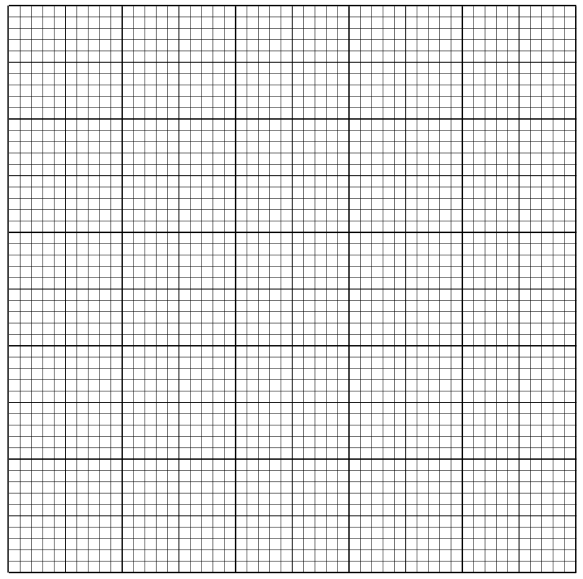
Answer
Draw a line graph on the printed grid:
- x-axis: time / days (0 to 5); y-axis: total loss in mass / g (0 to at least 23).
- Use a linear scale that fills at least half the grid in both directions, with a value at the origin.
- Plot the points (0, 0.0), (1, 7.5), (2, 13.0), (3, 18.0), (4, 21.5), (5, 23.0), each no larger than half a small square.
- Join the points with a single clear, unbroken ruled line (or a smooth curve).
Line graph of total loss in mass / g against time / days, correctly labelled axes, linear scale filling over half the grid, accurate plots, clear unbroken line.
Walkthrough
The independent variable, time, goes on the x-axis and the dependent variable, total loss in mass, on the y-axis — both axes must be fully labelled WITH units ('time / days', 'total loss in mass / g'). Choose linear scales: days 0–5 across, and 0 to 25 g up, so the plots fill at least half the printed grid in both directions and the origin is labelled 0. Plot each of the six points carefully; each point must be small (no more than half a small square) and in the right place. Finally join the plots with one clear unbroken line — 5090 accepts either ruled lines joining the points neatly or a smooth curve, but never extrapolate beyond the last point.
Key Takeaways
- Independent variable on the x-axis, dependent variable on the y-axis, both labelled with units.
- Scales must be linear, sensible and use over half the grid.
- Small, accurate plots; a single clear line through them.
Common Mistakes
- Swapping the axes or omitting units from the axis labels.
- Using an awkward scale (e.g. 3 g per square) that makes plotting error-prone.
- Plotting points too large or joining them with a sketchy, broken, or thick line.
- Extrapolating the line beyond day 5.
Things to Be Careful About
- Plot (0, 0.0) — the first data point is at the origin, not on the axis itself as a bare axis.
- Check each plotted point against the completed table from (d)(i); a wrong value there carries forward.
Suggest why drying fruit helps to preserve it.
______
Answer
Removing water prevents the growth of decomposers (bacteria and fungi), so the fruit does not decay.
Drying prevents growth of decomposers / microorganisms, so the fruit is preserved.
Walkthrough
Food decays because bacteria and fungi (decomposers) grow on it, and they need water to grow and reproduce. Drying removes water, so the decomposers cannot grow and the fruit keeps. The mark scheme accepts any wording equivalent to 'prevents growth of decomposers'.
Key Takeaways
- Water is essential for microbial growth; removing it is a standard preservation method.
- Preservation methods work by denying microorganisms what they need (water, warmth, oxygen).
Common Mistakes
- Saying 'kills bacteria' — drying does not kill them, it prevents their growth.
- Saying 'removes water' alone without linking it to stopping decomposers.
Things to Be Careful About
- Name the decomposers (bacteria/fungi/microorganisms) and state that their growth is prevented — that link is the marking point.
The rest of this paper
2 more questions- Q2Microscopy and Biological Drawing · Observations and Measurements8M
- Q3Planning Experiments and Investigations9M