Biology 5090/11 — October/November 2015
Cambridge O-Level · Multiple Choice · answer key with instant marking and worked solutions
Topics Organisms and Their Environment · Coordination and Control · Movement Into and Out of Cells · Plant Nutrition · Transport in Humans · Human Gas Exchange · +11 more
Tap an option under each question to check it — your score builds as you go.
The diagram shows a plant cell. The cell is stained with iodine solution.
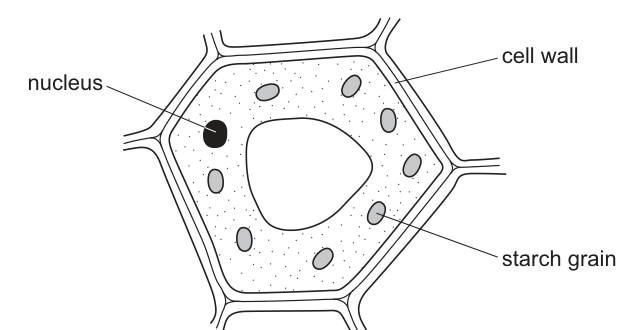
After staining with iodine solution, what are the colours of the cell wall and the starch grain?
Options
| cell wall | starch grain | |
|---|---|---|
| A | blue-black | blue-black |
| B | blue-black | orange-brown |
| C | orange-brown | blue-black |
| D | orange-brown | orange-brown |
Working
Iodine solution is orange-brown. It turns blue-black only where starch is present, so the starch grain becomes blue-black. The cell wall (cellulose) contains no starch, so it stays the colour of iodine solution, orange-brown.
Answer
C
C
Walkthrough
Iodine solution is the 5090 reagent for testing starch: it is orange-brown on its own and turns blue-black in contact with starch. In the stained cell, the starch grains therefore appear blue-black. The cell wall is made of cellulose, which does not react with iodine, so it simply shows the colour of the iodine solution itself — orange-brown. That combination (cell wall orange-brown, starch grain blue-black) is option C.
Key Takeaways
- Iodine solution tests for starch: brown to blue-black.
- Cellulose (cell walls) gives no reaction with iodine.
- Know all four food tests and their colour changes cold — they are frequent Paper 1 material.
Common Mistakes
- Choosing A or B by assuming the whole cell turns blue-black; only starch-containing structures do.
- Confusing iodine with Benedict's solution (blue to brick-red) or biuret reagent (blue to purple).
- Forgetting that an unstained structure shows the reagent's own colour, not white or clear.
Things to Be Careful About
- The question asks about two structures separately — read both columns of the option table before answering.
- The exact wording 'orange-brown' matches the mark scheme's description of iodine solution's own colour.
The rest of this paper
39 more questions- Q2Movement Into and Out of Cells1M
- Q3Movement Into and Out of Cells1M
- Q4Enzymes · Biological Molecules1M
- Q5Plant Nutrition1M
- Q6Plant Nutrition1M
- Q7Plant Nutrition1M
- Q8Human Nutrition1M
- Q9Organisms and Their Environment1M
- Q10Human Nutrition1M
- Q11Transport in Flowering Plants1M
- Q12Transport in Flowering Plants1M
- Q13Transport in Humans1M
- Q14Transport in Humans1M
- Q15Transport in Humans1M
- Q16Human Gas Exchange1M
- Q17Human Gas Exchange1M
- Q18Human Gas Exchange1M
- Q19Excretion · Movement Into and Out of Cells1M
- Q20Coordination and Control1M
- Q21Coordination and Control1M
- Q22Coordination and Control1M
- Q23Coordination and Control1M
- Q24[Legacy] Support, Movement and Locomotion1M
- Q25Disease and Immunity1M
- Q26Biotechnology and Genetic Modification1M
- Q27Organisms and Their Environment1M
- Q28Organisms and Their Environment1M
- Q29Organisms and Their Environment1M
- Q30Organisms and Their Environment1M
- Q31Disease and Immunity1M
- Q32Organisms and Their Environment1M
- Q33Sexual Reproduction in Plants1M
- Q34Sexual Reproduction in Plants1M
- Q35Sexual Reproduction in Humans1M
- Q36Disease and Immunity1M
- Q37Inheritance1M
- Q38Inheritance1M
- Q39Inheritance1M
- Q40Biotechnology and Genetic Modification1M