Biology 5090/62 — May/June 2015
Cambridge O-Level · Alternative to Practical · worked solutions for every part, with the mark scheme
Topics Planning Experiments and Investigations · Observations and Measurements · Microscopy and Biological Drawing · Analysis, Conclusions and Evaluation · Experimental Contexts · Use of Techniques, Apparatus and Materials
Some species of trees produce winged fruits that are dispersed by wind.
When these fruits fall from the tree, they spin round as they fall to the ground. This increases the time taken for the fruits to fall.
Fig. 1.1 shows a photograph of four winged fruits from a sycamore tree. The fruits are shown larger than their actual size.
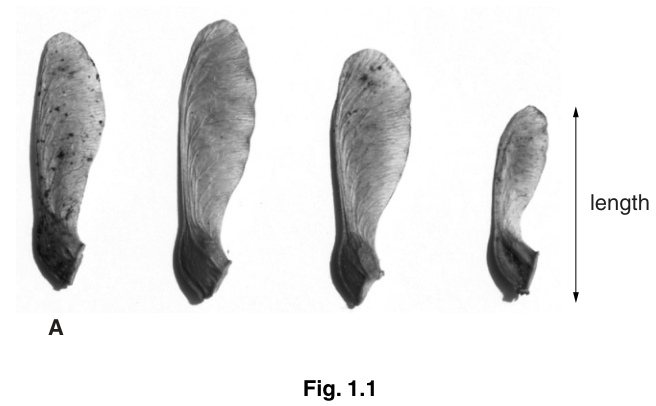
Measure and record the maximum length of the fruit labelled A in Fig. 1.1.
length = ______
The actual maximum length of this fruit is .
Using your measurement in (i), calculate the magnification of the fruit A in Fig. 1.1.
Show your working.
magnification = ______
A student carried out an investigation into the relationship between the length of sycamore fruits and the time they took to reach the ground when dropped from a height of .
He collected 6 fruits and measured the length of each. He then dropped each fruit from a height of and recorded the time each one took to reach the ground.
His results are shown below.
fruit 1 length = , time to reach ground = ; fruit 2 length = , time to reach ground = ; fruit 3 length = , time to reach ground = ; fruit 4 length = , time to reach ground = ; fruit 5 length = , time to reach ground = ; fruit 6 length = , time to reach ground =
Use these results to complete Table 1.1.
Table 1.1
| length of fruit / | time taken to reach the ground / |
|---|---|
On the grid below, construct a line graph of the data in Table 1.1. Join your plotted points with ruled, straight lines.

Use your graph to find the time it would take for a fruit with a length of to reach the ground.
______ seconds
Describe the relationship between the length of these sycamore fruits and the time taken for them to reach the ground.
______
Suggest one way in which this investigation could be improved to increase the reliability of the results.
______
Suggest two factors, other than length, that could affect the time taken for sycamore fruits to reach the ground when falling from a tree.
- ______
- ______
The rest of this paper
2 more questions- Q2Microscopy and Biological Drawing · Analysis, Conclusions and Evaluation · Experimental Contexts · Planning Experiments and Investigations15M
- Q3Experimental Contexts · Use of Techniques, Apparatus and Materials · Planning Experiments and Investigations · Observations and Measurements9M