Biology 5090/22 — May/June 2015
Cambridge O-Level · Theory · worked solutions for every part, with the mark scheme
Topics Organisms and Their Environment · Respiration · Biotechnology and Genetic Modification · Sexual Reproduction in Plants · Plant Nutrition · Human Nutrition · +10 more
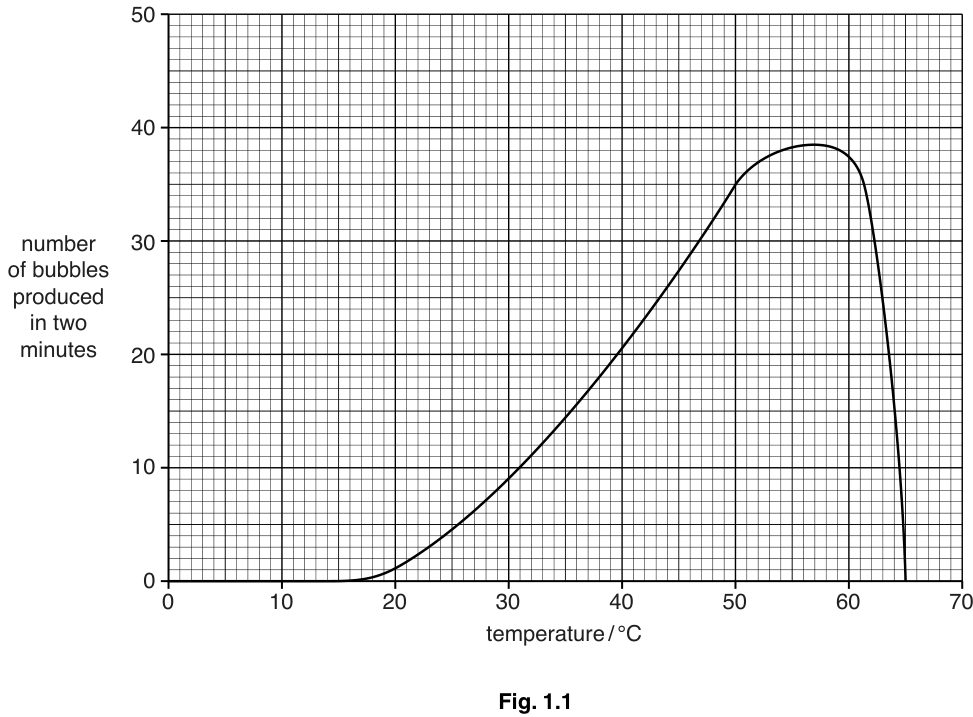
Fig. 1.1 shows the effect of temperature on the rate at which yeast cells in a nutrient solution produce bubbles of a gas.
Name each of the following:
- the gas released
______
- the metabolic process that releases it
______
- the essential chemical constituents of the nutrient solution.
______ and ______
Answer
- Gas released: carbon dioxide ()
- Metabolic process: respiration (fermentation)
- Essential chemical constituents of the nutrient solution: sugar (carbohydrate) and water
(Any two of: sugar/carbohydrate, water, protein/amino acids, oxygen, lipids/fats, mineral ions — for 1 mark.)
carbon dioxide; respiration; sugar and water
Walkthrough
Yeast cells in a nutrient solution produce bubbles of gas. Yeast is a fungus that respires glucose; when it respires, it releases carbon dioxide as a waste product. The bubbles are therefore bubbles of carbon dioxide. The metabolic process producing them is respiration — in yeast this may be aerobic or anaerobic (fermentation), and either answer is accepted.
The nutrient solution must contain everything yeast needs to stay alive and respire. The mark scheme lists several acceptable constituents and asks for any TWO for one mark: a sugar or carbohydrate (the respiratory substrate — the fuel), water (the solvent in which all reactions occur and which keeps the cells turgid/functional), protein or amino acids (for growth and repair), oxygen (for aerobic respiration), lipids or fats, or mineral ions. The safest pair to give is sugar (the substrate being respired) and water.
Key Takeaways
- Yeast produces carbon dioxide during respiration; the bubbles are evidence of the process.
- A nutrient solution needs a respiratory substrate (sugar) plus water and other nutrients.
- 'Any two from' means exactly two are needed for the single mark.
Common Mistakes
- Writing 'oxygen' as the gas released — oxygen is consumed in aerobic respiration, not released.
- Writing 'breathing' instead of 'respiration' — breathing is ventilation in animals, not a metabolic process in yeast.
- Giving only ONE constituent when two are required for the mark.
- Naming 'nutrients' vaguely without naming an actual substance.
Things to Be Careful About
- The mark scheme accepts 'respiration' OR 'fermentation' — either scores.
- 'Sugar' alone is fine; you do not need to name glucose specifically, though it is also accepted.
- Two named mineral ions together count as the pair for one mark.
Use Fig. 1.1 to find the optimum temperature for the metabolic process.
______
Answer
(any value in the range –)
57 °C
Walkthrough
The optimum temperature is the temperature at which the rate of bubble production is greatest — the peak of the curve. On Fig. 1.1 the curve peaks at about 38–39 bubbles per two minutes, at approximately . The mark scheme accepts any temperature between and inclusive, because reading a precise value off a hand-drawn-style curve involves some judgement.
Key Takeaways
- The optimum temperature for an enzyme-controlled process is where the rate is highest — the top of the curve.
- Graph readings have an accepted tolerance range; anything within it scores.
Common Mistakes
- Reading the peak number of bubbles (about 38) instead of the temperature.
- Quoting a temperature outside the accepted range, e.g. or .
- Forgetting the unit ().
Things to Be Careful About
- Always include the unit with your answer.
- Use a ruler to trace up from the peak to the x-axis for accuracy.
Explain the shape of the curve after .
Answer
After the rate decreases until it reaches zero (no more bubbles are produced). This is because the enzymes in the yeast are denatured by the high temperature: their active sites change shape so they no longer fit their substrates (lock-and-key hypothesis fails). The yeast cells themselves are killed by the high temperature.
Rate falls to zero because the enzymes are denatured — their active sites change shape so substrate no longer fits — and the yeast cells die.
Walkthrough
Above about the curve falls steeply to zero. Three linked ideas earn the three marks:
- What happens: the rate of bubble production decreases until it stops completely (zero bubbles per two minutes).
- Why: the enzymes inside the yeast are denatured. Above the optimum temperature, heat makes the protein molecules of the enzymes vibrate so much that the bonds holding their shape break. The tertiary structure changes, so the active site changes shape. Under the lock-and-key hypothesis, the substrate no longer fits the active site, so no enzyme-substrate complexes form and the reaction cannot proceed.
- The cells: the high temperature also kills the yeast cells themselves — the whole organism is destroyed, not just slowed down.
Note the mark scheme's rejects: saying 'denaturing of yeast' or 'killing of enzymes' loses marks — enzymes are denatured, organisms are killed. Keep the terms attached to the right thing.
Key Takeaways
- Denaturation is a permanent change in an enzyme's active site caused by high temperature (or unsuitable pH).
- The lock-and-key model explains why a changed active site stops the reaction: substrate and active site must be complementary.
- Enzymes are denatured; organisms are killed.
Common Mistakes
- Saying 'the enzymes are killed' or 'the yeast is denatured' — the scheme explicitly rejects these (R denaturing of yeast / killing of enzymes).
- Saying the rate 'decreases' without stating it reaches zero/stops.
- Omitting the mechanism — naming denaturation without mentioning the active site or lock-and-key idea loses a mark.
- Confusing denaturation with the enzyme simply working more slowly.
Things to Be Careful About
- Use the exact word denatured, not 'damaged' or 'destroyed'.
- Mention the active site changing shape — that is the credited mechanism.
- State the rate reaches zero, not just that it falls.
Explain what would happen to the rate at which bubbles of the gas are produced by the yeast if the temperature of the solution is then gradually reduced from to .
Answer
The rate would remain at zero — no bubbles would be produced. Denaturation is permanent: the enzymes are still denatured (their active sites remain changed in shape) even when the temperature falls, and the yeast cells are dead.
No change — the rate stays at zero, because denaturation is permanent and the yeast is dead.
Walkthrough
This part tests whether students understand that denaturation is irreversible. At the enzymes have already been denatured and the yeast killed. Cooling back down to does not restore the active sites' original shape — the change is permanent. So the rate stays at zero; no bubbles appear.
This contrasts with the effect of LOW temperature: below the optimum, enzymes are simply inactive (less kinetic energy) but not denatured, so warming restores activity. High temperature causes permanent damage. Candidates who confuse these two cases will incorrectly say the rate rises again as the temperature returns towards the optimum.
Key Takeaways
- Denaturation by high temperature is permanent and irreversible.
- Low temperature only slows enzymes (reversible); high temperature destroys them (irreversible).
- Dead yeast cannot resume metabolism however favourable the conditions become.
Common Mistakes
- Predicting the rate would rise again as temperature drops towards the optimum — this confuses reversible low-temperature inactivity with irreversible denaturation.
- Saying the enzymes 'recover' or 'renature' on cooling.
- Ignoring that the yeast cells themselves are dead.
Things to Be Careful About
- Both marks need the outcome AND the reason: state the rate stays at zero AND explain that denaturation is permanent (active sites still changed) or that the yeast is dead.
- Do not describe what happens below the optimum generally — answer specifically about this yeast that has already been heated to .
The rest of this paper
8 more questions- Q2Sexual Reproduction in Plants · Organisms and Their Environment · Transport in Flowering Plants · Plant Nutrition11M
- Q3Transport in Humans · Coordination and Control · Human Nutrition11M
- Q4Inheritance10M
- Q5Human Gas Exchange · Human Nutrition · Excretion · Respiration9M
- Q6Sexual Reproduction in Plants · Organisms and Their Environment · Plant Nutrition10M
- Q7Movement Into and Out of Cells10M
- Q8Biotechnology and Genetic Modification · Organisms and Their Environment10M
- Q9Sexual Reproduction in Humans · Disease and Immunity10M