Biology 5090/31 — October/November 2014
Cambridge O-Level · Practical Test · worked solutions for every part, with the mark scheme
Topics Experimental Contexts · Observations and Measurements · Planning Experiments and Investigations · Microscopy and Biological Drawing · Analysis, Conclusions and Evaluation
Yeast, a type of fungus, can respire anaerobically. This is called fermentation and results in the formation of ethanol (alcohol) and carbon dioxide.
glucose ethanol + carbon dioxide
You will investigate the effects of water and ethanol on anaerobic respiration of yeast.
You are provided with two beakers labelled A and B. Each beaker contains a mixture of yeast in glucose solution.
- Pour all of the water in the test-tube labelled A into the yeast mixture in beaker A.
- Carefully stir the mixture with the glass rod provided.
Wipe the glass rod clean with a paper towel. - Pour all of the ethanol in the test-tube labelled B into the yeast mixture in beaker B.
- Carefully stir the mixture with the glass rod provided.
- Fill the syringe labelled A, to the mark, with mixture from beaker A by pulling the plunger up slowly as shown in Fig. 1.1a.
- Remove the end of the glass tube attached to the syringe from the mixture in beaker A and carefully pull up the plunger further until the meniscus in the tube reaches the ink mark as shown in Fig. 1.1b.
- Lay flat the syringe with the tube attached, as shown in Fig. 1.1c, on the piece of black card.
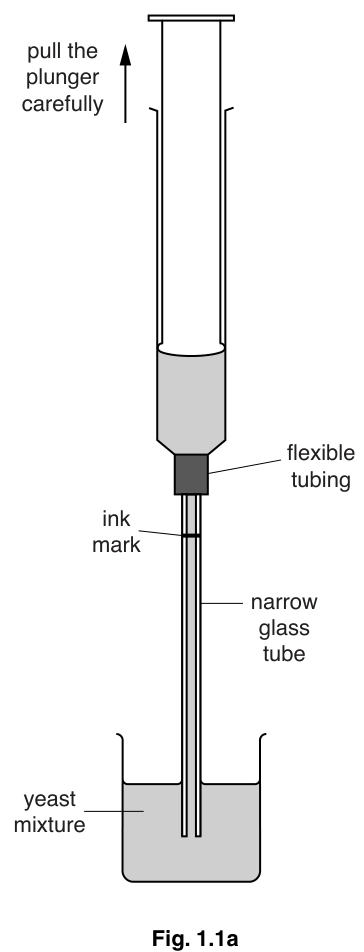
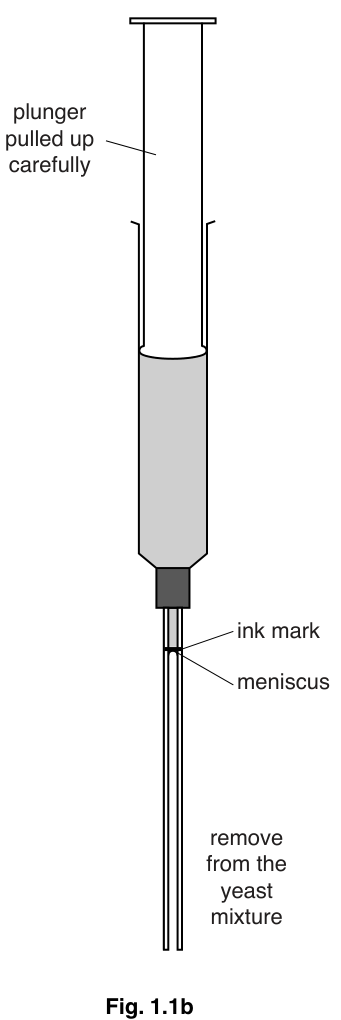
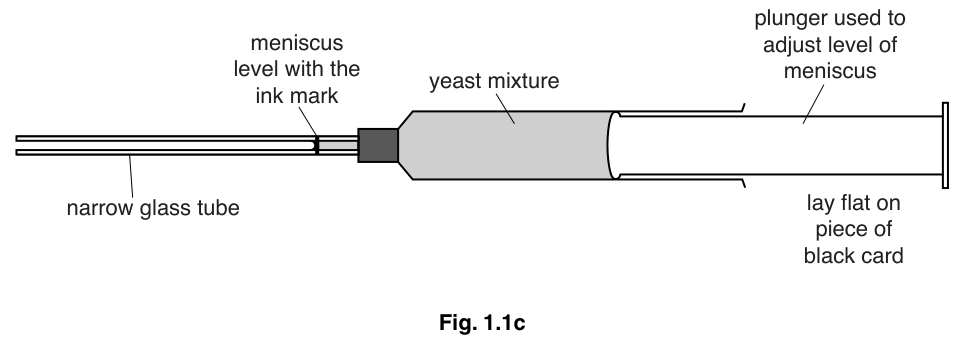
- Check the meniscus is still level with the ink mark. If not, carefully press or pull the plunger to re-align the meniscus with the ink mark as shown in Fig. 1.1c.
Record the time now as the start time for 0 minutes ______
Use a ruler to measure the distance, in mm, between the ink mark and the meniscus on the glass tube. Readings should be made after 10 minutes, 15 minutes and 20 minutes.
- Continue with setting up syringe B whilst taking readings for A.
Record your results in Table 1.1.
Table 1.1
| Time / min | Distance meniscus moved / mm | |
|---|---|---|
| A | B | |
| 0 | 0 | 0 |
| 10 | ||
| 15 | ||
| 20 |
- Fill the syringe labelled B, to the mark, with mixture from beaker B by pulling the plunger up slowly as shown in Fig. 1.1a.
- Remove the end of the glass tube attached to the syringe from the mixture in beaker B and carefully pull up the plunger further until the meniscus in the tube reaches the ink mark as shown in Fig. 1.1b.
- Lay flat the syringe with the tube attached, as shown in Fig. 1.1c, on the piece of black card.
Check the meniscus is still level with the ink mark. If not, carefully press or pull the plunger to re-align the meniscus with the ink mark as shown in Fig. 1.1c.
Record the time now as the start time for 0 minutes ______
Use a ruler to measure the distance, in mm, between the ink mark and the meniscus on the glass tube. Readings should be made after 10 minutes, 15 minutes and 20 minutes.
Record your results in Table 1.1.
Continue with Question 2 while waiting to record measurements.
Describe your results and suggest an explanation as to why the meniscus of the yeast mixture A moved along the tube attached to syringe A.
description = ______
explanation = ______
Describe and explain your results for mixture B.
description = ______
explanation = ______
Explain why syringe A was included in this investigation.
______
Name two variables that were kept constant during this investigation.
- ______
- ______
The rest of this paper
2 more questions- Q2Microscopy and Biological Drawing · Analysis, Conclusions and Evaluation · Experimental Contexts16M
- Q3Experimental Contexts · Observations and Measurements · Planning Experiments and Investigations9M