Biology 5090/22 — October/November 2014
Cambridge O-Level · Theory · worked solutions for every part, with the mark scheme
Topics Transport in Humans · Coordination and Control · Organisms and Their Environment · Excretion · Human Nutrition · Plant Nutrition · +4 more
Fig. 1.1 shows a kidney and its associated structures. The arrows show the direction of flow of fluids in these structures.
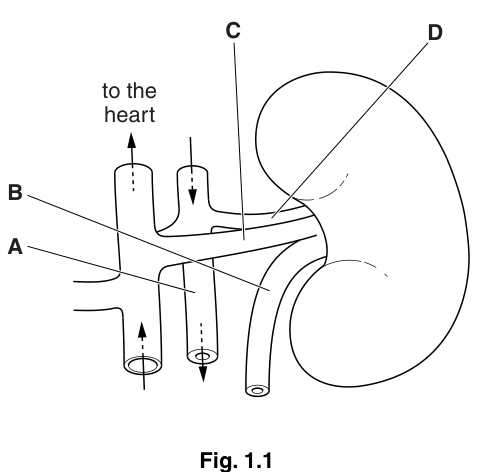
Name the structure labelled A in Fig. 1.1.
______
Name the chamber of the heart through which blood in structure A last passed.
______
Table 1.1 shows the relative concentrations of various substances in structures B and C.
Complete the table to show the possible concentrations of these substances in structure D.
Table 1.1
| substance | relative concentration in structure B | relative concentration in structure C | relative concentration in structure D |
|---|---|---|---|
| amino acids | 0.00 | 0.05 | |
| glucose | 0.00 | 0.10 | |
| mineral ions | 1.50 | 0.72 | |
| proteins | 0.00 | 8.00 | |
| urea | 2.00 | 0.03 |
Explain how the relative concentrations of glucose might change in structures B, C and D in a person with diabetes.
The rest of this paper
8 more questions- Q2Human Nutrition10M
- Q3Plant Nutrition · Transport in Flowering Plants · Organisms and Their Environment8M
- Q4Respiration · Biotechnology and Genetic Modification11M
- Q5Transport in Humans11M
- Q6Sexual Reproduction in Plants10M
- Q7Coordination and Control10M
- Q8Organisms and Their Environment10M
- Q9Transport in Humans10M