Biology 5090/62 — May/June 2014
Cambridge O-Level · Alternative to Practical · worked solutions for every part, with the mark scheme
Topics Microscopy and Biological Drawing · Experimental Contexts · Planning Experiments and Investigations · Analysis, Conclusions and Evaluation
Fresh food is often cooked before it is eaten.
Fig. 1.1 shows a fresh living green plant cell before cooking, as seen under a microscope.
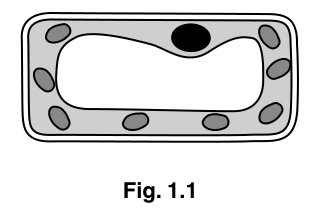
On Fig. 1.1, label the cell membrane and a chloroplast.
Some green cabbage leaves were cut into small pieces and placed in clean water and then boiled for 10 minutes. After that time the water was green.
Suggest how the membranes may have been changed by boiling to cause the water to become green.
An investigation was carried out to discover what happens to the vitamin C in cabbage leaves during cooking.
of fresh cabbage leaves were cut up, placed into boiling water and left to continue boiling for 10 minutes.
Samples of cabbage leaves and of the water they were boiled in were taken at intervals, cooled, and the vitamin C content was measured.
There is no vitamin C in clean water.
These measurements are shown in Table 1.1.
Table 1.1
| boiling time / min | vitamin C / mg per cabbage | vitamin C / mg per water |
|---|---|---|
| 0.0 | 50.0 | 0.0 |
| 1.0 | 33.0 | 17.0 |
| 2.0 | 27.0 | 23.0 |
| 4.0 | 24.0 | 26.0 |
| 8.0 | 20.0 | 22.0 |
| 10.0 | 17.0 | 20.0 |
Construct a graph of the data in Table 1.1.
Use the same axes for both sets of data.

After boiling for 10 minutes only about one third of the vitamin C remained in the cabbage leaves.
Use your graph to find the time at which the vitamin C content in cabbage had fallen to half.
Show your working.
answer = ______
Describe the changes in vitamin C content of the cabbage and the water during the 10 minutes.
in cabbage ______
in water ______
To extend this investigation, some students wanted to compare what happens to the vitamin C in a sample of fresh cabbage leaves when they were cooked in oil, safely, instead of water.
Describe four factors that would need to be kept the same to make a fair comparison.
Suggest two ways of improving the method used in these investigations.
The rest of this paper
1 more questions- Q2Microscopy and Biological Drawing · Experimental Contexts · Planning Experiments and Investigations19M