Biology 5090/22 — May/June 2014
Cambridge O-Level · Theory · worked solutions for every part, with the mark scheme
Topics Plant Nutrition · Coordination and Control · Organisms and Their Environment · Human Nutrition · Excretion · Inheritance · +11 more
State three substances found in the urine of a healthy person.
- ______
- ______
- ______
Answer
- water
- urea
- sodium ions (or any other named salt / ion, e.g. chloride ions, potassium ions)
water, urea, sodium ions
Walkthrough
The question asks for three substances found in the urine of a healthy person. Urine is the final waste product formed by the kidneys after filtration, reabsorption and secretion. The primary components are water, urea and dissolved salts (ions).
- Water: Makes up the bulk of urine and acts as the solvent.
- Urea: A nitrogenous waste product formed in the liver from the deamination of excess amino acids.
- Salts / ions: Excess mineral ions such as sodium (), chloride (), potassium () and calcium () that are not required by the body are excreted.
Any three of these, or other valid nitrogenous wastes like creatinine or uric acid, will score the marks. Glucose and sugars must be rejected because a healthy person reabsorbs all filtered glucose back into the blood.
Key Takeaways
- Urine is not just water; it is a solution containing water, urea and various mineral ions.
- In a healthy individual, useful substances like glucose and amino acids are completely reabsorbed in the proximal convoluted tubule and do not appear in the final urine.
Common Mistakes
- Writing glucose or sugar: This is a common error. Glucose is reabsorbed in a healthy person; its presence in urine (glycosuria) indicates diabetes.
- Naming the kidney or the bladder: These are organs, not substances found in the urine.
- Writing "nitrogen" alone: The mark scheme requires a specific nitrogenous waste like urea, or the phrase "nitrogenous waste".
Things to Be Careful About
- The question asks for substances, so naming structures (e.g., nephron, ureter) will not score.
- If naming salts, give a specific ion (e.g., sodium ions, ) rather than just the word "salt" to be safe, though the mark scheme accepts "salts / ions" generally.
- Do not include hormones or pigments unless specifically asked, as water, urea and ions are the primary expected answers.
The concentration of a person's urine can vary according to their diet.
Explain how changes in a person's diet can affect the concentration of their urine.
Answer
A diet containing more protein provides more amino acids after digestion. These amino acids undergo deamination in the liver, which increases the amount of urea produced and released into the blood. The kidneys filter this extra urea, making the urine more concentrated.
Alternatively, a diet containing more salts or ions means there are more dissolved substances in the blood. The kidneys reabsorb less water to balance this, resulting in a smaller volume of more concentrated urine.
See working
Walkthrough
The concentration of urine depends on the ratio of water to solutes (mainly urea and salts). We need to explain how diet changes this ratio.
Route 1: High protein diet
- A protein-rich diet means more amino acids are absorbed into the blood from the digestive system.
- The body cannot store excess amino acids. In the liver, they undergo deamination, a process that removes the amino group ().
- The amino group is converted into urea, a toxic nitrogenous waste, which is then released into the blood.
- The kidneys filter this increased urea concentration. Because there is more urea to be excreted, the urine becomes more concentrated (or a smaller volume of urine is produced containing more urea).
Route 2: High salt / ion diet
- A diet high in salts (e.g., salty snacks) increases the concentration of ions in the blood plasma.
- This lowers the water potential of the blood.
- The kidneys respond by reabsorbing less water back into the blood (or the osmotic gradient in the collecting duct draws less water out).
- The result is a smaller volume of more concentrated urine with more salts and urea.
Both routes correctly explain how diet alters urine concentration. The mark scheme accepts either the protein/urea pathway or the salt/water pathway.
Key Takeaways
- Deamination is the key link between dietary protein and urine concentration. It happens in the liver and produces urea.
- Urine concentration is a balance between the amount of solutes (urea, salts) and the amount of water reabsorbed by the kidneys.
- A high-protein diet directly increases urea load; a high-salt diet directly increases ionic load.
Common Mistakes
- Forgetting to mention deamination: Simply saying "more protein means more urea" is not enough; you must name the process (deamination) and the organ (liver).
- Confusing digestion with metabolism: Amino acids are digested in the gut, but deamination happens in the liver. Do not say "amino acids are broken down in the gut to make urea".
- Referring to specific foods: The mark scheme ignores references to specific foods (e.g., "eating cheese"). Stick to the nutrient categories: protein, amino acids, salts, ions.
- Saying the kidneys produce urea: The liver produces urea; the kidneys only excrete it.
Things to Be Careful About
- The question asks to explain, so every point must have a reason. Don't just list facts; link them with "because" or "so that".
- Ensure you reference the correct biological terms: amino acids, deamination, liver, urea, concentrated.
- Avoid vague statements like "the body gets more waste". Name the specific waste product: urea.
An investigation was carried out into the effect of diet on the rate of production of urine. Three students each took of a different drink A, B or C.
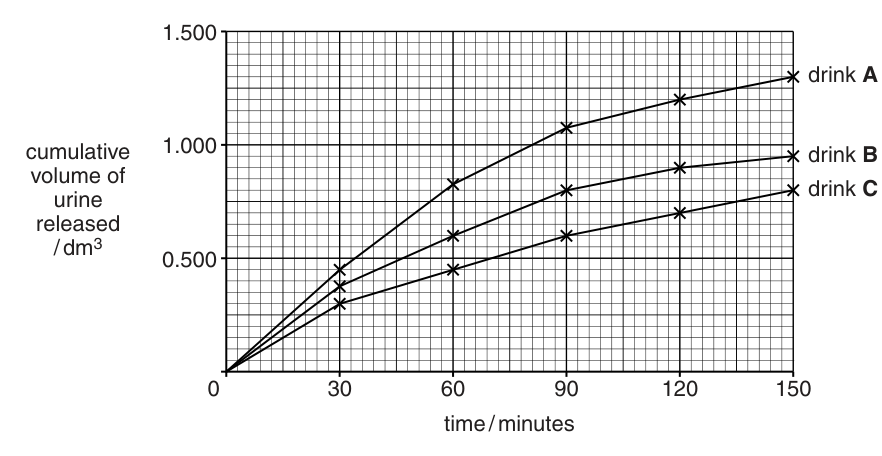
Fig. 1.1 shows the volume of urine released by each student over the next two and a half hours.
Suggest which of the three drinks it would be better to avoid on a very hot day.
Give an explanation for your answer.
drink ______
explanation ______
Answer
drink A
Drink A causes the production of the most urine, meaning the body loses the greatest volume of water. On a very hot day, the body already loses significant water through sweating to regulate body temperature. Drinking Drink A would cause excessive water loss and increase the risk of dehydration.
Drink A
Walkthrough
The question asks which drink to avoid on a hot day and why. We must look at the graph (Fig. 1.1) and relate the data to the body's response to heat.
Step 1: Read the graph
- The y-axis shows the cumulative volume of urine released. A steeper curve means more urine is being produced over time.
- Drink A has the steepest curve and reaches the highest volume () in 150 minutes.
- Drink B and Drink C produce less urine ( and respectively).
- Therefore, Drink A causes the body to lose the most water via urine.
Step 2: Relate to a hot day
- On a hot day, the body's main mechanism for temperature regulation (cooling down) is sweating.
- Sweat is mostly water. As it evaporates from the skin, it removes heat from the body.
- This means the body is already losing a large amount of water through the skin on a hot day.
Step 3: Combine the two
- If a person drinks Drink A, they will also lose a large amount of water through their kidneys as urine.
- The combination of heavy sweating and high urine production leads to a rapid loss of total body water.
- This creates a high risk of dehydration (a dangerous drop in body water levels), which can cause thirst, dizziness, and impaired body functions.
- Therefore, Drink A should be avoided.
Key Takeaways
- Cumulative graphs show the total amount produced over time. The steepest line represents the highest rate of production and the largest total volume.
- Water balance is a constant tug-of-war between water intake (drinking) and water loss (urine, sweat, breathing, faeces).
- On a hot day, sweating is the primary cooling mechanism, but it comes at the cost of water loss. Excreting more urine on top of this is dangerous.
Common Mistakes
- Choosing Drink C: Drink C produces the least urine, making it the safest choice on a hot day, not the one to avoid.
- Saying "Drink A makes you hot": The drink itself doesn't cause heat; the issue is the water loss. Focus on dehydration and water balance.
- Forgetting to mention sweating: The explanation must link the hot day to the body's natural response (sweating for temperature regulation). Without this, the physiological risk is not explained.
- Confusing urine with sweat: Keep the pathways clear. Drink A increases urine volume; the hot day increases sweat volume. Both deplete the same water reserve.
Things to Be Careful About
- Read the graph axes carefully: it is cumulative volume (), not rate. The final value at 150 minutes shows the total water lost.
- Use precise terminology: temperature regulation, sweating, dehydration.
- The mark scheme awards marks independently of the drink named, but the explanation must logically follow the choice. If you name Drink A, your explanation must be about high urine volume and dehydration.
The rest of this paper
8 more questions- Q2Inheritance · Cell Division and Reproduction11M
- Q3Sexual Reproduction in Plants · Biotechnology and Genetic Modification · Organisms and Their Environment · Plant Nutrition12M
- Q4Sexual Reproduction in Humans8M
- Q5Plant Nutrition · Transport in Flowering Plants7M
- Q6Human Gas Exchange · Plant Nutrition · Respiration · Coordination and Control10M
- Q7Classification · Cell Structure and Organisation · Organisms and Their Environment10M
- Q8Human Nutrition · [Legacy] Support, Movement and Locomotion10M
- Q9Human Nutrition · Transport in Humans10M