Biology 5090/61 — October/November 2013
Cambridge O-Level · Alternative to Practical · worked solutions for every part, with the mark scheme
Topics Experimental Contexts · Analysis, Conclusions and Evaluation · Observations and Measurements · Use of Techniques, Apparatus and Materials · Planning Experiments and Investigations
Warm blooded animals need to maintain a constant internal body temperature.
In cold weather some of these animals crowd together in groups.
Some students used test-tubes containing hot water to represent animals in an investigation into the loss of heat from animals' bodies.
One test-tube, A, represented one animal on its own, as shown in Fig. 1.1.
Another test-tube, B, represented an animal surrounded by seven similar animals in a group, as shown in Fig. 1.2.
Test-tube C represented one of the outer animals in the group, as shown in Fig. 1.2.
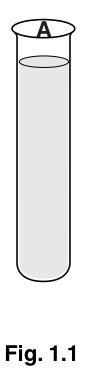
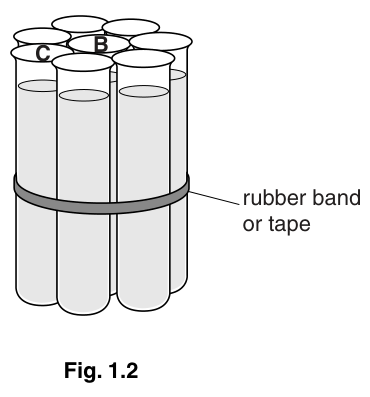
All nine test-tubes were filled with water at . The temperature of the water in test-tubes A, B and C was measured when the tubes were filled and then every two minutes for a total of ten minutes.
The results are shown in Table 1.1.
Table 1.1
| time / minutes | temperature / tube A | temperature / tube B | temperature / tube C |
|---|---|---|---|
| 0 | 70 | 69 | 68 |
| 2 | 64 | 69 | 66 |
| 4 | 54 | 68 | 65 |
| 6 | 48 | 68 | 64 |
| 8 | 44 | 67 | 62 |
| 10 | 37 | 67 | 60 |
On the grid below, plot the results for the three test-tubes A, B and C on the same axes.

Describe and compare the temperature changes in each of the three test-tubes.
Suggest and explain two ways to improve this method to make the results more reliable.
improvement 1 = ______
explanation = ______
improvement 2 = ______
explanation = ______
State which test-tube represents the animal that finds it easiest to maintain a constant body temperature.
______
Suggest how animals crowding together in a group can help them to maintain body temperature in cold weather.
The rest of this paper
3 more questions- Q2Experimental Contexts · Observations and Measurements · Analysis, Conclusions and Evaluation9M
- Q3Experimental Contexts · Observations and Measurements · Use of Techniques, Apparatus and Materials10M
- Q4Experimental Contexts · Use of Techniques, Apparatus and Materials5M