Biology 5090/12 — October/November 2013
Cambridge O-Level · Multiple Choice · answer key with instant marking and worked solutions
40
questions
40
marks
60
minutes
Topics Plant Nutrition · Organisms and Their Environment · Coordination and Control · Inheritance · Movement Into and Out of Cells · Transport in Flowering Plants · +14 more
Tap an option under each question to check it — your score builds as you go.
Q11MBiological MoleculesPlant NutritionFree sample
A plant is grown in bright sunlight. The diagram shows what is seen when a cell from this leaf is placed under a microscope. After a few hours, a leaf from this plant is stained with iodine solution.
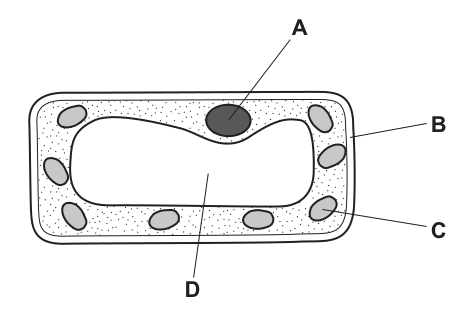
What will be stained blue / black?
Options
A A
B B
C C
D D
DifficultyMedium-Easy
Worked solution
Answer
C
Final answer
C
Detailed explanation
Walkthrough
- Iodine solution is used to test for the presence of starch. When starch is present, the iodine solution turns blue-black.
- The plant was grown in bright sunlight, so it has been carrying out photosynthesis.
- Photosynthesis produces glucose, which is quickly converted into starch for storage.
- In a leaf cell, starch is stored in the chloroplasts.
- Looking at the diagram, C points to a chloroplast. Therefore, C will be stained blue-black.
- A is the nucleus, B is the cell wall / cytoplasm, D is the large central vacuole. None of these store starch.
Key Takeaways
- Iodine solution tests for starch, giving a blue-black colour change.
- Starch is the storage carbohydrate produced during photosynthesis.
- In leaf cells, starch is stored within the chloroplasts.
Common Mistakes
- Confusing the iodine test with Benedict's test (which tests for reducing sugars and requires heating).
- Thinking that glucose is stored directly, rather than being converted to starch.
- Misidentifying the structures in the diagram (e.g., thinking C is a mitochondrion instead of a chloroplast).
Things to Be Careful About
- Remember that iodine solution is specifically for starch, not glucose.
- Ensure the label C is correctly identified as a chloroplast based on its oval shape and presence in a leaf cell.
- The question specifies "bright sunlight", which guarantees that photosynthesis and subsequent starch storage have occurred.
Techniques used
identify structures in a plant cell diagramapply the iodine test for starchlink photosynthesis products to storage locations
The rest of this paper
39 more questions- Q2Movement Into and Out of Cells1M
- Q3Movement Into and Out of Cells1M
- Q4Enzymes1M
- Q5Plant Nutrition1M
- Q6Plant Nutrition1M
- Q7Transport in Flowering Plants · Movement Into and Out of Cells1M
- Q8Human Nutrition1M
- Q9Human Nutrition1M
- Q10Human Nutrition1M
- Q11Transport in Flowering Plants1M
- Q12Transport in Flowering Plants1M
- Q13Transport in Humans1M
- Q14Transport in Humans1M
- Q15Transport in Humans · Excretion1M
- Q16Human Gas Exchange1M
- Q17Organisms and Their Environment · Plant Nutrition1M
- Q18Respiration1M
- Q19Coordination and Control1M
- Q20Coordination and Control1M
- Q21Excretion1M
- Q22Coordination and Control1M
- Q23[Legacy] Support, Movement and Locomotion1M
- Q24Coordination and Control1M
- Q25Disease and Immunity1M
- Q26Classification1M
- Q27Biotechnology and Genetic Modification1M
- Q28Organisms and Their Environment1M
- Q29Organisms and Their Environment1M
- Q30Disease and Immunity1M
- Q31Organisms and Their Environment1M
- Q32Sexual Reproduction in Plants1M
- Q33Sexual Reproduction in Plants1M
- Q34Cell Division and Reproduction1M
- Q35Sexual Reproduction in Humans1M
- Q36Sexual Reproduction in Humans1M
- Q37Inheritance1M
- Q38Inheritance1M
- Q39Inheritance1M
- Q40Inheritance1M
Loading the full paper…