Biology 5090/61 — May/June 2013
Cambridge O-Level · Alternative to Practical · worked solutions for every part, with the mark scheme
Topics Experimental Contexts · Use of Techniques, Apparatus and Materials · Analysis, Conclusions and Evaluation · Planning Experiments and Investigations · Microscopy and Biological Drawing
Some students carried out an investigation into the movement of food molecules from the intestines using a length of Visking tubing to represent a part of the digestive system. Visking tubing is made of a flexible transparent material.
- One end of the length of tubing was securely tied to close it as shown in Fig. 1.1.
- This tubing was filled with a solution containing both the reducing sugar glucose, and starch.
- The outside of the tubing was rinsed with water.
- The tubing was placed into a large test-tube filled with clean water and held closed and in position, by a clip.
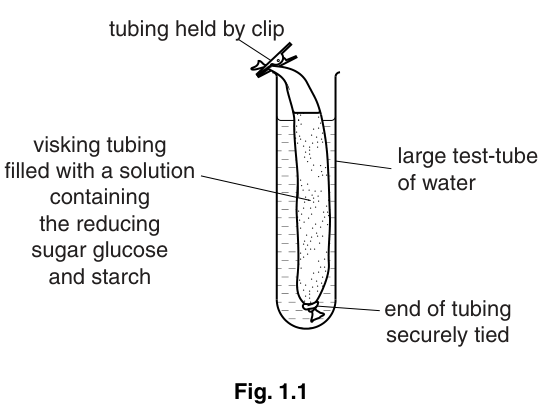
Samples of the water from the large test-tube were tested for the presence of reducing sugar and starch at different time intervals.
Describe how you could safely test for the presence of
reducing sugar
______
starch.
______
Explain why the outside of the tubing was rinsed before it was put into the large test-tube of water.
______
The results from the samples of water tested are shown in Table 1.1.
Table 1.1
| sampling time / min | reducing sugar test | starch test |
|---|---|---|
| 0 | negative | negative |
| 2 | negative | negative |
| 20 | positive | negative |
Suggest and explain what had happened during the 20 minutes to produce these results.
______
Suggest, giving your reasons, which part of the digestive system might be represented by the Visking tubing in the water in this investigation.
______
The rest of this paper
2 more questions- Q2Experimental Contexts · Analysis, Conclusions and Evaluation · Planning Experiments and Investigations14M
- Q3Microscopy and Biological Drawing · Experimental Contexts · Use of Techniques, Apparatus and Materials11M