Biology 5090/32 — May/June 2013
Cambridge O-Level · Practical Test · worked solutions for every part, with the mark scheme
Topics Experimental Contexts · Observations and Measurements · Analysis, Conclusions and Evaluation · Microscopy and Biological Drawing · Use of Techniques, Apparatus and Materials · Planning Experiments and Investigations
The movement of food molecules from the intestines can be investigated using a length of Visking tubing to represent a part of the digestive system. This tubing is made of a flexible transparent material.
You will investigate the movement of starch and glucose through the walls of this tubing into water. Fig. 1.1 shows the apparatus you will use.
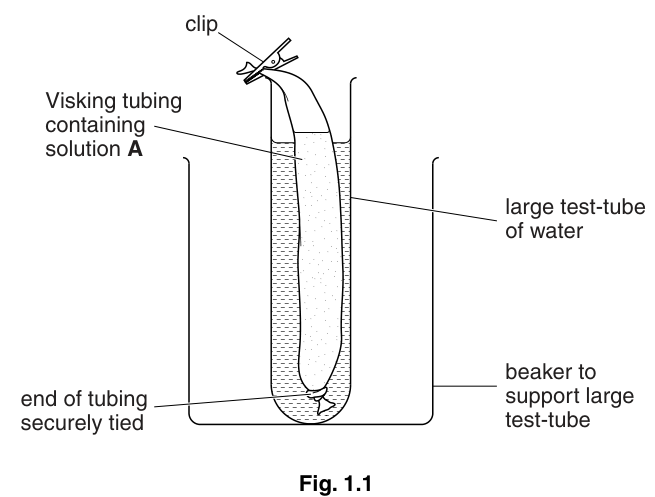
Describe how you will carry out a test for a reducing sugar.
You are provided with a length of soaked tubing that has been securely tied at one end.
You are provided with a solution of starch and glucose, labelled A.
- Using a pipette or small syringe, fill the tubing with solution A to a depth of approximately . It may be helpful to support the tubing in a large empty test-tube whilst filling it.
- Rinse the outside of the tubing with water from the beaker labelled 'rinsing water'.
- Put this tubing into a clean large test-tube. Use a clip or peg to attach the top of the tubing containing solution A to the top of the large test-tube.
- Pour clean water from the beaker labelled 'clean water' into the large test-tube to the level shown in Fig. 1.1.
- Support this large test-tube in a beaker.
- Immediately remove of water from the large test-tube and test it for reducing sugar.
- Record the time shown on the clock in Table 1.1. This is start time. Remove a drop of water from the large test-tube now and test it on a clean white tile for starch.
- Keep these samples until later.
Enter your observations and conclusions for the reducing sugar test and the starch test in Table 1.1 for time 0 mins, start time.
Table 1.1
| time / mins | clock time | reducing sugar test | starch test |
|---|---|---|---|
| 0 | observation ______ conclusion ______ | ______ ______ | |
| 20 | observation ______ conclusion ______ | ______ ______ |
Leave the experiment for 20 minutes. Begin Question 2 while you wait.
- After 20 minutes, repeat the same tests for reducing sugar and starch on a new sample of the water taken from the large test-tube surrounding the tubing. Remember to use clean pipettes each time. Record the clock time, your observations and conclusions in Table 1.1.
Suggest and explain what has happened during the 20 minutes to produce these results.
Suggest, giving your reasons, which part of the digestive system might be represented by the Visking tubing in the water in this investigation.
Explain why, in this investigation, the outside of the tubing was rinsed before it was put into the large test-tube of water.
The rest of this paper
2 more questions- Q2Experimental Contexts · Observations and Measurements · Microscopy and Biological Drawing · Analysis, Conclusions and Evaluation · Planning Experiments and Investigations17M
- Q3Microscopy and Biological Drawing · Experimental Contexts7M