Biology 5090/22 — October/November 2012
Cambridge O-Level · Theory · worked solutions for every part, with the mark scheme
Topics Plant Nutrition · Organisms and Their Environment · Transport in Humans · Human Nutrition · Inheritance · Cell Structure and Organisation · +5 more
Fig. 1.1(a) shows a section through a person's head and throat. Fig. 1.1(b) shows the same person swallowing a bolus of food.
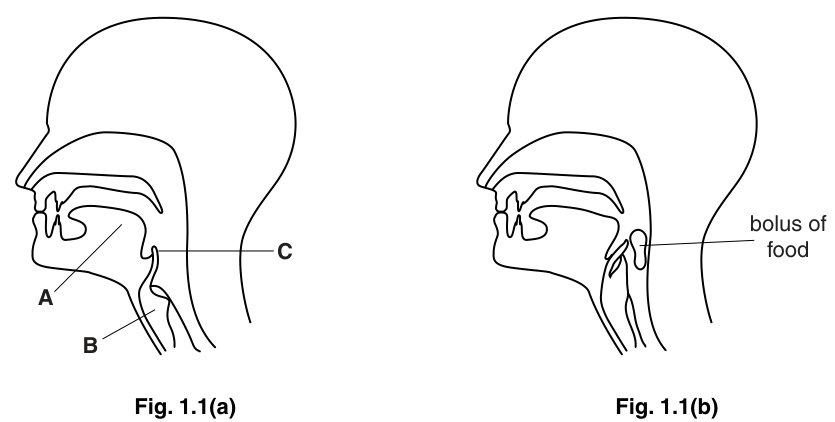
Identify structures A and B shown on Fig. 1.1(a).
A ______
B ______
Answer
A: tongue
B: larynx (or voice box)
A: tongue; B: larynx / voice box
Walkthrough
The question asks to identify two structures in a sagittal (side) section through a person's head and throat. Structure A is located in the oral cavity, forming the floor of the mouth and pressing against the upper teeth. This is the tongue, which is used to manipulate food and form it into a bolus. Structure B is located in the anterior (front) part of the neck, just below the pharynx. It is the larynx, also known as the voice box, which contains the vocal cords and leads down to the trachea (windpipe).
Key Takeaways
- The tongue is a muscular organ in the mouth used for tasting, manipulating food, and swallowing.
- The larynx (voice box) is the cartilaginous structure at the top of the trachea that houses the vocal cords.
Common Mistakes
- Confusing the larynx with the pharynx (the throat cavity behind the mouth and nose) or the trachea (the tube below the larynx). Label B points specifically to the laryngeal region above the main tracheal rings.
- Writing "throat" for A; the throat is the general region (pharynx), whereas A is specifically the muscular tongue.
Things to Be Careful About
- The mark scheme accepts larynx or voice box. Either is correct, but use precise biological terminology.
- Ensure you match the letter to the correct structure; A is the tongue, B is the larynx.
Name the process that will carry the bolus to the stomach.
______
Answer
peristalsis
peristalsis
Walkthrough
Once the bolus of food is swallowed and passes into the oesophagus, it must be transported to the stomach. This is achieved by peristalsis, which is a series of coordinated, wave-like muscular contractions of the oesophageal walls. These contractions squeeze the bolus forward and push it down into the stomach, working against gravity if necessary.
Key Takeaways
- Peristalsis is the involuntary muscular wave that moves food through the alimentary canal, particularly the oesophagus, stomach, and intestines.
Common Mistakes
- Writing "digestion" or "absorption"; these are chemical and uptake processes, not the physical transport mechanism.
- Confusing peristalsis with the action of the diaphragm or intercostal muscles, which are involved in breathing, not swallowing.
Things to Be Careful About
- The question asks for the process name. "Peristalsis" is the exact required term. Do not just describe it; name it.
Describe and explain what happens to structure C when the person swallows the bolus.
Answer
- Structure C (the epiglottis) closes or covers the opening to the trachea (windpipe / air passage / larynx).
- This action is helped by the raising of the larynx during swallowing.
- It prevents food from entering the trachea, lungs, or respiratory system (which would cause choking) and instead allows the food to enter the oesophagus.
See working
Walkthrough
Structure C is the epiglottis, a flap of cartilage located at the base of the tongue. When a person swallows, the epiglottis must change its position to protect the airway.
- Describe what happens: The epiglottis folds down to close or cover the glottis, which is the opening to the trachea (also called the windpipe, air passage, or larynx). This closing is assisted by the raising of the larynx as the whole laryngeal complex is pulled upwards during the swallowing reflex.
- Explain why this happens: The primary purpose is to prevent food and liquid from entering the respiratory system (trachea and lungs). If food enters the trachea, it causes choking and can lead to aspiration pneumonia. By covering the trachea, the epiglottis ensures the bolus is directed safely into the oesophagus, which leads to the stomach.
Key Takeaways
- The epiglottis acts as a valve during swallowing to prevent aspiration.
- Aspiration (food entering the airway) is dangerous and must be prevented by the mechanical closure of the epiglottis over the trachea.
Common Mistakes
- Naming the epiglottis instead of describing its action; the question asks to describe and explain what happens to structure C, not just name it.
- Saying the epiglottis "blocks the oesophagus"; it blocks the trachea, allowing the oesophagus to remain open for the food.
- Forgetting the explanation part; simply stating "it closes" is not enough, you must explain that it prevents food from going to the lungs.
Things to Be Careful About
- Use precise terms: trachea (not just "windpipe", though both are accepted), oesophagus (not "stomach" directly).
- The mark scheme awards up to 3 marks for: (1) closing/covering, (2) naming the trachea/larynx, (3) preventing food entry to lungs/respiratory system or allowing entry to oesophagus.
- Note the alternative valid point (AWP/AVP): mentioning that the larynx is raised during swallowing is a good additional detail that demonstrates deeper understanding.
Name a chemical process that may be taking place in the bolus.
______
Answer
digestion (or enzymatic action / hydrolysis)
digestion
Walkthrough
The question asks for a chemical process taking place in the bolus while it is in the mouth. While chewing is a physical process, the saliva contains enzymes that begin to break down chemical bonds in the food. This biochemical breakdown is called digestion (or more specifically, enzymatic action or hydrolysis).
Key Takeaways
- Chemical digestion involves the breakdown of large, insoluble food molecules into smaller, soluble ones using enzymes.
- This is distinct from physical digestion (e.g., chewing, churning), which changes the size but not the chemical structure of the food.
Common Mistakes
- Writing "chewing" or "mastication"; these are physical processes, not chemical.
- Writing "absorption"; no significant absorption occurs in the mouth.
Things to Be Careful About
- The mark scheme accepts digestion, enzymatic action, or hydrolysis. "Digestion" is the most general and safe term here.
Describe and explain your answer to (d)(i).
Answer
- The salivary glands in the mouth secrete saliva, which contains the enzyme amylase (specifically, salivary amylase).
- Amylase acts on the starch present in the food bolus.
- It catalyses the hydrolysis (breakdown) of starch into the disaccharide maltose.
- This enzymatic reaction occurs because saliva provides a neutral pH environment, which is optimal for amylase activity before the food reaches the highly acidic stomach.
See working
Walkthrough
To describe and explain the chemical process (digestion) in the bolus, we must detail the specific enzyme involved in the mouth.
- Identify the enzyme and its source: The salivary glands produce saliva, which contains the digestive enzyme amylase.
- Identify the substrate and product: Amylase specifically targets starch (a polysaccharide) found in foods like bread or potatoes. It breaks the glycosidic bonds in starch through hydrolysis, producing maltose (a disaccharide).
- Explain the conditions (pH): Enzymes are sensitive to pH. Salivary amylase works best at a neutral pH (around 7.0), which is the condition in the mouth. This is important to note because once the bolus reaches the stomach, the environment becomes highly acidic (due to hydrochloric acid), which would denature salivary amylase and stop this specific chemical digestion.
Key Takeaways
- Salivary amylase begins the chemical digestion of carbohydrates in the mouth.
- Substrate: Starch; Product: Maltose.
- Enzyme activity is highly dependent on pH; salivary amylase requires a neutral pH.
Common Mistakes
- Naming the wrong enzyme: pepsin is in the stomach (breaks down proteins), not the mouth.
- Stating the product is glucose; amylase only breaks starch down to maltose. Further breakdown to glucose occurs later in the small intestine.
- Forgetting to mention the source (saliva/salivary glands) or the conditions (neutral pH).
Things to Be Careful About
- The mark scheme awards up to 4 marks for: (1) amylase, (2) from saliva/salivary glands, (3) acts on starch, (4) breaks down to maltose, (5) neutral pH / no acid.
- Ensure you clearly link the enzyme to its specific substrate and product. Do not just say "enzymes break down food"; name the specific enzyme and molecules involved to score the full marks.
The rest of this paper
8 more questions- Q2Inheritance9M
- Q3Plant Nutrition · Organisms and Their Environment · Cell Structure and Organisation11M
- Q4Transport in Humans · Coordination and Control9M
- Q5Disease and Immunity · Transport in Humans11M
- Q6Transport in Flowering Plants · Plant Nutrition10M
- Q7Excretion10M
- Q8Enzymes10M
- Q9Organisms and Their Environment10M