Biology 5090/21 — October/November 2012
Cambridge O-Level · Theory · worked solutions for every part, with the mark scheme
Topics Respiration · Human Gas Exchange · Transport in Humans · Inheritance · Excretion · Coordination and Control · +12 more
The urinary systems of a dog and of a human being are similar in structure and function.
Fig. 1.1 shows the urinary system of a dog.
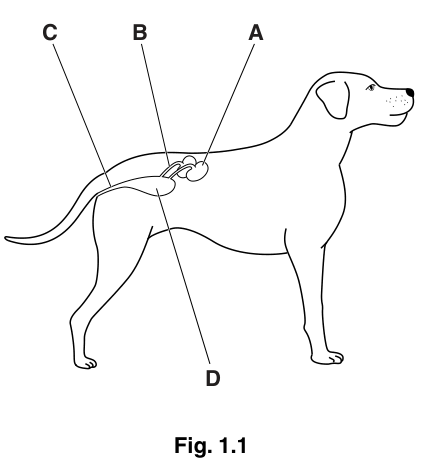
Name the parts A, B and C in Fig. 1.1.
A ______
B ______
C ______
State the function of D.
______
Fig. 1.2 shows the relationship between an alveolus and a blood capillary in the lung of a mammal. The arrows show the path taken by oxygen from inhaled air entering the blood during gas exchange.
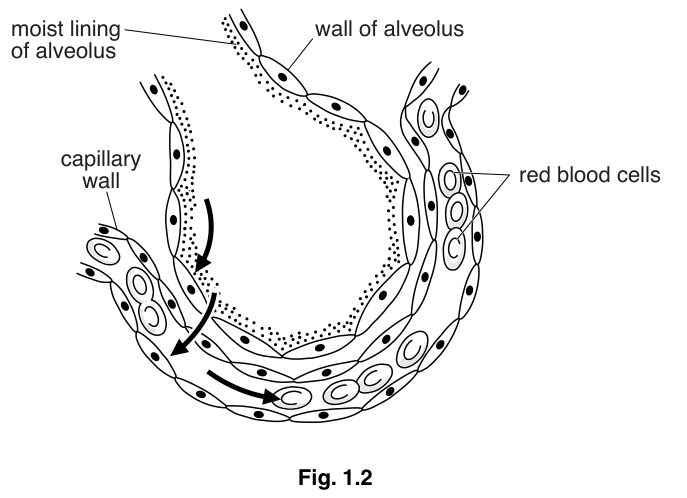
Draw two arrows on Fig. 1.2 to show the path taken by most carbon dioxide leaving the blood.
Explain why this movement of carbon dioxide is considered to be part of excretion.
Hormones are also substances that need to be excreted from the body after they have carried out their functions.
Explain how this is done.
The rest of this paper
8 more questions- Q2Enzymes · Human Nutrition · Biological Molecules9M
- Q3Human Gas Exchange · Respiration · Transport in Humans10M
- Q4Plant Nutrition · Organisms and Their Environment · Respiration10M
- Q5Cell Structure and Organisation · Classification · Respiration · Biotechnology and Genetic Modification10M
- Q6Transport in Flowering Plants10M
- Q7Cell Division and Reproduction · Inheritance10M
- Q8Transport in Humans10M
- Q9Sexual Reproduction in Humans · Sexual Reproduction in Plants · Inheritance10M