Biology 5090/61 — May/June 2012
Cambridge O-Level · Alternative to Practical · worked solutions for every part, with the mark scheme
Topics Experimental Contexts · Observations and Measurements · Analysis, Conclusions and Evaluation · Planning Experiments and Investigations · Microscopy and Biological Drawing · Use of Techniques, Apparatus and Materials
Bread is made from dough composed of flour, water and active yeast.
Some students carried out an investigation into two different types of flour, A and B, used in bread-making.
Two portions of dough were made, one using flour A and the other, flour B. For each dough, the same mass of flour, yeast and volume of water was used. A sample of each dough was placed in a measuring cylinder. The surface of the dough was smoothed and this original volume marked on the cylinder. The measuring cylinders were left for 30 minutes at a temperature of after which the volume of the dough was again marked, as shown in Fig. 1.1.
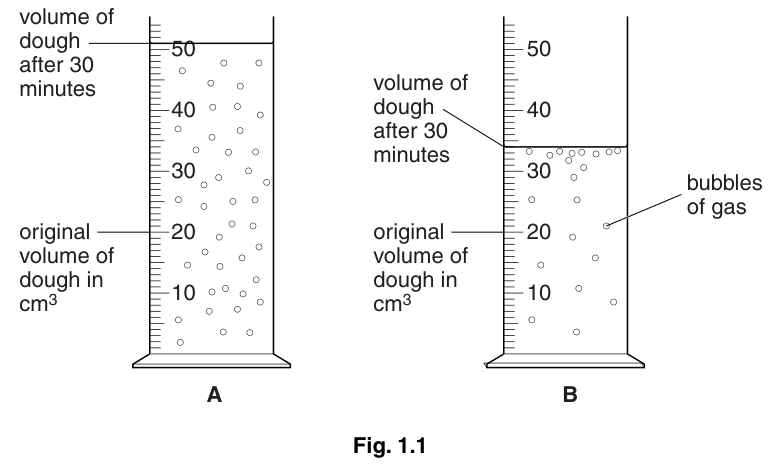
Complete Table 1.1.
Table 1.1
| volume of dough / | volume of dough / | |
|---|---|---|
| A | B | |
| initial volume | ||
| final volume after 30 minutes | ||
| change in volume |
Describe any differences in the two dough mixtures A and B after 30 minutes.
______
Explain how the metabolic processes of the active yeast have brought about the change in dough A.
______
Describe how you would carry out an investigation into the effect of temperature on the activity of the yeast in dough made with flour A.
______
The rest of this paper
2 more questions- Q2Microscopy and Biological Drawing · Experimental Contexts12M
- Q3Experimental Contexts · Microscopy and Biological Drawing · Use of Techniques, Apparatus and Materials · Observations and Measurements · Analysis, Conclusions and Evaluation · Planning Experiments and Investigations15M