Biology 5090/21 — May/June 2012
Cambridge O-Level · Theory · worked solutions for every part, with the mark scheme
Topics Human Nutrition · Enzymes · Respiration · Transport in Flowering Plants · Organisms and Their Environment · Cell Division and Reproduction · +9 more
Name the process by which plants manufacture carbohydrates from raw materials.
______
Answer
photosynthesis
photosynthesis
Walkthrough
The question describes plants manufacturing carbohydrates from raw materials — carbon dioxide and water — using light energy trapped by chlorophyll. That process has exactly one name on the 5090 syllabus: photosynthesis. The word equation is carbon dioxide + water → glucose + oxygen.
Key Takeaways
- Photosynthesis is the process by which plants make carbohydrates (glucose) from carbon dioxide and water using light energy.
- Learn the word equation; the question's phrase 'manufacture carbohydrates from raw materials' is the syllabus definition.
Common Mistakes
- Writing 'respiration' — that is the reverse process, breaking down glucose to release energy.
- Writing vague answers such as 'food making' — the mark scheme wants the precise term 'photosynthesis'.
Things to Be Careful About
- Spelling matters: 'photosynthesis', not 'photosynthisis'. The mark scheme is a single word, so there is nothing else to gain marks for — give the exact term and stop.
Starch is an insoluble carbohydrate stored inside plant cells.
Explain why starch is a more suitable storage substance than the soluble sugar glucose.
Answer
- Starch is insoluble, so it stays inside the cell where it is stored; glucose is soluble and would diffuse out of the cell.
- Because starch is insoluble it does not lower the water potential inside the cell, so water does not enter the cell by osmosis (which would make the cell swell).
Starch is insoluble so it stays in the cell and does not lower the cell's water potential, so water does not enter by osmosis; glucose is soluble and would move out of the cell.
Walkthrough
The question gives you the key fact: starch is insoluble, glucose is soluble. You must turn that fact into two consequences.
First consequence — where the carbohydrate stays. A soluble substance like glucose dissolves in the cell sap and can diffuse out of the cell through the cell membrane, so the stored food would be lost. Insoluble starch cannot dissolve or diffuse, so it stays put inside the cell as a long-term store. That is the first mark.
Second consequence — water movement. Dissolved glucose lowers the water potential inside the cell. Water always moves by osmosis from a region of higher water potential (outside) to lower water potential (inside), so a cell full of dissolved sugar would take in water and swell, possibly bursting or becoming waterlogged. Insoluble starch does not affect the water potential, so no excess water enters. That is the second mark, and it depends on using the terms 'water potential' and 'osmosis'.
Key Takeaways
- Storage carbohydrates must be insoluble: insoluble means immobile and osmotically inactive.
- Soluble sugars lower water potential and draw water in by osmosis; insoluble starch does neither.
- This is why animals store glycogen (insoluble) and plants store starch (insoluble), not glucose.
Common Mistakes
- The mark scheme rejects answers saying glucose is 'used up' — the point is about glucose moving out of the cell, not about it being metabolised.
- Writing 'glucose is soluble' alone without saying what follows (it diffuses out / lowers water potential) earns nothing — each mark needs the consequence.
- Saying 'water moves in' instead of naming osmosis, or 'concentration of water' instead of 'water potential' — the precise terms carry the mark.
Things to Be Careful About
- Two marks, two separate ideas: (1) starch stays in the cell, (2) no effect on water potential / no water gain by osmosis. Give both.
- Use 'water potential' and 'osmosis' exactly — the mark scheme underlines 'osmosis'.
Before a plant can use it, the stored starch must first be broken down by an enzyme. Fig. 1.1 shows the 'lock and key' hypothesis of how enzymes work.
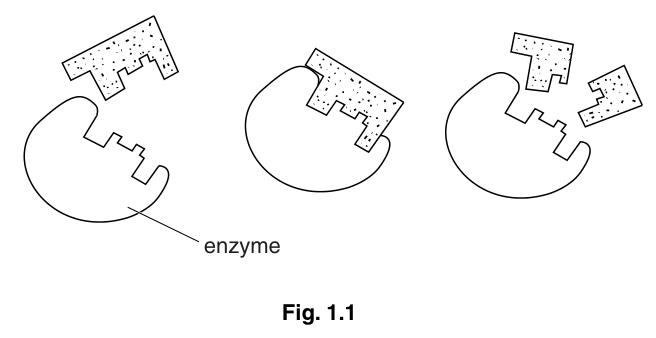
Describe the 'lock and key' hypothesis of enzyme action shown in Fig. 1.1.
Answer
- The enzyme has an active site with a shape complementary to that of the substrate.
- The substrate fits into the active site (like a key into a lock), forming an enzyme–substrate complex; this gives the enzyme its specificity.
- The substrate is broken down into smaller product molecules, which leave the active site.
- The active site is unchanged, so the enzyme is re-usable.
The substrate fits into the enzyme's complementary active site to form an enzyme–substrate complex; it is broken into smaller products which leave, leaving the enzyme unchanged and re-usable.
Walkthrough
Fig. 1.1 shows three stages, and the three marks map onto them.
Stage 1: the enzyme has a dent — the active site — whose shape exactly matches the shape of the substrate molecule. This is the 'lock and key' idea: only one substrate shape fits one active site, just as only one key fits one lock. The word 'complementary' (or 'perfect fit') is what earns the specificity mark.
Stage 2: the substrate slots into the active site, forming the enzyme–substrate complex. While held there, the substrate is broken into two smaller molecules — the products.
Stage 3: the products are released and diffuse away. Crucially, the enzyme itself is not used up: its active site is unchanged and can accept another substrate molecule. That re-usability is why small amounts of enzyme can process large amounts of substrate.
Key Takeaways
- Enzyme action: active site → complementary substrate fits → enzyme–substrate complex → products formed and released → enzyme unchanged and re-usable.
- Specificity comes from the complementary shapes of active site and substrate.
- The enzyme is a catalyst: it is not consumed by the reaction.
Common Mistakes
- Saying the enzyme 'eats' or is 'used up' in the reaction — the scheme credits the enzyme being unchanged and re-usable.
- Describing the substrate as 'food' or 'molecule' instead of using the term 'substrate' — the underlined term is required.
- Omitting the active site — the scheme's first point is 'correct ref. active site'.
- Saying the enzyme changes shape permanently or the products stay attached.
Things to Be Careful About
- Three marks, three distinct points: complementary fit/specificity, substrate fitting and being broken to products, products leaving with the enzyme unchanged. Cover all three.
- Use 'substrate', 'active site' and 'enzyme–substrate complex' — the precise vocabulary is the marking point.
In an investigation, two plants were grown in a solution containing mineral ions including nitrate and magnesium. Plant A was provided with air containing oxygen and plant B was provided with air from which the oxygen had been removed. Fig. 1.2 shows the plants after a period of growth in these conditions.
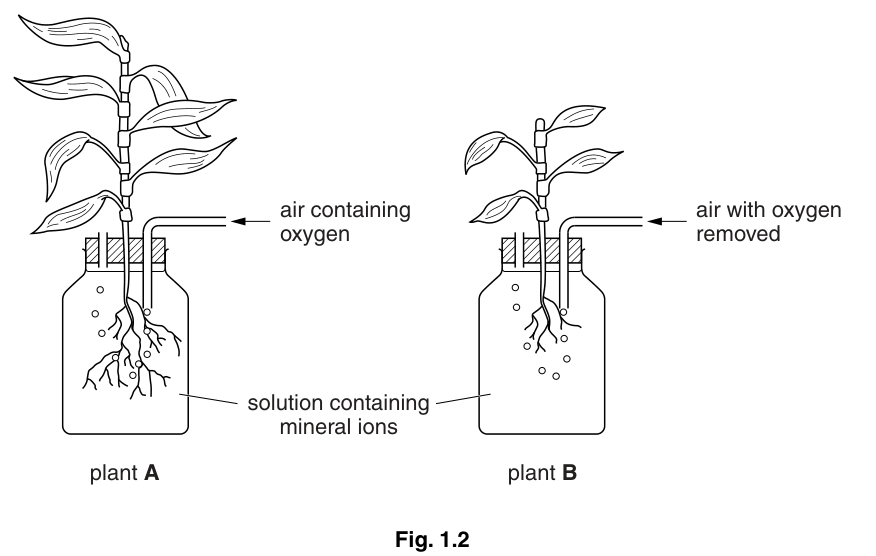
Suggest reasons for the increased growth of the plant in the solution supplied with air containing oxygen.
Answer
- With oxygen, the root cells respire aerobically, releasing more energy.
- This energy is used for the active transport of mineral ions into the root hair cells, so plant A absorbs more nitrate and magnesium ions.
- Magnesium is needed to make chlorophyll, so plant A makes more chlorophyll and photosynthesises faster, growing more.
- Nitrate is needed to make amino acids and proteins, so plant A makes more protein for growth.
Oxygen allows aerobic respiration in root cells, providing energy for active uptake of ions; more magnesium gives more chlorophyll and faster photosynthesis, and more nitrate gives more amino acids/protein for growth.
Walkthrough
The only difference between the two set-ups is oxygen in the air bubbled through the solution. So every difference in growth traces back to oxygen. Build the chain:
-
Oxygen allows aerobic respiration. Root cells (especially root hair cells) respire aerobically when oxygen is available, releasing much more energy than without it. This is the first mark — name respiration and locate it in the root.
-
Energy powers active transport. Mineral ions are taken up from the solution by active transport — against the concentration gradient, which requires energy from respiration. With oxygen, plant A can pump in ions faster, so it accumulates more nitrate and magnesium. The mark scheme wants both 'active transport' and the reference to its energy requirement.
-
What the ions do. Magnesium is a component of chlorophyll, so more magnesium means more chlorophyll, so a faster rate of photosynthesis and more carbohydrate for growth. Nitrate ions are used to make amino acids, which are joined into proteins — the material of new cytoplasm and hence growth.
Plant B, starved of oxygen, respires only anaerobically, gains little energy, takes up few ions, and grows poorly.
Key Takeaways
- Active uptake of mineral ions by root hair cells requires ATP-free energy released by (aerobic) respiration — this is the syllabus's core example of active transport in plants.
- Magnesium → chlorophyll; nitrate → amino acids/proteins. Learn these two ion functions.
- 'Suggest' questions still follow syllabus logic: oxygen → respiration → energy → active transport → ions → growth.
Common Mistakes
- Saying the plant 'breathes' oxygen through its leaves — the oxygen is supplied to the roots and used by root cells in respiration.
- Writing 'osmosis' or 'diffusion' for ion uptake — ions are taken up by active transport, against the gradient.
- Naming the ions but not their uses (magnesium for chlorophyll, nitrate for amino acids/proteins) — the '+' points in the scheme need both halves.
- Forgetting to mention respiration at all and jumping straight to ions.
Things to Be Careful About
- Four marks: respiration (in root cells), active transport of ions, energy requirement, and the fates of magnesium (chlorophyll/photosynthesis) and nitrate (amino acids/proteins). Give all four.
- The scheme underlines 'respiration' — use that exact word.
- Since the question says 'suggest', any biologically sound chain linking oxygen to growth can score, but the respiration–active transport link is the intended core.
The rest of this paper
8 more questions- Q2Classification · Organisms and Their Environment · Cell Division and Reproduction · Respiration · Enzymes · Human Nutrition12M
- Q3Cell Division and Reproduction · Inheritance · Human Nutrition10M
- Q4Coordination and Control10M
- Q5Human Nutrition · Biological Molecules8M
- Q6Transport in Flowering Plants10M
- Q7Excretion · Sexual Reproduction in Humans10M
- Q8Organisms and Their Environment10M
- Q9Human Gas Exchange10M