Biology 5090/21 — October/November 2011
Cambridge O-Level · Theory · worked solutions for every part, with the mark scheme
Topics Plant Nutrition · Inheritance · Cell Division and Reproduction · Transport in Flowering Plants · Cell Structure and Organisation · Classification · +7 more
Fig. 1.1 shows cells from three different types of organism (not drawn to the same scale).
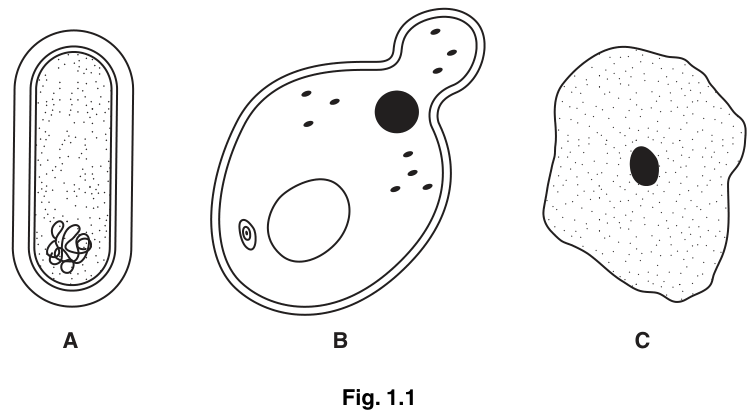
Name the type of organism represented by each of the cells and in each case give a reason for your answer.
organism A ______
reason ______
organism B ______
reason ______
organism C ______
reason ______
Answer
organism A: bacterium
reason: no (true) nucleus / presence of a circular DNA loop / presence of a slime capsule
organism B: fungus / yeast
reason: reproduces by budding / has a cell wall and a nucleus but lacks chloroplasts
organism C: animal
reason: no cell wall / surrounded only by a cell surface membrane
organism A: bacterium (reason: no nucleus); organism B: fungus / yeast (reason: budding); organism C: animal (reason: no cell wall)
Walkthrough
To identify each organism in Fig. 1.1, examine the key structural features of the cells:
-
Organism A:
- Features visible: It possesses an outer cell wall/capsule and a tangled circular strand of DNA (nucleoid) free in the cytoplasm, with no membrane-bound nucleus or large vacuole.
- Identification: This is a bacterium (prokaryote). The diagnostic reason is the lack of a true nucleus (or absence of a nuclear membrane) or the presence of a circular loop/strand of genetic material.
-
Organism B:
- Features visible: A eukaryotic single-celled organism with a distinct nucleus, a vacuole, and a cell wall, showing an outgrowth forming a daughter cell.
- Identification: This is a fungus (specifically a unicellular fungus, yeast). The diagnostic feature shown is budding (asexual reproduction) or having a cell wall with a nucleus but no chloroplasts.
-
Organism C:
- Features visible: An irregularly shaped cell with a nucleus and cytoplasm, bounded only by a flexible cell membrane without any outer cell wall.
- Identification: This is an animal cell (or single-celled protozoan like Amoeba). The diagnostic reason is the absence of a cell wall (it has only a cell membrane).
Key Takeaways
- Bacterial (prokaryotic) cells lack a membrane-bound nucleus and membrane-bound organelles; their DNA lies free in the cytoplasm.
- Yeast cells are fungi; they have a nucleus and a cell wall, and typically reproduce asexually by budding.
- Animal cells lack a cell wall, large central permanent vacuole, and chloroplasts.
Common Mistakes
- In the mark scheme: for organism C, naming specific cell types instead of the organism group is rejected (R named cells), and general terms like "protoctist" without justification are rejected (R protoctist).
- Giving a reason without naming the organism or omitting the reason loses the mark because each mark requires organism + reason.
Things to Be Careful About
- Ensure the stated reason directly supports the identification and is visible or characteristic (e.g., lack of nucleus for bacteria, budding for yeast, lack of cell wall for animal).
Fig. 1.2 shows a one-celled organism that has both plant and animal characteristics.
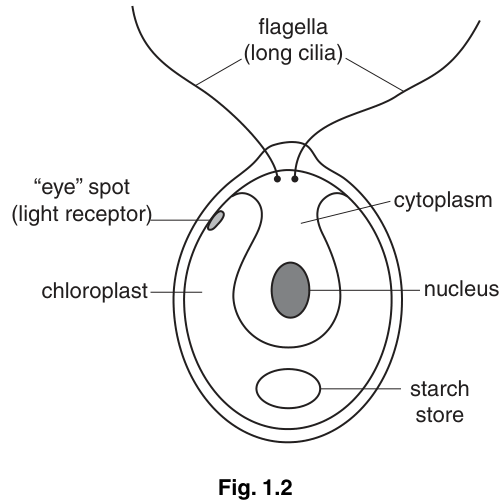
State two reasons in each case why the organism might be identified as
an animal
- ______
- ______
Answer
- presence of flagella / cilia (for locomotion / swimming)
- presence of an "eye" spot / light receptor
- flagella / cilia; 2. "eye" spot / light receptor
Walkthrough
Fig. 1.2 illustrates a single-celled flagellate (such as Chlamydomonas or Euglena). We are asked to state two animal-like characteristics.
- Animals are typically motile organisms capable of locomotion and have sensory structures to detect external stimuli.
- From Fig. 1.2, features characteristic of animals include:
- Flagella (or long cilia): enable active swimming/locomotion.
- "Eye" spot (light receptor): a specialised sensory structure used to detect light direction.
Key Takeaways
- Animal characteristics in unicellular protoctists include motility via flagella/cilia and sensitivity/sensory receptors such as eyespots.
Common Mistakes
- Confusing plant and animal features (e.g., listing chloroplast or starch store here).
Things to Be Careful About
- Write exactly two distinct points as requested by the numbered lines.
a plant
- ______
- ______
Answer
- presence of a chloroplast (containing chlorophyll)
- presence of a starch store (or cell wall)
- chloroplast; 2. starch store (or cell wall)
Walkthrough
Fig. 1.2 shows specific features typical of photosynthetic plant cells:
- Chloroplast (containing chlorophyll): allows the organism to carry out photosynthesis, which is characteristic of plants (autotrophs).
- Starch store: plants store excess carbohydrate in the form of starch (animals store glycogen).
- Cell wall: the presence of a rigid cell wall surrounding the cell is a defining plant feature.
Any two of these valid features score the two marks.
Key Takeaways
- Diagnostic features of plants include chloroplasts/chlorophyll for photosynthesis, storing carbohydrate as starch, and having a cell wall.
Common Mistakes
- Stating general features present in all cells (like nucleus or cytoplasm) rather than features specific to plants.
Things to Be Careful About
- Give two clear, separate structural features shown in the diagram.
The rest of this paper
8 more questions- Q2Cell Division and Reproduction · Plant Nutrition · Disease and Immunity · Inheritance11M
- Q3Coordination and Control11M
- Q4Plant Nutrition · Transport in Flowering Plants · Organisms and Their Environment · Inheritance9M
- Q5Cell Division and Reproduction · Inheritance12M
- Q6Biotechnology and Genetic Modification10M
- Q7Sexual Reproduction in Humans10M
- Q8Excretion10M
- Q9Transport in Flowering Plants · Respiration · Plant Nutrition10M