Biology 5090/22 — May/June 2010
Cambridge O-Level · Theory · worked solutions for every part, with the mark scheme
Topics Coordination and Control · Cell Division and Reproduction · Respiration · Plant Nutrition · Human Nutrition · Transport in Humans · +7 more
Name a hormone that is commonly produced using genetic engineering.
______
Name the organ that produces this hormone in the human body, and state two functions of the hormone in the body.
organ = ______
functions of the hormone
- ______
- ______
Fig. 1.1 shows how genetic engineering can be used to manufacture an enzyme (chymosin) that clots milk in the stomachs of young mammals.
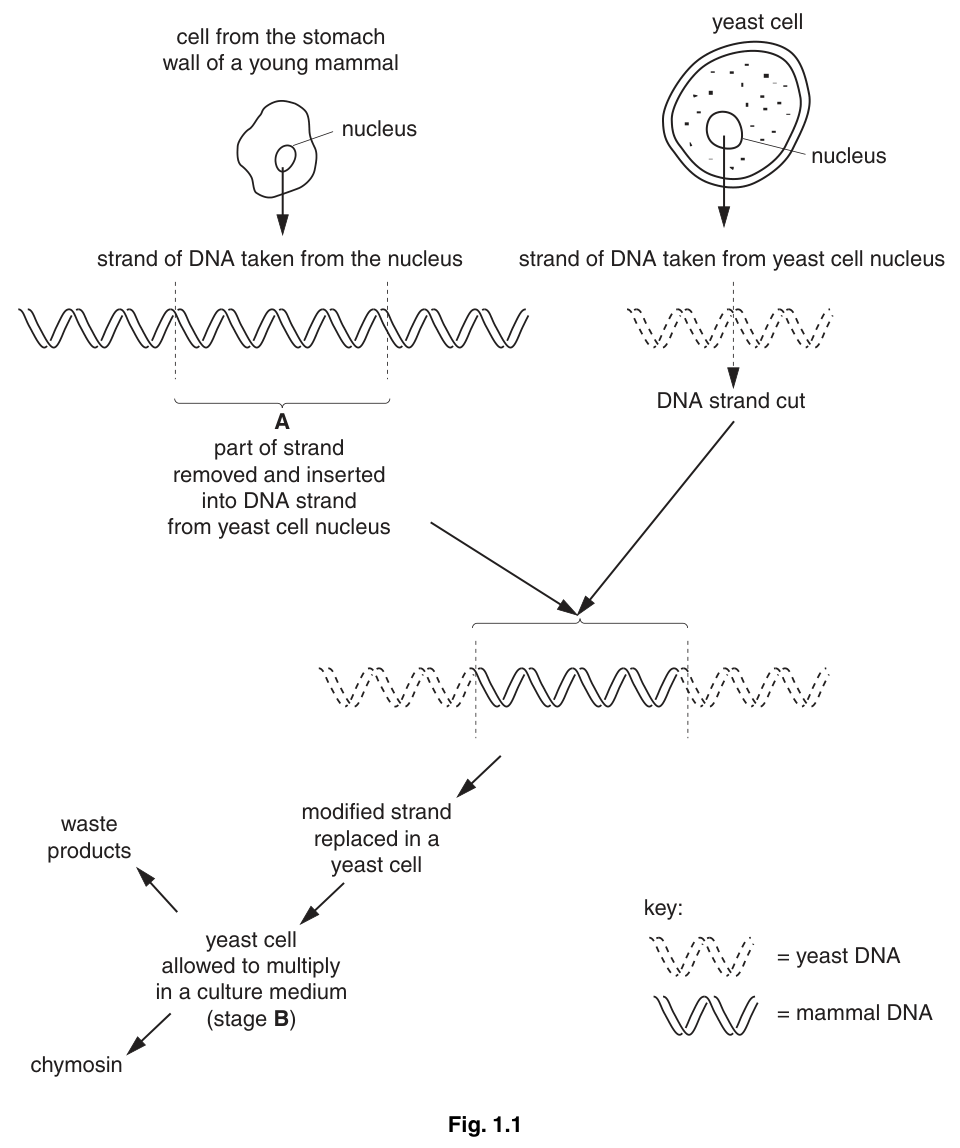
Name the thread-like structure of which the DNA strand is a part.
______
Name the part of the strand labelled A in Fig. 1.1.
______
Suggest
how the yeast could be cultured during stage B,
the identity of the waste products that may be formed during this process.
The rest of this paper
8 more questions- Q2Plant Nutrition · Movement Into and Out of Cells · Respiration9M
- Q3Human Nutrition · Transport in Humans · Disease and Immunity11M
- Q4Coordination and Control8M
- Q5Cell Structure and Organisation · Cell Division and Reproduction · Inheritance11M
- Q6Plant Nutrition · Transport in Flowering Plants10M
- Q7Organisms and Their Environment10M
- Q8(option-1)Disease and Immunity · Transport in Humans10M
- Q8(option-2)Human Nutrition10M