Biology 5090/21 — May/June 2010
Cambridge O-Level · Theory · worked solutions for every part, with the mark scheme
Topics Organisms and Their Environment · Excretion · Coordination and Control · Respiration · Transport in Flowering Plants · Human Gas Exchange · +8 more
Fig. 1.1 shows what happens to energy as it passes through an herbivorous mammal (an ox).
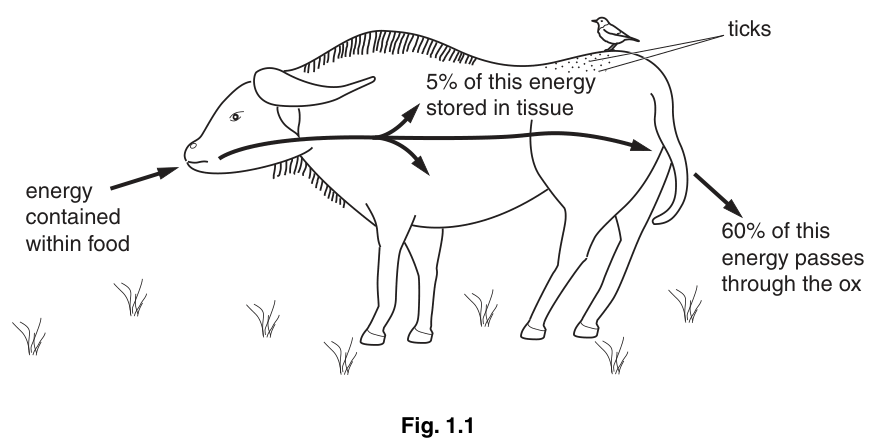
State the source of the energy in the food eaten by the ox.
______
State the form in which the energy is present in the carbohydrate eaten by the ox.
______
Name the process that makes the remaining 35% of the energy in the food available to the ox.
______
State three ways in which the energy may be used within the ox.
- ______
- ______
- ______
The bird on the ox's back is an oxpecker that feeds both on blood-sucking parasites (ticks) living on the ox, and on blood from the ox's wounds.
In the space below, draw a food web to show the feeding relationships of the organisms in Fig. 1.1.
Explain why there must always be fewer oxpeckers than ticks in this food web.
The rest of this paper
8 more questions- Q2Excretion · Coordination and Control · Organisms and Their Environment10M
- Q3Transport in Flowering Plants10M
- Q4Human Gas Exchange · Disease and Immunity10M
- Q5Cell Structure and Organisation · Plant Nutrition · Movement Into and Out of Cells10M
- Q6Sexual Reproduction in Plants10M
- Q7Coordination and Control10M
- Q8(option-1)Human Nutrition · Transport in Humans · Excretion10M
- Q8(option-2)Cell Division and Reproduction10M