Chemistry 5070/22 — October/November 2025
Cambridge O-Level · Theory · worked solutions for every part, with the mark scheme
Topics Stoichiometry · Atoms, Elements and Compounds · Organic Chemistry · Experimental Techniques and Chemical Analysis · Chemical Reactions · The Periodic Table · +6 more
Choose from the following compounds to answer the questions.
compound A
compound B
compound C
compound D
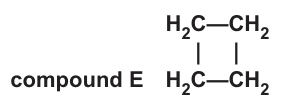
compound E
compound F
compound G
compound H
Each compound can be used once, more than once or not at all.
State which compound:
Answer
B
B
Walkthrough
Methanoic acid is the IUPAC name for the simplest carboxylic acid. It contains only one carbon atom and the carboxylic acid functional group (-COOH). Its molecular formula is HCOOH. Looking at the list of compounds, compound B is HCOOH.
Key Takeaways
Carboxylic acids contain the -COOH functional group. Methanoic acid is HCOOH, and ethanoic acid is CH3COOH.
Common Mistakes
Confusing methanoic acid (HCOOH) with ethanoic acid (CH3COOH) or other carboxylic acids in the list.
Things to Be Careful About
Ensure the formula matches the name exactly; methanoic acid has only one carbon atom, so it cannot be any of the longer-chain compounds like H.
Answer
C
C
Walkthrough
Ethene (CH2=CH2) undergoes hydration, which is the addition of steam in the presence of a phosphoric acid catalyst at high temperature and pressure, to produce ethanol (CH3CH2OH). Compound C is CH3CH2OH, which is ethanol.
Key Takeaways
Ethanol is industrially manufactured by the hydration of ethene. This is an addition reaction where water is added across the C=C double bond.
Common Mistakes
Thinking of fermentation, which is a different method used to manufacture ethanol but starts with sugars (like glucose), not ethene.
Things to Be Careful About
The question specifically asks for the compound manufactured by the hydration of ethene, which uniquely points to ethanol. Do not confuse this with the fermentation process.
Working
Compound H is CH3—CH2—CH2—COOH.
Counting the atoms: 4 carbon, 8 hydrogen, 2 oxygen.
Molecular formula = C4H8O2.
Divide the subscripts by their greatest common divisor (2) to find the empirical formula:
C4H8O2 → C2H4O.
Answer
H
H
Walkthrough
The empirical formula is the simplest whole-number ratio of atoms in a compound. We need to find a compound whose molecular formula reduces to C2H4O.
Compound H is CH3—CH2—CH2—COOH (butanoic acid). Counting the atoms gives a molecular formula of C4H8O2. Dividing the subscripts (4, 8, 2) by their greatest common divisor, which is 2, gives the empirical formula C2H4O.
Key Takeaways
The empirical formula is found by dividing the molecular formula subscripts by their greatest common divisor. For C4H8O2, dividing by 2 gives C2H4O.
Common Mistakes
Calculating the molecular formula instead of the empirical formula, or making arithmetic errors when dividing the subscripts. For example, compound D is CH3—COOCH3, which has the molecular formula C3H6O2. Dividing by 2 gives C1.5H3O, which is not a valid whole-number ratio; the simplest ratio is C3H6O2 itself.
Things to Be Careful About
Always ensure the final empirical formula has whole-number subscripts. Check the other compounds if unsure, but H is the only one that correctly reduces to C2H4O.
Answer
G
G
Walkthrough
Addition polymerisation is a reaction where many small molecules (monomers) with a carbon-carbon double bond (C=C) join together to form a long chain (polymer) with no other products. Looking at the list, compound G is CH3—CH2—CH=CH2 (but-1-ene), which is an alkene containing a C=C double bond. It can undergo addition polymerisation to form poly(butene).
Key Takeaways
Only alkenes (and other compounds containing C=C bonds) can undergo addition polymerisation because the double bond breaks to form new single bonds with other monomers.
Common Mistakes
Choosing an alkane (like F or E) or a compound without a C=C bond. Alkanes are saturated and cannot undergo addition reactions.
Things to Be Careful About
The monomer must have a C=C double bond. Compound G is the only alkene in the list that is not already used in another part and fits this description.
Answer
D
D
Walkthrough
Esters are organic compounds characterised by the ester functional group, which is written as -COO- or -COOR. Looking at the list, compound D is CH3—COOCH3 (methyl ethanoate). It contains the -COO- group linking a methyl group (CH3-) and another methyl group (-CH3), making it an ester.
Key Takeaways
Esters contain the -COO- functional group. They are formed by the reaction of a carboxylic acid with an alcohol (esterification).
Common Mistakes
Confusing the ester group (-COO-) with the carboxylic acid group (-COOH). Compound B and H have -COOH, so they are carboxylic acids, not esters.
Things to Be Careful About
Look for the -COO- linkage where the carbon is double-bonded to one oxygen and single-bonded to another oxygen, which is then bonded to a carbon chain. Compound D is CH3—COO—CH3, which clearly shows this structure.
Working
Structural isomers are compounds with the same molecular formula but different structural formulae.
Compound E is cyclobutane. Counting the atoms in the ring: 4 carbon atoms and 8 hydrogen atoms (each CH2 has 2 H). Molecular formula = C4H8.
Compound G is but-1-ene: CH3—CH2—CH=CH2. Counting the atoms: 4 carbon atoms and 8 hydrogen atoms. Molecular formula = C4H8.
Both E and G have the molecular formula C4H8 but different structures (one is a cyclic alkane, the other is an straight-chain alkene).
Answer
E and G
E and G
Walkthrough
Structural isomers are molecules that have the same molecular formula (same number and types of atoms) but different structural arrangements of atoms.
We need to find two compounds from the list with the same molecular formula.
Compound E is cyclobutane, a cyclic alkane. The image shows a four-membered ring of CH2 groups. Molecular formula: C4H8.
Compound G is but-1-ene: CH3—CH2—CH=CH2. Molecular formula: C4H8.
Both have the formula C4H8, but E is a ring and G is a straight chain with a double bond. They are structural isomers.
Key Takeaways
Structural isomers must have the exact same molecular formula. Calculate the molecular formula for each compound by counting all atoms, then compare them.
Common Mistakes
Assuming compounds with similar names or similar structures are isomers without checking the molecular formula. For example, F (butane, C4H10) and G (but-1-ene, C4H8) have different molecular formulas and are not isomers.
Things to Be Careful About
When counting atoms in cyclic compounds like E, remember that each corner of the ring is a carbon atom with enough hydrogen atoms to make four bonds total. In cyclobutane, each carbon is bonded to two other carbons and two hydrogens (CH2), giving C4H8.
A sample of titanium found on an asteroid contains four isotopes.
Table 2.1 shows the percentage abundances of these four isotopes.
Table 2.1
| isotope | percentage abundance |
|---|---|
| 9 | |
| 7 | |
| 75 | |
| 9 |
Answer
They have different numbers of neutrons (or different mass / nucleon numbers).
Different number of neutrons
Walkthrough
Isotopes are atoms of the same element that contain the same number of protons (same atomic number, 22) but different numbers of neutrons (and thus different mass/nucleon numbers).
For :
- Number of neutrons =
For :
- Number of neutrons =
Therefore, the valid differences are:
- Different number of neutrons (or has one more neutron than ).
- Different nucleon number / mass number (47 compared to 46).
Key Takeaways
- Isotopes share the same proton number but differ in their neutron count and mass number.
Common Mistakes
- Stating that they have different numbers of electrons or protons (isotopes always have identical numbers of protons and electrons in neutral atoms).
Things to Be Careful About
- Ensure you specify 'neutrons' or 'mass/nucleon number', not just 'mass' alone.
Answer
They have the same electronic configuration (or same number of outer-shell electrons).
Same electronic configuration
Walkthrough
Chemical reactions involve the loss, gain, or sharing of electrons. Because all isotopes of an element have the exact same number of protons, neutral atoms of those isotopes also have the exact same number of electrons and identical electronic configurations (specifically, the same number of valence/outer electrons). Hence, they participate in chemical bonding in exactly the same way.
Key Takeaways
- Chemical properties depend entirely on the number and arrangement of electrons (electronic configuration).
- Physical properties (such as density or rate of diffusion) can differ between isotopes due to differences in mass.
Common Mistakes
- Saying they have the "same number of protons" without mentioning electrons or electronic configuration; chemical reactions are governed by electrons.
Things to Be Careful About
- Always link chemical reactivity directly to the electron arrangement or number of electrons.
Show by calculation that the relative atomic mass of titanium for this sample is 47.84.
Working
Answer
47.84
Walkthrough
The relative atomic mass () of an element is the weighted average of the masses of its naturally occurring isotopes relative to of the mass of a carbon-12 atom.
To find :
-
Multiply the mass number of each isotope by its percentage abundance:
- :
- :
- :
- :
-
Sum these values together to find the numerator:
- Divide by the total abundance (the sum of percentages ):
Since this is a "show that" question, all stages of the fraction must be clearly set out.
Key Takeaways
- Formula for relative atomic mass from percentage abundances:
Common Mistakes
- Forgetting to divide by 100.
- Taking a simple arithmetic average of the four mass numbers instead of weighting by percentage abundance.
Things to Be Careful About
- In "show that" questions, full working showing substitution into the formula is required to score all marks.
The equation for the reaction between aluminium and dilute hydrochloric acid is shown.
Fig. 3.1 shows the reaction pathway diagram for this reaction.
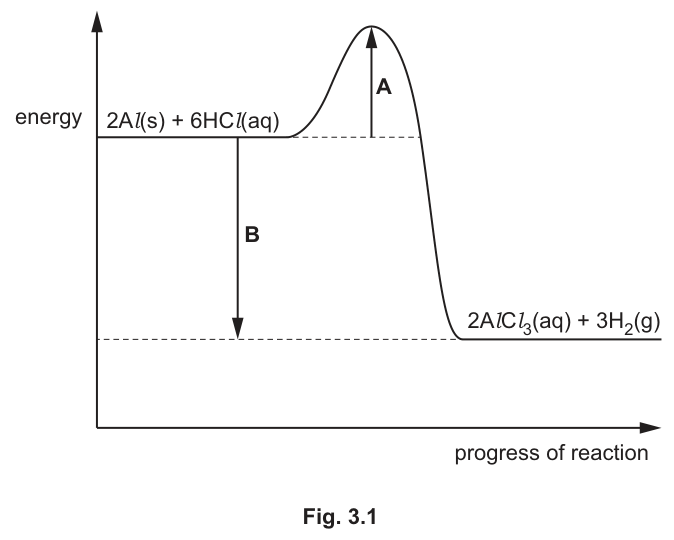
Identify the energy changes labelled A and B.
energy change A ______
energy change B ______
Answer
energy change A: activation energy (or )
energy change B: enthalpy change (or )
A: activation energy; B: enthalpy change
Walkthrough
A reaction pathway diagram plots energy against the progress of a reaction. The peak of the curve represents the transition state. The energy difference between the reactants and the peak is the minimum energy required to start the reaction, known as the activation energy (). This is labelled A.
The energy difference between the reactants and the products represents the overall heat change of the reaction. For an exothermic reaction, this is the enthalpy change (). This is labelled B.
Key Takeaways
On a reaction pathway diagram, the upward arrow from reactants to the peak is always the activation energy. The vertical arrow between the reactant and product energy levels is the enthalpy change ().
Common Mistakes
Candidates sometimes confuse activation energy with enthalpy change, or write for A. Remember: A is the barrier to start the reaction (activation energy), B is the net energy released (enthalpy change).
Things to Be Careful About
Both 'activation energy' and '' are accepted. Both 'enthalpy change' and '' are accepted. Do not just write 'energy' or 'heat' without the specific chemical term.
Answer
The energy level of the products is lower than the energy level of the reactants.
The product energy level is below the reactant energy level
Walkthrough
An exothermic reaction is one that releases energy to the surroundings. On a pathway diagram, this is shown by the products sitting at a lower energy level than the reactants. The difference in energy (labelled B) is released as heat.
Key Takeaways
Exothermic = products lower than reactants. Endothermic = products higher than reactants.
Common Mistakes
Saying 'energy is released' is not enough on its own without referencing the diagram. The mark scheme requires a reference to the relative positions of the energy levels: 'product level below reactant level'.
Things to Be Careful About
Always refer to 'energy level' or 'energy' when interpreting these diagrams. Do not say 'temperature is lower'.
Describe a chemical test for hydrogen.
test ______
observation if hydrogen present ______
Answer
test: put a lighted splint into the gas
test if hydrogen present: it 'pops' (or a squeaky pop is heard)
A lighted splint is placed in the gas, which 'pops'.
Walkthrough
Hydrogen is a flammable gas. The standard test involves introducing a flame to the gas. The hydrogen ignites rapidly with a small explosion, producing a characteristic 'squeaky pop' sound.
Key Takeaways
Hydrogen test: lighted splint -> 'pop'. Oxygen test: glowing splint -> relights. Carbon dioxide test: limewater -> turns milky.
Common Mistakes
Saying 'it burns' is not specific enough; many gases burn. The key observation is the 'pop' sound. Also, do not say 'glowing splint'; that is for oxygen. It must be a 'lighted' or 'burning' splint.
Things to Be Careful About
The mark scheme specifically looks for 'lighted splint' and 'pops'. Ensure both the action (test) and the observation are clearly stated if asked, though here they are combined in 1 mark.
A sample of aluminium reacts completely with dilute hydrochloric acid.
A total volume of of hydrogen, measured at r.t.p., is produced.
Calculate the mass of the sample of aluminium.
Give your answer to two significant figures.
mass of aluminium = ______
Working
Step 1: Calculate moles of hydrogen gas produced.
At r.t.p., 1 mole of gas occupies .
Step 2: Use the mole ratio from the balanced equation to find moles of aluminium.
Equation:
Ratio of Al : H is .
Step 3: Calculate the mass of aluminium.
of Al = 27.
Rounding to two significant figures:
Answer
mass of aluminium = 0.27 g
0.27
Walkthrough
First, convert the volume of hydrogen gas to moles using the molar gas volume at room temperature and pressure (r.t.p.), which is .
Next, use the stoichiometric ratio from the balanced chemical equation. The equation shows that 2 moles of Al produce 3 moles of H. Therefore, the moles of Al required is of the moles of H.
Finally, calculate the mass using the relative atomic mass of aluminium ().
The question asks for the answer to two significant figures, so rounds to .
Key Takeaways
Always check the state and conditions for gas volumes. At r.t.p., use (or ). At s.t.p., use . Remember to use the correct mole ratio from the balanced equation, not just 1:1.
Common Mistakes
Using the wrong molar gas volume (e.g., for r.t.p.). Forgetting to use the ratio and assuming moles of Al = moles of H. Forgetting to round to the correct number of significant figures at the end.
Things to Be Careful About
The volume is given in , so divide by , not . If you convert to first (), then divide by , you get the same result. Ensure final answers respect the requested significant figures.
Fluorine, chlorine, bromine and iodine are elements in Group VII.
Fluorine has a low boiling point. It is a gas at room temperature.
Answer
Any two from:
- random arrangement
- molecules are spread far apart
- molecules are moving (very) fast
- random motion
Random arrangement; molecules moving fast
Walkthrough
Fluorine is a gas at room temperature, so its molecules behave like all gas particles. The question asks for two separate ideas: arrangement and motion. In a gas the molecules have no fixed positions and no regular pattern, so their arrangement is random. They are also spread far apart compared with a liquid or solid. For motion, the molecules move quickly and in all directions, so their motion is random. Any two of these four points score the two marks.
Key Takeaways
- Gas particles are far apart, randomly arranged and move quickly in all directions.
- The particle model explains the properties of solids, liquids and gases.
Common Mistakes
- Writing 'regular arrangement' or 'fixed positions' – that describes a solid, not a gas.
- Saying molecules 'vibrate about fixed points' – that is a solid.
- Giving only one property when two marks are available.
Things to Be Careful About
- The mark scheme accepts any two from four, so write two clear, separate points.
- Use the word 'random' for both arrangement and motion to match the mark scheme.
Explain why fluorine is a gas at room temperature.
Use ideas about structure and bonding.
______
Answer
Fluorine is a simple molecular substance. The molecules are held together by weak intermolecular forces, so little energy is needed to overcome them and fluorine boils at a low temperature.
Weak intermolecular forces between fluorine molecules
Walkthrough
Fluorine exists as diatomic molecules, . Within each molecule the two fluorine atoms are joined by a strong covalent bond, but between separate molecules there are only weak intermolecular forces. To turn a liquid into a gas these weak forces between molecules must be overcome, not the covalent bond inside the molecule. Because the intermolecular forces are weak, only a small amount of energy is needed, so fluorine has a low boiling point and is a gas at room temperature.
Key Takeaways
- Simple molecular substances have strong covalent bonds within molecules but weak forces between molecules.
- The low melting/boiling points of simple molecules are due to weak intermolecular forces, not to breaking covalent bonds.
Common Mistakes
- Saying the covalent bond is weak – the covalent bond in is strong; it is the intermolecular forces that are weak.
- Saying 'the molecules are far apart' without mentioning forces – the mark is for weak intermolecular forces.
Things to Be Careful About
- The mark scheme wants the idea of weak intermolecular forces; mention 'intermolecular' specifically.
- Do not confuse intermolecular forces with intramolecular covalent bonds.
Bromine reacts with lithium to make the ionic compound lithium bromide.
Answer
1 high melting point / high boiling point
2 conducts electricity in aqueous solution
High melting point/boiling point; conducts electricity in aqueous solution
Walkthrough
Lithium bromide is an ionic compound made of and ions held in a giant ionic lattice. The strong electrostatic forces between oppositely charged ions give it a high melting point and boiling point. In the solid state the ions are fixed in the lattice and cannot move, so solid lithium bromide does not conduct electricity. When dissolved in water the lattice breaks down and the ions are free to move, so the aqueous solution conducts electricity. The question asks for two physical properties, so give one about melting/boiling point and one about electrical conductivity.
Key Takeaways
- Ionic compounds have high melting and boiling points because of strong electrostatic forces in the giant lattice.
- They conduct electricity only when molten or in aqueous solution, when ions are free to move.
- Solid ionic compounds do not conduct because the ions are fixed in the lattice.
Common Mistakes
- Writing 'conducts electricity when solid' – this is wrong because the ions cannot move.
- Giving chemical properties (e.g. reacts with water) instead of physical properties.
- Giving only one property when two are asked for.
Things to Be Careful About
- The mark scheme accepts 'high melting point' or 'high boiling point' as one property.
- For conductivity, specify 'in aqueous solution' (or molten) to show you know the ions must be free to move.
Construct the ionic half-equation to show the formation of lithium ions from lithium atoms.
______
Answer
Li -> Li+ + e-
Walkthrough
A lithium atom has one electron in its outer shell. To form a lithium ion it loses this electron, becoming a ion. The electron lost is written as on the product side. The equation is balanced because there is one lithium atom on each side and the total charge is zero on the left and on the right. Losing electrons is oxidation, so this is the oxidation half-equation.
Key Takeaways
- Metal atoms form positive ions by losing electrons.
- A half-equation must balance both atoms and charge.
- Loss of electrons is oxidation.
Common Mistakes
- Writing – that is the reverse (reduction) half-equation.
- Forgetting the electron on the correct side.
- Adding state symbols when the mark scheme does not require them is not penalised, but keep the equation simple.
Things to Be Careful About
- The mark scheme gives exactly ; copy it in that order.
- Check charge balance: left 0, right .
Construct the ionic half-equation to show the formation of bromide ions from bromine molecules.
______
Answer
Br2 + 2e- -> 2Br-
Walkthrough
A bromine molecule contains two bromine atoms. Each bromine atom gains one electron to become a bromide ion, . Because there are two atoms in , two electrons are needed in total. The half-equation must show on the left, on the right, and on the left to balance the charge: left charge , right charge . Gaining electrons is reduction, so this is the reduction half-equation.
Key Takeaways
- Non-metal atoms form negative ions by gaining electrons.
- A half-equation must balance atoms and charge.
- Gain of electrons is reduction.
Common Mistakes
- Writing – the charge is not balanced.
- Writing – the question starts from bromine molecules, so use .
- Putting the electrons on the wrong side.
Things to Be Careful About
- Count bromine atoms: one molecule gives two ions.
- Count charge: two electrons are needed to make two ions.
Chlorine gas is bubbled into aqueous lithium bromide. A reaction takes place.
Name the two products of this reaction.
______
Answer
lithium chloride and bromine
Lithium chloride and bromine
Walkthrough
In Group VII, reactivity decreases down the group: fluorine is the most reactive, then chlorine, bromine, then iodine. A more reactive halogen can displace a less reactive halogen from a solution of its salt. Chlorine is above bromine in the group, so it is more reactive and displaces bromine from aqueous lithium bromide. The bromide ions lose electrons to become bromine molecules, and the chloride ions stay in solution with the lithium ions, forming lithium chloride. The two products are therefore lithium chloride and bromine.
Key Takeaways
- Halogen reactivity decreases down Group VII.
- A more reactive halogen displaces a less reactive halogen from its salt solution.
- The displacement reaction is a redox reaction: bromide ions are oxidised to bromine, chlorine is reduced to chloride ions.
Common Mistakes
- Naming 'lithium bromine' or 'chlorine bromide' – the products are lithium chloride and bromine.
- Saying bromine displaces chlorine – bromine is less reactive than chlorine.
- Forgetting that bromine is formed as an element, not as bromide ions.
Things to Be Careful About
- The question asks for two products; give both.
- Chlorine is more reactive than bromine because it is higher in Group VII.
- The aqueous solution contains and ; after displacement the ions are and , so lithium chloride remains in solution.
Nickel is a transition element.
One of the properties of nickel is that it is a catalyst.
State a reaction that uses nickel as a catalyst.
______
Answer
Hydrogenation of alkenes / reaction of an alkene with hydrogen (to form an alkane).
Hydrogenation of alkenes / reaction of an alkene with hydrogen
Walkthrough
Nickel is widely used as an industrial catalyst. In organic chemistry, finely divided nickel catalyses the addition of hydrogen across the carbon-carbon double bond () in alkenes to produce saturated alkanes (or in the manufacture of margarine from vegetable oils).
Key Takeaways
- Nickel catalyses the hydrogenation of alkenes (reaction of alkenes with hydrogen at around to ).
- Catalytic activity is a characteristic property of transition elements.
Common Mistakes
- Confusing the nickel catalyst with the iron catalyst used in the Haber process or vanadium(V) oxide used in the Contact process.
Things to Be Careful About
- Clearly name the reaction or state the reactants (e.g. "ethene with hydrogen" or "hydrogenation of alkenes").
State one other chemical property of nickel that is typical of a transition element.
______
Answer
Forms compounds with more than one oxidation state / forms coloured compounds.
Forms compounds with more than one oxidation state
Walkthrough
Transition elements exhibit characteristic chemical properties, including:
- Variable oxidation states in their compounds (e.g. , ).
- Formation of coloured compounds/ions.
- Catalytic activity (which was already mentioned in part (a)).
State one other chemical property such as variable oxidation states or forming coloured compounds.
Key Takeaways
- Transition metals have variable oxidation states and form coloured compounds.
- Physical properties (high density, high melting point) are not chemical properties.
Common Mistakes
- Stating a physical property (such as "high melting point" or "good conductor") instead of a chemical property.
Things to Be Careful About
- Ensure the answer focuses strictly on a chemical property.
The physical properties of nickel and its alloys can be explained using ideas about structure and bonding.
Answer
The layers of metal ions can slide over one another (without breaking the metallic bond).
Layers of metal ions can slide over one another
Walkthrough
Pure metals consist of regular layers of identical positive metal ions surrounded by a sea of delocalised electrons. When a force is applied, these layers can slide over each other without breaking the non-directional metallic bonds, making the metal malleable.
Key Takeaways
- Malleability is explained by the regular arrangement of atoms/ions forming layers that slide easily when force is applied.
Common Mistakes
- Referring to "molecules" or "protons" sliding instead of layers of ions or atoms.
Things to Be Careful About
- Mention the word "layers" and the action "slide".
Nickel and other elements are added to iron to make the alloy stainless steel.
Explain why stainless steel is harder than either pure nickel or pure iron.
Include a labelled diagram in your answer.
______
Answer
- The added atoms/ions have different sizes compared to the iron/nickel atoms/ions.
- This disrupts the regular arrangement of the lattice, so the layers cannot slide over each other easily.
Different sized atoms disrupt the regular layers, preventing them from sliding easily.
Walkthrough
An alloy contains different elements with different atomic/ionic radii. In stainless steel, atoms of nickel, chromium, and carbon are mixed with iron. Because these atoms/ions are of different sizes, they distort the regular, orderly lattice structure of pure metal. As a result, the layers can no longer slide over each other smoothly when a force is applied, making the alloy harder and stronger than pure metals.
Key Takeaways
- Pure metals have regular layers of identical atoms/ions that slide easily.
- Alloys contain atoms of different sizes that disrupt the regular layers, making it harder for layers to slide.
Common Mistakes
- Stating that "stronger bonds are formed" rather than explaining the mechanical disruption of layer sliding.
- Drawing an alloy diagram without labelling the different sized atoms/ions.
Things to Be Careful About
- Always label the diagram to distinguish the different types/sizes of atoms (e.g., iron atoms and nickel/other metal atoms).
Stainless steel is used to make cutlery because it is hard and strong.
State one other property that makes stainless steel suitable to make cutlery.
______
Answer
Resistant to corrosion / resistant to rusting / does not react with food acids.
Resistant to corrosion / rusting
Walkthrough
Cutlery is constantly washed with water and comes into contact with acidic food. In addition to being hard and strong, stainless steel is highly resistant to corrosion and rusting due to the formation of a protective oxide layer by chromium/nickel, making it safe, durable, and shiny.
Key Takeaways
- Stainless steel is corrosion-resistant / rust-resistant.
Common Mistakes
- Repeating properties already given in the question stem (hard and strong).
Things to Be Careful About
- The question excludes 'hard and strong', so give an unmentioned property like corrosion resistance or non-toxic / unreactive with food.
Compound X contains nickel, hydrogen and oxygen only.
X contains 2.2% by mass of hydrogen and 34.5% by mass of oxygen.
Calculate the empirical formula of compound X.
empirical formula = ______
Working
Percentage of nickel:
Calculate moles of each element (using : , , ):
Divide by the smallest value ():
Empirical formula = (or )
Answer
NiH2O2
Walkthrough
- Find percentage of nickel: Subtract the percentages of and from :
- Convert percentages to moles: Divide each percentage by the respective relative atomic mass () of the element:
- Determine the simplest ratio: Divide all mole values by the smallest value ():
- Write the empirical formula: or .
Key Takeaways
- Empirical formula is the simplest whole-number ratio of atoms of each element in a compound.
- Steps: .
Common Mistakes
- Dividing percentage by atomic number () instead of relative atomic mass ().
- Rounding mole values prematurely before finding the ratio.
Things to Be Careful About
- Check that the percentages add up to .
- Use standard Cambridge values from the Periodic Table: , , .
The equation for the reversible reaction between carbon monoxide and nickel is shown.
The forward reaction is exothermic.
The reversible reaction is allowed to reach equilibrium in a closed system.
Predict and explain the effect of increasing the pressure on the position of equilibrium. The temperature remains constant.
prediction ______
explanation ______
Answer
prediction: Moves to the right / shifts in the forward direction / yields more
explanation: There are fewer moles / smaller volume of gas on the product side () than on the reactant side ().
prediction: moves to the right; explanation: fewer moles of gas on the product side (1 mol) than on the reactant side (4 mol)
Walkthrough
- Identify the gaseous species:
- Left-hand side: and total gas = .
- Right-hand side: total gas = .
- Solids do not contribute to gas pressure.
- Apply Le Chatelier's principle:
- An increase in pressure causes the equilibrium position to shift toward the side with fewer moles of gas to counteract the increase and reduce pressure.
- Since the right-hand side has compared to on the left, the equilibrium shifts to the right (forward direction).
Key Takeaways
- When pressure is increased, the equilibrium shifts towards the side with fewer moles of gas.
- Only count species in the gaseous state (); ignore solids () and liquids ().
Common Mistakes
- Counting the solid as part of the gas volume on the left side.
- Forgetting to explicitly compare the number of moles / volumes of gas on both sides.
Things to Be Careful About
- Ensure you specify "moles of gas" rather than just "moles".
This question is about the covalent compound hydrogen peroxide.
Fig. 6.1 shows the displayed formula of hydrogen peroxide.
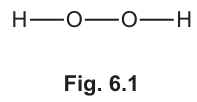
Draw the dot-and-cross diagram to show the electronic arrangement in a molecule of hydrogen peroxide.
Only draw the outer shell electrons of oxygen and hydrogen.
Answer
Dot-and-cross diagram of H2O2: one shared pair between each H and O, one shared pair between the two O atoms, and two lone pairs on each O atom.
Walkthrough
Hydrogen peroxide has the structure :
- Each hydrogen atom shares one pair of electrons with an oxygen atom to achieve a stable duplet (2 outer electrons).
- The two central oxygen atoms share one pair of electrons with each other.
- Oxygen is in Group VI and has 6 valence electrons. In , each oxygen atom forms two single covalent bonds (using 2 valence electrons) and retains two non-bonding lone pairs (4 non-bonding electrons) to complete its stable octet (8 outer electrons).
Key Takeaways
- Covalent bonds consist of shared pairs of electrons.
- Remember to include all non-bonding lone pairs on central or terminal atoms when drawing full outer-shell dot-and-cross diagrams.
Common Mistakes
- Forgetting the lone pairs on the oxygen atoms.
- Drawing double bonds instead of single bonds.
Things to Be Careful About
- Ensure distinct symbols (dots and crosses) are used consistently to show which atom provides each electron.
A sample of hydrogen peroxide has a mass of 0.170 g.
Calculate the number of molecules of hydrogen peroxide in this sample.
One mole of hydrogen peroxide contains molecules.
number of molecules = ______
Working
Answer
3.01 x 10^21
Walkthrough
- Calculate the relative molecular mass () of hydrogen peroxide, :
- Calculate the number of moles of present in :
- Multiply the number of moles by the Avogadro constant () to find the number of molecules:
Key Takeaways
- .
- .
Common Mistakes
- Calculating an incorrect (e.g., using 18 instead of 34).
- Directly multiplying the mass in grams by Avogadro's constant without converting to moles first.
Things to Be Careful About
- Keep scientific notation clear and correctly rounded (to 3 significant figures).
Calculate the total number of atoms in this sample of hydrogen peroxide.
number of atoms = ______
Working
Each molecule of contains 4 atoms ().
Answer
1.204 x 10^22
Walkthrough
- From the formula , each molecule contains 2 hydrogen atoms and 2 oxygen atoms, giving a total of 4 atoms per molecule.
- Multiply the number of molecules calculated in part (b)(i) by 4:
Key Takeaways
- Be careful to distinguish between 'molecules' and 'atoms'. Total atoms equals the number of molecules multiplied by the atomicity of the molecule.
Common Mistakes
- Leaving the answer as the number of molecules instead of converting to atoms.
- Multiplying by 2 instead of 4.
Things to Be Careful About
- Ensure correct application of error carried forward (ecf) from part (b)(i).
When aqueous hydrogen peroxide reacts with acidified aqueous potassium manganate(VII) there is a colour change from purple to colourless.
When aqueous hydrogen peroxide reacts with aqueous potassium iodide there is a colour change from colourless to brown.
Explain what these observations indicate about the chemical properties of aqueous hydrogen peroxide.
______
Answer
- It acts as a reducing agent (because it reduces purple to colourless ).
- It acts as an oxidising agent (because it oxidises colourless to brown ).
It is a reducing agent and an oxidising agent
Walkthrough
- Reaction with acidified : Acidified potassium manganate(VII) is a powerful oxidising agent that turns from purple to colourless when it is reduced to . Because hydrogen peroxide reduces it, hydrogen peroxide is acting as a reducing agent.
- Reaction with : Aqueous potassium iodide is a reducing agent. Colourless iodide ions () are oxidised to brown iodine (). Because hydrogen peroxide oxidises iodide, hydrogen peroxide is acting as an oxidising agent.
- Therefore, hydrogen peroxide can act as both an oxidising agent and a reducing agent.
Key Takeaways
- Decolourisation of acidified aqueous potassium manganate(VII) is the standard test for a reducing agent.
- Oxidation of colourless aqueous potassium iodide to brown iodine is the standard test for an oxidising agent.
Common Mistakes
- Confusing the roles and stating that is oxidised by iodide.
- Stating that is acidic/alkaline rather than identifying redox properties.
Things to Be Careful About
- The question asks for the chemical properties indicated by both observations, requiring both 'reducing agent' and 'oxidising agent' to be stated.
Barium peroxide reacts with cold dilute sulfuric acid to produce hydrogen peroxide.
Barium peroxide contains the ions and only.
Deduce the formula of barium peroxide.
______
Answer
BaO2
Walkthrough
- The given ions are barium, , and peroxide, .
- The charges are and , which balance in a ratio.
- Combining one ion and one ion gives the empirical/chemical formula .
Key Takeaways
- The overall charge on an ionic compound must be zero.
- A peroxide ion is polyatomic with the formula .
Common Mistakes
- Writing or simplifying the peroxide ion incorrectly to .
Things to Be Careful About
- Subscripts must be written clearly: .
The equation for the decomposition of aqueous hydrogen peroxide is shown.
The rate of decomposition increases as the temperature of the aqueous hydrogen peroxide increases.
Explain why.
______
Answer
- Particles gain more kinetic energy and move faster.
- There are more collisions per unit time that possess energy greater than or equal to the activation energy (more successful / effective collisions).
Particles have more kinetic energy / move faster, leading to more successful / effective collisions per unit time (more collisions with energy greater than or equal to the activation energy)
Walkthrough
- Increasing the temperature increases the average kinetic energy of the particles, causing them to move faster.
- Because particles have more kinetic energy, a greater fraction of collisions possess energy equal to or greater than the activation energy ().
- This leads to a higher frequency of successful (effective) collisions, thereby increasing the rate of reaction.
Key Takeaways
- Temperature affects rate primarily by increasing the proportion of particles with energy , as well as collision frequency.
- A complete answer must mention both particle kinetic energy/speed and the increase in successful/effective collisions.
Common Mistakes
- Stating only that 'there are more collisions' without specifying 'more successful/effective collisions' or 'more collisions per unit time with energy activation energy'.
Things to Be Careful About
- Always link collision energy to the activation energy.
Manganese(IV) oxide is a catalyst for the decomposition of aqueous hydrogen peroxide.
Describe how a catalyst increases the rate of reaction.
______
Answer
It provides an alternative reaction pathway with a lower activation energy.
Lowers the activation energy / provides an alternative pathway with lower activation energy
Walkthrough
- A catalyst speeds up a reaction without being chemically changed or used up.
- It works by providing an alternative reaction mechanism/pathway that has a lower activation energy ().
- With a lower activation energy, a greater proportion of colliding particles possess sufficient energy to react upon collision.
Key Takeaways
- A catalyst increases the rate of reaction by lowering the activation energy.
Common Mistakes
- Saying that a catalyst 'gives particles more energy' (energy is only increased by temperature, not by catalysts).
Things to Be Careful About
- State clearly that the activation energy is lowered.
PET is a polyester. It is a condensation polymer.
Fig. 7.1 shows the two monomers needed to make PET.
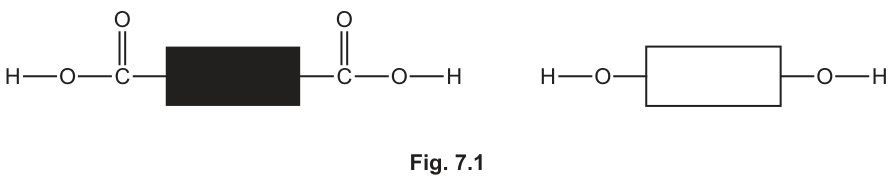
Answer
- dicarboxylic acid
- diol
dicarboxylic acid and diol
Walkthrough
The question provides structural diagrams of the two monomers used to make PET. The first monomer has two carboxylic acid groups (—COOH) at either end of a central block, making it a dicarboxylic acid. The second monomer has two hydroxyl groups (—OH) at either end, making it a diol. These are the standard names for the monomers in polyester synthesis.
Key Takeaways
Polyesters are formed from a dicarboxylic acid and a diol. Recognising the functional groups (—COOH and —OH) allows you to name the monomers correctly.
Common Mistakes
Calling the monomers 'carboxylic acid' or 'alcohol' without specifying 'di' (dicarboxylic acid and diol) is not precise enough for the mark. 'Ester' is the product linkage, not the monomer name.
Things to Be Careful About
Ensure you write 'dicarboxylic acid' and not just 'dicarboxylic'. The mark scheme accepts 'dicarboxylic (acid)'.
The two monomers react to make PET and a small molecule.
Answer
water
water
Walkthrough
In condensation polymerisation, two monomers join together with the loss of a small molecule. For a dicarboxylic acid and a diol reacting to form a polyester, the —OH from the carboxylic acid group and the —H from the hydroxyl group combine to form water (H₂O).
Key Takeaways
Condensation polymers are formed with the elimination of a small molecule, typically water.
Common Mistakes
Writing 'H₂O' instead of 'water' is usually acceptable, but naming it is safer. Do not write 'steam' or 'hydrogen' or 'oxygen'.
Things to Be Careful About
The question asks to 'name' the small molecule, so 'water' is the expected answer.
Answer
Block diagram showing two repeat units of PET with ester linkages and continuation bonds.
Walkthrough
PET is a polyester, so the monomers join via ester linkages (—C(=O)—O—). The dicarboxylic acid block (filled rectangle) connects to the diol block (open rectangle) through these ester linkages. To draw two repeat units, you must show the alternating sequence of the two monomer blocks connected by ester groups, with continuation bonds at both ends to indicate the polymer chain continues.
Key Takeaways
Condensation polymers like PET have repeating linkages between the monomer units. The structure must clearly show these linkages and the extent of the chain.
Common Mistakes
Forgetting the continuation bonds at the ends of the chain. Drawing only one repeat unit instead of two. Not showing the ester linkages clearly between the blocks.
Things to Be Careful About
The mark scheme awards one mark for ester linkages between each block and another for alternating ester linkages, at least two repeat units, and continuation bonds. Ensure all these elements are present in your drawing.
State two environmental challenges caused by the disposal of plastics made of PET.
1 ______
2 ______
Answer
- land-fills may fill up
- accumulation of plastics in oceans
(Alternatively: formation of toxic gases during burning)
land-fills may fill up and accumulation of plastics in oceans
Walkthrough
Plastics like PET are non-biodegradable, meaning they do not break down naturally in the environment. This leads to several environmental challenges when they are disposed of in land-fills or end up in waterways.
Key Takeaways
Non-biodegradable plastics accumulate in the environment, causing issues with land space and marine ecosystems.
Common Mistakes
Saying 'plastics cause pollution' is too vague. You must specify the environmental challenge, such as land-fills filling up or plastics accumulating in oceans.
Things to Be Careful About
The question asks for two challenges. Any two from the mark scheme list will score. Ensure your answers are specific to the disposal of plastics.
Answer
nylon (or protein)
nylon
Walkthrough
Polyamides are condensation polymers formed from diamines and dicarboxylic acids (or amino acids). The most common example is nylon. Proteins are also natural polyamides formed from amino acids.
Key Takeaways
Nylon and proteins are the standard examples of polyamides in the 5070 syllabus.
Common Mistakes
Naming a polyester like PET or a different polymer type. Ensure you name a polyamide specifically.
Things to Be Careful About
The mark scheme accepts 'nylon' or 'protein'. 'Nylon' is the most common synthetic example expected at this level.
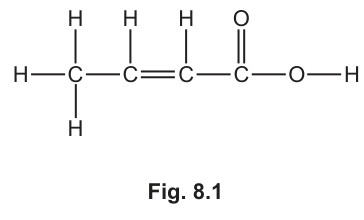
Fig. 8.1 shows the displayed formula of an unsaturated carboxylic acid, X.
Answer
It contains a carbon–carbon double bond ().
Contains a carbon–carbon double bond (C=C)
Walkthrough
An unsaturated organic compound is one that contains at least one carbon–carbon double bond () or triple bond. Looking at the displayed formula in Fig. 8.1, there is a double bond between two carbon atoms ().
Key Takeaways
- Saturated compounds contain only single carbon–carbon bonds ().
- Unsaturated compounds contain one or more carbon–carbon double (or triple) bonds ().
Common Mistakes
- Stating just "contains a double bond" without specifying that it is between carbon atoms (since the molecule also contains a bond, which does not make a hydrocarbon chain unsaturated in this context).
Things to Be Careful About
- Always specify carbon–carbon double bond or write .
Answer
- Orange / brown / red-brown (initial colour)
- Turns colourless / decolourises
Orange to colourless
Walkthrough
Aqueous bromine (bromine water) undergoes an addition reaction across the double bond of an unsaturated compound. As the bromine is consumed in the reaction to form a dibromo compound, the orange/brown colour disappears and the solution turns colourless.
Key Takeaways
- Bromine water is the standard chemical test for unsaturation ( bonds).
- A positive result is the decolourisation of bromine water: orange (or brown/red-brown) to colourless.
Common Mistakes
- Writing "clear" instead of "colourless". A coloured solution can be clear (transparent); "colourless" means having no colour.
Things to Be Careful About
- Include both the initial colour (orange/red-brown/brown) and the final colour (colourless).
Answer
It partially ionises / partially dissociates in aqueous solution.
Partially dissociates / ionises in aqueous solution
Walkthrough
An acid is a substance that ionises in water to produce hydrogen ions, . A strong acid fully ionises (completely dissociates) in aqueous solution, whereas a weak acid only partially ionises (partially dissociates), establishing an equilibrium where most of the acid remains as un-ionised molecules.
Key Takeaways
- Weak refers to the extent of ionisation/dissociation, not the concentration (dilute vs. concentrated).
- Weak acids only partially ionise in water.
Common Mistakes
- Confusing weak with dilute. "Dilute" means low amount of solute per unit volume of solution; "weak" means incomplete ionisation.
Things to Be Careful About
- Use the word partially (or incompletely) with ionises or dissociates.
Answer
Carbon dioxide
Carbon dioxide
Walkthrough
Carboxylic acids exhibit typical acidic properties. When an acid reacts with a metal carbonate, the products are a salt, water, and carbon dioxide gas:
Therefore, the gas produced is carbon dioxide.
Key Takeaways
- .
Common Mistakes
- Writing "hydrogen" or "oxygen" instead of carbon dioxide.
Things to Be Careful About
- The question asks to name the gas, so write "carbon dioxide" (though is often accepted, writing the name is safest).
Answer
- React with an alcohol
- In the presence of an acid catalyst (e.g. concentrated sulfuric acid)
React with an alcohol using an acid catalyst
Walkthrough
An ester is formed via an esterification (condensation) reaction between a carboxylic acid and an alcohol:
This reaction requires heating in the presence of an acid catalyst, typically concentrated sulfuric acid ().
Key Takeaways
- Esterification: .
- Conditions: acid catalyst (commonly concentrated sulfuric acid) and heat.
Common Mistakes
- Forgetting the acid catalyst and only stating the alcohol.
Things to Be Careful About
- Clearly state both the required reactant (an alcohol) and the required catalyst (acid / concentrated sulfuric acid).
Ethanoic acid is a saturated carboxylic acid.
Answer
Bacterial oxidation (by air) OR by heating with acidified potassium manganate(VII).
Bacterial oxidation or reaction with acidified potassium manganate(VII)
Walkthrough
Ethanol can be oxidised to ethanoic acid in two main ways:
- Chemical oxidation: Heating ethanol with an oxidising agent such as acidified potassium manganate(VII), (or acidified potassium dichromate(VI)).
- Bacterial oxidation: Leaving ethanol exposed to oxygen in the air in the presence of bacteria (such as Acetobacter), which converts ethanol into ethanoic acid (as occurs when wine turns to vinegar).
Key Takeaways
- Alcohols are oxidised to carboxylic acids by oxidising agents (e.g. acidified ) or bacterial oxidation (atmospheric oxygen).
Common Mistakes
- Stating "combustion" — combustion oxidises ethanol to and , not ethanoic acid.
Things to Be Careful About
- If naming the oxidising agent, include the condition "acidified".
Dilute ethanoic acid reacts with aqueous sodium hydroxide.
Name the two products of this reaction.
______
Answer
Sodium ethanoate and water
Sodium ethanoate and water
Walkthrough
Ethanoic acid reacts with the alkali sodium hydroxide in a typical neutralisation reaction (acid + base salt + water):
The salt formed is sodium ethanoate, and the other product is water.
Key Takeaways
- .
- Ethanoic acid forms ethanoate salts.
Common Mistakes
- Naming only the salt and forgetting water.
- Calling the salt "sodium acetate" (which is older terminology, "sodium ethanoate" is systematic IUPAC and required by 5070) or "sodium ethanate".
Things to Be Careful About
- Ensure both products are named as requested by the bold "two products".
Hydrated zinc chloride is a white solid.
Answer
Chemically combined with water (contains water of crystallisation)
Chemically combined with water
Walkthrough
The term hydrated in chemistry refers to a solid substance (typically a salt) that contains water of crystallisation chemically bonded within its crystal lattice structure.
Key Takeaways
- Hydrated means chemically combined with water.
- Anhydrous means containing no water of crystallisation.
Common Mistakes
- Confusing "hydrated" with "dissolved in water" or "aqueous solution". A hydrated substance is a solid, not a solution.
- Saying "contains moisture" or "is wet", which implies physical mixing rather than chemical combination.
Things to Be Careful About
- Ensure you mention that the water is chemically combined or refer directly to water of crystallisation.
Aqueous ammonia is added dropwise until in excess to a small volume of aqueous zinc chloride.
Describe the observations during this addition.
______
Answer
- White precipitate formed
- Dissolves / soluble in excess (aqueous ammonia) giving a colourless solution
White precipitate, soluble in excess giving a colourless solution
Walkthrough
When testing for cations with aqueous ammonia ():
- Adding a few drops produces a white precipitate of zinc hydroxide, :
- Adding excess aqueous ammonia causes the precipitate to dissolve, forming a colourless solution containing a complex ion (tetraamminezinc(II) ion, ).
Both parts of the observation (the initial precipitate and what happens in excess) are required to gain full marks.
Key Takeaways
- with gives a white ppt. that is soluble in excess forming a colourless solution.
- and give white precipitates insoluble in excess , which distinguishes from them.
Common Mistakes
- Stating only "white precipitate" and omitting what happens in excess.
- Stating that the precipitate remains / is insoluble in excess (which would be true for or , but not ).
Things to Be Careful About
- Always describe both stages: (1) dropwise addition, (2) addition until in excess.
Describe the observations when aqueous silver nitrate is added to aqueous zinc chloride.
______
Answer
White precipitate
White precipitate
Walkthrough
Aqueous zinc chloride contains chloride ions (). When aqueous silver nitrate () is added, silver ions react with chloride ions to form an insoluble silver chloride precipitate:
Silver chloride () is a white solid, so the observation is a white precipitate.
Key Takeaways
- Chloride ions () form a white precipitate of with .
- Bromide ions () form a cream precipitate of .
- Iodide ions () form a yellow precipitate of .
Common Mistakes
- Giving the colour as cream or yellow.
- Writing "colourless solution" or stating the name of the product rather than the visual observation.
Things to Be Careful About
- The question asks for observations, so write "white precipitate" rather than the chemical formula "".
Dilute and concentrated aqueous zinc chloride are electrolysed separately using carbon electrodes.
Complete Table 9.1.
Table 9.1
| dilute aqueous zinc chloride | concentrated aqueous zinc chloride | |
|---|---|---|
| product at anode | ||
| product at cathode |
Answer
| dilute aqueous zinc chloride | concentrated aqueous zinc chloride | |
|---|---|---|
| product at anode | oxygen (and water) | chlorine |
| product at cathode | hydrogen | hydrogen |
Anode: dilute = oxygen (and water), concentrated = chlorine; Cathode: dilute = hydrogen, concentrated = hydrogen
Walkthrough
In aqueous zinc chloride, the ions present are , , , and .
-
At the cathode (negative electrode):
- Both and migrate to the cathode.
- Zinc is more reactive than hydrogen (it lies above hydrogen in the reactivity series), so ions are preferentially discharged to form hydrogen gas ():
- This occurs in both dilute and concentrated solutions.
-
At the anode (positive electrode):
- Both and migrate to the anode.
- In dilute solution, ions are discharged preferentially because they are more easily oxidised than chloride ions at low halide concentration, producing oxygen gas and water:
- In concentrated solution, the high concentration of halide ions () causes chloride ions to be preferentially discharged, producing chlorine gas:
Key Takeaways
- At the cathode: hydrogen is produced if the metal is more reactive than hydrogen (e.g. , , , , , , ).
- At the anode: concentrated halide solutions discharge the halogen; dilute solutions discharge hydroxide ions to give oxygen gas.
Common Mistakes
- Predicting zinc metal at the cathode because it is a metal ion, forgetting that zinc is more reactive than hydrogen.
- Predicting chlorine at the anode for the dilute solution.
Things to Be Careful About
- Name the element/gas (e.g. oxygen, chlorine, hydrogen) or give the correct chemical formula (, , ).
Explain why aqueous zinc chloride conducts electricity but solid zinc chloride does not conduct electricity.
______
Answer
In aqueous solution, ions are free to move, but in the solid state, ions are fixed in a lattice and cannot move.
Ions are free to move in aqueous solution but cannot move in the solid
Walkthrough
Zinc chloride is an ionic compound composed of and ions held together by strong electrostatic attractions in a giant ionic lattice:
- In the solid state, the ions are held in fixed positions within the lattice and cannot move to carry an electric charge.
- In aqueous solution, the lattice breaks down, and the ions become mobile (free to move throughout the liquid) to carry electrical charge.
Key Takeaways
- Ionic substances conduct electricity only when molten or in aqueous solution because their ions are free to move.
- Electrical conduction in ionic compounds involves the movement of ions, not electrons.
Common Mistakes
- Referring to "delocalised electrons" or "free electrons" moving in ionic compounds (electrons only conduct in metals and graphite).
- Simply stating "electrons are free to move in solution".
Things to Be Careful About
- Clearly specify ions (not electrons or atoms) and mention the contrast in mobility between the aqueous and solid states.
Water is an important part of the environment.
Rivers and lakes are natural sources of water.
Name one substance in river water that may be harmful.
Explain why this substance may be harmful.
substance ______
explanation ______
Answer
substance: metal compounds
explanation: They are toxic or poisonous and can cause health problems.
metal compounds - toxic or poisonous; can cause health problems
Walkthrough
River water is not pure: it carries dissolved and suspended substances from the land, from industry and from living things. The mark scheme accepts any one of several harmful examples. Here we choose metal compounds (for example from industrial waste or old pipes). Metal compounds can be toxic: if animals or humans drink the water, these substances can poison cells and cause illness. The explanation must link the substance to a specific harm, not just say 'it is harmful'.
Key Takeaways
- Natural water may contain harmful pollutants such as heavy-metal compounds, sewage, microplastics and excess fertilisers.
- To score the mark, name a substance and give a clear consequence, for example 'toxic to aquatic life' or 'causes disease'.
Common Mistakes
- Naming a harmless substance such as 'oxygen' as harmful.
- Giving only a substance with no explanation, or an explanation such as 'it is bad' that does not state the harm.
- Choosing an answer outside the syllabus list (for example 'pollution' on its own).
Things to Be Careful About
- The question gives two blank lines: one for the substance and one for the explanation. Both must be completed.
- Keep the harm specific: 'toxic/poisonous', 'causes disease', 'endangers aquatic life' or 'causes eutrophication' are all acceptable.
Name one substance in river water that is beneficial.
Explain why this substance is beneficial.
substance ______
explanation ______
Answer
substance: dissolved oxygen
explanation: It is needed by fish and other aquatic organisms for respiration.
dissolved oxygen - needed for respiration by aquatic life
Walkthrough
River water can also contain useful substances. A very important one is dissolved oxygen: fish and other aquatic animals need this oxygen to respire. The explanation should connect the substance to its use, e.g. 'needed for respiration by aquatic life'. Another accepted answer is metal compounds that provide essential minerals for living things.
Key Takeaways
- Dissolved oxygen is beneficial because aquatic organisms respire in it.
- Some dissolved mineral compounds are beneficial because they provide essential elements.
Common Mistakes
- Giving 'water' as a substance in water, which is too trivial.
- Saying oxygen is harmful, which is usually wrong unless the question is about excess nutrients.
- Giving a benefit without saying for whom (aquatic life).
Things to Be Careful About
- One mark only, so substance + explanation together are needed.
- 'Dissolved oxygen' is better than just 'oxygen' because oxygen gas in the atmosphere is not what organisms use from the water.
Describe the three processes involved in the treatment of water for the domestic water supply.
State the reason why each process is used.
process 1 ______
reason ______
process 2 ______
reason ______
process 3 ______
reason ______
Answer
- Filtration – removes insoluble solids.
- Carbon treatment – removes bad tastes and odours.
- Chlorination – kills microbes/bacteria.
Filtration – removes insoluble solids; carbon treatment – removes bad tastes and odours; chlorination – kills microbes.
Walkthrough
The domestic water supply is treated in stages. First, water is left to stand or passed through filters so that insoluble solids (sand, mud, leaves) settle out or are trapped. Then the water is passed over activated carbon, which removes bad tastes and odours. Finally, a small amount of chlorine is added to kill microbes and make the water safe to drink. These are the three processes required by the mark scheme; sometimes 'sedimentation' is accepted instead of filtration for the first stage, and 'carbon' or 'carbonation' for the second.
Key Takeaways
- The three stages are: filtration/sedimentation, carbon treatment, chlorination.
- Each stage has one clear purpose: removing solids, removing taste/odour, killing microbes.
Common Mistakes
- Giving 'boiling the water' – this is not a large-scale treatment stage.
- Mixing up the purposes, e.g. saying chlorination removes solids.
- Naming the process without the reason, or the reason without the process.
Things to Be Careful About
- The mark scheme gives one mark per process+reason.
- Use the exact words from the syllabus where possible: sedimentation/filtration, carbon, chlorination.
- If you choose filtration, say 'removes insoluble solids', not just 'cleans water'.
Describe a qualitative chemical test to show the presence of water.
chemical test ______
observation ______
Answer
Test: add a small amount of anhydrous copper(II) sulfate to the water.
Observation: the white powder turns blue.
anhydrous copper(II) sulfate: white to blue
Walkthrough
You can test for water using a chemical test. Anhydrous copper(II) sulfate is white because it contains no water. When water is added, it becomes hydrated copper(II) sulfate, which is blue. So the white-to-blue colour change proves water is present. An alternative acceptable test uses anhydrous cobalt(II) chloride paper, which changes from blue to pink.
Key Takeaways
- Anhydrous copper(II) sulfate: white → blue in the presence of water.
- Anhydrous cobalt(II) chloride: blue → pink in the presence of water.
Common Mistakes
- Using hydrated copper(II) sulfate, which is already blue and shows no change.
- Only writing 'it turns blue' without saying the initial colour.
- Giving a pH test, which tests acidity, not presence of water.
Things to Be Careful About
- 'Anhydrous' means without water; this is the key word.
- You must give both the test and the observation to earn the mark.
Answer
Pure water boils at exactly . If dissolved impurities are present, the boiling point rises above , showing the water is impure.
Pure water boils at 100 °C; impure water boils above 100 °C.
Walkthrough
A pure substance has a sharp, fixed boiling point. Pure water boils at exactly 100 °C at normal atmospheric pressure. Impurities dissolved in water disrupt the particles and make it harder for the liquid to boil, so an impure sample boils at a temperature higher than 100 °C (and over a range rather than at one fixed temperature). By measuring the boiling point and comparing it with 100 °C, we can judge purity.
Key Takeaways
- Pure water: boiling point exactly 100 °C.
- Impure water: boiling point above 100 °C.
- A fixed boiling point indicates purity; a higher, wider boiling point indicates impurities.
Common Mistakes
- Saying impurities lower the boiling point: for dissolved solids, they raise it.
- Forgetting to state the value 100 °C.
- Confusing boiling point with melting point, or saying 'it becomes pure'.
Things to Be Careful About
- The explanation must mention comparison with 100 °C.
- The question is about measuring boiling point, not about testing water with copper sulfate, so do not switch tests.
- At O Level you can assume normal atmospheric pressure.