Chemistry 5070/21 — October/November 2025
Cambridge O-Level · Theory · worked solutions for every part, with the mark scheme
Topics Atoms, Elements and Compounds · Stoichiometry · Organic Chemistry · The Periodic Table · Experimental Techniques and Chemical Analysis · Chemical Energetics · +6 more
Choose from the following compounds to answer the questions.
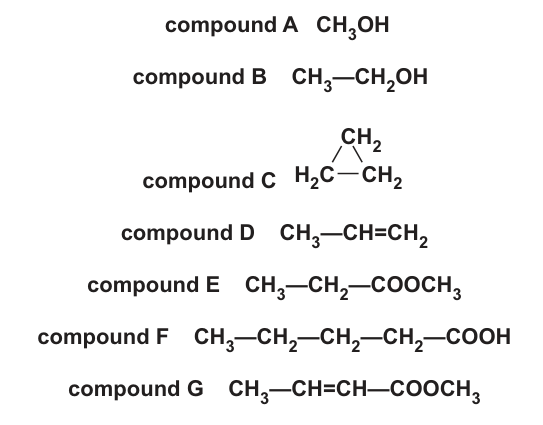
Each compound can be used once, more than once or not at all.
State which compound:
Answer
A
A
Walkthrough
Methanol is the alcohol with one carbon atom, represented by the formula . Looking at the provided options, compound A is .
Key Takeaways
- Alcohols contain the hydroxyl functional group ().
- The prefix 'meth-' indicates a continuous chain of 1 carbon atom.
Common Mistakes
- Confusing methanol (, compound A) with ethanol (, compound B).
Things to Be Careful About
- Ensure you match the single-carbon alcohol correctly to the formula.
Answer
B
B
Walkthrough
The fermentation of aqueous glucose using yeast produces ethanol () and carbon dioxide:
Compound B is ethanol ().
Key Takeaways
- Ethanol is produced industrially by either the fermentation of glucose or the catalytic hydration of ethene.
Common Mistakes
- Selecting methanol (A) instead of ethanol (B).
Things to Be Careful About
- Fermentation specifically yields ethanol, not other alcohols.
Answer
F
F
Walkthrough
Carboxylic acids are characterised by the carboxyl functional group (). Among the given compounds, compound F (, pentanoic acid) contains the group.
Key Takeaways
- Carboxylic acids have the general formula and contain the functional group.
Common Mistakes
- Confusing the ester group () in E or G with the carboxylic acid group () in F.
Things to Be Careful About
- Check the ending of the structural formula carefully: vs. .
Answer
C
C
Walkthrough
A hydrocarbon is a compound that contains hydrogen and carbon only. A saturated hydrocarbon contains only single carbon-carbon bonds (no double bonds).
- Compounds A, B, E, F, and G contain oxygen, so they are not hydrocarbons.
- Compound D () is an alkene containing a double bond, making it unsaturated.
- Compound C (cyclopropane, a 3-membered ring of groups) contains only carbon and hydrogen, and all carbon-carbon bonds are single bonds, so it is a saturated hydrocarbon.
Key Takeaways
- Saturated: contains only single bonds.
- Hydrocarbon: contains carbon and hydrogen only.
Common Mistakes
- Selecting D by confusing saturated with unsaturated.
- Forgetting that cycloalkanes are saturated hydrocarbons even though they have the general formula .
Things to Be Careful About
- Ensure the chosen compound contains NO oxygen atoms.
Answer
E
E
Walkthrough
When methanol () reacts with propanoic acid () in an esterification reaction, the ester formed is methyl propanoate:
Compound E is , which is methyl propanoate.
Key Takeaways
- Esterification: .
- The acid provides the alkanoate part () and the alcohol provides the alkyl group ().
Common Mistakes
- Choosing G (), which contains a double bond and is formed from an unsaturated acid (but-2-enoic acid), not propanoic acid.
Things to Be Careful About
- Count the number of carbon atoms in the acid chain (propanoic acid has 3 carbons: ).
Answer
C and D
C and D
Walkthrough
Determine the molecular formula of each compound by counting the number of each type of atom:
- A:
- B:
- C:
- D:
- E:
- F:
- G:
Compounds C and D both have the molecular formula .
Key Takeaways
- Structural isomers have the same molecular formula but different structural arrangements of atoms.
- Cycloalkanes and alkenes with the same number of carbons share the general formula .
Common Mistakes
- Assuming E and F have the same molecular formula because both contain two oxygen atoms, without counting carbon atoms (E has 4 carbons while F has 5).
Things to Be Careful About
- Ensure you carefully count all hydrogen and carbon atoms in cyclic structures like C.
A sample of sulfur found on the planet Mars contains four isotopes.
Table 2.1 shows the percentage abundances of these four isotopes.
Table 2.1
| isotope | percentage abundance |
|---|---|
| 95.04 | |
| 0.75 | |
| 4.20 | |
| 0.01 |
Answer
They have a different number of neutrons.
They have a different number of neutrons (or different mass / nucleon number)
Walkthrough
Isotopes of the same element have the same number of protons (proton number = 16 in both) and electrons, but they have different numbers of neutrons.
For , the number of neutrons is .
For , the number of neutrons is .
Therefore, a correct difference is that they have a different number of neutrons (or different mass number / nucleon number).
Key Takeaways
- Isotopes are atoms of the same element with the same number of protons but different numbers of neutrons.
- Mass number (nucleon number) = number of protons + number of neutrons.
Common Mistakes
- Stating that they have different numbers of protons or electrons (which would make them different elements or ions).
Things to Be Careful About
- Ensure you clearly identify the difference rather than a similarity.
Answer
They have the same electronic configuration (or same number of valence electrons).
Same electronic configuration
Walkthrough
Chemical reactions involve the loss, gain, or sharing of outer-shell electrons. Since all isotopes of sulfur have the same number of protons (16), neutral atoms of these isotopes all possess 16 electrons arranged with the same electron configuration (2,8,6). Because their electronic structures—and specifically their number of valence electrons—are identical, they undergo the exact same chemical reactions and exhibit identical chemical properties.
Key Takeaways
- Chemical properties of an element are determined by its electronic configuration (especially the number of outer-shell / valence electrons).
- Isotopes share identical chemical properties because they have the same electron configuration.
Common Mistakes
- Explaining physical properties instead of chemical properties (physical properties like mass and density differ because of different masses).
- Stating 'they have the same number of protons' without linking to electrons/electron configuration.
Things to Be Careful About
- Mention the 'electronic configuration' or 'same number of outer/valence electrons' clearly for full credit.
Working
Answer
32.09
Walkthrough
The relative atomic mass () of an element is the weighted average of the isotopic masses according to their percentage abundances.
The formula is:
Substituting the values from Table 2.1:
Calculating each term in the numerator:
Sum of numerator
Dividing by 100 gives:
This confirms the target value of 32.09.
Key Takeaways
- takes into account both the mass numbers of all naturally occurring isotopes and their relative abundances.
- Always divide the sum of by 100.
Common Mistakes
- Forgetting to divide by 100.
- Simple arithmetic errors when multiplying or adding intermediate values.
Things to Be Careful About
- Show the full substitution (numerator and denominator) clearly since this is a 'show that' question.
Sodium hydrogencarbonate decomposes when heated.
Fig. 3.1 shows the reaction pathway diagram for the decomposition of sodium hydrogencarbonate.
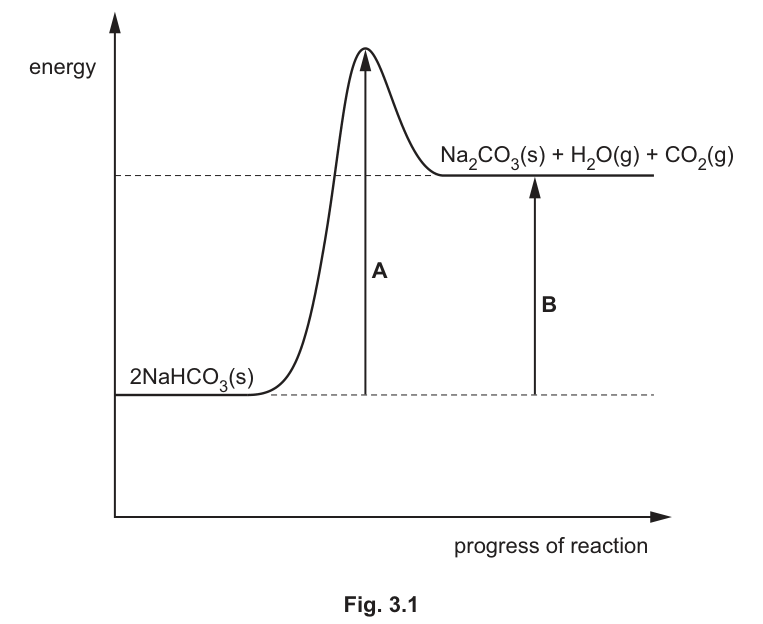
Identify the energy changes labelled A and B.
energy change A = ______
energy change B = ______
Answer
energy change A = activation energy
energy change B = enthalpy change (or )
A = activation energy, B = enthalpy change
Walkthrough
The diagram plots energy on the y-axis against the progress of the reaction. Arrow A points from the reactant energy level up to the peak of the curve. This peak represents the transition state, and the energy difference between the reactants and the peak is the activation energy (). Arrow B points from the reactant energy level up to the product energy level. This difference represents the overall enthalpy change () of the reaction.
Key Takeaways
On a reaction pathway diagram, the height from reactants to the peak is the activation energy, and the height from reactants to products is the enthalpy change.
Common Mistakes
Confusing activation energy with enthalpy change, or writing for arrow A. Activation energy is always measured from the reactants to the peak.
Things to Be Careful About
Both 'activation energy' and '' are accepted for A. Both 'enthalpy change' and '' are accepted for B. Ensure you match the label to the correct arrow.
Use the reaction pathway diagram to explain why the decomposition of sodium hydrogencarbonate is endothermic.
______
Answer
The energy level of the products is higher than the energy level of the reactants.
Product energy level is above reactant energy level
Walkthrough
An endothermic reaction is one where the products have more energy than the reactants, meaning energy has been absorbed from the surroundings. On the diagram, the horizontal line for the products () is positioned higher on the energy axis than the horizontal line for the reactants ().
Key Takeaways
If the product line is above the reactant line on an energy profile, the reaction is endothermic. If it is below, the reaction is exothermic.
Common Mistakes
Saying 'energy is absorbed' without referencing the diagram. The question specifically asks to 'use the reaction pathway diagram', so you must describe the relative positions of the energy levels.
Things to Be Careful About
Keep the explanation concise. One clear statement comparing the product and reactant energy levels is all that is required for the mark.
Describe a chemical test for carbon dioxide.
test = ______
observation if carbon dioxide present = ______
Answer
test = bubble gas through limewater
observation if carbon dioxide present = limewater turns milky (or cloudy)
Bubble through limewater; limewater turns milky
Walkthrough
Carbon dioxide is identified by passing it through limewater, which is an aqueous solution of calcium hydroxide. If is present, it reacts with the calcium hydroxide to form a white precipitate of calcium carbonate, making the solution look milky or cloudy.
Key Takeaways
The standard test for carbon dioxide is bubbling it through limewater, and the positive result is the solution turning milky.
Common Mistakes
Saying 'limewater turns white' instead of 'milky' or 'cloudy'. Saying 'bubbles form' is not a valid observation for this test. Do not confuse this with the test for oxygen (glowing splint relights) or hydrogen (squeaky pop).
Things to Be Careful About
The question asks for both the test and the observation. Both must be stated to earn the mark. 'Limewater' is the key reagent; 'aqueous calcium hydroxide' is also acceptable.
A sample of sodium hydrogencarbonate is completely decomposed.
A total volume of of carbon dioxide, measured at r.t.p., is produced.
Calculate the mass of the sample of sodium hydrogencarbonate.
Give your answer to two significant figures.
mass of sodium hydrogencarbonate = ______
Working
From the equation, 2 moles of produce 1 mole of .
Answer
mass of sodium hydrogencarbonate = 1.6 g
1.6
Walkthrough
First, convert the volume of carbon dioxide to moles using the molar gas volume at room temperature and pressure (r.t.p.), which is .
Next, use the stoichiometric ratio from the balanced chemical equation to find the moles of sodium hydrogencarbonate. The equation shows that 2 moles of decompose to produce 1 mole of , so the mole ratio is 2:1.
Then, calculate the relative formula mass () of using atomic masses: , , , .
Finally, calculate the mass of the sample.
The question asks for the answer to two significant figures, so we round to .
Key Takeaways
Always convert gas volumes to moles using the appropriate molar volume ( at r.t.p. or at s.t.p.). Use the coefficients in the balanced equation to find the mole ratio between substances.
Common Mistakes
Using the wrong molar volume (e.g., instead of for r.t.p.). Forgetting to multiply the moles of by 2 to get the moles of . Not rounding the final answer to the correct number of significant figures.
Things to Be Careful About
The volume is given in , so the molar volume must be , not (unless you convert the volume to first). Ensure your final answer is given to exactly two significant figures as requested.
Fluorine, chlorine, bromine and iodine are elements in Group VII.
Bromine has a low boiling point. It is a liquid at room temperature.
Answer
Any two from:
- The molecules are randomly arranged / irregularly arranged.
- The molecules are close together / touching each other.
- The molecules slide / move / flow over one another.
Randomly arranged, close together, moving/sliding over one another
Walkthrough
In the liquid state:
- Arrangement: Particles (or molecules in molecular substances such as bromine, ) are close together with most touching, but they are arranged randomly without a regular, fixed repeating pattern.
- Motion: Particles have sufficient kinetic energy to overcome fixed positions, so they slide, flow, or move past each other continuously.
Giving both the random/touching arrangement and the sliding/flowing motion secures the 2 marks.
Key Takeaways
- In a liquid, particles are closely packed and touching (unlike a gas) but irregularly/randomly arranged (unlike a regular lattice in a solid).
- Liquid particles are free to slide and move over each other, allowing liquids to flow and take the shape of their container.
Common Mistakes
- Describing particles in a liquid as "far apart" (which is only true for gases).
- Describing movement merely as "vibrating about fixed positions" (which describes solids).
Things to Be Careful About
- Ensure you describe both arrangement (random / touching) and motion (sliding / moving over each other) clearly.
Explain why bromine has a low boiling point.
Use ideas about structure and bonding.
______
Answer
Bromine has weak intermolecular forces (which require little thermal energy to overcome).
Weak intermolecular forces
Walkthrough
Bromine exists as simple covalent molecules (). When liquid bromine boils, the strong covalent bonds within the bromine molecules are not broken. Instead, it is only the weak intermolecular forces (forces between separate molecules) that are overcome. Because these intermolecular attractions are weak, very little heat/thermal energy is required to separate the molecules, resulting in a low boiling point.
Key Takeaways
- Simple molecular substances have low melting and boiling points because the intermolecular forces between molecules are weak.
- Covalent bonds within the molecules are strong and remain intact during boiling.
Common Mistakes
- Stating that "covalent bonds are weak and break easily" — covalent bonds are very strong; boiling does not break them.
- Omitting the key term "intermolecular".
Things to Be Careful About
- Always specify "weak forces between molecules" or "weak intermolecular forces" rather than simply "weak bonds".
Fluorine reacts with potassium to make the ionic compound potassium fluoride.
Answer
- High melting point / high boiling point
- Conducts electricity when molten or in aqueous solution (or soluble in water)
- High melting point (or high boiling point)
- Conducts electricity when molten or in aqueous solution
Walkthrough
Potassium fluoride () is an ionic compound composed of a giant ionic lattice of alternating and ions held together by strong electrostatic attractions.
Characteristic physical properties of ionic compounds include:
- High melting and boiling points (due to strong electrostatic attractions between oppositely charged ions throughout the giant lattice).
- Electrical conductivity when molten or aqueous (ions become free to move and carry charge; does not conduct when solid because ions are in fixed positions).
- Solubility in water (most simple ionic compounds dissolve in water).
Giving any two standard properties scores full marks.
Key Takeaways
- Giant ionic structures exhibit high melting/boiling points, conduct electricity only when liquid/molten or dissolved in water, and are usually solid at room temperature.
Common Mistakes
- Writing "conducts electricity" without specifying when molten or in aqueous solution (ionic solids do not conduct electricity).
Things to Be Careful About
- Always qualify electrical conductivity for ionic compounds: specify "molten" or "in aqueous solution".
Construct the ionic half-equation to show the formation of potassium ions from potassium atoms.
______
Answer
K -> K+ + e-
Walkthrough
Potassium is a Group I metal with 1 valence electron. To achieve a stable electron configuration, a potassium atom loses 1 electron to form a potassium cation with a charge:
Key Takeaways
- Metals lose valence electrons during oxidation to form positive cations.
- The lost electron(s) are written on the product side (right-hand side) of the half-equation.
Common Mistakes
- Writing (Cambridge conventions require electrons to be added on the appropriate side using , not subtracted).
- Incorrect charge on the potassium ion (e.g., ).
Things to Be Careful About
- Ensure the number of atoms and total charges balance on both sides (LHS: charge 0; RHS: ).
Construct the ionic half-equation to show the formation of fluoride ions from fluorine molecules.
______
Answer
F2 + 2e- -> 2F-
Walkthrough
Fluorine gas exists as diatomic molecules, . Each fluorine atom needs to gain 1 electron to complete its outer shell and form a fluoride ion (). Therefore, one molecule gains 2 electrons to form 2 fluoride ions:
Key Takeaways
- Non-metals gain electrons (reduction) to form negative anions.
- Halogens exist as diatomic molecules (), so 2 electrons are needed per halogen molecule to yield 2 halide ions ().
Common Mistakes
- Writing when the question specifically asked for the formation from fluorine molecules ().
- Writing instead of .
Things to Be Careful About
- Check charge and atom balance: LHS charge is ; RHS charge is .
Chlorine gas is bubbled into aqueous potassium iodide. A reaction takes place.
Chlorine is an oxidising agent.
Answer
Potassium chloride and iodine
Potassium chloride and iodine
Walkthrough
Chlorine is higher in Group VII than iodine, meaning chlorine is more reactive than iodine. A more reactive halogen displaces a less reactive halide from its aqueous solution.
The word equation is:
The chemical equation is:
Therefore, the two products formed are potassium chloride and iodine.
Key Takeaways
- Halogen reactivity decreases down Group VII.
- A more reactive halogen displaces a less reactive halide ion from solution, liberating the less reactive halogen element and forming a new halide salt.
Common Mistakes
- Writing "potassium chlorate" or confusing the names "iodine" and "iodide".
Things to Be Careful About
- The question asks for the names of the products, not their formulae.
Answer
The colourless solution turns brown (or red-brown / yellow / orange-brown).
The colourless solution turns brown
Walkthrough
Aqueous potassium iodide () is a colourless solution. When chlorine gas is bubbled into it, chlorine oxidises iodide ions () to form aqueous iodine (). Aqueous iodine in the presence of iodide forms a brown/red-brown (or yellow/orange-brown) solution.
Therefore, the visible observation is that the colourless solution turns brown.
Key Takeaways
- Aqueous iodide ions () are colourless.
- Aqueous iodine () appears yellow, orange, or brown depending on its concentration.
Common Mistakes
- Stating that a "purple gas" is seen (iodine vapour is purple, but in aqueous solution at room temperature, it dissolves to form a brown solution).
- Giving a conclusion rather than an observation (e.g., writing "iodine is formed" instead of describing what is seen).
Things to Be Careful About
- An observation requires what you actually see (a colour change), not the chemical name of the product.
Nickel is a transition element.
Nickel has good electrical conductivity and good thermal conductivity.
Nickel is also ductile and malleable.
State two other physical properties of nickel that are typical of a transition element.
- ______
- ______
Answer
Any two from:
- high melting point / high boiling point
- high density
- hard / strong
high melting point, high density
Walkthrough
Transition elements have characteristic physical properties that distinguish them from s-block metals (like Group I alkali metals), including high melting/boiling points, high densities, and high tensile strength/hardness. The question states that nickel conducts heat and electricity and is malleable and ductile, asking for two other physical properties typical of transition elements.
Key Takeaways
- General physical properties of transition metals: high melting and boiling points, high density, good conductors of electricity and heat, hard and strong.
- Chemical properties include: variable oxidation states, forming coloured compounds, and acting as catalysts.
Common Mistakes
- Listing chemical properties (e.g. "forms coloured compounds", "acts as a catalyst") instead of physical properties.
- Repeating properties already mentioned in the question stem (electrical/thermal conductivity, ductility, malleability).
Things to Be Careful About
- Ensure the stated properties are strictly physical.
The physical properties of nickel can be explained using ideas about structure and bonding.
Answer
It contains delocalised electrons / mobile electrons that are free to move.
Delocalised electrons that are free to move
Walkthrough
Metals consist of a giant lattice of positive ions surrounded by a 'sea' of delocalised valence electrons. When a potential difference is applied, these delocalised electrons are free to move throughout the metallic lattice, conducting electric charge.
Key Takeaways
- Electrical conductivity in metals is due to mobile (delocalised) electrons.
- In ionic compounds when molten or aqueous, conductivity is due to mobile ions, NOT electrons.
Common Mistakes
- Saying "ions can move" (ions are fixed in the lattice; only electrons move in solid metals).
- Simply saying "it contains electrons" without mentioning that they are delocalised or free to move.
Things to Be Careful About
- Always mention that the electrons can move / are mobile.
Answer
Layers of metal ions can slide over each other (without breaking the metallic bond).
Layers of metal ions can slide over each other
Walkthrough
In pure metals, atoms/ions are arranged in regular layers. When a tensile force is applied (pulling into a wire, i.e., ductility), these layers of positive ions can slide past one another without disrupting the non-directional metallic bonding holding the structure together.
Key Takeaways
- Ductility (drawn into wires) and malleability (hammered into sheets) occur because layers of positive metal ions can slide over one another.
- The metallic bond is non-directional, so it remains intact as layers slide.
Common Mistakes
- Referring to "layers of molecules" or "layers of atoms sliding" (the mark scheme specifically expects "layers of ions" or "layers of metal atoms/ions").
- Forgetting to mention the sliding of layers.
Things to Be Careful About
- Clearly state that it is the layers of ions that slide.
Compound X contains nickel, carbon and oxygen only.
X contains 28.1% by mass carbon and 37.4% by mass oxygen.
Calculate the empirical formula of compound X.
empirical formula = ______
Working
Calculate percentage of nickel:
Calculate moles of each element using , , :
Divide by the smallest number of moles ():
Answer
NiC4O4
Walkthrough
- Find % of Nickel: The compound contains only , , and . Subtract the percentages of and from to obtain the percentage of ().
- Find Moles: Divide the mass percentage of each element by its relative atomic mass ():
- Simplest Whole-Number Ratio: Divide all mole values by the smallest value ():
- Write the Empirical Formula: (or ).
Key Takeaways
- Empirical formula gives the simplest whole-number ratio of atoms in a compound.
- Steps: Percentages divide by to find moles divide by smallest to find simplest ratio.
Common Mistakes
- Dividing by atomic numbers instead of relative atomic masses ().
- Using molecular masses (e.g. dividing by instead of ).
- Forgetting to calculate the percentage of nickel first.
Things to Be Careful About
- Ensure correct rounding and check that the final ratio consists of integers.
Nickel reacts slowly with dilute hydrochloric acid to form aqueous nickel(II) ions and hydrogen.
Construct the ionic equation for this reaction.
Include state symbols in your answer.
______
Answer
Ni(s) + 2H+(aq) -> Ni2+(aq) + H2(g)
Walkthrough
- Identify the Full Equation: Nickel reacts with hydrochloric acid:
- Separate Aqueous Species into Ions:
- Cancel Spectator Ions: Chloride ions () are spectators:
- Check Charges and State Symbols: Charge on LHS is , charge on RHS is . States are , , , and .
Key Takeaways
- Full acid + metal reactions give a salt + hydrogen.
- The ionic equation for a metal reacting with dilute acid involves the oxidation of the metal to metal ions and reduction of ions to gas.
Common Mistakes
- Writing a full molecular equation containing ions instead of the net ionic equation.
- Omitting state symbols or writing incorrect ones (e.g. ).
- Forgetting to balance the hydrogen ions ().
Things to Be Careful About
- Ensure the charge balance is satisfied in addition to atom balance.
Predict if nickel reacts with aqueous copper(II) ions.
Explain your answer.
prediction = ______
explanation = ______
Answer
prediction: yes
explanation: nickel is more reactive than copper (so nickel displaces copper)
prediction = yes; explanation = nickel is more reactive than copper
Walkthrough
In part (d)(i), we learned that nickel reacts with dilute acid to produce hydrogen gas, which shows that nickel is above hydrogen in the reactivity series. Copper is below hydrogen in the reactivity series and does not react with dilute acids. Therefore, nickel is more reactive than copper and will displace ions from aqueous solution:
Key Takeaways
- A more reactive metal displaces a less reactive metal from a solution of its ions/salt.
- Since nickel reacts with dilute acid (releasing ), it is more reactive than hydrogen and copper.
Common Mistakes
- Stating that copper is more reactive than nickel.
- Predicting 'no' based on nickel reacting 'slowly' with acid without comparing it to copper.
Things to Be Careful About
- Both prediction ('yes') and explanation ('nickel is more reactive than copper') are required to secure the mark.
This question is about an unsaturated hydrocarbon called ethyne.
Fig. 6.1 shows the displayed formula of ethyne.
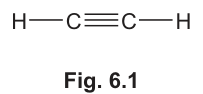
Draw a dot-and-cross diagram to show the electronic arrangement in a molecule of ethyne.
Include only the outer shell electrons of each atom.
Answer
Dot-and-cross diagram: C triple-bonded to C (three shared pairs, 6 electrons), each C single-bonded to H (one shared pair, 2 electrons). No lone pairs.
Walkthrough
Ethyne has the molecular formula . Carbon is in Group IV and has 4 outer-shell electrons. Hydrogen is in Group I and has 1 outer-shell electron. To achieve a full outer shell, each carbon atom shares three pairs of electrons with the other carbon atom, forming a triple bond. Each carbon also shares one pair of electrons with a hydrogen atom, forming a single bond. This gives each carbon 8 electrons in its outer shell and each hydrogen 2 electrons.
Key Takeaways
- Dot-and-cross diagrams show only outer-shell electrons.
- A triple bond consists of three shared pairs (6 electrons).
- Carbon forms four bonds and hydrogen forms one bond in stable molecules.
Common Mistakes
- Including inner-shell electrons (carbon has 2 inner-shell electrons, but these are not shown in dot-and-cross diagrams for bonding).
- Forgetting to show all three pairs in the C≡C triple bond.
- Adding lone pairs to carbon or hydrogen atoms (there are none in ethyne).
Things to Be Careful About
- Use different symbols (e.g., dots and crosses) for electrons from different atoms to show where they come from.
- Ensure the diagram clearly shows 8 electrons around each carbon and 2 around each hydrogen.
A sample of ethyne gas has a mass of .
Calculate the number of molecules of ethyne in this sample.
One mole of ethyne contains molecules.
number of molecules = ______
Working
Relative molecular mass () of ethyne ():
Moles of ethyne:
Number of molecules:
Answer
3.01e21
Walkthrough
First, calculate the relative molecular mass () of ethyne (). Carbon has and hydrogen has , so . Next, use the formula to find the number of moles: mol. Finally, multiply the number of moles by Avogadro's constant () to find the number of molecules: .
Key Takeaways
- is the sum of the relative atomic masses of all atoms in a molecule.
- The mole connects mass to number of particles via Avogadro's constant.
Common Mistakes
- Using the wrong (e.g., forgetting to multiply by 2 for carbon or hydrogen).
- Forgetting to multiply moles by Avogadro's constant.
- Incorrect handling of scientific notation.
Things to Be Careful About
- Ensure the final answer is in the correct form (scientific notation with appropriate significant figures).
Calculate the total number of atoms in this sample of ethyne.
number of atoms = ______
Working
Each molecule of ethyne () contains 4 atoms (2 carbon + 2 hydrogen).
Total number of atoms:
Answer
1.204e22
Walkthrough
Ethyne has the formula , meaning each molecule contains 2 carbon atoms and 2 hydrogen atoms, for a total of 4 atoms per molecule. Multiply the number of molecules calculated in part (i) by 4 to get the total number of atoms: .
Key Takeaways
- Total atoms = (number of molecules) × (atoms per molecule).
Common Mistakes
- Forgetting to count all atoms in the molecule (e.g., only counting carbon atoms).
- Carrying forward an error from part (i) without correction.
Things to Be Careful About
- Use the unrounded value from part (i) if possible, though is exact here.
Answer
It contains only carbon and hydrogen.
contains only carbon and hydrogen
Walkthrough
A hydrocarbon is an organic compound consisting entirely of hydrogen and carbon. Since ethyne () is made up of only these two elements, it is a hydrocarbon.
Key Takeaways
- Hydrocarbons contain only carbon and hydrogen.
Common Mistakes
- Stating it contains carbon, hydrogen, and oxygen (incorrect for hydrocarbons).
- Giving a more detailed structural explanation when a simple compositional definition is required.
Things to Be Careful About
- Keep the answer concise and directly address the definition.
Answer
The orange (or brown) bromine water turns colourless.
orange to colourless
Walkthrough
Ethyne is an unsaturated hydrocarbon (it contains a carbon-carbon triple bond). When an unsaturated hydrocarbon is bubbled through aqueous bromine (bromine water), an addition reaction occurs across the multiple bond. Bromine is consumed in the reaction, causing the characteristic orange/brown colour of the bromine water to disappear, leaving a colourless solution.
Key Takeaways
- Unsaturated hydrocarbons decolourise bromine water.
- This is a test for carbon-carbon multiple bonds (double or triple).
Common Mistakes
- Saying the solution turns blue (confusing with iodine or starch tests).
- Not specifying the initial colour of bromine water (orange or brown).
- Saying the gas is colourless instead of the solution.
Things to Be Careful About
- State both the initial colour and the final colour for full marks.
- Use the term 'decolourises' or 'turns colourless'.
Ethyne is formed when calcium carbide reacts with water.
Calcium carbide contains the ions and only.
Deduce the formula of calcium carbide.
______
Answer
CaC2
Walkthrough
Calcium carbide is an ionic compound formed from calcium ions () and ethynide ions (). To form a neutral compound, the total positive charge must equal the total negative charge. One ion (charge +2) balances one ion (charge -2). Therefore, the formula is .
Key Takeaways
- Ionic formulas are determined by balancing the total positive and negative charges.
- Polyatomic ions like are treated as a single unit with their overall charge.
Common Mistakes
- Writing or (incorrect charge balancing).
- Forgetting to keep the polyatomic ion together.
Things to Be Careful About
- The subscripts should be in their simplest ratio (1:1 here, not 2:2).
- Write the cation first, then the anion.
Ethene is used to make ethanol and poly(ethene).
Fig. 7.1 shows the displayed formula of ethene.
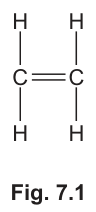
Alkenes such as ethene are manufactured from hydrocarbons such as .
Answer
cracking
cracking
Walkthrough
Cracking is the thermal decomposition process used in the petrochemical industry to break down large, less useful long-chain hydrocarbon molecules (such as ) into smaller, more useful short-chain alkanes and alkenes like ethene ().
Key Takeaways
- Cracking breaks covalent bonds in larger hydrocarbon molecules to produce smaller molecules, including alkenes containing double bonds.
Common Mistakes
- Confusing cracking with 'fractional distillation' (which separates hydrocarbons based on boiling points without breaking chemical bonds).
Things to Be Careful About
- Ensure the term 'cracking' (or 'catalytic / thermal cracking') is spelled correctly.
Answer
- High temperature / heat
- Catalyst (e.g. aluminium oxide / zeolite)
High temperature and a catalyst
Walkthrough
Catalytic cracking requires strong heating (high temperatures, typically to ) to provide the energy needed to break strong covalent bonds, along with a solid catalyst (such as , , or zeolite) to speed up the process and allow it to occur at lower operating temperatures.
Key Takeaways
- Industrial catalytic cracking conditions: high temperature / heat and a catalyst (or steam/thermal cracking at very high temperature).
Common Mistakes
- Writing 'high pressure' — cracking does not require high pressure (it is typically carried out at atmospheric or slight positive pressure).
Things to Be Careful About
- Make sure to give both distinct conditions required for the two marks: temperature (heat) and catalyst.
Ethene reacts with steam to make ethanol.
This is a reversible reaction.
Describe and explain the effect of increasing the temperature on the rate of the forward reaction.
______
Answer
- The rate increases.
- Particles have more kinetic energy (move faster), so a greater proportion of collisions have energy greater than or equal to the activation energy (more frequent successful collisions).
Rate increases because particles have more kinetic energy and there are more successful / effective collisions per unit time.
Walkthrough
When temperature is increased:
- The gas particles gain kinetic energy and move faster.
- A much higher fraction of colliding particles possess energy equal to or exceeding the activation energy ().
- Consequently, the frequency of successful (effective) collisions increases, causing the rate of the forward reaction to increase.
Key Takeaways
- Higher temperature increases particle speed / kinetic energy.
- The crucial factor for the rate increase is that more collisions possess energy (effective collisions).
Common Mistakes
- Stating only that 'collisions increase' without mentioning kinetic energy or that collisions are 'successful' / have energy .
- Confusing the effect on reaction rate with the shift in equilibrium position.
Things to Be Careful About
- Ensure both the effect (rate increases) and the collision theory reasoning are clearly stated.
Describe and explain the effect of increasing the pressure on the position of equilibrium while keeping the temperature constant.
______
Answer
- The position of equilibrium shifts to the right (towards the forward reaction / product).
- There are fewer moles of gas on the product side (1 mole of ) than on the reactant side ( moles of gas).
Moves to the right because there are fewer moles of gas on the product side.
Walkthrough
- Look at the equation:
- Count the moles of gas on each side:
- Reactants:
- Products:
- According to Le Chatelier's principle, increasing the pressure favours the side with fewer moles of gas in order to reduce the pressure. Therefore, the equilibrium shifts to the right (favouring the formation of ethanol).
Key Takeaways
- Increasing pressure shifts equilibrium towards the side with fewer moles of gas (smaller gas volume).
Common Mistakes
- Forgetting that is a gas in this industrial hydration reaction and not counting it as a gaseous mole.
Things to Be Careful About
- State both the direction of shift ('shifts to the right' or 'forward direction') and the comparison of moles/volumes of gas.
Ethene is used to make the polymer poly(ethene).
This polymer is used to make plastics.
Answer
Structure of poly(ethene) with two repeat units (4 carbon chain with single bonds, 8 hydrogens, and continuation bonds at each end)
Walkthrough
During the addition polymerisation of ethene, the double bond () in each monomer breaks open to form single bonds () linking the units into a long carbon chain.
- One repeat unit consists of .
- Two repeat units require a continuous chain of 4 carbon atoms joined by single bonds ().
- Each carbon atom is bonded to 2 hydrogen atoms.
- Continuation bonds (extension single bonds) must extend outwards through each end of the chain to show that the polymer continues.
Key Takeaways
- Addition polymerisation converts double bonds into single bonds in the polymer backbone.
- Two repeat units of ethene contain 4 carbon atoms in the main chain.
Common Mistakes
- Leaving double bonds between the carbons in the polymer.
- Omitting continuation/extension bonds at the ends of the chain.
- Drawing brackets with instead of showing the required two repeat units explicitly.
Things to Be Careful About
- Ensure every carbon atom forms exactly 4 single bonds.
State two environmental challenges caused by the disposal of poly(ethene).
- ______
- ______
Answer
- Landfill sites fill up / non-biodegradable waste accumulates in landfills.
- Accumulation of plastics in oceans / waterways (harms marine wildlife).
(ALLOW: Releases toxic / harmful gases when burned / incinerated)
- Landfill sites fill up. 2. Accumulation of plastics in oceans (or release of toxic gases on combustion).
Walkthrough
Poly(ethene) is a non-biodegradable polymer because its strong and single bonds make it chemically unreactive and resistant to breakdown by microorganisms.
This leads to major environmental challenges:
- Landfill issues: Takes up large amounts of landfill space without decomposing.
- Marine pollution: Accumulates in oceans and waterways, choking or entangling marine organisms.
- Incineration issues: Burning plastics can produce toxic fumes (e.g. carbon monoxide, acidic gases, particulates).
Key Takeaways
- Plastics are non-biodegradable, leading to persistent environmental accumulation in landfills and oceans, and produce toxic emissions upon incineration.
Common Mistakes
- Vague answers like 'causes pollution' without specifying how (e.g. landfills, oceans, toxic gases).
- Stating that plastics deplete the ozone layer.
Things to Be Careful About
- Give two clearly distinct environmental issues as prompted by 1 and 2.
Ethene reacts with hydrogen in the presence of a nickel catalyst.
Answer
Two reactants combine to form only one product.
Only one product is formed
Walkthrough
An addition reaction is defined chemically as a reaction in which two (or more) molecules combine across a double (or multiple) bond to form a single product with no other by-products.
Key Takeaways
- In addition reactions: .
Common Mistakes
- Confusing addition with substitution (where an atom is replaced and two products are formed) or condensation (where a small molecule like water is eliminated).
Things to Be Careful About
- State clearly that only one product is formed.
Answer
Displayed formula of ethane (C2H6)
Walkthrough
When ethene reacts with hydrogen () in the presence of a nickel catalyst (hydrogenation), the double bond is converted to a single bond, and one hydrogen atom adds to each carbon atom.
The product is ethane, .
A displayed formula must show all atoms and all covalent bonds explicitly:
- Two carbon atoms linked by a single line ().
- Each carbon atom bonded to 3 hydrogen atoms via single lines.
Key Takeaways
- Hydrogenation of an alkene produces the corresponding alkane.
- A displayed formula shows all atoms and all bonds.
Common Mistakes
- Writing a structural formula (e.g. ) instead of a displayed formula with explicit bond lines.
- Leaving a double bond between the carbons.
Things to Be Careful About
- Ensure every and bond is drawn as a line.
Petroleum is a mixture of hydrocarbons most of which are alkanes.
Table 8.1 shows some of the unbranched alkanes present in petroleum and the number of carbon atoms in one molecule of the alkane.
Table 8.1
| name | number of carbon atoms in one molecule of the alkane |
|---|---|
| decane | 10 |
| ethane | 2 |
| methane | 1 |
| pentane | 5 |
| tetradecane | 14 |
Answer
C14H30
Walkthrough
Alkanes belong to a homologous series with the general molecular formula:
From Table 8.1, tetradecane contains carbon atoms ().
Substituting into the formula:
Therefore, the molecular formula of tetradecane is .
Key Takeaways
- All unbranched alkanes follow the general formula .
Common Mistakes
- Forgetting to add to , resulting in an alkene formula like .
- Using non-subscript digits or incorrect case (e.g.
c14h30).
Things to Be Careful About
- Ensure element symbols are capitalised correctly and numbers are properly subscripted.
Answer
tetradecane
tetradecane
Walkthrough
Viscosity refers to how thick or resistant to flow a liquid is. As the number of carbon atoms in an alkane chain increases, the molecules become larger and the intermolecular forces of attraction between them become stronger, making the liquid more viscous (less runny).
Among the alkanes listed in Table 8.1, tetradecane has the largest number of carbon atoms (), so it has the strongest intermolecular forces and thus the highest viscosity.
Key Takeaways
- As chain length / molecular size increases in alkanes:
- Boiling point increases
- Viscosity increases (becomes less runny / more thick)
- Flammability decreases
- Volatility decreases
Common Mistakes
- Confusing viscosity with volatility or ease of flow (e.g. naming methane instead).
Things to Be Careful About
- The question specifically asks for the name of the alkane, not its formula.
Petroleum is separated into useful fractions by fractional distillation.
Answer
- Petroleum is heated / vapourised / boiled.
- The vapours enter a fractionating column (which is hotter at the bottom and cooler at the top).
- The fractions separate because they have different boiling points (they condense at different levels / temperatures).
Petroleum is heated and vapourised, entering a fractionating column where fractions separate due to differences in boiling points
Walkthrough
Fractional distillation separates a mixture of miscible liquids with different boiling points:
- Heating/Vapourisation: Petroleum (crude oil) is strongly heated until it turns into vapour (boiled/vapourised).
- Fractionating Column: The mixture of vapours enters the bottom of a fractionating column, which has a temperature gradient (hot at the bottom, cool at the top).
- Condensation & Separation: As the vapours rise, each fraction cools and condenses when the temperature drops to its boiling point. Fractions with higher boiling points condense near the bottom, while fractions with lower boiling points rise further up and condense near the top. Thus, separation occurs because the different hydrocarbons have different boiling points.
Key Takeaways
- The key operating principle of fractional distillation is separation based on different boiling points.
- Petroleum must first be heated/vapourised before entering the fractionating column.
Common Mistakes
- Failing to state why they separate (differences in boiling points).
- Omitting the initial heating or vapourisation step.
Things to Be Careful About
- Ensure you clearly mention heating/boiling and the difference in boiling points to secure all marking points.
Methane and ethane are both in the refinery gas fraction.
State one use for the refinery gas fraction.
______
Answer
heating / cooking
heating
Walkthrough
Refinery gas (or petroleum gas) consists of short-chain alkanes such as methane, ethane, propane, and butane. These small hydrocarbons are gases at room temperature and burn easily with a clean flame, making them ideal as bottled gas for heating and cooking (e.g. liquefied petroleum gas / LPG, domestic gas).
Key Takeaways
- Refinery gas fraction is used for: heating, cooking, or fuel for domestic use.
Common Mistakes
- Giving uses suited for other fractions, such as car fuel (petrol/gasoline) or jet fuel (kerosene).
Things to Be Careful About
- State a single clear use as requested by the command word 'State one use'.
Answer
chemical feedstock
chemical feedstock
Walkthrough
The naphtha fraction contains hydrocarbons with about to carbon atoms. Its primary use in the petroleum and petrochemical industry is as a chemical feedstock (raw material for making other chemicals, plastics, and synthetic compounds) via catalytic cracking.
Key Takeaways
- Naphtha is mainly used as a chemical feedstock for producing other useful chemicals and polymers.
Common Mistakes
- Confusing naphtha with kerosene/paraffin (used for jet aircraft fuel/heating) or diesel (used for fuel in diesel engines).
Things to Be Careful About
- The term 'feedstock' or 'chemical feedstock' is the standard O Level syllabus term for naphtha's use.
Anhydrous copper(II) sulfate is a white solid.
Answer
A substance containing no water (or no water of crystallisation).
Substance which contains no water
Walkthrough
The term 'anhydrous' comes from Greek roots meaning 'without water'. In chemistry, an anhydrous salt is a substance that contains no water of crystallisation in its crystal structure.
Key Takeaways
- Anhydrous: containing no water / without water of crystallisation.
- Hydrated: containing water of crystallisation chemically combined in its crystal lattice.
Common Mistakes
- Confusing 'anhydrous' with 'dry' in an everyday sense (e.g. just surface moisture).
- Stating that it does not dissolve in water.
Things to Be Careful About
- Ensure the definition clearly refers to containing no water rather than merely not being in liquid form.
Anhydrous copper(II) sulfate is added to water.
State the colour of the solution formed.
______
Answer
Blue
Blue
Walkthrough
When anhydrous copper(II) sulfate () dissolves in water, hydrated copper(II) ions () form, which impart a characteristic blue colour to the solution.
Key Takeaways
- Aqueous copper(II) compounds are typically blue.
- Anhydrous copper(II) sulfate changes from white to blue upon the addition of water (a common chemical test for water).
Common Mistakes
- Stating 'white' (the colour of the solid anhydrous salt) instead of the colour of the solution.
Things to Be Careful About
- Ensure the state is noted: the question asks for the colour of the solution, which is blue.
Aqueous ammonia is added dropwise until in excess to a small volume of aqueous copper(II) sulfate.
Describe the observations during this addition.
______
Answer
- A light blue precipitate forms.
- The precipitate dissolves in excess aqueous ammonia to form a dark blue solution.
Light blue precipitate, soluble in excess to form a dark blue solution
Walkthrough
- On initial addition of aqueous ammonia, hydroxide ions produced by ammonia precipitate copper(II) hydroxide:
This appears as a pale/light blue precipitate.
2. When excess aqueous ammonia is added, the copper(II) hydroxide precipitate dissolves due to the formation of a soluble tetraamminecopper(II) complex ion, producing a characteristic deep/dark blue solution.
Key Takeaways
- with aqueous : light blue precipitate, soluble in excess giving a dark blue solution.
- with aqueous : light blue precipitate, insoluble in excess.
Common Mistakes
- Omitting the word 'precipitate' for the first observation.
- Forgetting to state what happens in excess (that the precipitate dissolves / gives a dark blue solution).
Things to Be Careful About
- Clearly distinguish between the 'light blue precipitate' and the 'dark blue solution'.
Describe the observations when aqueous barium nitrate is added to aqueous copper(II) sulfate.
______
Answer
White precipitate
White precipitate
Walkthrough
Aqueous copper(II) sulfate contains sulfate ions (). When barium nitrate is added, barium ions () react with sulfate ions to form insoluble barium sulfate ():
This insoluble solid appears as a white precipitate.
Key Takeaways
- The reaction between and forms insoluble , which is a white precipitate.
Common Mistakes
- Writing 'white solution' or 'turns cloudy' without stating 'precipitate'.
Things to Be Careful About
- Always specify 'precipitate' (or 'solid') rather than just a colour change.
Aqueous copper(II) sulfate is electrolysed separately with carbon electrodes and with copper electrodes.
Complete Table 9.1.
Table 9.1
| carbon electrodes | copper electrodes | |
|---|---|---|
| observations at anode | ||
| observations at cathode |
Answer
| carbon electrodes | copper electrodes | |
|---|---|---|
| observations at anode | fizzing / bubbling | anode decreases in size / mass / gets smaller |
| observations at cathode | pink / brown solid forms | cathode increases in size / mass / pink solid forms |
Table completed: Carbon anode = fizzing / bubbles; Carbon cathode = pink solid; Copper anode = gets smaller / decreases in mass; Copper cathode = gets bigger / pink solid forms
Walkthrough
-
With inert carbon (graphite) electrodes:
- At the anode (+): Hydroxide ions () from water are discharged in preference to sulfate ions, forming oxygen gas: Observation: Bubbling / fizzing / effervescence / gas given off.
- At the cathode (-): Copper(II) ions () are discharged in preference to ions, forming copper metal: Observation: Pink / reddish-brown solid deposits / forms.
-
With active copper electrodes:
- At the anode (+): The copper anode oxidises and dissolves into the solution: Observation: The anode decreases in mass / dissolves / gets smaller.
- At the cathode (-): Copper(II) ions from solution are reduced and deposited onto the cathode: Observation: The cathode increases in mass / gets bigger / pink solid deposits.
Key Takeaways
- Inert electrodes (carbon/platinum) do not react; anions/water molecules are discharged at the anode.
- Non-inert/reactive electrodes (e.g. copper in copper(II) solution) participate in the reaction: anode dissolves, cathode gains mass.
Common Mistakes
- Stating that oxygen gas forms at the copper anode (the copper anode itself dissolves instead).
- Giving names of products (e.g., 'copper', 'oxygen') rather than visible observations (e.g., 'pink solid', 'bubbles').
Things to Be Careful About
- The question specifically asks for observations, so write what is seen (e.g. 'pink solid', 'fizzing', 'gets smaller') rather than just naming the substances.
Explain why aqueous copper(II) sulfate conducts electricity but solid copper(II) sulfate does not conduct electricity.
______
Answer
In aqueous solution, ions are mobile / free to move, but in the solid state, ions are held in fixed positions in the lattice and cannot move.
Ions are free to move in aqueous solution but are held in fixed positions in the solid
Walkthrough
- Copper(II) sulfate is an ionic compound composed of and ions.
- In the solid state, the ions are held tightly in a regular giant ionic lattice by strong electrostatic forces and are not free to move (they only vibrate about fixed positions).
- When dissolved in water (aqueous state), the lattice breaks down and the ions are free to move throughout the solution, allowing them to carry electric charge and conduct electricity.
Key Takeaways
- Ionic substances conduct electricity only when molten or in aqueous solution because their ions are free to move.
- In the solid state, ions cannot move, so solid ionic compounds do not conduct electricity.
Common Mistakes
- Referring to 'free electrons' or 'delocalised electrons' moving — ionic compounds conduct electricity via the movement of mobile ions, not electrons.
Things to Be Careful About
- Always mention ions (not electrons or atoms) when explaining the electrical conductivity of ionic compounds.
Air is a mixture of gases.
Answer
21%
21%
Walkthrough
Clean, dry air is composed approximately of nitrogen, oxygen, and the remaining is a mixture of noble gases (mainly argon) and carbon dioxide (about ).
Key Takeaways
- Clean, dry air contains approximately and by volume.
Common Mistakes
- Confusing the percentages of nitrogen () and oxygen ().
Things to Be Careful About
- Ensure you write the correct number: 21 (or ).
The percentage of carbon dioxide in air is increasing.
Answer
Global warming
global warming
Walkthrough
Carbon dioxide is a greenhouse gas that absorbs infrared radiation emitted from the Earth's surface and re-radiates it, trapping thermal energy in the atmosphere. An increase in atmospheric carbon dioxide enhances the greenhouse effect, leading to global warming and global climate change.
Key Takeaways
- is a greenhouse gas.
- An increase in levels leads to an enhanced greenhouse effect, causing global warming and climate change.
Common Mistakes
- Confusing global warming (caused by greenhouse gases like and ) with acid rain (caused by and ) or ozone depletion (caused by CFCs).
Things to Be Careful About
- Acceptable answers include enhanced greenhouse effect, global warming, or climate change.
State one strategy to reduce this increase in the percentage of carbon dioxide.
______
Answer
Planting more trees / afforestation
planting more trees / afforestation
Walkthrough
To reduce the increase of in the atmosphere, we can:
- Increase uptake: Plant more trees (afforestation/reforestation) so that more is absorbed by photosynthesis.
- Decrease emissions: Reduce reliance on burning fossil fuels by switching to renewable energy sources (e.g. wind, solar) or using hydrogen as a fuel (which only produces water when burned).
Key Takeaways
- Photosynthesis absorbs : .
- Shifting away from fossil fuels to renewable sources reduces carbon emissions.
Common Mistakes
- Giving vague answers like 'stop pollution' without specifying an actionable strategy (e.g. using renewable energy, planting trees).
Things to Be Careful About
- Give only one clear, distinct strategy as requested by the question.
Some air pollutants such as sulfur dioxide cause acid rain.
Answer
Oxides of nitrogen
oxides of nitrogen
Walkthrough
Acid rain is formed when acidic non-metal oxides dissolve in atmospheric moisture/rainwater. The two major pollutants responsible are:
- Sulfur dioxide ()
- Oxides of nitrogen (such as and , often grouped as )
Since sulfur dioxide is already mentioned in the question stem, the other pollutant is nitrogen dioxide / oxides of nitrogen.
Key Takeaways
- forms sulfurous/sulfuric acid ().
- forms nitric acid ().
- Both contribute directly to acid rain.
Common Mistakes
- Naming carbon dioxide, which causes only naturally slight acidity in rain (pH ~5.6), but is not considered the cause of damaging 'acid rain' (pH < 5).
- Naming carbon monoxide, which is toxic but neutral and does not cause acid rain.
Things to Be Careful About
- Give the chemical name or formula accurately (e.g. 'oxides of nitrogen', 'nitrogen dioxide', or ).
The burning of fossil fuels containing sulfur in power stations produces sulfur dioxide emissions.
Describe one way these sulfur dioxide emissions are reduced.
______
Answer
Flue gas desulfurisation (reacting the waste gases with calcium oxide / calcium carbonate)
flue gas desulfurisation (reacting waste gases with calcium oxide / calcium carbonate)
Walkthrough
Sulfur dioxide is an acidic gas produced during the combustion of sulfur-containing fossil fuels in power stations. Emissions can be reduced by:
- Flue gas desulfurisation (FGD): Treating the waste exhaust gases (flue gases) before they leave the chimney by reacting them with a basic compound, such as calcium oxide () or calcium carbonate (), in a neutralisation reaction:
- Using low-sulfur fuels: Removing sulfur from fuels prior to burning them.
- Switching to alternative/renewable energy sources: Using solar, wind, or nuclear power instead of fossil fuels.
Key Takeaways
- Flue gas desulfurisation uses basic oxides/carbonates (like or ) to neutralise and trap acidic gas.
Common Mistakes
- Confusing flue gas desulfurisation with catalytic converters (catalytic converters are fitted to car exhausts to remove , , and unburnt hydrocarbons, not power station ).
Things to Be Careful About
- Specify the reagent used in flue gas desulfurisation (calcium oxide or calcium carbonate) if describing the reaction method.