Chemistry 5070/12 — October/November 2025
Cambridge O-Level · Multiple Choice · answer key with instant marking and worked solutions
Topics Organic Chemistry · Atoms, Elements and Compounds · Stoichiometry · Chemical Reactions · Acids, Bases and Salts · Metals · +6 more
Tap an option under each question to check it — your score builds as you go.
Separate samples of water and air each have a volume of at room temperature and pressure.
The pressure applied to both samples is increased by the same amount at room temperature.
Which row describes the volumes at the increased pressure?
Options
| volume of water / | volume of air / | |
|---|---|---|
| A | 20 | 3 |
| B | 20 | 300 |
| C | 30 | 3 |
| D | 30 | 300 |
Working
- Water is a liquid. Particles in liquids are closely packed with negligible space between them, making liquids virtually incompressible. Therefore, when the pressure increases, the volume of water remains unchanged at .
- Air is a mixture of gases. Particles in gases are far apart with large amounts of empty space between them. Increasing the pressure forces the particles closer together, which significantly decreases the volume of air from to .
Hence, the correct row is C.
Answer
C
C
Walkthrough
To determine how the volumes of water and air change when pressure is increased, we use the kinetic particle theory:
-
Liquid (Water):
- In liquids, the particles are touching or very close together with almost no empty space between them.
- Because there is virtually no space between particles to push them closer, liquids have a fixed volume and cannot be compressed under ordinary pressures. Thus, the volume of water stays at .
-
Gas (Air):
- In gases, particles are spread very far apart relative to their size, with vast empty spaces between them.
- Increasing the external pressure pushes the gas particles closer together (Boyle's Law: pressure and volume are inversely proportional at constant temperature).
- Consequently, the volume of air decreases noticeably from its initial (to ).
Comparing the options:
- Water volume remains .
- Air volume decreases to .
This matches row C.
Key Takeaways
- Solids and liquids are practically incompressible because their particles are already closely packed.
- Gases are easily compressed because of the large distances and empty spaces between gas particles.
- An increase in pressure on a gas at constant temperature results in a decrease in its volume.
Common Mistakes
- Believing that liquids can be compressed noticeably like gases (leading to choices A or B).
- Confusing an increase in pressure with an increase in volume (thinking the gas expands when pressure is increased, leading to option D).
Things to Be Careful About
- Ensure you read which state each sample is in: water is a liquid at room temperature and pressure, whereas air is a gas.
Why does a balloon full of helium gas become smaller as the temperature changes from to ?
Options
A The gas condenses to a liquid and so takes up less space.
B The gas particles become smaller at lower temperatures.
C The gas particles diffuse through the balloon and escape.
D The gas particles move more slowly so reducing the pressure.
Working
- As the temperature decreases from to , the average kinetic energy of the helium particles decreases, so they move more slowly.
- The slower-moving particles collide with the inside walls of the balloon less frequently and with less force, reducing the internal pressure until the volume of the balloon decreases.
- A is incorrect because helium does not condense until extremely low temperatures (near ).
- B is incorrect because individual particles (atoms) do not change size when cooled.
- C is incorrect because diffusion/escape is not the direct effect of the temperature drop being described.
Answer
D
D
Walkthrough
According to kinetic particle theory, temperature is a measure of the average kinetic energy of particles:
- As the temperature decreases from to , the helium atoms lose kinetic energy and move more slowly.
- Slower-moving gas particles collide with the inner surface of the balloon less frequently and with less force.
- This causes a decrease in the pressure exerted by the gas inside the balloon. The external atmospheric pressure compresses the flexible balloon until the internal and external forces balance again, resulting in a smaller volume.
Therefore, option D correctly explains the observation.
Key Takeaways
- Lowering the temperature of a gas causes its particles to move more slowly (reduced average kinetic energy).
- For a gas inside an expandable container like a balloon, a drop in temperature leads to a decrease in gas volume at constant external pressure (Charles's law concept explained via particle theory).
Common Mistakes
- Thinking that the particles themselves expand or shrink with temperature changes (particles retain their size; only the spacing between them changes).
- Assuming the gas condenses to a liquid at common temperatures (helium has a boiling point of , so it remains gaseous at ).
Things to Be Careful About
- Always distinguish between the properties of individual particles (which do not expand, contract, melt, or boil) and the bulk properties of the substance (which depend on particle movement and separation).
Atom X has an atomic number of 19 and a nucleon number of 42.
Atom Y has an atomic number of 20 and a nucleon number of 40.
Which statement is correct?
Options
A Atom X contains two more electrons than atom Y.
B Atom X contains three more neutrons than atom Y.
C Atom Y contains one more neutron than atom X.
D X and Y are atoms of the same element.
Working
Determine the number of protons, neutrons, and electrons for each neutral atom:
For atom X:
- Proton number (atomic number) =
- Number of electrons =
- Nucleon number =
- Number of neutrons =
For atom Y:
- Proton number (atomic number) =
- Number of electrons =
- Nucleon number =
- Number of neutrons =
Evaluate each statement:
- A is incorrect: Atom X has electrons and atom Y has electrons, so atom X has fewer electron than atom Y.
- B is correct: Atom X has neutrons and atom Y has neutrons, so atom X contains more neutrons than atom Y.
- C is incorrect: Atom Y has fewer neutrons than atom X.
- D is incorrect: Atom X (atomic number ) and atom Y (atomic number ) have different proton numbers, so they are atoms of different elements.
Answer
B
B
Walkthrough
To solve this question, determine the subatomic particles present in each neutral atom:
-
Atom X:
- Atomic number () , which means it has protons and electrons.
- Nucleon number () .
- Number of neutrons .
-
Atom Y:
- Atomic number () , which means it has protons and electrons.
- Nucleon number () .
- Number of neutrons .
Comparing the two atoms:
- Neutron count: Atom X has neutrons and atom Y has neutrons. Therefore, atom X has more neutrons than atom Y. This confirms that option B is correct.
- Electron count: Atom X has electrons while atom Y has , meaning atom X has fewer electron, ruling out option A.
- Identity of element: The identity of an element is determined solely by its proton number (atomic number). Because their atomic numbers are different ( and ), they are different elements (potassium and calcium), ruling out option D.
Key Takeaways
- Atomic number (proton number) = number of protons = number of electrons (in a neutral atom).
- Nucleon number (mass number) = number of protons + number of neutrons.
- Number of neutrons = nucleon number atomic number.
- Atoms of the same element must have the same atomic number (proton number).
Common Mistakes
- Confusing atomic number with nucleon number when calculating the number of neutrons.
- Forgetting that for neutral atoms, the number of electrons equals the atomic number, not the nucleon number.
- Assuming atoms with similar nucleon numbers are isotopes or the same element; only atoms with identical proton numbers belong to the same element.
Things to Be Careful About
- Double-check simple subtraction ( and ) to avoid arithmetic errors.
In which ionic compound do all the ions have the same electronic configuration?
Options
A beryllium sulfide
B lithium fluoride
C magnesium chloride
D sodium oxide
Working
Determine the electronic configurations of the ions present in each compound:
- A beryllium sulfide: contains (configuration: 2) and (configuration: 2,8,8) — different configurations.
- B lithium fluoride: contains (configuration: 2) and (configuration: 2,8) — different configurations.
- C magnesium chloride: contains (configuration: 2,8) and (configuration: 2,8,8) — different configurations.
- D sodium oxide: contains (configuration: 2,8) and (configuration: 2,8) — both ions have identical electronic configurations.
Answer
D
D
Walkthrough
When atoms form ions, they gain or lose electrons to achieve a stable noble gas electronic configuration:
-
Sodium oxide ():
- A neutral sodium atom has an atomic number of 11 (electron configuration 2,8,1). To form a ion, it loses 1 electron, giving the configuration 2,8 (10 electrons, isoelectronic with neon).
- A neutral oxygen atom has an atomic number of 8 (electron configuration 2,6). To form an ion, it gains 2 electrons, giving the configuration 2,8 (10 electrons, isoelectronic with neon).
- Since both and have the electronic configuration 2,8, all ions in sodium oxide have the same configuration.
-
Eliminating the other options:
- In beryllium sulfide (), has 2 electrons (configuration 2) while has 18 electrons (configuration 2,8,8).
- In lithium fluoride (), has 2 electrons (configuration 2) while has 10 electrons (configuration 2,8).
- In magnesium chloride (), has 10 electrons (configuration 2,8) while has 18 electrons (configuration 2,8,8).
Key Takeaways
- Metal atoms lose valence electrons to form positive ions (cations), adopting the configuration of the preceding noble gas.
- Non-metal atoms gain electrons into their valence shell to form negative ions (anions), adopting the configuration of the next noble gas.
- Ions that share the exact same number and arrangement of electrons are called isoelectronic.
Common Mistakes
- Confusing lithium and sodium: candidates often mistakenly think has 10 electrons instead of 2 electrons (duplet configuration like helium).
- Looking at the neutral atom configurations rather than the ionic configurations.
Things to Be Careful About
- Always check the atomic number on the Periodic Table to find the number of protons and neutral electrons before adding or subtracting electrons for ionic charges.
Which ion has a positive charge?
Options
A ammonium
B carbonate
C manganate(VII)
D sulfite
Working
Evaluate the formula and charge of each named ion:
- Ammonium: (positively charged cation)
- Carbonate: (negatively charged anion)
- Manganate(VII): (negatively charged anion)
- Sulfite: (negatively charged anion)
Therefore, only the ammonium ion carries a positive charge.
Answer
A
A
Walkthrough
An ion is a charged particle formed when an atom or group of atoms gains or loses electrons.
- A cation has a positive charge.
- An anion has a negative charge.
Looking at the options:
- A (ammonium) has the chemical formula . It is formed when an ammonia molecule () accepts a hydrogen ion (), giving it a charge. This is a positively charged ion.
- B (carbonate) has the formula , which is an anion with a charge.
- C (manganate(VII)) has the formula , which is an anion with a charge.
- D (sulfite) has the formula , which is an anion with a charge.
Hence, option A is the correct answer.
Key Takeaways
- Common polyatomic cations include the ammonium ion () and hydrogen ion ().
- Most common compound ions ending in "-ate" or "-ite" (e.g., carbonate, sulfate, sulfite, nitrate, manganate) are negatively charged anions.
Common Mistakes
- Confusing ammonia (, a neutral molecule) with ammonium (, a positive ion).
- Confusing the positive charge of the ammonium cation with negatively charged polyatomic ions containing non-metals.
Things to Be Careful About
- Pay close attention to standard chemical nomenclature and common polyatomic ion formulae (e.g., , , , , ).
Which row is correct?
Options
| structure and bonding of hydrogen chloride | structure and bonding of diamond | |
|---|---|---|
| A | giant covalent | giant covalent |
| B | giant covalent | simple molecular |
| C | simple molecular | giant covalent |
| D | simple molecular | simple molecular |
Working
- Hydrogen chloride (): consists of small, discrete molecules where hydrogen and chlorine share a pair of electrons. Therefore, it has a simple molecular structure.
- Diamond: an allotrope of carbon where each carbon atom is covalently bonded to four other carbon atoms in a tetrahedral, three-dimensional lattice. Therefore, it has a giant covalent structure.
Matching these descriptions corresponds to row C.
Answer
C
C
Walkthrough
-
Structure of Hydrogen Chloride ():
Hydrogen chloride is formed by a covalent bond between a hydrogen atom and a chlorine atom, forming discrete diatomic molecules (). Because it exists as discrete units held together by weak intermolecular forces, its structure is classified as simple molecular (or simple covalent). -
Structure of Diamond:
Diamond is an allotrope of carbon consisting of an extensive, continuous three-dimensional network of strong covalent bonds where each carbon atom is bonded tetrahedrally to four other carbon atoms. This vast lattice means diamond has a giant covalent (or macromolecular) structure. -
Conclusion:
- Hydrogen chloride: simple molecular
- Diamond: giant covalent
This combination corresponds to option C.
Key Takeaways
- Simple molecular substances (e.g., , , , ) consist of small molecules with strong covalent bonds within the molecules (intramolecular) and weak forces between the molecules (intermolecular).
- Giant covalent substances (e.g., diamond, graphite, silicon(IV) oxide ) consist of vast networks of millions of atoms linked by strong covalent bonds throughout the entire structure.
Common Mistakes
- Confusing "covalent bonding" (the type of chemical bond) with "giant covalent" (the overall lattice structure).
- Misclassifying acids like as giant structures because they can form ions when dissolved in water (); as a pure substance, is simple molecular.
Things to Be Careful About
- Ensure you distinguish between simple molecules and giant lattices when both contain only covalent bonds.
Powdered calcium carbonate reacts with dilute hydrochloric acid to produce calcium chloride, water and carbon dioxide.
What is the correct ionic equation, including state symbols, for this reaction?
Options
A
B
C
D
Working
- Write the full chemical equation with state symbols:
- Split all soluble aqueous ionic substances into their constituent ions (solids, liquids, and gases do not dissociate):
- Cancel the spectator ions ( present unchanged on both sides) to obtain the net ionic equation:
This matches option B.
- Option A is the full molecular equation, not an ionic equation.
- Options C and D incorrectly show calcium carbonate as aqueous dissociated ions ( and ), even though it is an insoluble solid .
Answer
B
B
Walkthrough
To construct an ionic equation:
- Full equation: Start with the balanced equation showing all chemical formulae and state symbols:
- Ionic breakdown: Only soluble ionic substances and strong acids in aqueous solution dissociate into separate ions. Solid calcium carbonate, , is insoluble in water, so it must remain as the intact formula unit on the reactant side:
- Cancel spectator ions: The chloride ions () appear unchanged on both the reactant and product sides, which means they do not take part in the reaction. Removing them leaves the net ionic equation:
This confirms that B is the correct answer.
Key Takeaways
- When writing ionic equations, only dissociate soluble ionic compounds (marked (aq)) and aqueous acids.
- Insoluble solids, pure liquids (like ), and gases (like ) must be kept as whole molecules or formula units.
- Spectator ions are ions that remain unchanged in oxidation state and physical state on both sides of the equation, and are cancelled out in the final net ionic equation.
Common Mistakes
- Mistaking the full molecular equation (Option A) for an ionic equation.
- Splitting solid into aqueous and ions (Options C and D). This is only valid for soluble carbonates (such as ).
Things to Be Careful About
- Always check the state symbols given in the question: "Powdered calcium carbonate" indicates a solid state symbol, , which prevents it from being split into ions.
Which structure shows the carboxylic acid with the lowest relative molecular mass?
Options
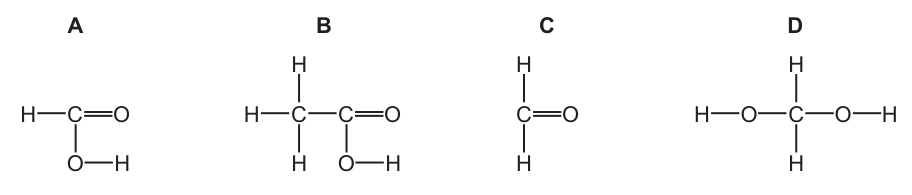
Working
- A carboxylic acid contains the carboxyl functional group, (a carbonyl group attached to a hydroxyl group on the same carbon atom).
- Identify the functional groups in each structure:
- A: Contains , which is methanoic acid (a carboxylic acid with 1 carbon atom, formula , ).
- B: Contains , which is ethanoic acid (a carboxylic acid with 2 carbon atoms, formula , ).
- C: Contains , which is methanal (an aldehyde, not a carboxylic acid).
- D: Contains two groups on the same carbon atom (a diol, not a carboxylic acid).
- Comparing carboxylic acids A and B, methanoic acid (A) has fewer carbon and hydrogen atoms, giving it the lowest relative molecular mass ().
Answer
A
A
Walkthrough
To determine which structure shows the carboxylic acid with the lowest relative molecular mass ():
-
Identify the carboxylic acid functional group:
The defining functional group of a carboxylic acid is the carboxyl group, written as . In a displayed formula, this consists of a carbon atom doubly bonded to an oxygen atom () and singly bonded to a hydroxyl group (). -
Examine each option:
- Structure A has a single carbon atom bonded to , , and . This is methanoic acid (formic acid), , which is the simplest possible carboxylic acid with .
- Structure B has a two-carbon chain terminating in . This is ethanoic acid, , with .
- Structure C has a carbon atom double-bonded to an oxygen atom and single-bonded to two hydrogen atoms (). This is an aldehyde (methanal/formaldehyde), not a carboxylic acid.
- Structure D has two single bonds attached to a single carbon atom. It lacks a carbonyl () double bond and is therefore not a carboxylic acid.
-
Compare molecular masses:
Between the two carboxylic acids, methanoic acid (A, 1 carbon atom) has a lower relative molecular mass than ethanoic acid (B, 2 carbon atoms). Therefore, A is the correct answer.
Key Takeaways
- The carboxyl functional group consists of both a carbonyl group () and a hydroxyl group () on the same carbon atom ().
- The first member of the carboxylic acid homologous series is methanoic acid (), containing only 1 carbon atom, which gives it the lowest among all carboxylic acids.
Common Mistakes
- Mistaking an aldehyde (like C, which has and ) or an alcohol/diol (like D, which has only groups) for a carboxylic acid.
- Selecting ethanoic acid (B) simply because it is the most commonly encountered carboxylic acid in school chemistry, forgetting that methanoic acid (A) is smaller.
Things to Be Careful About
- Ensure both the and parts of the functional group are present on the exact same carbon atom to qualify as a carboxylic acid.
A mixture of of hydrogen and of oxygen occupies a volume, , measured at r.t.p.
The gases react until there is no further change.
Which reactant is in excess and what is the final volume of the mixture measured at r.t.p.?
Options
| reactant in excess | final volume | |
|---|---|---|
| A | hydrogen | |
| B | hydrogen | |
| C | oxygen | |
| D | oxygen |
Working
- Calculate the initial moles of each gas ( of , of ):
Total initial moles of gas , which corresponds to initial volume .
- Determine the excess reactant using the stoichiometric equation:
of reacts completely with of .
- is the limiting reactant.
- is in excess.
- Calculate the remaining gas:
Since the product is a liquid at r.t.p., only the unreacted oxygen gas contributes to the final gas volume:
Answer
C
C
Walkthrough
-
Convert initial masses to moles:
- Molar mass of hydrogen gas, .
- Molar mass of oxygen gas, .
- Total initial gas moles , which corresponds to the initial volume .
- Molar mass of hydrogen gas, .
-
Identify the limiting and excess reactants:
- According to the balanced equation: of reacts with of .
- Therefore, of requires only of .
- Since we have of , oxygen is in excess.
-
Determine the final volume:
- is completely consumed ( remaining).
- Unreacted .
- The product is liquid water, , which has a negligible volume compared to gases and does not contribute to the gas volume at r.t.p.
- The final gas volume is proportional to the remaining moles of gas:
- Thus, the final volume is , making C the correct option.
Key Takeaways
- Equal masses of gases with different molar masses contain different numbers of moles.
- Avogadro's law states that equal volumes of gases at the same temperature and pressure contain equal numbers of moles (volume is directly proportional to moles of gas).
- Always check the state symbols: liquid and solid products do not count towards the final volume of a gas mixture.
Common Mistakes
- Forgetting that is a liquid at r.t.p. and attempting to include water vapour in the final gas volume.
- Comparing reacting masses directly ( vs ) instead of converting to moles first.
Things to Be Careful About
- Ensure diatomic formulas ( and ) are used to calculate the molar masses ( and ), not atomic masses ( and ).
A chemist prepares calcium nitrate. They start with of pure calcium oxide and an excess of dilute nitric acid. They produce of pure, dry anhydrous calcium nitrate crystals.
What is the percentage yield of calcium nitrate?
[relative atomic masses, : ; ; ; ]
Options
A 54.0
B 63.2
C 67.1
D 86.8
Working
- Write the balanced chemical equation:
- Calculate the relative formula masses ():
- Calculate the moles of :
-
From the stoichiometric ratio, theoretical moles of .
-
Calculate the theoretical yield of :
- Calculate the percentage yield:
Answer
A
A
Walkthrough
-
Identify the reaction and stoichiometry:
Calcium oxide reacts with dilute nitric acid to form calcium nitrate and water:of produces of .
-
Find the relative formula masses ():
-
Determine the theoretical yield:
-
Calculate percentage yield:
This corresponds to option A.
Key Takeaways
- .
- Always calculate the theoretical yield based on the limiting reactant (here, , as nitric acid is in excess) using mole ratios from the balanced equation.
Common Mistakes
- Forgetting to multiply the nitrate group by when calculating , which leads to an incorrect theoretical yield.
- Directly comparing masses without converting to moles or accounting for the difference in molar masses between reactant and product.
Things to Be Careful About
- Ensure proper expansion of parentheses in the formula : .
- Keep unrounded intermediate numbers in your calculator to avoid rounding errors in the final value.
The apparatus shown is used to investigate the electrolysis using inert electrodes of dilute sulfuric acid and concentrated aqueous sodium chloride in separate experiments.
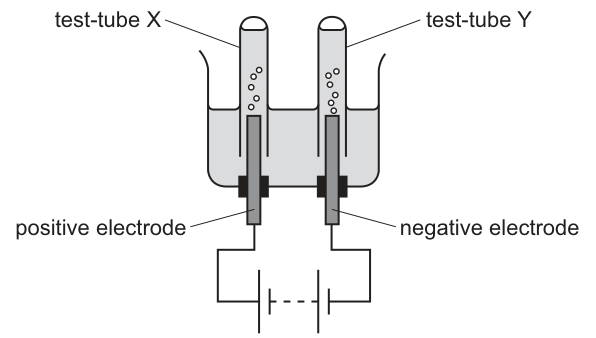
Which row shows the ratio of volume of gas collected in each test-tube?
Options
| ratio of volume of gas in X and Y with dilute X:Y | ratio of volume of gas in X and Y with concentrated aqueous NaCl X:Y | |
|---|---|---|
| A | 1 : 2 | 2 : 1 |
| B | 1 : 1 | 1 : 1 |
| C | 1 : 2 | 1 : 1 |
| D | 2 : 1 | 1 : 2 |
Working
-
Electrolysis of dilute :
- Test-tube X (positive electrode / anode): Hydroxide ions / water are discharged to form oxygen gas.
- Test-tube Y (negative electrode / cathode): Hydrogen ions are discharged to form hydrogen gas.
- For every of electrons transferred, of is produced at X and of is produced at Y.
- Ratio of volume of gas (X : Y) = .
-
Electrolysis of concentrated aqueous (brine):
- Test-tube X (positive electrode / anode): Chloride ions are selectively discharged to form chlorine gas.
- Test-tube Y (negative electrode / cathode): Hydrogen ions are discharged preferentially over sodium ions to form hydrogen gas.
- For every of electrons transferred, of is produced at X and of is produced at Y.
- Ratio of volume of gas (X : Y) = .
Combining both ratios gives row C.
Answer
C
C
Walkthrough
To find the ratio of gases collected, determine the gas formed at each electrode and compare the number of moles produced per quantity of electric charge ():
-
Identify the polarity of the electrodes:
- Test-tube X covers the positive electrode (anode).
- Test-tube Y covers the negative electrode (cathode).
-
Dilute sulfuric acid ():
- The ions present are , , and from water: and .
- At the anode (X): ions are oxidised to produce :
- At the cathode (Y): ions are reduced to produce :
- Ratio of (in X) to (in Y) = .
-
Concentrated aqueous sodium chloride ():
- The ions present are , , , and .
- At the anode (X): In concentrated solution, the halide ion () is discharged in preference to , forming :
- At the cathode (Y): is lower in the discharge series than , so is discharged to form :
- Ratio of (in X) to (in Y) = .
Therefore, the correct row is C ( and ).
Key Takeaways
- At r.t.p., equal numbers of moles of different gases occupy the same volume (), so the mole ratio directly gives the volume ratio.
- The electrolysis of dilute sulfuric acid produces twice as much hydrogen by volume at the cathode as oxygen at the anode ().
- The electrolysis of concentrated produces equal volumes of chlorine at the anode and hydrogen at the cathode ().
Common Mistakes
- Inverting the ratio (e.g. writing instead of ) by confusing which gas is collected in test-tube X (anode) versus test-tube Y (cathode).
- Assuming oxygen is discharged at the anode during the electrolysis of concentrated ; concentrated halide ions are preferentially discharged over .
Things to Be Careful About
- Always check the electrode polarity from the cell diagram: the longer line in the DC cell symbol is the positive terminal, and the shorter line is the negative terminal.
Which statement about reactions is correct?
Options
A A reaction in which the number of bonds broken equals the number of bonds formed always has an enthalpy change, .
B Combustion can be either exothermic or endothermic.
C In exothermic reactions, thermal energy is transferred to the surroundings, so the temperature of the surroundings increases.
D The activation energy, , for a reaction is the minimum energy particles must have in order to collide.
Working
- A is incorrect: Different chemical bonds have different bond energies. Even if the total number of bonds broken equals the total number formed, the energy absorbed to break bonds will generally not equal the energy released when making new bonds, so .
- B is incorrect: Combustion reactions release heat and are always exothermic.
- C is correct: By definition, an exothermic reaction releases thermal energy to the surroundings, leading to a temperature rise in the surroundings.
- D is incorrect: Activation energy () is the minimum energy colliding particles must possess to react (have a successful collision), not merely to collide.
Answer
C
C
Walkthrough
Let us analyse each statement:
- Option A: . Since different covalent bonds (e.g., vs ) have different bond strengths, having the same count of bonds broken and formed does not mean the numerical energy values cancel to zero.
- Option B: Combustion is the rapid reaction of a substance with oxygen, releasing heat and light energy. It is universally exothermic.
- Option C: In an exothermic reaction, chemical potential energy is converted to thermal energy and transferred to the surroundings, causing the temperature of the reaction mixture and surroundings to rise. This statement is entirely correct.
- Option D: Particles collide continuously due to random motion regardless of their kinetic energy. The activation energy () is defined as the minimum kinetic energy that colliding particles must possess in order to react successfully.
Thus, option C is the correct statement.
Key Takeaways
- An exothermic reaction transfers thermal energy to the surroundings, resulting in a temperature increase ().
- An endothermic reaction takes in thermal energy from the surroundings, resulting in a temperature decrease ().
- Activation energy () is the minimum energy required for collisions to result in a chemical reaction.
Common Mistakes
- Confusing "colliding" with "reacting upon collision" in the definition of activation energy.
- Assuming bond energy depends purely on the number of bonds rather than the specific identity of the bonded atoms.
Things to Be Careful About
- In exothermic reactions, energy flows out to the surroundings, which makes the thermometer reading go up (a common point of sign confusion for students).
The word equations for two reactions of ethene are shown.
The bond energies of the bonds involved in the reactions are shown in the table.
| bond energy in | |
|---|---|
| 612 | |
| 347 | |
| 413 | |
| 436 | |
| 193 | |
| 290 |
What is the value of ?
Options
A
B
C
D
Working
Calculate for each reaction:
For reaction 1 ():
- Bonds broken:
- Bonds formed:
(Alternatively, canceling the 4 unchanged bonds: broken ; formed ; )
For reaction 2 ():
- Bonds broken:
- Bonds formed:
Now calculate :
Answer
C
C
Walkthrough
To find , we calculate the enthalpy change of each reaction separately using the bond energies provided.
-
Reaction 1:
- Energy absorbed to break bonds = (ignoring the 4 bonds present in both reactants and products).
- Energy released to form bonds = .
- .
-
Reaction 2:
- Energy absorbed to break bonds = .
- Energy released to form bonds = .
- .
-
Difference:
Thus, option C is correct.
Key Takeaways
- .
- Bonds that appear unchanged on both reactant and product sides can either be included fully or canceled out on both sides to simplify the arithmetic.
- Be careful with signs when subtracting negative enthalpy changes.
Common Mistakes
- Inverting the formula to , which gives positive enthalpy changes for exothermic addition reactions.
- Forgetting that double negatives become positive when calculating , leading to (Option B) or .
Things to Be Careful About
- In ethane, there are 6 bonds and 1 single bond. In 1,2-dibromoethane, there are 4 bonds, 2 bonds, and 1 bond.
- Ensure each term has the correct multiplier (e.g., ).
Two changes are described.
Which row is correct?
Options
| change 1 | change 2 | |
|---|---|---|
| A | chemical change | chemical change |
| B | chemical change | physical change |
| C | physical change | chemical change |
| D | physical change | physical change |
Working
- Change 1: A new substance, nitrogen dioxide gas (), is formed when copper reacts with concentrated nitric acid. The formation of a new chemical substance indicates a chemical change.
- Change 2: Concentrated sulfuric acid dehydrates sugar to produce carbon and water vapor, and the question states this change cannot be reversed. Irreversibility and the formation of new substances define a chemical change.
Therefore, both change 1 and change 2 are chemical changes, which corresponds to row A.
Answer
A
A
Walkthrough
To determine whether a change is physical or chemical:
- Chemical change: Involves the breaking and making of chemical bonds, leading to the formation of one or more new substances. Chemical changes are usually difficult to reverse.
- Physical change: No new chemical substances are formed (e.g., changes of state, dissolving). The substance retains its chemical identity and the change is typically easily reversible.
Let us evaluate each change:
- In change 1, copper () reacts with concentrated nitric acid () to produce copper(II) nitrate, water, and nitrogen dioxide gas (). Because a new substance is formed, this is a chemical change.
- In change 2, concentrated sulfuric acid acts as a powerful dehydrating agent on sugar (sucrose, ), removing water elements to leave behind a black mass of elemental carbon (). Since new substances are formed and the process is irreversible, this is also a chemical change.
Thus, both are chemical changes (Row A).
Key Takeaways
- A chemical change always results in the formation of new chemical substances and is typically not easily reversed.
- A physical change alters only the physical state or appearance of a substance without altering its chemical composition.
Common Mistakes
- Mistaking the reaction of sulfuric acid with sugar as simple mixing or dissolving (a physical process) rather than a dehydration redox reaction.
- Forgetting that the release of a gas with different properties from the reactants (e.g., nitrogen dioxide) is clear evidence of a chemical reaction.
Things to Be Careful About
- Look for tell-tale signs of chemical changes: evolution of gas, change in colour, permanent temperature change, and irreversibility.
Which change increases the rate of a chemical reaction?
Options
A using a higher pressure in a gaseous reaction
B using a lower temperature
C using a more dilute solution
D using larger pieces of a solid
Working
- A: Increasing pressure pushes gas particles closer together, which increases the number of particles per unit volume. This leads to more frequent collisions between reacting particles, thereby increasing the rate of reaction. (Correct)
- B: Lowering the temperature decreases the average kinetic energy of the particles, leading to less frequent collisions and a smaller proportion of particles possessing energy equal to or greater than the activation energy (), which decreases the rate.
- C: A more dilute solution has fewer reactant particles per unit volume, resulting in a lower collision frequency and a decreased rate.
- D: Using larger pieces of a solid decreases the total surface area exposed for collisions, which reduces the frequency of collisions and decreases the rate.
Answer
A
A
Walkthrough
According to collision theory, for a chemical reaction to occur, reactant particles must collide with each other with energy greater than or equal to the activation energy (). The rate of reaction depends on the frequency of successful collisions.
Let us analyse each option:
- Option A: Increasing the pressure of a gaseous mixture decreases the volume occupied by the gas. As a result, the particles are closer together, meaning the concentration of particles (particles per unit volume) is higher. This increases the frequency of collisions between reactant molecules, which increases the rate of reaction. This statement is correct.
- Option B: Lowering the temperature causes particles to move slower (lower average kinetic energy), which reduces both the collision frequency and the fraction of particles having energy . This decreases the reaction rate.
- Option C: Diluting a solution reduces the number of reactant particles per unit volume, which lowers the collision frequency and decreases the rate.
- Option D: Larger pieces of solid have a smaller surface-area-to-volume ratio than smaller pieces or powder, exposing fewer reactant particles to collisions at any given time, thus decreasing the rate.
Therefore, A is the only change that increases the reaction rate.
Key Takeaways
- Factors that increase the rate of reaction:
- Increasing temperature: Particles have more kinetic energy, move faster (higher collision frequency), and a greater proportion of collisions have energy .
- Increasing concentration / pressure (for gases): More particles per unit volume, resulting in a higher collision frequency.
- Increasing surface area (smaller particle size): More particles are exposed at the surface, leading to a higher collision frequency.
- Adding a catalyst: Provides an alternative reaction pathway with a lower activation energy, increasing the fraction of successful collisions.
Common Mistakes
- Confusing "more dilute" with "more concentrated" — dilution decreases concentration, which lowers the rate.
- Confusing larger pieces with larger surface area — larger pieces have a smaller total surface area for a given mass.
Things to Be Careful About
- When explaining the effect of pressure or concentration, always frame it in terms of particles per unit volume and frequency of collisions (or collisions per second/unit time).
In two separate experiments, 1 and 2, an excess of powdered calcium carbonate reacts in a flask with dilute hydrochloric acid.
In experiment 1, the volume of carbon dioxide evolved is measured at regular time intervals.
In experiment 2, the mass of the flask and its contents is measured at regular time intervals.
The results of both experiments are plotted on graphs.
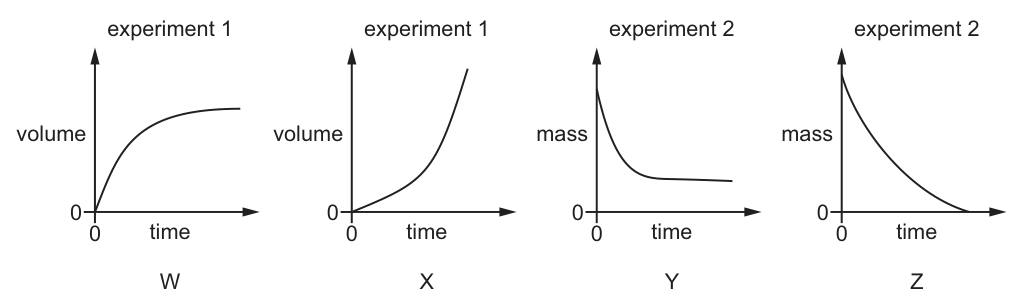
Which graphs show the results of these two experiments?
Options
| experiment 1 | experiment 2 | |
|---|---|---|
| A | W | Y |
| B | W | Z |
| C | X | Y |
| D | X | Z |
Working
-
Experiment 1 (volume of evolved vs time):
- The reaction is fastest at the start (), so the gradient is steepest at the beginning.
- As the acid is used up, the rate decreases, so the curve becomes less steep.
- The reaction stops when the limiting reactant is completely used up, meaning the volume reaches a plateau and the curve becomes horizontal.
- This matches graph W (graph X incorrectly shows an increasing rate of reaction).
-
Experiment 2 (mass of flask and contents vs time):
- The total mass starts at a high positive value (the mass of the flask, acid, and excess solid).
- As gas escapes, the mass decreases rapidly at first, then more slowly, and eventually levels off at a non-zero constant mass once the reaction finishes.
- The mass never drops to zero because the flask, water, unreacted calcium carbonate, and dissolved calcium chloride remain.
- This matches graph Y (graph Z incorrectly shows the mass dropping to zero).
Therefore, experiment 1 is represented by W and experiment 2 is represented by Y.
Answer
A
A
Walkthrough
In both experiments, calcium carbonate reacts with hydrochloric acid:
-
Experiment 1 (Gas Volume Method):
- At the beginning, the concentration of acid is highest, giving the highest frequency of successful collisions and thus the fastest rate of gas production (steepest gradient at the origin).
- As the reaction proceeds, acid particles are consumed, reducing the frequency of collisions, so the gradient decreases.
- When the acid is completely used up, no more gas is produced, and the graph flattens out into a horizontal plateau at a maximum volume. This shape is correctly shown by W.
-
Experiment 2 (Mass Loss Method):
- Because is a gas, it escapes from the open flask, causing the total mass of the system to decrease over time.
- The mass loss is fastest initially (steepest negative slope) and levels off when no further is released.
- Since the flask, liquid water, dissolved , and unreacted remain on the balance, the final mass is still a substantial positive number. This behaviour is correctly shown by Y.
Matching both gives W and Y, which corresponds to option A.
Key Takeaways
- For a typical rate curve where products accumulate (e.g. gas volume), the graph begins at , curves upward with a decreasing gradient, and levels off.
- For a mass-loss curve, the graph begins at an initial positive mass, curves downward with a decreasing gradient, and levels off at a non-zero plateau.
Common Mistakes
- Confusing graph Y and graph Z: choosing Z forgets that only the escaping gas is lost; the remaining flask and contents still have mass.
- Choosing X for volume: assuming the line curves upwards exponentially rather than flattening as reactants are consumed.
Things to Be Careful About
- Check the axes carefully: volume starts at 0, while mass begins at a non-zero value and never reaches 0.
Which statements about the Haber process for the manufacture of ammonia are correct?
- At equilibrium, the concentrations of the reactants and products are no longer changing.
- Increasing the pressure moves the position of equilibrium to the right.
- Increasing the temperature moves the position of equilibrium to the left.
Options
A 1, 2 and 3
B 1 and 2 only
C 1 and 3 only
D 2 and 3 only
Working
The equation for the Haber process is:
- Statement 1 is correct: In a dynamic equilibrium, the forward and reverse reaction rates are equal, so the concentrations of all reactants and products remain constant (they are no longer changing).
- Statement 2 is correct: There are of gas on the left-hand side and of gas on the right-hand side. Increasing the pressure shifts the equilibrium to the side with fewer moles of gas (to the right).
- Statement 3 is correct: The forward reaction is exothermic (gives out heat). Increasing the temperature shifts the equilibrium in the endothermic direction (to the left) to absorb the added heat.
Since statements 1, 2, and 3 are all correct, the correct option is A.
Answer
A
A
Walkthrough
To determine the correct combination of statements, let us analyse each one individually for the Haber process:
-
Statement 1: By definition, a closed system reaches dynamic equilibrium when the rate of the forward reaction equals the rate of the backward reaction. As a result, the amounts and concentrations of reactants ( and ) and products () remain constant over time. Therefore, statement 1 is correct.
-
Statement 2: Looking at the stoichiometry of the gaseous species:
- Reactant side:
- Product side:
According to Le Chatelier's principle, an increase in pressure shifts the equilibrium position to counteract the change by favouring the side that occupies a smaller volume (fewer moles of gas). Therefore, increasing pressure shifts the position of equilibrium to the right, making statement 2 correct.
-
Statement 3: The forward reaction is exothermic (it has a negative enthalpy change, ). An increase in temperature favours the endothermic pathway (the reverse reaction) to remove the excess heat. Thus, the position of equilibrium moves to the left, decreasing the yield of ammonia. Therefore, statement 3 is correct.
Since statements 1, 2, and 3 are all true, option A is the correct answer.
Key Takeaways
- Dynamic equilibrium requires equal forward and reverse rates, leading to constant concentrations of reactants and products.
- Increasing pressure shifts the equilibrium position toward the side with fewer gas molecules.
- Increasing temperature shifts the equilibrium position in the endothermic direction.
Common Mistakes
- Confusing "concentrations remain constant" with "concentrations become equal". Reactants and products rarely have equal concentrations at equilibrium; their amounts simply stop changing.
- Forgetting that the forward synthesis of ammonia is exothermic, leading to the incorrect prediction of the temperature effect.
Things to Be Careful About
- Always count only the stoichiometric coefficients of gaseous species when predicting the effect of pressure changes.
Acidified aqueous potassium manganate(VII) is used as a test reagent.
When it is added to an aqueous solution of compound M, the colour of the test reagent changes from ......1...... . This colour change shows that M is ......2...... .
Which words correctly complete gaps 1 and 2?
Options
| 1 | 2 | |
|---|---|---|
| A | colourless to purple | oxidised |
| B | colourless to purple | reduced |
| C | purple to colourless | oxidised |
| D | purple to colourless | reduced |
Working
- Acidified aqueous potassium manganate(VII), , is a powerful oxidising agent with a characteristic purple colour.
- When reacted with a reducing agent (compound ), the ion is reduced to almost colourless , resulting in a colour change from purple to colourless (gap 1).
- Since potassium manganate(VII) is reduced, compound acts as a reducing agent and is therefore oxidised (gap 2).
This matches row C.
Answer
C
C
Walkthrough
Acidified aqueous potassium manganate(VII), , is a widely used laboratory reagent to test for the presence of reducing agents:
- Colour of the reagent: The manganate(VII) ion, , gives the solution an intense purple colour.
- Redox reaction: In acidic solution, is reduced to the manganese(II) ion, , which is virtually colourless in dilute solution. Therefore, when a reaction occurs, the colour changes from purple to colourless.
- Fate of compound : In any redox reaction, oxidation and reduction happen simultaneously. Because potassium manganate(VII) acts as an oxidising agent (and gets reduced itself), it oxidises the substance it reacts with. Hence, compound is oxidised (acting as a reducing agent).
Combining these two points:
- Gap 1 = purple to colourless
- Gap 2 = oxidised
This corresponds to option C.
Key Takeaways
- Acidified potassium manganate(VII) () is a test reagent for reducing agents; its colour changes from purple to colourless.
- Acidified potassium iodide () is a test reagent for oxidising agents; its colour changes from colourless to brown.
- An oxidising agent oxidises another substance while being reduced itself.
Common Mistakes
- Confusing the direction of the colour change: potassium manganate(VII) starts as purple and becomes decolourised, not the other way around.
- Confusing whether is oxidised or reduced: since is reduced, the reactant must be oxidised.
Things to Be Careful About
- Ensure you identify what happens to the substance being tested () versus what happens to the test reagent (). The question asks what happens to ("shows that M is ...").
In a neutralisation reaction, which change in particles occurs?
Options
A
B
C
D
Working
The essential ionic equation for the neutralisation reaction between an acid and an alkali is:
- The reactants are hydrogen ions () and hydroxide ions (), which are ions.
- The product is water (), which consists of simple covalent molecules.
Therefore, the particle change occurring in neutralisation is .
Answer
B
B
Walkthrough
Neutralisation is the reaction between an acid and a base (or alkali). In aqueous solution, an acid provides hydrogen ions () and an alkali provides hydroxide ions ().
When these react, the overall ionic equation is:
Examining the types of particles involved:
- and are charged species, which are ions.
- is a neutral covalent compound made of simple molecules.
Thus, ions combine to form molecules (), which corresponds to option B.
Key Takeaways
- The fundamental ionic equation for any acid-alkali neutralisation is .
- Recognise the distinction between atoms (uncharged individual particles), ions (charged particles), and molecules (two or more covalently bonded atoms).
Common Mistakes
- Confusing neutralisation with redox reactions where electrons are transferred between atoms and ions (e.g. or ).
- Thinking water is ionic rather than simple molecular.
Things to Be Careful About
- Always write out the ionic equation for a given process if asked about particle-level changes to clearly identify the species before and after the reaction.
Which pair of substances are both insoluble in water?
Options
A ammonium chloride and ammonium carbonate
B copper carbonate and copper hydroxide
C lead nitrate and lead chloride
D zinc sulfate and zinc hydroxide
Working
Applying the general solubility rules for common salts and bases in water:
- A: All ammonium () salts are soluble in water. Therefore, both ammonium chloride and ammonium carbonate are soluble.
- B: Most carbonates are insoluble (except Group I and ammonium), so copper(II) carbonate () is insoluble. Most hydroxides are insoluble (except Group I, ammonium, and barium; calcium is slightly soluble), so copper(II) hydroxide () is insoluble. Thus, both are insoluble.
- C: All nitrates are soluble, so lead(II) nitrate () is soluble. Lead(II) chloride () is insoluble in cold water.
- D: Most sulfates are soluble (except barium, lead, and calcium is sparingly soluble), so zinc sulfate () is soluble. Zinc hydroxide () is insoluble.
Answer
B
B
Walkthrough
To determine which pair contains two insoluble substances, recall the standard solubility rules for O Level Chemistry:
-
Soluble substances:
- All salts of Group I metals (, , etc.) and ammonium ().
- All nitrates ().
- Most chlorides (), except lead(II) chloride () and silver chloride ().
- Most sulfates (), except barium sulfate (), lead(II) sulfate (), and calcium sulfate (, which is sparingly soluble).
-
Insoluble substances:
- Most carbonates (), except sodium, potassium, and ammonium carbonates.
- Most hydroxides (), except sodium, potassium, and ammonium hydroxides (calcium hydroxide is slightly soluble, barium hydroxide is soluble).
Now evaluate each option:
- Option A: Ammonium chloride and ammonium carbonate contain the cation, making both soluble.
- Option B: Copper(II) carbonate () and copper(II) hydroxide () are both insoluble in water. Hence, this is the correct option.
- Option C: Lead(II) nitrate is soluble (all nitrates dissolve), whereas lead(II) chloride is insoluble.
- Option D: Zinc sulfate is soluble (sulfate of a metal other than , , ), while zinc hydroxide is insoluble.
Key Takeaways
- All salts containing , , , and are completely soluble in water without exception.
- Carbonates and hydroxides of transition metals (e.g., , , , ) form insoluble precipitates in water.
Common Mistakes
- Confusing lead salts: while lead chloride and lead sulfate are insoluble, all nitrates including lead nitrate () are soluble.
- Forgetting that all ammonium salts are soluble regardless of the anion.
Things to Be Careful About
- Ensure you check both compounds in each pair, as options C and D contain one soluble substance and one insoluble substance.
The atomic number of element X is 12.
What is the formula of the chloride of X?
Options
A XCl
B
C
D
Working
- Element has an atomic number of , which gives the electron configuration .
- Having valence electrons in Group II, an atom of loses electrons to form the ion .
- Chlorine is in Group VII with valence electrons (configuration ) and gains electron to form the chloride ion .
- To form a neutral ionic compound, two ions are needed for every one ion to balance the charges: .
- Therefore, the formula of the chloride is .
Answer
B
B
Walkthrough
-
Identify the electron configuration of element X:
The atomic number is , meaning an atom of contains protons and electrons. Arranging these electrons into shells gives (element is magnesium, ). -
Determine the charge on the ion formed by X:
With outer shell electrons, readily loses electrons to achieve a stable, full outer shell (octet configuration ), forming a dipositive cation: . -
Determine the charge on the chloride ion:
Chlorine has an atomic number of with an electron configuration of . It gains electron to complete its outer shell, forming a uninegative chloride anion: . -
Combine the ions to write the formula:
Compounds must be electrically neutral overall. Combining one ion with two ions gives a net charge of . Thus, the empirical formula is , corresponding to option B.
Key Takeaways
- Group II elements have valence electrons and form ions ().
- Group VII elements (halogens) have valence electrons and form halide ions ().
- Ionic formulae are determined by balancing total positive and total negative charges to achieve overall electrical neutrality.
Common Mistakes
- Inverting the ratio of ions to write (Option D), which confuses the charge on the metal with the subscript of the non-metal.
- Assuming a ratio (Option A) without working out the ion charges.
Things to Be Careful About
- Ensure correct shell capacities () when writing electron configurations at O Level.
- Subscripts represent the whole-number ratio of atoms or ions in a compound and are written after the element symbol (e.g., , not or ).
Elements P, Q, R and S are in either Group I or Group VII of the Periodic Table.
P is a liquid at r.t.p.
Q is a gas at r.t.p.
Elements R and S both form basic oxides.
Element R has a higher melting point than element S.
Which pair of elements gives the most vigorous reaction?
Options
A P and R
B P and S
C Q and R
D Q and S
Working
-
Identify the Group of each element:
- R and S: Both form basic oxides, which is characteristic of metals. Therefore, R and S are in Group I (alkali metals).
- P and Q: Since R and S are in Group I, P and Q must be non-metals in Group VII (halogens).
-
Determine the relative reactivity in Group VII (P and Q):
- P is a liquid at r.t.p. (bromine, ).
- Q is a gas at r.t.p. (fluorine, , or chlorine, ).
- In Group VII, elements higher up the group are gases and are more reactive than liquids lower down. Therefore, Q is higher up Group VII than P and is the more reactive halogen.
-
Determine the relative reactivity in Group I (R and S):
- In Group I, melting points decrease down the group as metallic bonding gets weaker with increasing ionic radius.
- Since R has a higher melting point than S, R is higher up the group than S.
- Reactivity in Group I increases down the group. Therefore, S is lower down the group and is the more reactive alkali metal.
-
Combine the most reactive elements:
- The most vigorous reaction occurs between the most reactive alkali metal (S) and the most reactive halogen (Q).
Therefore, the pair of elements is Q and S.
Answer
D
D
Walkthrough
To find which pair of elements gives the most vigorous reaction, we need to deduce the identity or relative reactivity of each element step-by-step:
-
Distinguish between Group I and Group VII:
- Metals form basic oxides, while non-metals form acidic oxides. Since elements R and S form basic oxides, they must be the alkali metals (Group I).
- Consequently, P and Q must be the halogens (Group VII).
-
Compare the halogens (P and Q):
- Group VII trends show that boiling points increase down the group: fluorine and chlorine are gases at room temperature and pressure (r.t.p.), bromine is a liquid, and iodine is a solid.
- Element P is a liquid (bromine), and element Q is a gas (fluorine or chlorine).
- In Group VII, reactivity decreases down the group because larger atoms have a weaker electrostatic attraction for incoming electrons. Thus, a gaseous halogen at the top (Q) is more reactive than a liquid halogen further down (P).
-
Compare the alkali metals (R and S):
- In Group I, melting points decrease down the group because the ionic radius increases, which weakens the attraction between the positive metal ions and the delocalised electrons in the metallic lattice.
- Since R has a higher melting point than S, R is located higher up in Group I than S.
- In Group I, reactivity increases down the group because the single outer electron is further from the nucleus and more shielded, making it easier to lose.
- Therefore, S (being lower in the group) is more reactive than R.
-
Selecting the pair:
- The most vigorous reaction occurs between the most reactive metal (S) and the most reactive non-metal (Q), which gives the combination Q and S (Option D).
Key Takeaways
- Metal oxides are basic; non-metal oxides are acidic.
- In Group I, melting point decreases down the group, while reactivity increases down the group.
- In Group VII, melting point increases down the group (states go from gas liquid solid), while reactivity decreases down the group.
Common Mistakes
- Confusing the reactivity trend of Group I with Group VII (assuming both increase or both decrease down the group).
- Reversing the melting point trend of Group I (thinking metals lower down melt higher, when in fact metallic bonding weakens down the group due to larger ionic radius).
Things to Be Careful About
- Ensure you carefully match each element to its correct group before comparing trends.
- Make sure not to mix up which element has the higher melting point (R has the higher melting point, making it higher up and thus less reactive than S).
Three statements about noble gases are listed.
- Their atoms all have eight electrons in the outer shell.
- They are unreactive because their outer shells are full.
- They are diatomic.
Which statements are correct?
Options
A 1, 2 and 3
B 1 and 2 only
C 1 only
D 2 only
Working
- Statement 1 is incorrect because helium () has only electrons in its outer shell, not .
- Statement 2 is correct because noble gas atoms have full outer electron shells (a stable electronic configuration), meaning they do not readily gain, lose, or share electrons, making them unreactive.
- Statement 3 is incorrect because noble gases exist as single, unbonded atoms; they are monatomic, not diatomic.
Therefore, only statement 2 is correct.
Answer
D
D
Walkthrough
To determine which statements are correct, evaluate each statement one by one:
-
"Their atoms all have eight electrons in the outer shell."
- While neon, argon, krypton, xenon, and radon all have valence electrons (an octet), helium () has a proton number of and an electronic configuration of simply . Its first shell is full with only electrons (a duplet). Because helium is a noble gas, not all noble gases have eight electrons in their outer shell. Thus, Statement 1 is incorrect.
-
"They are unreactive because their outer shells are full."
- Chemical reactivity is driven by atoms tending to lose, gain, or share electrons to attain a full outer shell. Because noble gas atoms already have a full outer shell of electrons (a stable electronic configuration: 2 for He, 8 for the others), they have no tendency to react. Thus, Statement 2 is correct.
-
"They are diatomic."
- Diatomic molecules consist of two atoms chemically bonded together (such as , , ). Because noble gas atoms are chemically stable and unreactive on their own, they do not bond with each other and exist as individual single atoms (monatomic gases, such as , , ). Thus, Statement 3 is incorrect.
Since only Statement 2 is correct, option D is the correct answer.
Key Takeaways
- Group VIII / 0 elements are known as the noble gases.
- Noble gases are chemically inert (unreactive) because they possess a stable, full outer shell of valence electrons.
- Helium has a full outer shell containing 2 electrons; the other noble gases have 8 electrons in their outer shell.
- Noble gases exist as monatomic gases, not diatomic.
Common Mistakes
- Forgetting that helium is in Group VIII / 0: candidates often remember the "octet rule" ( outer electrons) and wrongly assume all noble gases have valence electrons.
- Confusing the terms monatomic (single atoms) and diatomic (two-atom molecules).
Things to Be Careful About
- Pay close attention to absolute words like "all". Helium is the standard counterexample for statements claiming all noble gases have 8 outer electrons.
Solid 1 and solid 2 are both elements.
Solid 1 is not malleable.
Solid 2 is ductile.
Which statement is correct?
Options
A Solid 1 has good electrical conductivity only when molten.
B Solid 2 has good electrical conductivity only when molten.
C The layers of ions in solid 1 can slide over one another.
D The layers of ions in solid 2 can slide over one another.
Working
- Solid 2 is ductile (can be drawn into wires), which is a characteristic property of metals.
- In metals, positive ions are arranged in regular layers surrounded by a 'sea' of delocalised electrons. When a force is applied, these layers of ions can slide past each other without breaking the metallic bond, making the metal malleable and ductile.
- Therefore, solid 2 consists of layers of ions that can slide over one another.
- Distractor analysis:
- A and B: Conducting electricity only when molten is a property of ionic compounds, not elemental solids. Solid 2 (a metal) conducts electricity in both solid and molten states.
- C: Solid 1 is not malleable (it is brittle/non-metallic), so its layers do not slide over one another in this way.
Answer
D
D
Walkthrough
-
Identify the nature of the elements:
- Solid 1 is an element that is not malleable (brittle), which indicates it is a non-metal (or a giant covalent substance like diamond).
- Solid 2 is ductile (can be stretched into wires), which is a unique property of metallic elements.
-
Relate ductility to metallic structure:
- A metal consists of a giant lattice of positive metal cations surrounded by a sea of mobile, delocalised electrons.
- Because the metallic bonding is non-directional, when stress or force is applied, the regular layers of positive ions can easily slide over one another without disrupting the metallic bonding. This explains why metals are both malleable and ductile.
- Therefore, the statement "The layers of ions in solid 2 can slide over one another" is correct (D).
-
Evaluate the other options:
- A and B refer to conducting electricity only when molten. This is characteristic of ionic compounds (where ions are fixed in a solid lattice and only mobile in liquid form). However, both solids in the question are elements. Solid 2 is a metal, so it conducts electricity in both the solid and molten states due to free-moving delocalised electrons.
- C is incorrect because solid 1 is not malleable, meaning it does not possess layers of ions that can freely slide over each other.
Key Takeaways
- Malleability and ductility of metals are explained by the ability of layers of positive metal ions to slide over each other when a force is applied.
- Metals conduct electricity in both the solid and liquid (molten) states due to delocalised electrons.
Common Mistakes
- Confusing the electrical conductivity of metals with ionic compounds (thinking metals only conduct when molten).
- Forgetting the definition of ductile (able to be pulled into wires) and malleable (able to be hammered into sheets).
Things to Be Careful About
- Always notice that the question specifies both substances are elements. This immediately rules out ionic compound behavior (options A and B).
When a piece of aluminium is placed in cold, dilute hydrochloric acid, no reaction is observed initially.
What is the reason for this?
Options
A Aluminium contains small amounts of a more reactive metal that reacts with the acid instead.
B Aluminium is above hydrogen in the reactivity series.
C Aluminium is amphoteric and will only react with bases.
D Aluminium is coated with an oxide layer that prevents the acid getting to the metal.
Working
- Aluminium readily reacts with oxygen in the air to form an unreactive, impermeable, protective surface layer of aluminium oxide ().
- This oxide layer physically shields the underlying aluminium metal from coming into contact with dilute acid, preventing an immediate reaction.
- Once the acid slowly dissolves the oxide layer, the exposed aluminium reacts vigorously with the acid.
- Therefore, option D correctly explains the initial lack of reaction.
Answer
D
D
Walkthrough
Aluminium is high in the reactivity series (above zinc, iron, and hydrogen) and would be expected to react rapidly with dilute acids to produce aluminium chloride and hydrogen gas:
However, upon exposure to air, aluminium rapidly forms a very thin, tough, adhering, and non-porous layer of aluminium oxide () on its surface. This protective oxide coating prevents aqueous reagents such as water and dilute acids from reaching the metal underneath.
Initially, no effervescence is seen because the acid must first react with and dissolve this basic/amphoteric oxide layer. Once the barrier is stripped away, the acidic solution reaches the metal, and vigorous bubbling of hydrogen gas begins.
Evaluating the options:
- A is incorrect because aluminium does not contain reactive metal impurities that prevent its reaction.
- B is a true statement (aluminium is above hydrogen), but being higher in the reactivity series would predict a faster reaction, not a lack of one.
- C is incorrect because aluminium oxide is amphoteric (reacting with both acids and bases), and aluminium metal reacts readily with both acids and alkalis once the surface is exposed.
- D is the correct scientific reason.
Key Takeaways
- Aluminium appears less reactive than its position in the reactivity series suggests due to the formation of a protective, impervious oxide layer ().
- This protective layer is responsible for aluminium's resistance to corrosion.
Common Mistakes
- Confusing the reactivity of aluminium metal with the protective property of its oxide coating.
- Thinking aluminium is unreactive because it is placed low in the reactivity series (it is actually high up).
Things to Be Careful About
- Ensure you distinguish between aluminium being inherently unreactive (which is false) versus its apparent unreactivity due to surface passivation (which is true).
A piece of zinc is attached to a steel car to prevent it from rusting.
Which statement is correct?
Options
A A piece of copper is more effective than zinc because copper does not rust.
B A piece of magnesium is more effective than zinc because magnesium is less reactive than zinc.
C The piece of zinc provides a barrier around the entire steel car.
D The piece of zinc provides sacrificial protection to the steel car.
Working
- Zinc is higher in the reactivity series than iron (the main element in steel). Therefore, zinc oxidises (loses electrons) preferentially instead of iron, protecting the steel sacrificially.
- A is incorrect: Copper is less reactive than iron and would accelerate rusting rather than prevent it.
- B is incorrect: Magnesium is more reactive than zinc, not less reactive.
- C is incorrect: A single attached piece of zinc does not act as a physical barrier over the whole car body; it protects via electrochemical sacrificial protection.
- D is correct: Attaching a more reactive metal (zinc) provides sacrificial protection.
Answer
D
D
Walkthrough
Rusting is the corrosion of iron in the presence of both oxygen and water. Steel is an alloy consisting primarily of iron.
There are two main approaches to rust prevention:
- Barrier methods: Coating the entire surface with paint, oil, grease, or plastic to physically block contact with air and moisture.
- Sacrificial protection (cathodic protection): Attaching blocks of a more reactive metal (such as zinc or magnesium) to the iron/steel. Because zinc has a greater tendency to lose electrons than iron (), zinc corrodes preferentially. The electrons flow to the iron, preventing the iron from being oxidised to even if exposed to air and water.
Evaluating the given statements:
- A: Copper is less reactive than iron. If attached to steel, it would cause the iron to oxidise even faster.
- B: Magnesium is more reactive than zinc, so the statement that magnesium is "less reactive than zinc" is incorrect.
- C: A single attached piece cannot physically coat or cover the whole surface of the car.
- D: This accurately describes sacrificial protection.
Key Takeaways
- For sacrificial protection, the sacrificial anode must be made of a metal higher in the reactivity series than iron (e.g. zinc, magnesium).
- The more reactive metal oxidises preferentially, sparing the iron/steel structure.
Common Mistakes
- Confusing sacrificial protection with physical barrier protection (such as continuous coating/galvanising).
- Forgetting the order of the reactivity series: .
Things to Be Careful About
- Attaching a less reactive metal (like copper) promotes faster corrosion of iron because iron will sacrifice itself for the less reactive metal.
Which statement about the extraction of iron from hematite in the blast furnace is correct?
Options
A Coke is reduced to carbon dioxide producing thermal energy to heat the furnace.
B Hematite contains iron(III) oxide which is reduced by carbon monoxide.
C Limestone is added to the blast furnace and is a substance that consists mainly of calcium oxide.
D Molten slag is formed from a reaction between hematite and silicon(IV) oxide.
Working
- A is incorrect: Coke () is oxidised (not reduced) by oxygen to form carbon dioxide: .
- B is correct: The main iron ore is hematite, which contains iron(III) oxide (). It is reduced to molten iron by carbon monoxide: .
- C is incorrect: Limestone consists mainly of calcium carbonate (), not calcium oxide ( is produced inside the blast furnace by thermal decomposition of limestone).
- D is incorrect: Slag (calcium silicate, ) is formed by the reaction between calcium oxide () and the acidic impurity silicon(IV) oxide (), not hematite.
Answer
B
B
Walkthrough
The extraction of iron takes place in a blast furnace using three main raw materials alongside hot air:
- Hematite (contains as the iron source).
- Coke (carbon, , used as fuel and to generate the reducing agent).
- Limestone (calcium carbonate, , used to remove acidic impurities).
Let us evaluate each option:
- Option A: Carbon burns in oxygen: . Carbon gains oxygen, meaning it is oxidised, not reduced. This statement is false.
- Option B: Hematite provides . Carbon monoxide () reduces to molten iron: . Here, iron(III) oxide loses oxygen and is reduced. This statement is completely correct.
- Option C: Limestone is mainly calcium carbonate (), not calcium oxide (). is only formed when limestone undergoes thermal decomposition in the furnace (). This statement is false.
- Option D: Molten slag () is formed when calcium oxide reacts with sandy/silica impurities: . Hematite does not react with to make slag. This statement is false.
Therefore, option B is the correct choice.
Key Takeaways
- Hematite is iron(III) oxide, .
- The main reducing agent in the blast furnace is carbon monoxide ().
- Limestone is calcium carbonate (), which thermally decomposes to calcium oxide ().
- Slag () forms from the neutralisation reaction between basic and acidic .
Common Mistakes
- Confusing limestone () with lime/quicklime ().
- Confusing oxidation with reduction when describing the combustion of coke.
- Stating that carbon is the only reducing agent; while carbon can reduce at very high temperatures, is the primary reducing agent in the blast furnace.
Things to Be Careful About
- Always check the definition of oxidation (gain of oxygen / loss of electrons) vs reduction (loss of oxygen / gain of electrons) in redox contexts.
- Remember the exact role and identity of each raw material added at the top of the blast furnace.
Water may contain many substances before it is purified for drinking. Three substances are listed.
- dissolved oxygen
- harmful microbes
- insoluble solids
Which substances are removed by the treatment of the domestic water supply?
Options
A 1 and 2
B 1 and 3
C 2 and 3
D 3 only
Working
- 1. Dissolved oxygen: Dissolved oxygen is beneficial and is not removed during water treatment.
- 2. Harmful microbes: Microbes (bacteria and other pathogens) are killed/removed during disinfection (typically via chlorination).
- 3. Insoluble solids: Insoluble particles and solids are removed by sedimentation and filtration through beds of sand and gravel.
Therefore, substances 2 and 3 are removed.
Answer
C
C
Walkthrough
The purification of water for the domestic water supply involves several key stages designed to make water safe to drink (potable):
- Screening and Sedimentation: Coarse and larger suspended insoluble particles settle out or are trapped by screens.
- Filtration: Water is passed through sand and gravel beds to remove remaining fine insoluble solids (substance 3).
- Chlorination / Disinfection: A small amount of chlorine (or ozone/UV light) is added to kill bacteria and other harmful microbes (substance 2).
Dissolved oxygen (substance 1) and harmless dissolved minerals remain in the water and are beneficial; they are not removed during typical water treatment. Therefore, only statements 2 and 3 represent substances removed during the process, making C the correct option.
Key Takeaways
- Filtration removes insoluble solids.
- Chlorination kills harmful microbes (bacteria/pathogens).
- Dissolved gases (such as oxygen) and harmless dissolved mineral ions are not removed during normal domestic water treatment.
Common Mistakes
- Confusing the removal of insoluble impurities with the removal of dissolved gases. Candidates sometimes incorrectly assume that water purification removes all dissolved substances, including oxygen.
- Confusing domestic water treatment (filtration and chlorination to produce potable water) with distillation/deionisation (which produces pure water).
Things to Be Careful About
- Ensure you distinguish between potable water (safe to drink, contains dissolved minerals and oxygen) and pure water (chemically pure ). Domestic water supply treatment aims to make water potable, not pure.
Dry air is a mixture of gases. 99% of the mixture is nitrogen and oxygen.
What is in the highest abundance in the remaining 1%?
Options
A argon
B chlorine
C hydrogen
D water vapour
Working
Clean, dry air has the approximate composition:
- Nitrogen:
- Oxygen:
- Argon (and other noble gases): approximately
- Carbon dioxide: approximately
Of the remaining after nitrogen and oxygen, argon has the highest percentage composition (abundance).
- A (argon) is correct as it makes up about of dry air.
- B (chlorine) is not a normal constituent of clean, dry air.
- C (hydrogen) is present only in trace amounts (around ).
- D (water vapour) is excluded by the definition of dry air.
Answer
A
A
Walkthrough
The composition of clean, dry air is a standard recall topic in the Cambridge O Level syllabus:
- Noble gases (mainly argon, )
Since , the remaining is predominantly argon. Therefore, option A is the correct answer.
Key Takeaways
- Clean, dry air is mainly composed of nitrogen () and oxygen ().
- The third most abundant gas in dry air is argon (approx. or roughly ).
- Carbon dioxide is present in very small amounts ().
Common Mistakes
- Confusing "dry air" with humid atmospheric air: water vapour varies between and in natural air, but "dry air" specifically excludes water vapour.
- Choosing carbon dioxide instead of argon, often due to widespread discussion of as a greenhouse gas despite its low percentage ().
Things to Be Careful About
- Pay attention to the word "dry" in the question, which deliberately excludes water vapour.
Which statement about alkanes is correct?
Options
A Ethane reacts with chlorine in an addition reaction.
B Propane has a higher boiling point than butane.
C The molecule of the alkane that contains 99 carbon atoms has 200 hydrogen atoms.
D There are three isomers with the formula .
Working
- A is incorrect: Alkanes are saturated hydrocarbons and react with chlorine via a substitution reaction in the presence of ultraviolet light, not an addition reaction.
- B is incorrect: As the carbon chain length increases, boiling point increases due to stronger intermolecular forces. Therefore, butane () has a higher boiling point than propane ().
- C is correct: The general formula for alkanes is . For an alkane with carbon atoms, the number of hydrogen atoms is:
- D is incorrect: There are only two isomers with the formula : butane (straight chain) and 2-methylpropane (branched chain).
Answer
C
C
Walkthrough
To find the correct statement, evaluate each option using the properties and formulae of alkanes:
- Option A: Alkanes contain only single and covalent bonds; they are saturated. Because they have no double bonds, they cannot undergo addition reactions. Instead, ethane reacts with chlorine via photochemical substitution, where a hydrogen atom is replaced by a chlorine atom.
- Option B: Boiling points in a homologous series increase as molecular size increases. Butane (, 4 carbons) has a larger molecular mass and stronger attractive forces between molecules than propane (, 3 carbons). Thus, butane has a higher boiling point than propane.
- Option C: Alkanes belong to a homologous series with the general formula . Setting gives hydrogen atoms, so the formula is . This statement is correct.
- Option D: The alkane has exactly two structural isomers: butane () and 2-methylpropane ().
Key Takeaways
- The general formula for non-cyclic alkanes is .
- Alkanes undergo substitution reactions with halogens (in the presence of UV light), whereas alkenes undergo addition reactions.
- Boiling points of alkanes increase with increasing chain length () because the intermolecular forces become stronger.
- Butane () has 2 isomers, while pentane () has 3 isomers.
Common Mistakes
- Confusing substitution with addition reactions (addition is characteristic of unsaturated compounds like alkenes).
- Confusing the number of isomers of butane (2) with those of pentane (3).
- Reversing the trend of boiling points in a homologous series.
Things to Be Careful About
- Ensure you multiply and add correctly when using : double the number of carbons first, then add 2.
Compound X is an alcohol containing only three carbon atoms. Compound Y is an alcohol containing only four carbon atoms.
Both compounds have the general formula .
Which row shows the numbers of structural isomers of compounds X and Y that are unbranched alcohols?
Options
| X | Y | |
|---|---|---|
| A | 1 | 2 |
| B | 2 | 2 |
| C | 2 | 3 |
| D | 1 | 3 |
Working
-
Compound X is a 3-carbon alcohol (propanol, ):
- With an unbranched 3-carbon chain (), the group can be located at carbon-1 (propan-1-ol) or carbon-2 (propan-2-ol).
- This gives unbranched isomers for X.
-
Compound Y is a 4-carbon alcohol (butanol, ):
- With an unbranched 4-carbon chain (), the group can be located at carbon-1 (butan-1-ol) or carbon-2 (butan-2-ol).
- Positioning the on carbon-3 or carbon-4 is identical to carbon-2 and carbon-1 due to numbering from the closer end.
- This gives unbranched isomers for Y.
Therefore, row B is correct.
Answer
B
B
Walkthrough
To find the number of structural isomers for each compound, we must consider the restriction given: they must be unbranched alcohols.
-
For Compound X (3 carbon atoms, ):
- A straight 3-carbon chain has three positions: .
- Attaching to (or ) gives propan-1-ol: .
- Attaching to gives propan-2-ol: .
- Thus, there are 2 unbranched isomers of X.
-
For Compound Y (4 carbon atoms, ):
- A straight 4-carbon chain has four positions: .
- Attaching to (or ) gives butan-1-ol: .
- Attaching to (or ) gives butan-2-ol: .
- (Note: 2-methylpropan-1-ol and 2-methylpropan-2-ol are branched and therefore excluded by the question).
- Thus, there are 2 unbranched isomers of Y.
This matches row B (X = 2, Y = 2).
Key Takeaways
- Structural isomers are compounds with the same molecular formula but different structural formulae.
- Positional isomerism arises when the functional group () is attached at different carbon positions along the same parent chain.
- Always check for symmetry: carbon chains are numbered from whichever end gives the functional group the lowest possible locant number.
Common Mistakes
- Counting butan-3-ol as a separate isomer from butan-2-ol (forgetting that the carbon chain can be numbered from either end).
- Including branched isomers (such as 2-methylpropan-1-ol and 2-methylpropan-2-ol for ), which would give 4 isomers total instead of 2 unbranched ones.
Things to Be Careful About
- Pay close attention to qualifiers like "unbranched". For 4 carbons, there are 4 total structural isomers of alcohols, but only 2 of them possess a straight, unbranched carbon skeleton.
Which two compounds react together to form ?
Options
A ethanoic acid and ethanol
B methanoic acid and ethanol
C methanoic acid and propanol
D propanoic acid and methanol
Working
An ester of the general structure is formed from a carboxylic acid () and an alcohol ():
- In , the carboxylic acid part is , which has three carbon atoms. This is derived from propanoic acid ().
- The alcohol part attached to the oxygen atom is , which has one carbon atom. This is derived from methanol ().
Therefore, the reactants are propanoic acid and methanol, forming the ester methyl propanoate.
- A (ethanoic acid and ethanol) forms ethyl ethanoate, .
- B (methanoic acid and ethanol) forms ethyl methanoate, .
- C (methanoic acid and propanol) forms propyl methanoate, .
Answer
D
D
Walkthrough
An ester is formed by the condensation reaction (esterification) between a carboxylic acid and an alcohol in the presence of an acid catalyst (such as concentrated sulfuric acid):
To identify the starting materials from the structural formula of an ester:
- Look at the carbonyl-containing group, . This part comes from the carboxylic acid, . Here, the group is , which has a total of 3 carbons, corresponding to propanoic acid ().
- Look at the alkyl group bonded to the single-bonded oxygen atom, . This group comes from the alcohol, . Here, the group is , which has 1 carbon, corresponding to methanol ().
Combining propanoic acid and methanol produces methyl propanoate, , and water. Thus, option D is correct.
Key Takeaways
- When naming or identifying esters, the prefix (e.g., 'methyl') comes from the alcohol, while the suffix (e.g., 'propanoate') comes from the carboxylic acid.
- In the formula , originates from the carboxylic acid and originates from the alcohol.
Common Mistakes
- Confusing which part of the ester comes from the acid and which from the alcohol (e.g., mistaking methyl propanoate for propyl methanoate or ethyl ethanoate).
- Forgetting to count the carbon atom in the carbonyl group () when identifying the length of the carboxylic acid chain.
Things to Be Careful About
- Ensure you count all carbon atoms carefully in both segments: has carbons (propanoic acid), not 2 (ethanoic acid).
Three statements about fuels are listed.
- Fossil fuels include coal, natural gas and wood.
- Petroleum is a mixture of hydrocarbons.
- Naphtha is used as a chemical feedstock.
Which statements are correct?
Options
A 1, 2 and 3
B 1 and 2 only
C 1 and 3 only
D 2 and 3 only
Working
- Statement 1 is incorrect: Coal, crude oil (petroleum), and natural gas are fossil fuels formed over millions of years from the remains of living organisms. Wood is a biofuel / biomass, not a fossil fuel.
- Statement 2 is correct: Petroleum (crude oil) is a complex mixture of many different hydrocarbons (mostly alkanes).
- Statement 3 is correct: The naphtha fraction obtained from the fractional distillation of crude oil is used as a chemical feedstock for making petrochemicals (such as through cracking to produce alkenes).
Therefore, statements 2 and 3 only are correct.
Answer
D
D
Walkthrough
- Evaluate Statement 1: Fossil fuels are non-renewable energy sources formed over millions of years from buried organic matter under high heat and pressure. The three main fossil fuels are coal, petroleum (crude oil), and natural gas (mainly methane). Wood is recently living plant matter and is classified as a biofuel/biomass, not a fossil fuel. Hence, statement 1 is false.
- Evaluate Statement 2: Petroleum is defined as a naturally occurring mixture consisting predominantly of hydrocarbons (compounds containing carbon and hydrogen only). Hence, statement 2 is true.
- Evaluate Statement 3: During the fractional distillation of petroleum, different fractions are separated based on boiling point ranges. The naphtha fraction is widely used as a chemical feedstock to produce other organic chemicals and polymers. Hence, statement 3 is true.
Combining these evaluations, statements 2 and 3 are correct, corresponding to option D.
Key Takeaways
- Fossil fuels include coal, petroleum (crude oil), and natural gas.
- Petroleum is a mixture of hydrocarbons.
- Common petroleum fractions and their uses:
- Refinery gas: bottled gas for heating and cooking
- Gasoline / petrol: fuel for cars
- Naphtha: chemical feedstock for petrochemicals
- Kerosene / paraffin: jet fuel
- Diesel / gas oil: fuel for diesel engines
- Fuel oil: fuel for ships and home heating
- Lubricating oil: lubricants, waxes, and polishes
- Bitumen: surfacing roads and roofing
Common Mistakes
- Confusing biomass/biofuels like wood with fossil fuels.
- Confusing the uses of the fractions (e.g. confusing naphtha with kerosene or bitumen).
Things to Be Careful About
- Ensure you distinguish between renewable biological fuels (e.g. wood, ethanol from fermentation) and non-renewable fossil fuels (coal, oil, gas).
Which statement about propene is correct?
Options
A Propene is a saturated hydrocarbon because it has a double carbon–carbon bond in its molecule.
B Propene is the third member of the homologous series of alkenes.
C Propene reacts with bromine in a substitution reaction that results in the rapid decolourisation of the bromine.
D Propene reacts with hydrogen in the presence of a nickel catalyst to produce propane.
Working
- A is incorrect: Molecules with a carbon–carbon double bond () are unsaturated, not saturated.
- B is incorrect: The first member of the alkene series is ethene (), so propene () is the second member.
- C is incorrect: The reaction between propene and aqueous bromine is an addition reaction, not a substitution reaction.
- D is correct: Alkenes undergo catalytic hydrogenation (addition of ) in the presence of a nickel catalyst at around to form the corresponding alkane (propane):
Answer
D
D
Walkthrough
Propene () belongs to the alkene homologous series, characterized by the presence of at least one carbon–carbon double bond ().
Let's evaluate each option:
- Option A: "Saturated" means that all carbon–carbon bonds are single covalent bonds (). Because propene contains a double bond (), it is an unsaturated hydrocarbon. Thus, option A is false.
- Option B: The homologous series of alkenes begins with ethene () as a double bond requires at least two carbon atoms ("methene" does not exist). Therefore, ethene is the 1st member, propene () is the 2nd member, and butene () is the 3rd member. Thus, option B is false.
- Option C: Propene does decolourise aqueous bromine from orange-brown to colourless rapidly, but this occurs via an addition reaction (forming 1,2-dibromopropane), not a substitution reaction. Substitution reactions require UV light and occur with alkanes. Thus, option C is false.
- Option D: Hydrogenation is the addition of hydrogen across the double bond. This reaction requires a nickel catalyst (and heat, ) to convert propene into propane (). Thus, option D is correct.
Key Takeaways
- Unsaturated: Contains at least one double bond; Saturated: Contains only single bonds.
- Alkenes start at (ethene).
- Characteristic reactions of alkenes are addition reactions (hydrogenation, halogenation, hydration).
- Hydrogenation of alkenes uses and a nickel catalyst to produce alkanes.
Common Mistakes
- Confusing the number of carbon atoms ( carbons) with the position in the homologous series (propene is the 2nd alkene, not the 3rd).
- Calling the reaction of alkenes with bromine a "substitution" instead of an "addition" reaction.
Things to Be Careful About
- Ensure you distinguish between the general reaction types: alkanes undergo photochemical substitution (with chlorine/bromine in UV light), while alkenes undergo addition across the double bond.
Copper(II) oxide reacts with dilute ethanoic acid.
Which equation for this reaction is correct?
Options
A
B
C
D
Working
Copper(II) oxide, , is a metal oxide (base), and ethanoic acid, , is an acid.
The general reaction is:
- The copper(II) ion has a charge of () and the ethanoate ion has a charge of ().
- Therefore, the formula of copper(II) ethanoate is .
- Water () is produced, not hydrogen gas ().
Balancing the equation:
- A and B are incorrect because the formula of the salt is given as , which assumes .
- C is incorrect because hydrogen gas () is formed in acid + metal reactions, not acid + base reactions.
- D is correct.
Answer
D
D
Walkthrough
- Identify the reaction type: Copper(II) oxide () is a basic metal oxide, and ethanoic acid () is a carboxylic acid. When an acid reacts with a metal oxide (base), the products are a salt and water ():
This immediately rules out options A and C, which suggest that hydrogen gas () is formed. Hydrogen gas is formed when acids react with reactive metals, not with metal oxides.
-
Determine the salt formula:
- Copper(II) is .
- The ethanoate ion formed by deprotonating ethanoic acid is .
- To balance the charge of , two ethanoate ions () are needed, giving the formula .
This eliminates options A and B, which show .
-
Balance the equation:
- 1 mole of reacts with 2 moles of to produce 1 mole of and 1 mole of :
This matches option D.
Key Takeaways
- Metal oxide + Acid Salt + Water (neutralisation reaction).
- Carboxylic acids lose the acidic hydrogen on the group to form carboxylate anions with a charge (e.g., ethanoate, ).
- Transition metal roman numerals indicate the oxidation state and charge of the cation (e.g., copper(II) is ).
Common Mistakes
- Confusing the reaction of an acid with a metal (which produces ) and an acid with a metal oxide (which produces ).
- Forgetting that has a charge, leading to incorrect salt formulae like .
Things to Be Careful About
- Keep track of brackets when multiplying polyatomic ions: indicates two complete ethanoate units per copper(II) ion.
The diagram shows the repeat unit of a polymer.
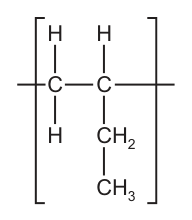
Which row shows the monomer and type of polymerisation involved in making this polymer?
Options
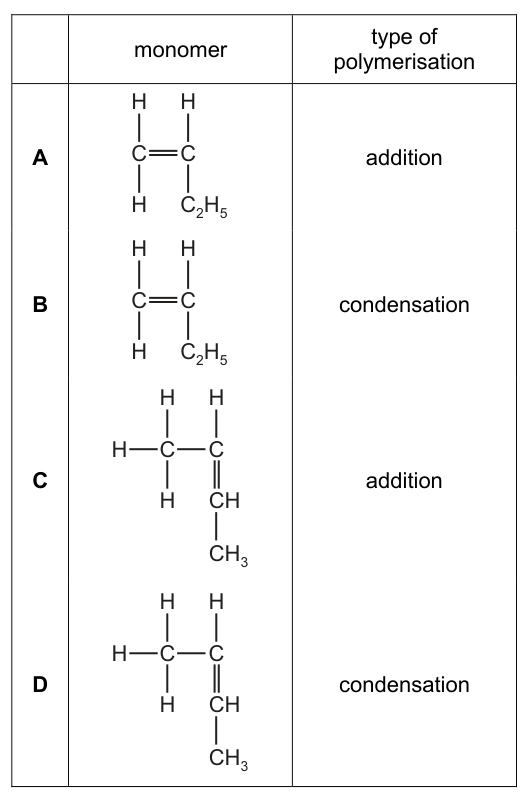
Working
- The repeat unit shows a two-carbon backbone containing only single bonds: one carbon is bonded to two hydrogen atoms () and the other carbon is bonded to one hydrogen atom and an ethyl group ().
- To form the monomer, replace the single bond between the two main chain carbons with a double bond and remove the extending open bonds, giving (but-1-ene).
- Since the polymer is formed from alkene monomers joining together without the loss of any small molecules, the reaction is addition polymerisation.
Answer
A
A
Walkthrough
-
Identify the type of polymerisation:
- The polymer backbone consists entirely of carbon-carbon single bonds with no other functional groups (like ester or amide linkages) and no loss of small molecules (such as ). Therefore, this is an addition polymer formed by addition polymerisation.
- This eliminates options B and D (which incorrectly state condensation polymerisation).
-
Identify the monomer structure:
- To find the monomer of an addition polymer, locate the two adjacent carbon atoms forming the repeat unit backbone:
- Add a double bond between these two backbone carbons and remove the extending polymer bonds:
- This is but-1-ene, which matches the structure given in option A.
- Option C shows but-2-ene (), whose repeat unit would be , which is incorrect.
- To find the monomer of an addition polymer, locate the two adjacent carbon atoms forming the repeat unit backbone:
Thus, row A is the correct answer.
Key Takeaways
- In addition polymerisation, alkene monomers join together by breaking their carbon-carbon double bonds () to form long chains with a continuous carbon-carbon single bond () backbone.
- To find the monomer from a given addition polymer repeat unit:
- Isolate the two-carbon backbone unit.
- Put a double bond between the two carbon atoms.
- Keep all side groups/atoms unchanged on their respective carbons.
Common Mistakes
- Confusing addition polymerisation with condensation polymerisation (condensation involves the loss of a small molecule like water and typically produces polyesters or polyamides).
- Incorrectly identifying the position of the double bond (e.g., choosing but-2-ene instead of but-1-ene).
Things to Be Careful About
- Ensure the number of carbon atoms on the side chain and main chain matches between the monomer and the repeat unit. Here, is an ethyl group ().
Which piece of apparatus is used to measure the volume of acid required to neutralise of alkali in a titration?
Options
A beaker
B burette
C measuring cylinder
D volumetric pipette
Working
- A burette is used in a titration to accurately deliver and measure variable volumes of liquid added dropwise until the end-point is reached.
- A volumetric pipette is used to measure an exact, fixed volume of liquid (such as of alkali), not a variable volume added incrementally.
- A measuring cylinder and beaker do not provide the precision required for titration analysis.
Therefore, the correct apparatus is the burette.
Answer
B
B
Walkthrough
In an acid-base titration:
- A volumetric pipette is used to accurately measure and transfer a single fixed volume of solution (e.g., of alkali) into a conical flask.
- A burette is used to add the other solution (the acid) incrementally until the indicator shows that neutralisation is complete. The burette allows the candidate to measure a variable volume to an accuracy of .
Hence, the apparatus used to measure the volume of acid added to reach neutralisation is the burette (B).
Key Takeaways
- Burette: Accurately measures variable delivered volumes (graduated in intervals).
- Volumetric pipette: Accurately measures one specific, fixed volume (e.g. ).
- Measuring cylinder: Measures approximate volumes; not precise enough for titrations.
- Beaker: Used for holding and mixing liquids, not for accurate measurement.
Common Mistakes
- Confusing the roles of the pipette and the burette: the pipette measures the fixed starting volume in the flask, while the burette delivers the variable titrant volume.
Things to Be Careful About
- Pay attention to whether the question asks for a fixed volume transfer (pipette) or the variable volume delivered to reach neutralisation (burette).
A mixture contains two solids, X and Y, and no other substances. X and Y are both soluble in water.
The student separates X and Y using two steps.
What is step 2?
Options
A chromatography
B crystallisation
C distillation
D filtration
Working
Both substances and are soluble solids, so dissolving them in water produces a solution containing both dissolved solutes.
- A (chromatography): Chromatography is used to separate different soluble substances dissolved in the same solvent based on their different solubilities and affinities for the stationary phase.
- B (crystallisation): Used to obtain crystals of a solute from a saturated solution, not to cleanly separate two soluble solids from one another at this level.
- C (distillation): Used to separate and collect the liquid solvent from a solution or separate miscible liquids with different boiling points.
- D (filtration): Used to separate an insoluble solid from a liquid. Since both solids have dissolved, both pass straight through the filter paper into the filtrate.
Therefore, chromatography is the correct method for step 2.
Answer
A
A
Walkthrough
When both solids and are added to cold water and stirred (Step 1), both dissolve completely to form an aqueous solution containing two dissolved solutes.
To separate the two dissolved substances:
- Paper chromatography (Option A) separates mixtures of soluble substances based on differences in their partition between the stationary phase (paper) and the mobile phase (water/solvent). As the solvent moves up the paper, the two solutes travel at different rates, effectively separating them.
- Crystallisation (Option B) is used to obtain a pure solid solute from a single-solute solution, but does not effectively separate two dissolved solids without more complex fractional crystallisation techniques.
- Distillation (Option C) separates the solvent (water) from the non-volatile solutes, leaving both solids mixed together in the flask.
- Filtration (Option D) only works when one solid is insoluble; since both and are soluble, they will both pass through the filter paper in the filtrate.
Key Takeaways
- Filtration separates an insoluble solid from a liquid.
- Crystallisation / Evaporation separates a dissolved solid from a solution.
- Simple distillation separates a liquid solvent from a solution.
- Chromatography separates a mixture of multiple dissolved solutes.
Common Mistakes
- Choosing filtration because it is a very common two-step separation method (dissolve then filter), forgetting that filtration requires one of the substances to be insoluble in water.
Things to Be Careful About
- Always check the solubility of all components in the mixture: if both dissolve, physical filtration cannot separate them.
Solid J contains cations and chloride ions. The aqueous solution of J is colourless. Two separate samples of the solution are tested.
Aqueous sodium hydroxide added to the first sample produces a white precipitate.
Aqueous ammonia added to the second sample produces a white precipitate.
Which statement about J is correct?
Options
A The cation in J must be .
B The cation in J must be .
C When dilute nitric acid and then aqueous barium nitrate are added to an aqueous solution of J, a white precipitate is formed.
D When dilute nitric acid and then aqueous silver nitrate are added to an aqueous solution of J, a white precipitate is formed.
Working
- The question states that solid contains chloride ions ().
- Testing for chloride ions involves acidifying with dilute nitric acid () followed by adding aqueous silver nitrate (), which produces a white precipitate of silver chloride ():
- Evaluating the options:
- A is incorrect: Cations such as , , , and can all give white precipitates with and without knowing the effect of excess reagent, so it does not have to be .
- B is incorrect: forms a green precipitate, and its solution is pale green, not colourless.
- C is incorrect: Dilute nitric acid and barium nitrate test for sulfate ions (), not chloride ions.
- D is correct: The test for chloride ions gives a white precipitate with acidified silver nitrate.
Answer
D
D
Walkthrough
- Identify the anion present: The question explicitly states that solid contains chloride ions ().
- Recall the qualitative test for halides/chloride:
- To test for aqueous chloride ions, the solution is acidified with dilute nitric acid (to eliminate carbonate ions that might also form a precipitate) and aqueous silver nitrate is added.
- Chloride ions react with silver ions to form an insoluble white precipitate of silver chloride, :
- Evaluate the options:
- Option A: Both , , , and give a white precipitate with limited and limited aqueous ammonia. Without observing what happens in excess reagent, we cannot uniquely conclude the cation is .
- Option B: gives a green precipitate with and aqueous ammonia; its solution is also typically pale green, not colourless.
- Option C: Barium nitrate is used to test for sulfate ions (), which would form insoluble . Solid contains chloride ions, not sulfate ions.
- Option D: Acidified aqueous silver nitrate forms a white precipitate with chloride ions, making this statement definitively true.
Key Takeaways
- The standard qualitative test for chloride ions () is acidification with dilute followed by the addition of aqueous , yielding a white precipitate of .
- Barium nitrate (acidified with dilute nitric acid) is the test reagent for sulfate ions ().
- Deducing a specific cation with a white precipitate requires observing solubility in excess and excess .
Common Mistakes
- Confusing the reagent for the halide test () with the reagent for the sulfate test ( / ).
- Jumping to a specific cation conclusion (e.g., ) without enough data regarding behaviour in excess alkali.
Things to Be Careful About
- Always note that tests for anions require acidification with dilute nitric acid () to prevent false positive precipitates from carbonate ions ().
Solid Q reacts with dilute hydrochloric acid, producing a gas that turns limewater milky.
Warming solid Q with aqueous sodium hydroxide produces a gas that turns damp red litmus paper blue.
What is solid Q?
Options
A ammonium carbonate
B ammonium nitrate
C calcium carbonate
D calcium nitrate
Working
- Reaction 1: Solid reacts with dilute hydrochloric acid to produce a gas that turns limewater milky. The gas is carbon dioxide (), which confirms that contains the carbonate ion ().
- Reaction 2: Warming solid with aqueous sodium hydroxide produces an alkaline gas that turns damp red litmus paper blue. The gas is ammonia (), which confirms that contains the ammonium ion ().
Combining the cation and anion identifies solid as ammonium carbonate.
Answer
A
A
Walkthrough
-
Identify the anion: When a substance reacts with a dilute acid (such as ) to produce carbon dioxide (), which turns limewater (aqueous calcium hydroxide) cloudy/milky by forming a precipitate of , the anion present is the carbonate ion ().
- This eliminates option B (ammonium nitrate) and option D (calcium nitrate).
-
Identify the cation: When an ammonium salt is warmed with a strong alkali (such as ), ammonia gas () is evolved:
Ammonia is the only common alkaline gas tested at O Level, and it turns damp red litmus paper blue. This confirms that solid contains the ammonium ion ().
- Calcium salts do not produce an alkaline gas when warmed with sodium hydroxide, eliminating option C.
-
Conclusion: Solid is ammonium carbonate, .
Key Takeaways
- Carbonates react with acids to form a salt, water, and carbon dioxide gas (tested by bubbling through limewater).
- Ammonium salts react with warm aqueous alkalis to release ammonia gas (tested using damp red litmus paper, which turns blue).
Common Mistakes
- Confusing the test for nitrate ions with the test for ammonium ions: testing for nitrate requires adding aluminium foil/powder in addition to sodium hydroxide and warming.
- Forgetting that the red litmus paper must be damp so that ammonia gas can dissolve and form ions to cause the colour change.
Things to Be Careful About
- Ensure both qualitative tests are satisfied: identifying only the carbonate might tempt a candidate to choose calcium carbonate (C), while identifying only the ammonium ion might lead to ammonium nitrate (B).
Your score so far
Answer a question to start scoring
Your marks add up here as you work through the paper.