Chemistry 5070/11 — October/November 2025
Cambridge O-Level · Multiple Choice · answer key with instant marking and worked solutions
Topics Atoms, Elements and Compounds · Organic Chemistry · Stoichiometry · Acids, Bases and Salts · The Periodic Table · Metals · +6 more
Tap an option under each question to check it — your score builds as you go.
The pressure of a sample of air is reduced and its temperature remains constant.
Which row describes the changes in the volume of the air and the distance between the particles in the air?
Options
| volume of air | distance between the particles in the air | |
|---|---|---|
| A | decreases | decreases |
| B | decreases | increases |
| C | increases | decreases |
| D | increases | increases |
Working
- At constant temperature, the volume of a fixed mass of gas is inversely proportional to its pressure ().
- When pressure is reduced, the gas expands, so the volume of the air increases.
- As the volume increases, the same number of gas particles occupy a larger space, so the average distance between the particles increases.
Matching row:
- volume of air: increases
- distance between the particles in the air: increases
This corresponds to option D.
Answer
D
D
Walkthrough
- Effect of pressure on volume: For a fixed mass of gas at constant temperature, pressure and volume are inversely related. Reducing the external pressure allows the gas particles to push outward until the internal and external pressures balance, causing the gas to expand. Therefore, the volume of the air increases.
- Effect on particle separation: The total number of particles (molecules of nitrogen, oxygen, etc.) remains constant. When these particles spread out to occupy a larger total volume, the mean distance separating individual particles must increase.
Combining both conclusions identifies row D as the correct answer.
Key Takeaways
- For gases at constant temperature, decreasing pressure leads to an increase in volume (gas expansion).
- In an expanded gas volume, particles are spread further apart, increasing the average inter-particle distance.
Common Mistakes
- Confusing direct and inverse relationships: thinking a decrease in pressure causes a decrease in volume.
- Believing that changing pressure alters the size of individual particles rather than the empty space (distance) between them.
Things to Be Careful About
- Check whether the question states pressure is increased or reduced, and whether temperature is kept constant.
Which substance would diffuse most quickly?
Options
A carbon dioxide at
B carbon dioxide at
C neon at
D neon at
Working
-
The rate of diffusion of a gas depends on two factors:
- Relative molecular / atomic mass ( or ): Gases with a lower relative mass diffuse faster because their particles move faster at any given temperature. Since , neon () diffuses faster than carbon dioxide ().
- Temperature: At a higher temperature, particles have higher average kinetic energy and therefore diffuse more quickly ().
-
Combining both factors, neon at has the lowest relative mass and the highest temperature, so it diffuses most quickly.
Answer
D
D
Walkthrough
Diffusion is the net movement of particles from a region of higher concentration to a region of lower concentration down a concentration gradient, as a result of their random thermal motion.
Two factors determine the speed at which a gas diffuses:
-
Mass of the particles ( or ): Lighter particles have higher average velocities than heavier particles at the same temperature. Comparing the two gases:
- For carbon dioxide ():
- For neon ():
Because neon has a significantly lower relative atomic mass than carbon dioxide's relative molecular mass, neon particles diffuse faster.
-
Temperature: As temperature increases, gas particles gain kinetic energy, causing them to move faster. Therefore, diffusion is faster at than at .
To find the substance that diffuses most quickly, we choose the lighter gas at the higher temperature: neon at (Option D).
Key Takeaways
- Rate of diffusion : Lower relative molecular/atomic mass results in a faster rate of diffusion.
- Rate of diffusion : Higher temperature provides greater kinetic energy, resulting in faster particle movement and higher rate of diffusion.
Common Mistakes
- Forgetting that noble gases like neon exist as monatomic gases (, ) rather than diatomic molecules.
- Assuming higher density or heavier molecules have more momentum and therefore diffuse faster (a common physics misconception; in reality, smaller/lighter particles move faster at the same kinetic energy).
Things to Be Careful About
- Check both variables (mass and temperature) systematically before selecting the option.
- Ensure you calculate accurately using values from the Periodic Table (, , ).
The main component of mineral X is calcium carbonate, .
X also contains tiny grains of silicon(IV) oxide, .
There are no other substances in X.
Which row shows two correct statements about X?
Options
| statement 1 | statement 2 | |
|---|---|---|
| A | X is a compound | X contains exactly four different elements |
| B | X is a compound | X contains exactly five different elements |
| C | X is a mixture | X contains exactly four different elements |
| D | X is a mixture | X contains exactly five different elements |
Working
-
Determine whether X is a compound or a mixture:
- Mineral X contains two distinct substances, calcium carbonate () and silicon(IV) oxide (), that are physically combined without chemical bonding between them.
- Therefore, X is a mixture.
-
Determine the number of different elements in X:
- In , the elements are calcium (), carbon (), and oxygen ().
- In , the elements are silicon () and oxygen ().
- Listing the unique elements gives: , , , and , which is exactly four different elements.
Combining these two deductions gives row C.
Answer
C
C
Walkthrough
To find the correct row, we evaluate both statements in turn:
-
Statement 1: Compound vs Mixture
- A compound is a single substance formed from two or more elements chemically combined in fixed proportions.
- A mixture contains two or more different substances (elements or compounds) that are not chemically bonded together.
- Because mineral X consists of calcium carbonate () containing grains of silicon(IV) oxide (), it is composed of two separate chemical compounds. This makes mineral X a mixture.
- This eliminates options A and B.
-
Statement 2: Number of different elements
- Break down each chemical formula into its constituent elements:
- contains calcium (), carbon (), and oxygen ().
- contains silicon () and oxygen ().
- Count the total number of distinct elements present: , , , and . Since oxygen is present in both compounds, it is only counted once.
- Thus, there are exactly different elements present in X.
- This eliminates option D.
- Break down each chemical formula into its constituent elements:
Therefore, row C is correct.
Key Takeaways
- A mixture consists of two or more substances that can be present in varying proportions and are not chemically bonded together.
- When counting the number of different elements in a mixture or complex substance, identify each unique chemical symbol and avoid double-counting elements shared between compounds.
Common Mistakes
- Counting the total number of element symbols across both formulae () instead of counting unique elements, forgetting that oxygen () is present in both and .
- Confusing the terms mixture and compound, mistaking the mineral as a whole for a single chemical compound.
Things to Be Careful About
- Element symbols consist of either a single capital letter (e.g., , ) or a capital letter followed by a lowercase letter (e.g., , ). Ensure that two-letter symbols like are recognised as one element (calcium) rather than two separate elements.
The structure of hydroxylamine, , is shown.
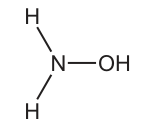
Which row about hydroxylamine is correct?
Options
| total number of electrons in the molecule | number of electrons in the bonds of the molecule | |
|---|---|---|
| A | 14 | 8 |
| B | 14 | 6 |
| C | 18 | 8 |
| D | 18 | 6 |
Working
-
Total number of electrons in :
- has atomic number 7:
- has atomic number 1:
- has atomic number 8:
-
Number of electrons in the bonds:
- There are two single bonds, one single bond, and one single bond in the group, giving a total of 4 single covalent bonds.
- Each single bond contains 1 pair of electrons (2 electrons).
Therefore, row C is correct.
Answer
C
C
Walkthrough
To find the correct row, we evaluate both columns separately:
-
Total number of electrons in the molecule:
- A neutral atom contains a number of electrons equal to its proton number (atomic number).
- From the Periodic Table:
- Nitrogen () has atomic number 7
- Hydrogen () has atomic number 1 each ()
- Oxygen () has atomic number 8
- Total electrons in .
- This eliminates options A and B (which only counted valence electrons: ).
-
Number of electrons in the bonds of the molecule:
- Each single covalent bond is formed by a shared pair of electrons (2 electrons).
- Hydroxylamine contains:
- bonds
- bond
- bond (the bond between and in the hydroxyl group is often written condensed as , but is still a single covalent bond)
- Total single bonds .
- Number of bonding electrons .
Matching both results (18 total electrons, 8 bonding electrons) leads directly to option C.
Key Takeaways
- The total number of electrons in a neutral molecule is the sum of the atomic numbers (proton numbers) of all constituent atoms, not just the outer-shell (valence) electrons.
- A single covalent bond consists of 2 electrons (one shared pair).
- Groups written in condensed form such as contain an internal covalent bond (the single bond) that must be included when counting bonds.
Common Mistakes
- Confusing the total number of electrons with the total number of valence (outer-shell) electrons (), which leads incorrectly to option A or B.
- Overlooking the covalent bond between oxygen and hydrogen in the group, counting only 3 visible bond lines in the diagram and concluding there are bonding electrons, leading to option D.
Things to Be Careful About
- Ensure all bonds are counted when functional groups are written as , , or .
- Double-check atomic numbers from the Periodic Table rather than using relative atomic masses ().
Metals lose electrons when they combine with a non-metal to form an ionic compound.
Calcium combines with hydrogen to form the ionic compound calcium hydride, .
How many electrons are there in the outer shell of each of the two hydride ions in ?
Options
A 0
B 1
C 2
D 4
Working
- A neutral hydrogen atom has proton and electron, giving it an electronic configuration of .
- Calcium is in Group II and loses valence electrons to form a calcium ion, .
- In , each of the two hydrogen atoms gains electron from the calcium atom to form a hydride ion, .
- Gaining electron gives each hydride ion electrons in its first (outer) shell, achieving a stable helium-like configuration ().
- Option A () represents a hydrogen ion (proton, ), not a hydride ion ().
- Option B () is the number of electrons in a neutral hydrogen atom.
- Option D () is incorrect as the first shell can hold a maximum of only electrons.
Answer
C
C
Walkthrough
When a metal reacts with a non-metal to form an ionic compound, the metal atom transfers electrons to the non-metal atom:
- Calcium () has an atomic number of and an electronic configuration of . It loses its outer-shell electrons to form a ion with a stable noble gas configuration ().
- Hydrogen () has electron in its first electron shell. To complete this shell (which has a maximum capacity of electrons, like helium), each hydrogen atom accepts electron from calcium.
- The resulting ion is the hydride ion, , which possesses electrons in its outer (and only) shell.
Therefore, each hydride ion in has electrons in its outer shell, corresponding to option C.
Key Takeaways
- When hydrogen acts as a non-metal in metal hydrides, it gains an electron to form the hydride ion, .
- The first electron shell holds a maximum of electrons (a complete duplet, matching the electron configuration of helium).
Common Mistakes
- Confusing the hydride ion (, with electrons) with the hydrogen ion/proton (, with electrons).
- Thinking the outer shell always requires an octet ( electrons), forgetting that hydrogen's outer shell is the first shell, which is full with electrons.
Things to Be Careful About
- Pay attention to the prefix/suffix: "hydride" refers to the negative anion , whereas "hydrogen ion" commonly refers to .
What is a property of diamond?
Options
A It can be used as a lubricant.
B It has a melting point below .
C It has good electrical conductivity.
D It is extremely hard.
Working
- A is incorrect: graphite, not diamond, is used as a lubricant because its layers can slide over each other.
- B is incorrect: diamond has a very high melting point () due to strong covalent bonds extending in three dimensions throughout the giant lattice.
- C is incorrect: diamond is an electrical insulator because all four outer electrons of each carbon atom are localised in covalent bonds, leaving no delocalised electrons to carry charge.
- D is correct: diamond has a rigid, three-dimensional tetrahedral lattice of strong covalent bonds, making it extremely hard.
Answer
D
D
Walkthrough
Diamond is an allotrope of carbon with a giant covalent macromolecular structure:
- Each carbon atom forms four strong covalent bonds with four other carbon atoms in a rigid, tetrahedral arrangement.
- Because breaking this rigid network requires a vast amount of energy, diamond is extremely hard and has a very high melting and boiling point.
- All valence electrons are held in single covalent bonds, meaning there are no free or delocalised electrons to carry an electrical current (unlike graphite, which has delocalised electrons and acts as a good conductor).
- The lubricant property also belongs to graphite, where weak intermolecular forces between layers allow the layers to slide over one another easily.
Therefore, the only correct property listed for diamond is that it is extremely hard (D).
Key Takeaways
- Diamond: Giant covalent structure; 4 covalent bonds per carbon; tetrahedral lattice; extremely hard; high melting point; electrical insulator.
- Graphite: Giant covalent structure; 3 covalent bonds per carbon (forming hexagonal layers) with 1 delocalised electron per carbon; conducts electricity; soft and slippery (used as a lubricant).
Common Mistakes
- Confusing the properties of diamond with those of graphite (such as electrical conductivity and use as a lubricant).
- Thinking non-metals universally have low melting points; giant covalent structures (diamond, graphite, silicon dioxide) have very high melting points.
Things to Be Careful About
- Ensure you attribute electrical conductivity and softness/lubrication specifically to graphite due to its layered structure and delocalised electrons, whereas diamond's 4-bond tetrahedral arrangement makes it hard and an electrical insulator.
Which statement about the bonding in copper is correct?
Options
A Copper atoms are attracted to a ‘sea’ of delocalised electrons.
B Copper atoms are attracted to a shared pair of electrons.
C Copper ions are attracted to a ‘sea’ of delocalised electrons.
D Copper ions are attracted to a shared pair of electrons.
Working
- Copper is a metal and has metallic bonding.
- Metallic bonding is the electrostatic attraction between a regular lattice of positive metal ions (cations) and a 'sea' of delocalised electrons.
- Therefore, copper ions are attracted to a 'sea' of delocalised electrons.
Option analysis:
- A is incorrect because the lattice consists of positive copper ions, not neutral atoms.
- B and D are incorrect because a shared pair of electrons describes covalent bonding, not metallic bonding.
- C correctly identifies the attraction between copper ions and the delocalised electrons.
Answer
C
C
Walkthrough
Metallic bonding is found in pure metals like copper () and in alloys. In a metallic lattice, metal atoms lose their outer shell electrons to form positively charged ions (cations). These delocalised outer-shell electrons are free to move throughout the entire structure, forming a mobile 'sea' of electrons. The metallic bond itself is defined as the strong electrostatic attraction between the positively charged metal ions and the negatively charged delocalised electrons.
- Statement A is wrong because the species in the lattice are positive ions, having already released their outer valence electrons into the delocalised sea, not neutral atoms.
- Statements B and D describe covalent bonding (the attraction of nuclei to a shared pair of electrons), which occurs between non-metal atoms, not in metals.
- Statement C accurately describes metallic bonding.
Key Takeaways
- Metallic bonding involves a regular lattice of positive metal ions embedded in a 'sea' of delocalised electrons.
- Covalent bonding involves a shared pair of electrons between non-metal atoms.
- Ionic bonding involves electrostatic attraction between oppositely charged ions.
Common Mistakes
- Confusing metal atoms with metal ions; in a metal crystal lattice, valence electrons are delocalised, leaving positive metal cations.
- Mixing up the terminology of covalent bonding ('shared pair of electrons') with metallic bonding ('delocalised electrons').
Things to Be Careful About
- Pay close attention to keywords in definition questions: distinguish clearly between atoms, ions, and molecules.
Aluminium ions, , react with sulfate ions, , to form aluminium sulfate.
Which row shows the correct empirical formula and ionic formula of aluminium sulfate?
Options
| empirical formula | ionic formula | |
|---|---|---|
| A | ||
| B | ||
| C | ||
| D |
Working
To form a neutral compound between and , the total positive and negative charges must balance:
Therefore, the ionic formula is (or ).
Counting the individual atoms in this formula unit gives:
- aluminium atoms:
- sulfur atoms:
- oxygen atoms:
The ratio of is , which cannot be simplified further. Thus, the empirical formula is .
Matching with the table gives row C.
Answer
C
C
Walkthrough
-
Determine the ionic formula:
- Aluminium forms ions.
- Sulfate is a polyatomic ion with the formula .
- In any stable ionic compound, the sum of all positive and negative charges must equal zero.
- The lowest common multiple of and is . Thus, we need two ions () and three ions ().
- Written showing the ions, this is .
-
Determine the empirical formula:
- The empirical formula is the simplest whole-number ratio of the elements in the compound.
- Expanding the formula unit gives , , and .
- The simplest integer ratio of is , making the empirical formula .
-
This correctly corresponds to option C.
Key Takeaways
- For an ionic compound to be electrically neutral, the total positive charge must equal the total negative charge.
- The empirical formula gives the simplest whole-number ratio of all atoms of each element in the substance.
- When expanding polyatomic groups with subscripts (like ), multiply the subscript inside the brackets by the subscript outside the brackets ( oxygen atoms).
Common Mistakes
- Forgetting to multiply the number of oxygen atoms by the outer bracket subscript (e.g., mistakenly thinking there are only or oxygen atoms).
- Swapping the charges of the cation and anion (e.g., thinking is and is as in distractor D).
- Omitting the need to balance charges (e.g., ratio in distractor A).
Things to Be Careful About
- Ensure subscripts outside the brackets apply to every atom inside the bracket: in , there are sulfur atoms and oxygen atoms.
Which statement is correct?
Options
A The concentration of a solution is expressed in .
B The empirical formula of a compound always gives the actual numbers of each type of atom in one molecule.
C The molecular formula of a compound always contains more atoms than the empirical formula.
D The relative atomic mass of an element is .
Working
- A is incorrect: Concentration is measured in or , not .
- B is incorrect: The empirical formula gives the simplest whole-number ratio of atoms of each element in a compound, whereas the molecular formula gives the actual numbers of atoms.
- C is incorrect: In compounds where the simplest ratio equals the molecular formula (e.g. , , ), the molecular formula contains the same number of atoms as the empirical formula, not more.
- D is correct: Relative atomic mass, , is defined as the average mass of naturally occurring atoms of an element compared to of the mass of an atom of carbon-12.
Answer
D
D
Walkthrough
Let us evaluate each option systematically:
-
Option A: Concentration is defined as the amount of solute per unit volume of solution. Therefore, its standard units are or . The given unit is inverted (it represents molar volume).
-
Option B: This statement gives the definition of the molecular formula, not the empirical formula. The empirical formula is defined as the simplest whole-number ratio of the elements in a compound.
-
Option C: The molecular formula is an integer multiple () of the empirical formula. When (such as in , , and ), the molecular formula is identical to the empirical formula and contains the exact same number of atoms, so it does not always contain more atoms.
-
Option D: This correctly states the standard IUPAC and Cambridge O Level definition of relative atomic mass (), which is the ratio of the average mass of one atom of the element to of the mass of one carbon-12 atom.
Hence, statement D is the correct choice.
Key Takeaways
- Relative Atomic Mass (): The average mass of naturally occurring atoms of an element on a scale where the carbon-12 atom has a mass of exactly 12 units.
- Empirical Formula: The simplest whole-number ratio of atoms of each element in a compound.
- Molecular Formula: The actual number of atoms of each element present in one molecule of a compound.
- Concentration: The amount of substance in moles (or mass in grams) dissolved in of solution ( or ).
Common Mistakes
- Confusing the definitions of empirical formula and molecular formula.
- Assuming the molecular formula is always larger than the empirical formula, forgetting cases where the molecular formula cannot be simplified further (i.e. ).
- Forgetting that the carbon-12 standard is based on the mass of a single atom.
Things to Be Careful About
- Watch out for absolute words like always in multiple choice options, as counter-examples often disprove them.
- Keep units clear: volume is in , moles are in , so concentration is .
How many atoms are there in of water, ?
Options
A
B
C
D
Working
- Calculate the relative molecular mass () of :
- Calculate the number of moles of molecules:
- Determine the total number of atoms:
Each molecule of contains atoms ( hydrogen atoms and oxygen atom).
This matches option C.
Answer
C
C
Walkthrough
To find the total number of atoms in a given mass of a compound, follow these steps:
-
Find the molar mass () of water ():
- Relative atomic mass of
- Relative atomic mass of
-
Find the number of moles of water molecules:
-
Count the atoms per formula unit:
- Each water molecule contains two hydrogen atoms and one oxygen atom, which is a total of atoms per molecule.
- Therefore, the number of moles of atoms is .
-
Calculate the total number of individual atoms:
- Using the Avogadro constant ():
- .
Hence, option C is correct.
Key Takeaways
- Always distinguish between molecules and atoms when dealing with mole calculations for covalent compounds.
- To find the number of particles, multiply the number of moles by the Avogadro constant (). If finding total atoms, multiply further by the number of atoms per molecule.
Common Mistakes
- Option A (): Calculates only the number of molecules () without multiplying by atoms per molecule.
- Option B (): Accounts for only the hydrogen atoms () and forgets the oxygen atom.
- Option D (): Multiplies incorrectly by instead of .
Things to Be Careful About
- Ensure you read whether the question asks for the number of molecules or the number of atoms.
- Be precise with scientific notation powers of .
A mixture of sodium hydrogencarbonate and sodium chloride is heated.
The equation for the reaction that takes place when sodium hydrogencarbonate is heated is shown.
Sodium chloride is unchanged on heating.
When of the mixture is heated, the loss in mass is .
What is the percentage by mass of sodium hydrogencarbonate in the mixture?
[relative molecular mass, : , 84; , 106; , 44; , 18]
Options
A 34%
B 48%
C 68%
D 95%
Working
According to the balanced equation:
The loss in mass is due to the gases that escape: and .
Mass of gases produced per of decomposed:
Mass of of :
Therefore, of produces of gas (loss in mass).
Using the given mass loss of :
Calculate the percentage by mass of in the mixture:
Answer
C
C
Walkthrough
-
Identify what causes the mass loss: In the thermal decomposition of sodium hydrogencarbonate, the products are solid , gaseous , and gaseous . Since sodium chloride does not react or decompose, the loss in mass () corresponds entirely to the total mass of the escaped gases, .
-
Determine the mass relationship from stoichiometry:
- of has a mass of .
- Decomposing of yields of () and of (), giving a total mass loss of .
-
Calculate the mass of in the mixture:
- Calculate percentage by mass:
This matches option C.
Key Takeaways
- When a reaction mixture loses mass upon heating in an open container, the loss in mass is equal to the mass of all gaseous products formed.
- You must account for all gases released (here both and ), not just one of them.
- Percentage by mass in a mixture is calculated as .
Common Mistakes
- Forgetting that water is produced as steam (gas) and assuming only escapes, which leads to using instead of and finding an incorrect mass.
- Forgetting the stoichiometric coefficient of in front of , using instead of (which yields , corresponding to distractor A).
Things to Be Careful About
- Check state symbols carefully: means it is in the gas phase and escapes the container along with .
- Keep unrounded intermediate numbers in your calculator before converting to the final percentage to avoid rounding discrepancies.
Electrolysis is used to plate a metal statue with silver.
The statue is an electrode in a suitable electrolyte.
Which row is correct?
Options
| statue | electrolyte | |
|---|---|---|
| A | cathode | |
| B | cathode | |
| C | anode | |
| D | anode |
Working
- In electroplating, the object to be plated (the statue) must act as the cathode (the negative electrode), so that positive metal ions () migrate towards it and are reduced to form a coating of metal:
- The electrolyte must be a solution containing ions of the plating metal (silver). According to solubility rules, all nitrates are soluble, so aqueous silver nitrate, , is a suitable electrolyte. Silver chloride, , is insoluble in water and cannot form an aqueous solution .
Therefore, the statue is the cathode and the electrolyte is .
Answer
B
B
Walkthrough
To solve this question, we must apply two fundamental concepts of electroplating:
- Role of the electrodes in electroplating:
- Electroplating involves depositing a layer of metal onto an object.
- The metal to be deposited exists in the electrolyte as positive cations (here, ).
- Positive ions (cations) are attracted to the negative electrode, which is the cathode.
- At the cathode, reduction takes place as silver ions gain electrons to form solid silver atoms:
- Therefore, the object to be plated (the statue) must be connected to the negative terminal as the cathode.
- Choice of a suitable electrolyte:
- The electrolyte must be an aqueous solution containing the ions of the plating metal ().
- From the solubility rules, all common nitrates are soluble in water, making an ideal aqueous electrolyte.
- Silver chloride () is an insoluble precipitate, so it cannot provide a suitable aqueous electrolyte solution.
Matching these two requirements gives row B.
Key Takeaways
- In electroplating:
- The object to be plated is made the cathode (negative electrode).
- The plating metal is made the anode (positive electrode) so it can dissolve and replenish the solution.
- The electrolyte must be a soluble salt containing ions of the plating metal.
- All nitrates are soluble in water; halides of silver (, , ) are insoluble.
Common Mistakes
- Confusing the cathode and anode: candidates often mistakenly think the object is the anode because they confuse which electrode attracts positive ions.
- Overlooking the solubility of silver salts: selecting without realising that is insoluble in water.
Things to Be Careful About
- Always check both columns in electroplating tables: the electrode assignment (cathode vs anode) and the chemical validity of the electrolyte (soluble vs insoluble compound).
Which row is correct?
Options
| purpose of hydrogen–oxygen fuel cell | chemical product of hydrogen–oxygen fuel cell | |
|---|---|---|
| A | to recycle waste | hydrogen |
| B | to recycle waste | water |
| C | to produce electrical energy | hydrogen |
| D | to produce electrical energy | water |
Working
- Purpose: A hydrogen–oxygen fuel cell is an electrochemical cell that reacts hydrogen fuel with oxygen to produce electrical energy directly and continuously.
- Chemical Product: The overall reaction occurring in the fuel cell is the oxidation of hydrogen:
Therefore, the only chemical product is water ().
- Options A and B incorrectly state the purpose as recycling waste.
- Option C incorrectly lists hydrogen as a product (hydrogen is the reactant fuel).
- Option D correctly identifies both the purpose (producing electrical energy) and the product (water).
Answer
D
D
Walkthrough
A fuel cell is an electrochemical device that converts chemical energy from a fuel directly into electrical energy through redox reactions.
In a hydrogen–oxygen fuel cell:
- Hydrogen gas () is supplied at the anode, where it is oxidised.
- Oxygen gas () is supplied at the cathode, where it is reduced.
- The electrons flow through an external circuit, generating an electric current (electrical energy).
- The hydrogen and oxygen combine to produce pure water () as the only chemical product:
Because its primary function is the continuous generation of electricity and its sole reaction product is water, row D is the correct answer.
Key Takeaways
- A fuel cell's main purpose is to produce electrical energy from chemical energy.
- The only chemical product formed in a hydrogen–oxygen fuel cell is water (), making it non-polluting at the point of use.
- Unlike rechargeable batteries, a fuel cell does not store electrical energy; it produces electricity continuously as long as fuel and oxygen are supplied.
Common Mistakes
- Confusing reactants with products: confusing hydrogen (the fuel reactant) with the product (water).
- Confusing fuel cells with waste management or recycling systems.
Things to Be Careful About
- Ensure you distinguish between simple chemical cells, rechargeable secondary cells, and fuel cells: fuel cells require a continuous external supply of reactants.
Some bond energy data are given in the table.
| bond | bond energy in |
|---|---|
| O–O | 150 |
| O=O | 496 |
| O–H | 460 |
| N–H | 390 |
| N–N | 160 |
| N=N | 410 |
| N≡N | 944 |
| H–H | 436 |
Hydrazine, , reacts with oxygen, as shown.
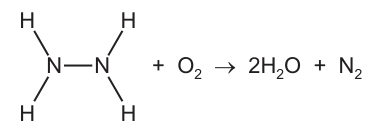
A value for the enthalpy change, , of this reaction is calculated by selecting and using data from the table.
What is the value of ?
Options
A
B
C
D
Working
-
Identify and calculate the energy required to break bonds in reactants (endothermic):
- In :
- In :
-
Identify and calculate the energy released when bonds form in products (exothermic):
- In :
- In :
-
Calculate the enthalpy change, :
Answer
B
B
Walkthrough
To calculate the overall enthalpy change () of a reaction from bond energies, follow these three steps:
-
Calculate the energy required to break all the bonds in the reactants:
- Bond breaking is an endothermic process (takes in energy, ).
- Looking at hydrazine (), there are single bonds and single bond:
- Oxygen gas () contains one double bond ():
- Total energy absorbed .
-
Calculate the energy released when all new bonds form in the products:
- Bond making is an exothermic process (releases energy, ).
- Two water molecules () contain a total of single bonds:
- A nitrogen molecule () contains one triple bond ():
- Total energy released .
-
Calculate :
Thus, option B is correct.
Key Takeaways
- Bond breaking is endothermic (requires energy input); bond making is exothermic (releases energy).
- .
- Be careful to identify the correct bond order: has a double bond (), and has a triple bond ().
Common Mistakes
- Selecting the wrong bond from the table (e.g., using instead of for , or / instead of for ).
- Forgetting that contains bonds in total, not 2.
- Inverting the formula to calculate , which gives (wrong sign for an exothermic reaction).
Things to Be Careful About
- Always count all individual bonds using the displayed formula and stoichiometric balancing coefficients.
- Check the sign: since more energy is released in bond formation () than is required for bond breaking (), the overall reaction must be exothermic (negative ).
The rate of reaction between calcium carbonate and dilute hydrochloric acid is measured in three separate experiments.
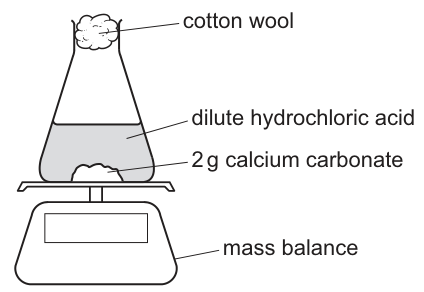
In experiment 1, the calcium carbonate is powdered, and an excess of hydrochloric acid is used.
In experiment 2, the calcium carbonate is in lumps, and an excess of hydrochloric acid is used.
In experiment 3, the calcium carbonate is in lumps, less hydrochloric acid is used, and the calcium carbonate is in excess.
The results of these experiments are shown.
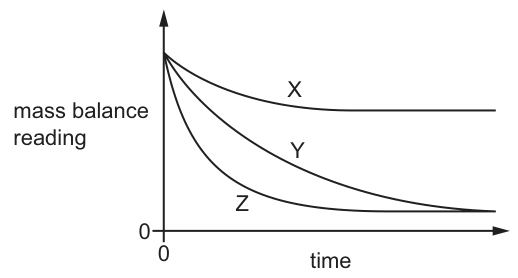
Which statement is correct?
Options
A Experiment 1 is shown by curve X.
B Experiment 1 is shown by curve Y.
C Experiment 2 is shown by curve Y.
D Experiment 3 is shown by curve Z.
Working
-
Determine the total mass of lost (final balance reading):
- In Experiment 1 and Experiment 2, calcium carbonate () is the limiting reactant because dilute hydrochloric acid is in excess. Both experiments consume the same amount of , producing the same total volume and mass of . Thus, their curves (Y and Z) must level off at the same final, lower mass balance reading.
- In Experiment 3, less hydrochloric acid is used and is the limiting reactant (calcium carbonate is in excess). Less is produced, meaning less mass is lost, so the balance reading levels off at a higher mass value. Therefore, Experiment 3 is curve X.
-
Determine the initial rate of reaction (steepness of curve):
- Experiment 1 uses powdered , which has a greater surface area than lumps, resulting in a higher frequency of successful collisions and a faster rate of reaction (steeper drop). Thus, Experiment 1 is curve Z.
- Experiment 2 uses large lumps of , which have a smaller surface area and a slower rate of reaction (less steep drop) than powder, but finishes at the same final mass reading as Experiment 1. Thus, Experiment 2 is curve Y.
- Option A is incorrect (Experiment 1 is Z).
- Option B is incorrect (Experiment 1 is Z).
- Option C is correct (Experiment 2 is Y).
- Option D is incorrect (Experiment 3 is X).
Answer
C
C
Walkthrough
When calcium carbonate reacts with hydrochloric acid, carbon dioxide gas is produced and escapes through the cotton wool plug:
Because gas escapes the flask, the reading on the mass balance decreases over time.
Two key features of the graph allow us to assign each curve:
-
The final horizontal level (extent of reaction):
- In Experiment 1 and Experiment 2, acid is in excess, so all of reacts. They produce the same total mass of , so both curves must finish at the exact same lowest mass balance reading. These are curves Y and Z.
- In Experiment 3, acid is limiting (less acid is used), so less escapes. The final mass of the flask remains higher. Thus, Experiment 3 corresponds to curve X.
-
The initial slope/gradient (rate of reaction):
- Experiment 1 uses powder, giving a greater surface area of contact between solid particles and acid particles. This increases collision frequency, leading to a faster rate (steeper curve, leveling off sooner). Thus, Experiment 1 corresponds to curve Z.
- Experiment 2 uses lumps, which have a smaller surface area, resulting in a lower collision frequency and a slower rate (less steep curve). Thus, Experiment 2 corresponds to curve Y.
Matching with the given options confirms that C is the correct statement.
Key Takeaways
- Surface area: Smaller particle size (powder) increases total surface area exposed, increasing the collision frequency and the rate of reaction (steeper initial gradient).
- Limiting reactant: The amount of the limiting reactant determines the total amount of product formed and hence the final plateau of the curve.
- On a mass loss curve, a faster reaction is represented by a steeper downward slope, and a smaller total mass loss is represented by a curve leveling off higher up on the y-axis.
Common Mistakes
- Confusing a mass loss graph with a gas volume collection graph: in mass loss, curves slope downwards, and a faster reaction drops more steeply towards the bottom.
- Overlooking the limiting reactant in Experiment 3 and assuming it would reach the same mass level as the other two experiments.
Things to Be Careful About
- Ensure you identify which substance is in excess and which is limiting in each experiment to predict the final vertical height of the horizontal plateau.
The equation shows the reversible reaction between nitrogen and hydrogen to form ammonia.
The forward reaction is exothermic.
Which statement is correct when the temperature is increased?
Options
A The activation energy increases.
B The equilibrium shifts to form more ammonia.
C The rate of the forward reaction decreases.
D The rate at which ammonia decomposes increases.
Working
- A is incorrect: Activation energy is a fixed barrier for a particular pathway and is not affected by temperature (it can only be lowered by adding a catalyst).
- B is incorrect: The forward reaction is exothermic. Increasing the temperature favours the endothermic (reverse) reaction, shifting the equilibrium to the left to form less .
- C is incorrect: Increasing temperature provides particles with more kinetic energy, leading to more frequent successful collisions, so the rate of the forward reaction increases.
- D is correct: Increasing temperature increases the rate of both the forward and reverse reactions. Ammonia decomposing is the reverse reaction, so its rate increases.
Answer
D
D
Walkthrough
To determine the correct statement when the temperature is increased, we consider the two separate effects of temperature in chemical reactions:
-
Effect on Reaction Rates (Collision Theory):
- When temperature increases, particles gain kinetic energy and move faster.
- A greater proportion of colliding particles have energy equal to or greater than the activation energy ().
- Consequently, the frequency of effective collisions increases, which increases the rate of both the forward and the backward reactions.
- The decomposition of ammonia is the reverse reaction (), so its rate increases. This makes D correct, and rules out C.
-
Effect on Equilibrium (Le Chatelier's Principle):
- The forward reaction is exothermic (releases heat).
- According to Le Chatelier's principle, increasing the temperature causes the equilibrium to shift in the direction that absorbs heat (the endothermic direction, which is to the left).
- This decreases the yield of ammonia (less is formed), ruling out B.
-
Effect on Activation Energy:
- The activation energy () is an inherent characteristic of the reaction pathway and does not change with temperature. Only the addition of a catalyst changes activation energy. This rules out A.
Key Takeaways
- Temperature always increases reaction rates: Both the forward and reverse reaction rates increase as temperature rises because collisions occur more frequently and with greater energy.
- Equilibrium position vs. Rate: An increase in temperature shifts the equilibrium in the endothermic direction, but the rates of both forward and reverse reactions increase simultaneously (though the endothermic rate increases more until a new equilibrium is reached).
Common Mistakes
- Confusing the shift in equilibrium position with the change in reaction rate (e.g., thinking that because the forward reaction is not favoured at high temperatures, its rate must decrease).
- Thinking that increasing temperature changes the activation energy.
Things to Be Careful About
- Make sure to distinguish between "amount/yield of ammonia" (an equilibrium concept) and "rate of reaction" (a kinetic concept).
Which statement is correct?
Options
A Ethanoic acid is a weak acid because when it is added to excess alkali not all of the ethanoic acid reacts.
B Ethanoic acid is a weaker acid than sulfuric acid because a smaller proportion of its molecules dissociate in aqueous solution.
C Hydrochloric acid is a stronger acid than ethanoic acid because hydrochloric acid always has a higher pH than ethanoic acid.
D Sulfuric acid is a strong acid because it produces two hydrogen ions for every molecule that dissociates.
Working
- A is incorrect: When reacted with an excess of alkali, all ethanoic acid molecules eventually react because neutralisation removes ions, shifting the dissociation equilibrium until completion.
- B is correct: Acid strength refers to the degree of dissociation (or ionisation) into ions in aqueous solution. Ethanoic acid is a weak acid because it only partially ionises/dissociates, whereas sulfuric acid is a strong acid that completely ionises/dissociates.
- C is incorrect: A stronger acid has a lower pH than a weak acid of the same concentration, not a higher pH (and pH also depends on concentration).
- D is incorrect: Producing two ions per molecule means sulfuric acid is dibasic (diprotic), not that it is strong. Its strength is due to full dissociation in water.
Answer
B
B
Walkthrough
An acid is defined by its ability to dissociate and produce hydrogen ions () in aqueous solution.
- Strong acids (such as , , and ) dissociate completely into ions when dissolved in water:
- Weak acids (such as carboxylic acids like ) only partially dissociate in water, establishing a dynamic equilibrium where most molecules remain intact:
Evaluating the options:
- Option A is incorrect because neutralisation is a complete reaction; adding excess base drives the equilibrium to the right until all the acid has reacted.
- Option B correctly describes the definition of acid strength: ethanoic acid is weaker because a smaller proportion of its molecules ionise in solution.
- Option C confuses the pH scale (lower pH means more acidic / higher ) and ignores that pH depends on concentration as well as strength.
- Option D confuses basicity (the number of replaceable hydrogen ions per molecule, i.e., diprotic) with acid strength (completeness of dissociation).
Key Takeaways
- Acid strength is a measure of the extent to which an acid dissociates/ionises in aqueous solution.
- Acid concentration refers to the number of moles of acid per unit volume ().
- Basicity (or proticity) refers to the number of ionisable ions per acid molecule (e.g., is dibasic, is monobasic).
Common Mistakes
- Confusing strength (extent of ionisation) with concentration (amount of solute dissolved in water).
- Confusing dibasic/diprotic nature (number of per molecule) with being a strong acid.
- Forgetting that on the pH scale, lower numbers indicate higher acidity.
Things to Be Careful About
- Even though weak acids are partially dissociated in pure water, adding an alkali shifts the dissociation equilibrium until the weak acid reacts completely.
Some properties of a solid oxide are listed.
- It reacts with dilute sulfuric acid giving a salt and water.
- It is insoluble in water.
- It reacts with aqueous sodium hydroxide.
Which oxide is being described?
Options
A aluminium oxide
B magnesium oxide
C phosphorus(V) oxide
D sodium oxide
Working
- An oxide that reacts with both an acid (dilute sulfuric acid) and a base (aqueous sodium hydroxide) to form a salt and water is an amphoteric oxide.
- Aluminium oxide () is an amphoteric oxide that is insoluble in water.
- Magnesium oxide () is a basic oxide; it reacts with acids but not with alkalis.
- Phosphorus(V) oxide () is an acidic oxide; it reacts with alkalis and dissolves/reacts with water, but does not react with acids.
- Sodium oxide () is a basic oxide that dissolves in water to form sodium hydroxide.
Therefore, the oxide described is aluminium oxide.
Answer
A
A
Walkthrough
Oxides are classified based on their acid-base behaviour:
- Basic oxides: Oxides of metals (e.g. , ) that react with acids to form a salt and water. They do not react with alkalis.
- Acidic oxides: Oxides of non-metals (e.g. , , ) that react with bases/alkalis to form a salt and water. They do not react with acids.
- Amphoteric oxides: Oxides of specific metals (specifically aluminium oxide, , and zinc oxide, ) that exhibit both basic and acidic properties. They react with acids to form a salt and water, and also react with alkalis to form complex salts (aluminates or zincates) and water.
- Neutral oxides: Oxides of non-metals (e.g. , ) that do not react with either acids or bases.
The question gives three clues:
- Reacts with acid: indicates basic or amphoteric character.
- Insoluble in water.
- Reacts with alkali (): indicates acidic or amphoteric character.
Since it reacts with both an acid and an alkali, it must be amphoteric, which uniquely matches aluminium oxide (A).
Key Takeaways
- Amphoteric oxides (notably and in O Level Chemistry) react with both acids and alkalis.
- Most metal oxides are basic, whereas most non-metal oxides are acidic.
Common Mistakes
- Confusing magnesium oxide with aluminium oxide: magnesium oxide is purely basic and will not react with sodium hydroxide.
- Thinking that non-metal oxides react with acids.
Things to Be Careful About
- Ensure you check both reaction clues (reaction with acid and reaction with base) together to identify amphoteric behavior rather than basic or acidic behavior alone.
Two compounds are dissolved separately in water.
When the two solutions are mixed, there is no observable change.
What are the two compounds?
Options
A sodium chloride and barium nitrate
B sodium chloride and lead nitrate
C sodium sulfate and barium chloride
D sodium sulfate and lead chloride
Working
When two aqueous solutions are mixed, an observable change occurs if an insoluble precipitate is formed.
Applying solubility rules to the potential ion-exchange products of each pair:
- A: . All nitrates, all sodium salts, and barium chloride are soluble in water. No precipitate forms, so there is no observable change.
- B: forms insoluble lead(II) chloride, , which appears as a white precipitate.
- C: forms insoluble barium sulfate, , which appears as a white precipitate.
- D: forms insoluble lead(II) sulfate, , which appears as a white precipitate (and is largely insoluble in cold water initially).
Therefore, pair A produces no observable change.
Answer
A
A
Walkthrough
To solve this question, recall the standard solubility rules for ionic compounds in water:
- All sodium, potassium, and ammonium salts are soluble.
- All nitrates are soluble.
- Most chlorides are soluble, except silver chloride () and lead(II) chloride ().
- Most sulfates are soluble, except barium sulfate (), lead(II) sulfate (), and calcium sulfate (, sparingly soluble).
Let us evaluate each option:
- In A, the ions present in solution are , , , and . The new ion combinations are sodium nitrate () and barium chloride (). Since both are soluble, all ions remain dissolved as spectator ions, and no visible precipitation occurs.
- In B, mixing with forms a white precipitate of .
- In C, mixing with forms a white precipitate of .
- In D, mixing sulfate ions with lead ions forms a white precipitate of .
Thus, only pair A results in no observable change.
Key Takeaways
- A precipitation reaction occurs when two solutions containing soluble salts are mixed and produce an insoluble salt.
- If all possible cation-anion pairings remain soluble, no reaction takes place and no visible change is observed.
Common Mistakes
- Confusing barium sulfate (insoluble) with barium chloride (soluble).
- Forgetting that lead(II) halides (like ) and lead(II) sulfate are insoluble in cold water.
Things to Be Careful About
- Always check both potential cross-products (cation A + anion B, and cation B + anion A) when mixing two ionic solutions.
Part of the Periodic Table is shown.
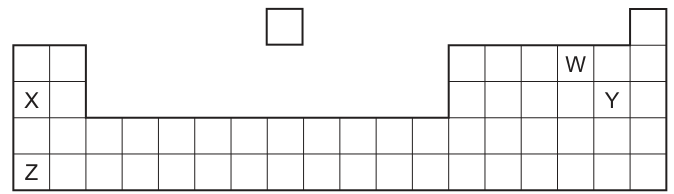
W, X, Y and Z are not the correct symbols of the elements.
Which statement is correct?
Options
A The compound formed between X and W has covalent bonds.
B W and Y are both gases at r.t.p. that contain covalent bonds.
C X and Y react together more vigorously than Z and Y at r.t.p.
D X and Z both have two outer-shell electrons.
Working
- Element is located in Group VI and Period 2, which corresponds to oxygen (). It exists as diatomic molecules of , which is a gas at r.t.p. containing a double covalent bond.
- Element is located in Group VII and Period 3, which corresponds to chlorine (). It exists as diatomic molecules of , which is a gas at r.t.p. containing a single covalent bond.
- Therefore, and are both gases at r.t.p. that contain covalent bonds (statement B is correct).
Checking other options:
- A is incorrect: is a Group I metal and is a non-metal, so they form an ionic compound.
- C is incorrect: Reactivity in Group I increases down the group, so is more reactive than and reacts more vigorously with .
- D is incorrect: and are in Group I, so they have one outer-shell electron, not two.
Answer
B
B
Walkthrough
-
Identify the elements from the Periodic Table grid:
- is in Group I, Period 3 (sodium, ).
- is in Group I, Period 5 (rubidium, ).
- is in Group VI, Period 2 (oxygen, ).
- is in Group VII, Period 3 (chlorine, ).
-
Evaluate each option:
- Option A: is a metal and is a non-metal. When a metal reacts with a non-metal, electrons are transferred to form an ionic compound with ionic bonds, not covalent bonds.
- Option B: Non-metals in Groups VI and VII commonly exist as simple diatomic molecules. Oxygen () and chlorine () are both simple molecular substances with low boiling points, so they are gases at room temperature and pressure (r.t.p.) and are held together by shared pairs of electrons (covalent bonds). This statement is correct.
- Option C: For Group I alkali metals, reactivity increases down the group as the outer electron is further from the nucleus and more easily lost. Therefore, is more reactive than and reacts more vigorously with .
- Option D: The group number indicates the number of outer-shell (valence) electrons. Since and are in Group I, they each possess 1 valence electron, not 2.
Key Takeaways
- Elements in the same group have the same number of outer-shell electrons.
- Reactivity increases down Group I as the single valence electron is lost more readily.
- Non-metal elements such as oxygen (Group VI) and chlorine (Group VII) form diatomic, covalently bonded molecules that exist as gases at r.t.p.
Common Mistakes
- Confusing Group I (1 valence electron) with Group II (2 valence electrons).
- Assuming compounds between metals and non-metals contain covalent bonds.
- Forgetting that reactivity increases down Group I, unlike Group VII where reactivity decreases down the group.
Things to Be Careful About
- Always determine both the group (column) and period (row) accurately from the outline to identify whether an element is a metal or a non-metal.
The Group I metals lithium, sodium and potassium show trends in their melting points and in their reactions with water.
Which statement is correct going down the group from lithium to potassium?
Options
A Their melting points decrease and their reaction with water becomes less vigorous.
B Their melting points decrease and their reaction with water becomes more vigorous.
C Their melting points increase and their reaction with water becomes less vigorous.
D Their melting points increase and their reaction with water becomes more vigorous.
Working
- Melting point trend: Going down Group I from lithium to potassium, atomic radii increase. The metallic bonding becomes weaker because the attraction between the delocalised electrons and the larger metal cations weakens. Therefore, melting points decrease.
- Reactivity trend: Group I metals react by losing their single valence electron. Going down the group, the outer electron is further from the nucleus and more shielded, so it is lost more easily. Therefore, the reaction with water becomes more vigorous.
Matching these two trends leads to option B.
Answer
B
B
Walkthrough
In Group I (the alkali metals):
- Physical Trend (Melting Point): As you go down the group (from to to ), the metal atoms increase in size. The metallic bond is the electrostatic attraction between positive metal ions and the sea of delocalised electrons. With larger ions, the positive nucleus is further away from the delocalised electrons, making the metallic bond weaker and requiring less thermal energy to break. Thus, melting points decrease down the group.
- Chemical Trend (Reactivity with Water): Group I metals react with water to form a metal hydroxide and hydrogen gas:
In this reaction, the metal atoms lose their one outer shell electron to form ions. As you descend the group, the outer electron is in a higher energy level, further from the attractive force of the nucleus, and shielded by more inner electron shells. Hence, it is lost more readily, making the reaction with water increasingly vigorous (lithium fizzes steadily, sodium melts into a ball and fizzes rapidly, potassium catches fire with a lilac flame).
Combining both points, melting points decrease and reactivity becomes more vigorous, which corresponds to option B.
Key Takeaways
- For Group I metals, melting points and boiling points decrease down the group.
- Reactivity with water, air, and halogens increases down Group I.
- Reactivity increases because the single valence electron is more easily lost as atomic radius and electron shielding increase.
Common Mistakes
- Confusing the reactivity trend of Group I (which increases down the group) with Group VII halogens (which decreases down the group).
- Confusing the melting point trend of Group I metals (decreases down the group) with Group VII non-metals (increases down the group due to stronger van der Waals forces).
Things to Be Careful About
- Ensure you read the direction carefully: the question specifies "going down the group from lithium to potassium".
Chlorine gas is bubbled into separate samples of aqueous potassium iodide and aqueous potassium bromide.
In which solutions is there a colour change?
Options
| aqueous potassium iodide | aqueous potassium bromide | |
|---|---|---|
| A | ✓ | ✓ |
| B | ✓ | ✗ |
| C | ✗ | ✓ |
| D | ✗ | ✗ |
key
✓ = yes
✗ = no
Working
In Group VII, reactivity decreases down the group: .
- Chlorine + aqueous potassium iodide ():
- Chlorine is more reactive than iodine, so chlorine displaces iodide ions:
- Iodine is produced, causing a colour change from colourless to brown (or yellow/brown).
- Chlorine + aqueous potassium bromide ():
- Chlorine is more reactive than bromine, so chlorine displaces bromide ions:
- Bromine is produced, causing a colour change from colourless to orange (or yellow/orange).
Both solutions undergo a displacement reaction and show a colour change (✓ in both columns).
Answer
A
A
Walkthrough
Halogens (Group VII elements) undergo displacement reactions with solutions containing halide ions. A more reactive halogen will displace a less reactive halide ion from an aqueous solution of its salt.
The reactivity of halogens decreases as you go down Group VII:
- When chlorine gas () is bubbled into aqueous potassium iodide (), chlorine oxidises the colourless iodide ions () to aqueous iodine (), forming a brown solution. Hence, there is a colour change.
- When chlorine gas () is bubbled into aqueous potassium bromide (), chlorine oxidises the colourless bromide ions () to aqueous bromine (), forming an orange/yellow solution. Hence, there is also a colour change.
Since both mixtures show a colour change, option A (✓, ✓) is correct.
Key Takeaways
- Halogen reactivity decreases down Group VII because the atomic radius increases, making it harder for the nucleus to attract an incoming electron to form a halide ion.
- A displacement reaction occurs when a more reactive halogen is added to a solution of a less reactive halide.
- Aqueous bromine is orange/yellow and aqueous iodine is brown, giving clear visual evidence of displacement.
Common Mistakes
- Confusing the trend in reactivity of Group VII (decreases down the group) with Group I (increases down the group).
- Thinking that chlorine can only displace one of the halides rather than all halides below it in the group.
Things to Be Careful About
- Make sure not to confuse the colours of the free halogens in aqueous solution (bromine is orange-brown; iodine is brown) with their corresponding halide ions, which are colourless in solution.
Which statement about the elements in Group VIII of the Periodic Table is correct?
Options
A Going down the group, the number of electrons in the atom increases by eight for each noble gas.
B Going down the group, the number of electrons in the outer shell increases by eight for each noble gas.
C The number of electrons in the outer shell is the same for each noble gas.
D The outer shell of each noble gas is fully occupied by electrons.
Working
- Group VIII (Group 0) elements are the noble gases: (configuration: 2), (2,8), (2,8,8), (2,8,18,8), etc.
- Option A is incorrect: The total number of electrons increases by 8 from () to (), and by 8 from () to (), but then by 18 from () to ().
- Option B is incorrect: The number of outer-shell electrons does not increase down the group; it is for helium and for all other noble gases.
- Option C is incorrect: Helium has electrons in its outer shell (a complete first shell), whereas the other noble gases have electrons in their outer shell.
- Option D is correct: Every noble gas has a full outer shell of electrons ( electrons for the first shell in helium, and for the outermost shells of neon, argon, etc.), which makes them chemically unreactive.
Answer
D
D
Walkthrough
Group VIII (often designated as Group 0) contains the noble gases: helium (), neon (), argon (), krypton (), xenon (), and radon ().
Let us evaluate each statement:
- Option A: The atomic numbers are , , , . The increase in total electron count between consecutive elements is , , , etc. Thus, it does not increase by eight for every step down the group.
- Option B: Outer shell electrons do not increase by eight down the group; the number of outer electrons is 2 for and 8 for the rest.
- Option C: Helium only has 2 outer electrons, while neon, argon, krypton, etc., have 8 outer electrons. Therefore, the number of outer electrons is not the same for all noble gases.
- Option D: The defining electronic feature of noble gases is that their outermost electron shell is completely full (a duplet of electrons for the first shell in , and an octet for subsequent noble gases). This full outer shell confers extreme chemical stability and unreactivity.
Thus, D is the correct statement.
Key Takeaways
- Noble gases possess completely full outer electron shells.
- Helium has a complete outer shell containing only 2 electrons (duplet configuration).
- Other noble gases (, , , ) have full outer shells containing 8 electrons (octet configuration).
Common Mistakes
- Assuming that all noble gases have 8 electrons in their outer shell and choosing option C. Helium is a common exception that candidates often forget.
Things to Be Careful About
- Distinguish between the total number of electrons and the number of outer-shell electrons.
- Remember that the maximum capacity of the first shell () is only 2 electrons.
Which statement is correct?
Options
A Aluminium is used in food containers because of its resistance to corrosion.
B Aluminium is used in the manufacture of aircraft because of its low ductility.
C Copper is used in electrical wiring because of its high density.
D Copper is used in the manufacture of overhead electrical cables because it forms an unreactive oxide layer.
Working
- A is correct: Aluminium resists corrosion due to a thin, tough, non-porous layer of aluminium oxide () on its surface, making it suitable for food and drink containers.
- B is incorrect: Aluminium is used in aircraft manufacture because of its low density (light weight) and high strength-to-weight ratio, not low ductility.
- C is incorrect: Copper is used in electrical wiring because it is a very good electrical conductor and is ductile, not because of its high density.
- D is incorrect: Aluminium (often reinforced with steel) is used for overhead electrical power cables due to its low density and good electrical conductivity; copper is too dense and heavy for overhead cables.
Answer
A
A
Walkthrough
To determine the correct statement, evaluate the match between each metal's stated use and its associated property:
- Option A: Aluminium naturally and rapidly reacts with oxygen in the air to form an adherent, unreactive layer of aluminium oxide (). This protective oxide layer prevents acids and water in food from reacting with the underlying metal, giving it excellent corrosion resistance. Therefore, statement A is correct.
- Option B: Aluminium is chosen for aircraft bodies primarily because of its low density and good strength (especially when alloyed, e.g., duralumin), allowing aircraft to be light and fuel-efficient. Low ductility would mean the metal is brittle and hard to draw into shapes, which is neither true nor desirable.
- Option C: Copper is widely used in household electrical wiring due to its excellent electrical conductivity and ductility (ability to be drawn into wires). Its high density is a disadvantage rather than the reason for its use.
- Option D: Overhead electrical cables require materials with low density so the pylons can support their weight over long spans without sagging excessively. For this reason, aluminium (with a steel core for tensile strength) is used for overhead power cables, not copper.
Key Takeaways
- Aluminium uses and properties:
- Food containers: resistance to corrosion (due to the inert, protective layer) and non-toxicity.
- Aircraft bodies: low density and high strength-to-weight ratio (in alloys).
- Overhead power cables: low density and good electrical conductivity.
- Copper uses and properties:
- Electrical wiring: high electrical conductivity and ductility.
- Cooking utensils / pipes: good thermal conductivity, malleability, and unreactivity with water.
Common Mistakes
- Confusing the metal used for domestic electrical wiring (copper, due to very high conductivity) with that used for overhead power transmission cables (aluminium, due to low density).
- Attributing the protective oxide layer to copper instead of aluminium.
Things to Be Careful About
- Always ensure that both parts of a statement match: the use must be valid and correctly explained by the stated property.
Which elements are the major constituents of brass?
Options
A Br and As
B Cu and Sn
C Cu and Zn
D Sn and Zn
Working
- Brass is an alloy made predominantly of copper () and zinc ().
- Bronze is an alloy of copper () and tin (), which corresponds to option B.
- Option A (bromine and arsenic) is a distractor playing on the word 'brass'.
- Option D is an incorrect combination of metals.
Therefore, the major constituents of brass are and .
Answer
C
C
Walkthrough
An alloy is a mixture of a metal with other elements (metals or non-metals) designed to modify its physical properties, such as hardness and resistance to corrosion.
Key alloys required in the Cambridge O Level syllabus include:
- Brass: an alloy of copper () and zinc ().
- Bronze: an alloy of copper () and tin ().
- Steel: an alloy of iron () and carbon () (or other transition metals in stainless steel).
Since the question asks for the constituents of brass, the correct pair of elements is copper and zinc ( and ), giving option C.
Key Takeaways
- Brass contains copper and zinc ().
- Bronze contains copper and tin ().
Common Mistakes
- Confusing brass with bronze (choosing and , option B).
- Guessing chemical elements from phonetic similarities (e.g., choosing bromine and arsenic , option A).
Things to Be Careful About
Remember standard chemical symbols: is copper, is zinc, and is tin. A helpful mnemonic is: "Brass has a 'z' in its sound/composition (Zinc), while Bronze does not."
The diagrams show two methods in which metal X is used to prevent the rusting of iron.
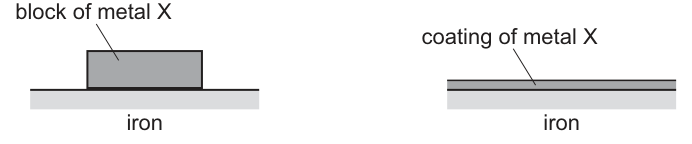
A student suggests that metal X must be less reactive than iron and must have a lower proton number than iron.
Which suggestions are correct?
Options
| less reactive | lower proton number | |
|---|---|---|
| A | ✓ | ✓ |
| B | ✓ | ✗ |
| C | ✗ | ✓ |
| D | ✗ | ✗ |
key
✓ = yes
✗ = no
Working
- Reactivity: The diagram shows sacrificial protection (a block of metal attached to iron) and galvanising/coating. For sacrificial protection to work, metal must oxidise (corrode) in preference to iron. Therefore, metal must be more reactive than iron, not less reactive. Thus, the suggestion that metal must be less reactive is incorrect (✗).
- Proton number: Zinc (, proton number ) is more reactive than iron (, proton number ) and is commonly used for both sacrificial protection and coating (galvanising). Since has a higher proton number than (), metal does not need to have a lower proton number than iron. Thus, the suggestion that metal must have a lower proton number is incorrect (✗).
Therefore, both suggestions are incorrect (✗, ✗).
Answer
D
D
Walkthrough
Rusting of iron requires both oxygen and water. Two major methods of preventing rusting shown in the diagrams are:
- Sacrificial protection (left diagram): Blocks of a more reactive metal (such as magnesium or zinc) are attached to iron. Because the sacrificial metal is higher in the reactivity series, it gives up electrons more readily than iron, oxidising instead of iron and preventing iron from corroding.
- Coating/Galvanising (right diagram): A layer of metal (such as zinc) covers the entire iron surface, acting as a physical barrier and providing sacrificial protection if scratched.
Evaluating the student's two suggestions:
- "Metal must be less reactive than iron": For the block method (sacrificial protection) to work without fully covering the iron, metal must be more reactive than iron. If it were less reactive, iron would sacrifice itself to protect metal , accelerating rusting. Hence, this suggestion is incorrect (✗).
- "Metal must have a lower proton number than iron": The most common metal used for both sacrificial blocks and coatings is zinc (). Iron has a proton number of , whereas zinc has a proton number of . Because zinc is both more reactive than iron and has a higher proton number (), metal does not need to have a lower proton number. Hence, this suggestion is incorrect (✗).
Thus, row D is the correct option.
Key Takeaways
- Sacrificial protection requires a metal that is more reactive than iron (higher in the reactivity series).
- Reactivity does not simply correlate directly with lower proton number across different groups/periods; for example, zinc () is more reactive than iron ().
Common Mistakes
- Confusing barrier protection (where unreactive metals like tin can be used as a complete coating) with sacrificial protection (which strictly requires a more reactive metal).
- Assuming that elements with lower proton numbers are always more reactive.
Things to Be Careful About
- In the left diagram, the iron is only partially covered by a block of metal . This clearly indicates sacrificial protection, which only functions if metal is more reactive than iron.
Aluminium is extracted from molten aluminium oxide by electrolysis.
Which material is used for the electrodes in the industrial extraction?
Options
A aluminium
B carbon
C cryolite
D platinum
Working
In the industrial electrolysis of aluminium oxide (dissolved in molten cryolite), both the positive anodes and the negative cathode lining are made of carbon (graphite).
- A (aluminium): Aluminium is the product formed at the cathode, not the electrode material.
- B (carbon): Carbon (graphite) is used for both the anode and cathode.
- C (cryolite): Cryolite is the solvent used to lower the melting point of aluminium oxide, not an electrode.
- D (platinum): Platinum is an inert electrode used in laboratory electrolysis, not in the industrial extraction of aluminium due to its high cost.
Answer
B
B
Walkthrough
In the industrial extraction of aluminium from bauxite:
- Bauxite is purified to obtain pure aluminium oxide (, alumina).
- Aluminium oxide has a very high melting point (over ), so it is dissolved in molten cryolite () to lower the operating temperature to around and improve electrical conductivity.
- The electrolysis cell uses carbon (graphite) for both the positive anodes and the negative cathode (the cell lining).
- At the cathode:
- At the anode:
- The oxygen gas produced reacts with the hot carbon anodes to form carbon dioxide (), which is why the anodes must be replaced regularly.
Therefore, the correct material is carbon (option B).
Key Takeaways
- Graphite (a form of carbon) conducts electricity and has a high melting point, making it suitable and cost-effective as electrodes in the Hall-Héroult process.
- Cryolite is the solvent / electrolyte additive, not an electrode material.
Common Mistakes
- Confusing cryolite (the solvent) with the electrode material.
- Choosing platinum because it is a common inert electrode in laboratory demonstrations, forgetting that carbon is the economical choice used industrially.
Things to Be Careful About
- Ensure you distinguish between the role of each component: aluminium oxide is the ore/feedstock, cryolite is the solvent, and carbon/graphite is the electrode material.
Which substance is used to remove odours in the treatment of the domestic water supply?
Options
A carbon
B chlorine
C fluorine
D silver
Working
- Carbon (in the form of activated charcoal) has a large surface area that adsorbs dissolved organic compounds responsible for unpleasant tastes and odours.
- Chlorine is used to disinfect water and kill bacteria/microbes.
- Fluorine (or fluoride compounds) may be added to help prevent tooth decay.
- Silver is not used in large-scale domestic water treatment.
Therefore, the substance used to remove odours is carbon.
Answer
A
A
Walkthrough
In the purification of the domestic water supply, several steps are carried out:
- Screening and sedimentation/filtration: Removes insoluble solids and large suspended particles (using coarse screens and sand/gravel beds).
- Carbon filtration: Water is passed through beds of activated carbon (charcoal). Activated carbon has a very high porosity and large surface area, allowing it to adsorb trace dissolved organic impurities that cause bad tastes and odours.
- Chlorination: Chlorine gas is added to kill harmful bacteria and microorganisms (disinfection).
Since the question asks specifically for the substance that removes odours, the correct choice is carbon (option A).
Key Takeaways
- Activated carbon is used in water treatment to adsorb substances that cause unpleasant tastes and odours.
- Chlorine is used to kill bacteria (disinfection/sterilisation).
- Coarse screens, sedimentation, and sand filters are used to remove insoluble particles and suspended solids.
Common Mistakes
- Confusing the role of chlorine (killing bacteria) with the role of carbon (removing tastes and odours).
- Choosing fluorine/fluoride, which is sometimes added to strengthen teeth/prevent tooth decay, not to remove odours.
Things to Be Careful About
- Ensure you know the distinct purpose of each chemical added during water treatment: chlorine kills pathogens, carbon removes bad taste and odour, and fluoride promotes dental health.
Carbon dioxide, methane and oxygen are gases involved in the carbon cycle.
Which of these gases cause global warming?
Options
A carbon dioxide only
B carbon dioxide and methane
C carbon dioxide and oxygen
D methane only
Working
- Greenhouse gases absorb infrared radiation re-emitted from the Earth's surface and trap thermal energy in the atmosphere, leading to global warming.
- Carbon dioxide () is a major greenhouse gas released by respiration and the combustion of fossil fuels.
- Methane () is also a potent greenhouse gas produced by livestock digestion and the decomposition of organic waste.
- Oxygen () is a diatomic gas that makes up roughly of clean, dry air and does not act as a greenhouse gas.
Therefore, the gases that cause global warming are carbon dioxide and methane.
Answer
B
B
Walkthrough
Greenhouse gases are atmospheric gases capable of absorbing thermal infrared radiation emitted by the Earth's surface, preventing this heat from escaping into space and thereby causing the enhanced greenhouse effect (global warming).
- Carbon dioxide (): A well-known greenhouse gas produced naturally through respiration and unnaturally in large quantities through the complete combustion of carbon-containing fossil fuels.
- Methane (): Another significant greenhouse gas produced mainly from agricultural activities (such as cattle farming/digestive processes) and the anaerobic decay of organic waste in landfill sites.
- Oxygen (): A major non-greenhouse atmospheric gas. Symmetrical homonuclear diatomic molecules like and do not absorb infrared radiation in a way that contributes to the greenhouse effect.
Hence, both carbon dioxide and methane cause global warming, making option B correct.
Key Takeaways
- The two primary greenhouse gases studied in the Cambridge O Level Chemistry syllabus are carbon dioxide () and methane ().
- Common major atmospheric gases such as nitrogen () and oxygen () are not greenhouse gases.
Common Mistakes
- Selecting A or D by forgetting that both carbon dioxide and methane are classified as greenhouse gases.
- Confusing air pollutants (like sulfur dioxide, which causes acid rain) with greenhouse gases (which cause global warming).
Things to Be Careful About
- Ensure you distinguish between gases that cause global warming (greenhouse gases like , ) and gases that cause acid rain (, ) or ozone depletion (CFCs).
How many structural isomers are there with the molecular formula ?
Options
A 2
B 3
C 4
D 5
Working
To find all the structural isomers of , consider the different carbon skeletons and the possible positions for the chlorine atom:
-
Unbranched chain (butane skeleton, ):
- Attach to carbon-1: 1-chlorobutane ()
- Attach to carbon-2: 2-chlorobutane ()
-
Branched chain (methylpropane skeleton, ):
- Attach to a primary carbon: 1-chloro-2-methylpropane ()
- Attach to the central carbon: 2-chloro-2-methylpropane ()
There are 4 unique structural isomers in total.
Answer
C
C
Walkthrough
Structural isomers are compounds that share the same molecular formula but have different structural formulae (the atoms are bonded together in a different order).
To find all structural isomers for systematically:
-
Start with a straight chain of 4 carbons (butane backbone):
- Placing the chlorine atom on the terminal carbon gives: 1-chlorobutane
- Placing the chlorine atom on the second carbon gives: 2-chlorobutane
- Placing it on the third carbon is identical to placing it on the second (numbering from the other end gives 2-chlorobutane again).
-
Next, consider a branched chain of 4 carbons (2-methylpropane backbone):
- Placing the chlorine atom on one of the three equivalent methyl groups () gives: 1-chloro-2-methylpropane
- Placing the chlorine atom on the central carbon atom gives: 2-chloro-2-methylpropane
Counting all unique structures gives a total of structural isomers. Therefore, option C is correct.
Key Takeaways
- Structural isomers have the same molecular formula but different arrangements of atoms.
- The most reliable method to count structural isomers is systematic: vary the carbon skeleton first (chain isomerism), then vary the functional group/substituent position on each skeleton (position isomerism).
- Always name the isomers using IUPAC rules to ensure no duplicate structures are counted.
Common Mistakes
- Counting the same isomer twice due to drawing a chain bent in a different direction (e.g. thinking chlorine on C-3 of a straight chain is "3-chlorobutane", when it is simply 2-chlorobutane numbered from the opposite end).
- Forgetting to explore branched carbon skeletons and only considering the straight chain.
Things to Be Careful About
- Ensure every carbon atom forms exactly 4 covalent bonds and that each proposed structure matches the formula exactly.
P is a branched hydrocarbon with the ratio of carbon atoms to hydrogen atoms being .
P has a relative molecular mass of 56.
What is the identity of P?
Options
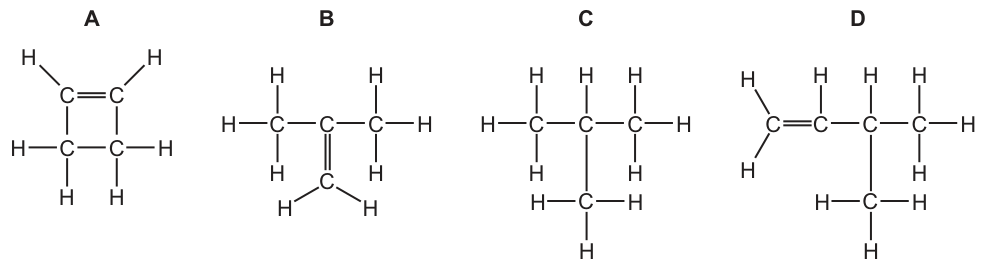
Working
-
Determine the molecular formula of P:
- The ratio of is , giving the empirical formula .
- Empirical formula mass .
- Therefore, the molecular formula of is .
-
Evaluate the options:
- A is cyclic (cyclobutene, ), which is not branched and has an incorrect formula.
- B is 2-methylprop-1-ene, which has a branched chain and the molecular formula ().
- C is 2-methylpropane, which has the formula ().
- D is 3-methylbut-1-ene, which has the formula ().
Answer
B
B
Walkthrough
- Find the empirical formula: The question states that the ratio of carbon atoms to hydrogen atoms is . This gives the empirical formula .
- Find the molecular formula:
- The mass of one unit is .
- Dividing the relative molecular mass () by gives:
- Multiplying the empirical formula by gives the molecular formula .
- Check structural requirements:
- Hydrocarbon must be branched (it has a side chain attached to the main carbon chain).
- Structure B is 2-methylprop-1-ene, which contains 4 carbon atoms and 8 hydrogen atoms, has a branch ( group), and has .
- Therefore, B is the correct structure.
Key Takeaways
- The molecular formula is always a whole-number multiple of the empirical formula:
- A branched hydrocarbon has at least one carbon atom bonded to three or four other carbon atoms, forming side chains.
Common Mistakes
- Confusing cyclic structures with branched structures: Option A forms a closed ring, not a branched open chain.
- Choosing an alkane (Option C): 2-methylpropane has the formula (), which does not fit the ratio.
Things to Be Careful About
- Count the total number of carbon and hydrogen atoms carefully on displayed formulae to confirm the calculated .
Which row gives the correct names of the two compounds?
Options
| A | but-1-ene | propan-1-ol |
| B | but-1-ene | propan-2-ol |
| C | but-2-ene | propan-1-ol |
| D | but-2-ene | propan-2-ol |
Working
-
For :
- The longest continuous carbon chain has 4 carbon atoms, so the stem is but-.
- There is a carbon-carbon double bond (), making it an alkene.
- Numbering from the end closest to the double bond puts the double bond between carbon-1 and carbon-2, giving the name but-1-ene.
-
For :
- The longest continuous carbon chain has 3 carbon atoms, so the stem is propan-.
- It contains a hydroxyl group (), making it an alcohol.
- The group is attached to the second carbon atom in the chain, giving the name propan-2-ol.
Therefore, row B correctly names both compounds.
Answer
B
B
Walkthrough
To name organic compounds systematically:
-
Determine the stem (root): Count the number of carbon atoms in the longest unbranched chain:
- 1 carbon = meth-
- 2 carbons = eth-
- 3 carbons = prop-
- 4 carbons = but-
-
Identify the functional group and suffix:
- A carbon-carbon double bond () indicates an alkene, ending in -ene.
- A hydroxyl group () indicates an alcohol, ending in -ol.
-
Assign locants (numbers): Number the carbon chain from the end that gives the functional group the lowest possible number:
- In , numbering from right to left gives the bond positions 1 and 2, which is smaller than numbering from left to right (positions 3 and 4). Thus, it is named but-1-ene.
- In , numbering from either side places the group on carbon 2 of a 3-carbon chain. Thus, it is named propan-2-ol.
Matching these names to the options leads directly to row B.
Key Takeaways
- Number the carbon backbone from the end nearest to the functional group to assign the lowest locant number.
- Positional isomers differ by the location of the functional group on the carbon chain (e.g., but-1-ene vs but-2-ene, and propan-1-ol vs propan-2-ol).
Common Mistakes
- Numbering the chain from the wrong end (e.g., reading left-to-right as "but-3-ene").
- Confusing propan-1-ol (where is on an end carbon, ) with propan-2-ol (where is on the central carbon, ).
Things to Be Careful About
- In condensed structural formulas such as , brackets indicate that the group inside the brackets is a branch attached to the preceding carbon atom.
Which equation represents the reaction of ethane with chlorine in the presence of ultraviolet light?
Options
A
B
C
D
Working
Alkanes react with chlorine in the presence of ultraviolet (UV) light via a photochemical substitution reaction.
In this reaction, one hydrogen atom in ethane () is replaced (substituted) by one chlorine atom from a chlorine molecule (), forming chloroethane () and hydrogen chloride ():
- A is incorrect because chlorine cannot exist as isolated unbonded atoms, and the formula has an impossible valency for carbon (5 bonds).
- C is incorrect because hydrogen gas () is not produced in this substitution reaction.
- D is incorrect because elimination/dehydrogenation does not occur under these conditions.
Answer
B
B
Walkthrough
Alkanes are generally unreactive saturated hydrocarbons due to the presence of strong and single covalent bonds. However, they undergo substitution reactions with halogens (such as chlorine and bromine) in the presence of ultraviolet (UV) light or sunlight.
In a substitution reaction, one atom or group of atoms is replaced by another atom or group of atoms:
- Ultraviolet light provides the activation energy needed to break the covalent bond.
- One chlorine atom replaces a hydrogen atom on the ethane molecule, producing chloroethane ().
- The displaced hydrogen atom bonds with the second chlorine atom to produce hydrogen chloride gas ().
The overall balanced equation is:
Thus, option B is correct.
Key Takeaways
- Alkanes undergo substitution reactions with halogens.
- The reaction requires ultraviolet (UV) light (or sunlight) to initiate.
- The organic product has one halogen atom in place of a hydrogen atom (monohalogenation in the first step), and the inorganic product is a hydrogen halide (e.g., ).
Common Mistakes
- Confusing substitution with addition: thinking that adds across without removing hydrogen (addition only occurs in unsaturated hydrocarbons such as alkenes).
- Mistakenly writing as the byproduct instead of .
Things to Be Careful About
- Ensure carbon forms exactly 4 covalent bonds in the product. Formulae like violate carbon's valency.
Which compound reacts with hydrogen in an addition reaction?
Options
A
B
C
D
Working
- Addition reactions are characteristic of unsaturated hydrocarbons (alkenes) containing a double bond.
- is but-2-ene (an alkene), which contains a double bond and reacts with hydrogen (hydrogenation) to form butane:
- (butane) is a saturated alkane and does not undergo addition reactions.
- (butanoic acid) is a carboxylic acid.
- (butan-1-ol) is an alcohol.
Answer
A
A
Walkthrough
An addition reaction is a reaction in which two or more molecules combine to form a single product. In organic chemistry at O Level, addition reactions are characteristic of alkenes due to the presence of an unsaturated carbon-carbon double bond ().
- Option A (): This condensed formula represents but-2-ene, . Because it contains a double bond, it readily reacts with hydrogen gas in the presence of a nickel catalyst at elevated temperatures (hydrogenation) to form the saturated alkane butane (). Hence, this is the correct answer.
- Option B (): This is butane, a saturated alkane containing only single bonds. Alkanes are relatively unreactive and undergo substitution reactions (with halogens in UV light) or combustion, not addition.
- Option C (): This is butanoic acid, a carboxylic acid with a functional group. It does not undergo addition of hydrogen across a bond.
- Option D (): This is butan-1-ol, an alcohol with an group, which also does not undergo alkene-type addition reactions.
Key Takeaways
- Alkenes are unsaturated hydrocarbons that undergo addition reactions with hydrogen (hydrogenation), halogens (halogenation), and steam (hydration).
- Hydrogenation converts an alkene to an alkane in the presence of a nickel catalyst at around to .
- Saturated compounds (alkanes, simple alcohols, carboxylic acids) do not undergo addition reactions.
Common Mistakes
- Missing that the condensed formula implies a double bond between the two central carbon atoms (since each central carbon has only one attached hydrogen).
- Confusing addition reactions with substitution reactions.
Things to Be Careful About
- Count the bonds on each carbon atom in condensed structural formulae to identify double bonds when they are written without the explicit double bond symbol ().
Which statement about carboxylic acids is correct?
Options
A They are prepared by the oxidation of alkanes.
B They decolourise bromine water.
C They react with alcohols to form esters.
D They react with carbonates to form a salt, hydrogen and water.
Working
- A is incorrect: Carboxylic acids are prepared by the oxidation of alcohols (e.g. ethanol to ethanoic acid), not alkanes.
- B is incorrect: Decolourising bromine water is the test for unsaturation (carbon-carbon double bonds, ) in alkenes; carboxylic acids do not decolourise bromine water.
- C is correct: Carboxylic acids react with alcohols in the presence of an acid catalyst to produce esters and water (esterification).
- D is incorrect: The reaction between an acid and a carbonate produces a salt, carbon dioxide (), and water, not hydrogen.
Answer
C
C
Walkthrough
To find the correct statement about carboxylic acids, let us evaluate each option:
- Option A: Alkanes are unreactive saturated hydrocarbons and do not readily oxidise to carboxylic acids. Carboxylic acids are typically prepared in the laboratory by the oxidation of primary alcohols (such as oxidising ethanol using acidified potassium manganate(VII)). Hence, A is false.
- Option B: Aqueous bromine (bromine water) tests for the presence of a double bond. Alkenes undergo an addition reaction with bromine water, turning it from orange-brown to colourless. Carboxylic acids do not contain bonds and do not decolourise bromine water. Hence, B is false.
- Option C: Carboxylic acids react with alcohols in the presence of a concentrated sulfuric acid catalyst (acting as a catalyst and dehydrating agent) to form sweet-smelling organic compounds called esters and water. This is the condensation reaction known as esterification. Hence, C is correct.
- Option D: The general reaction of any acid with a carbonate is:
Hydrogen gas is produced when acids react with reactive metals, not metal carbonates. Hence, D is false.
Key Takeaways
- Esterification: .
- Acid reactions: Carboxylic acids behave as typical weak acids: reacting with metals to give hydrogen, with bases/alkalis to give water, and with carbonates to give carbon dioxide and water.
- Preparation of carboxylic acids: Oxidation of alcohols.
Common Mistakes
- Confusing the gaseous product of acid-carbonate reactions () with that of acid-metal reactions ().
- Forgetting that the bromine water test is specific to unsaturated hydrocarbons (alkenes) rather than all organic molecules with oxygen-containing functional groups.
Things to Be Careful About
- Ensure the difference between the reagent used to form carboxylic acids (alcohols) and the starting materials of other organic pathways is clearly understood.
The structures of X and Y are shown.
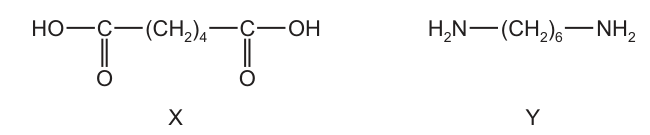
What is the structure of the polymer formed when X and Y react together?
Options
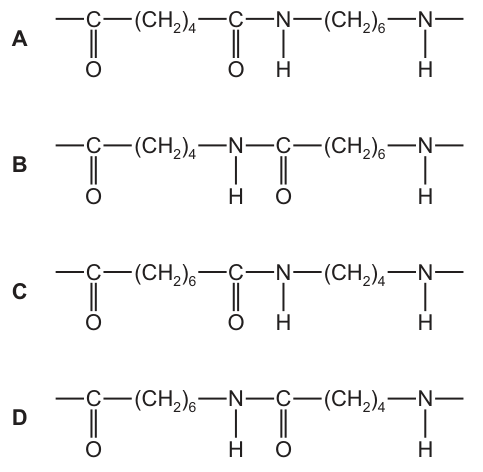
Working
- Monomer is a dicarboxylic acid: . The dicarboxylic acid segment contains methylene groups, , flanked by two carbonyl groups, .
- Monomer is a diamine: . The diamine segment contains methylene groups, , flanked by two amino groups, .
- During condensation polymerisation, water () is eliminated as an group from the carboxylic acid reacts with an from the amine to form an amide linkage, .
- The resulting polymer repeat unit has the structure:
- This corresponds to structure A.
Answer
A
A
Walkthrough
-
Identify the monomers and reaction type:
- Compound has two carboxylic acid groups () and four groups in between: it is hexanedioic acid.
- Compound has two amine groups () and six groups in between: it is hexane-1,6-diamine.
- When a dicarboxylic acid reacts with a diamine, they undergo condensation polymerisation to form a polyamide (nylon-6,6) and water.
-
Determine the linkages and repeat unit:
- Each loses an group, leaving a carbonyl group, .
- Each loses an atom, leaving an amine group, .
- A covalent bond forms between the carbonyl carbon and the amine nitrogen to create an amide linkage ().
- The dicarboxylic acid residue is .
- The diamine residue is .
- Combining these gives the repeat unit shown in option A.
-
Elimination of distractors:
- B incorrectly swaps one carbonyl and one amine group so that the residues are asymmetric and have mixed functional ends.
- C inverts the number of groups, putting in the diacid unit and in the diamine unit.
- D has both inverted chain lengths and incorrect linkage connectivity.
Key Takeaways
- Polyamides are formed by condensation polymerisation between dicarboxylic acids and diamines.
- For each amide link formed, a molecule of is eliminated ( from the carboxylic acid, from the amine).
- Always check the number of carbon atoms / methylene groups () within each monomer unit to ensure they match the starting materials.
Common Mistakes
- Confusing the number of units between the acid and amine components (e.g., choosing C instead of A).
- Forgetting that the dicarboxylic acid contributes two carbonyl groups () at the ends of its chain, while the diamine contributes two groups.
Things to Be Careful About
- Ensure you read the indices of the groups carefully ( vs ).
Which diagram shows a measuring cylinder?
Options
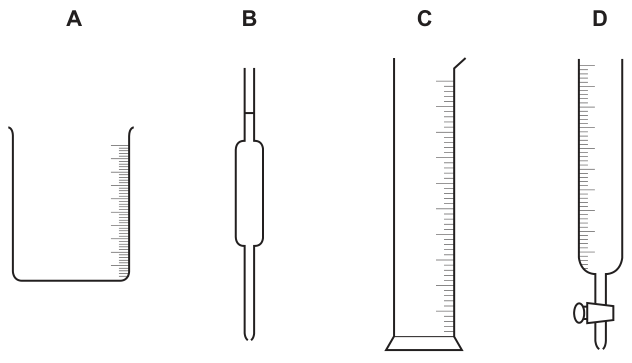
Working
- A is a beaker, which is used for holding, mixing, and heating liquids, but gives only approximate volume measurements.
- B is a volumetric pipette, which is designed to accurately deliver a single fixed volume of liquid (e.g. ).
- C is a measuring cylinder, a cylindrical vessel with a flat base, pouring spout, and graduations along its length used to measure variable liquid volumes.
- D is a burette, a long graduated tube with a stopcock/tap at the bottom used to accurately deliver variable volumes of liquid during titrations.
Therefore, diagram C shows a measuring cylinder.
Answer
C
C
Walkthrough
In chemistry laboratories, several types of glassware are used for handling and measuring liquids:
- Beaker (A): Wide cylindrical container with a flat bottom and a small pouring lip. Volume markings on beakers are only rough approximations and are not used for precise measurement.
- Pipette (B): A narrow tube with a central bulb and a single calibration mark. It is used to transfer a precise, fixed volume of liquid (e.g. or ).
- Measuring cylinder (C): A tall, narrow cylinder with regular graduation marks along the side, a flat supporting base, and a spout for pouring. It is used to measure volumes of liquid moderately accurately (typically to the nearest or ).
- Burette (D): A long, graduated glass tube fitted with a stopcock (tap) at the bottom, calibrated with zero at the top to measure variable delivered volumes accurately to .
Matching the descriptions confirms that C is the measuring cylinder.
Key Takeaways
- Be able to identify and distinguish common laboratory apparatus used for measuring liquid volumes: beakers, measuring cylinders, volumetric pipettes, and burettes.
- Understand the relative precision and typical use of each piece of apparatus.
Common Mistakes
- Confusing a measuring cylinder with a burette; remember that a burette always features a tap at the bottom and has its zero mark at the top.
- Confusing a volumetric pipette (single fixed volume) with a graduated cylinder or burette.
Things to Be Careful About
- Look for structural features such as the tap on the burette (D), the bulb and single mark on the pipette (B), the flat wide body of the beaker (A), and the flat base with pouring spout on the measuring cylinder (C).
A chromatogram of mixture X and pure substances P, Q, R and S is shown.
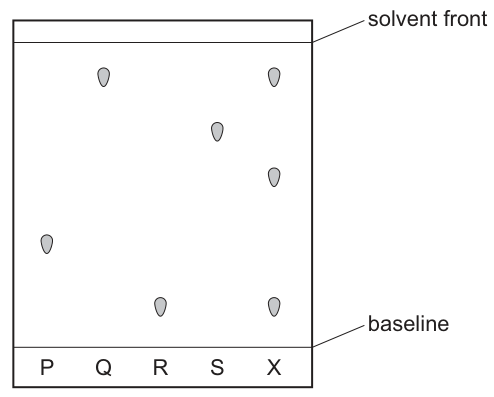
Which statement is correct?
Options
A R is completely insoluble in the solvent used.
B The value of Q is greater than the value of S.
C X is a mixture of Q, R and S.
D The paper is placed in the solvent with the solvent above the baseline.
Working
- The retention factor () is calculated as:
- Spot Q has travelled further up the chromatography paper from the baseline than spot S.
- Therefore, the value of Q is greater than the value of S, making statement B correct.
Evaluation of distractors:
- A is incorrect: Although substance R remains near the baseline, chromatography alone does not definitively prove complete insolubility under all conditions.
- C is incorrect: Mixture X has spots that do not align with all three of Q, R, and S (it contains a spot below S).
- D is incorrect: The solvent level must always start below the baseline to prevent the samples from dissolving directly into the solvent reservoir.
Answer
B
B
Walkthrough
In paper chromatography, substances separate based on their relative solubilities in the mobile phase (solvent) and their attraction to the stationary phase (paper).
The retention factor, , is given by:
Since the solvent front is the same for all spots on the paper:
- A spot that travels further up from the baseline has a larger value.
- Spot Q is clearly higher than spot S, so . Hence, statement B is correct.
Let us review why the other options are incorrect:
- A: A spot remaining at the baseline indicates very low solubility/high affinity for the paper in this solvent system, but stating it is "completely insoluble" is an unwarranted absolute.
- C: Looking closely at mixture X, its middle spot is at a different height than S.
- D: The solvent level must be below the pencil baseline at the start of the experiment; otherwise, the sample spots would wash off into the solvent bath rather than moving up the paper.
Key Takeaways
- values range between and .
- The further a component moves from the baseline, the higher its value.
- The starting solvent level must always be below the baseline.
Common Mistakes
- Measuring the distance from the bottom edge of the paper instead of from the baseline.
- Confusing values by thinking lower spots have higher values.
Things to Be Careful About
- Ensure values are calculated relative to the baseline and solvent front, not the bottom of the paper.
Sulfur dioxide is a gas that is prepared by heating sodium sulfite with hydrochloric acid. It is an acidic gas. Sulfur dioxide is more dense than air.
Which set of apparatus is suitable for preparing and collecting a dry sample of sulfur dioxide?
Options
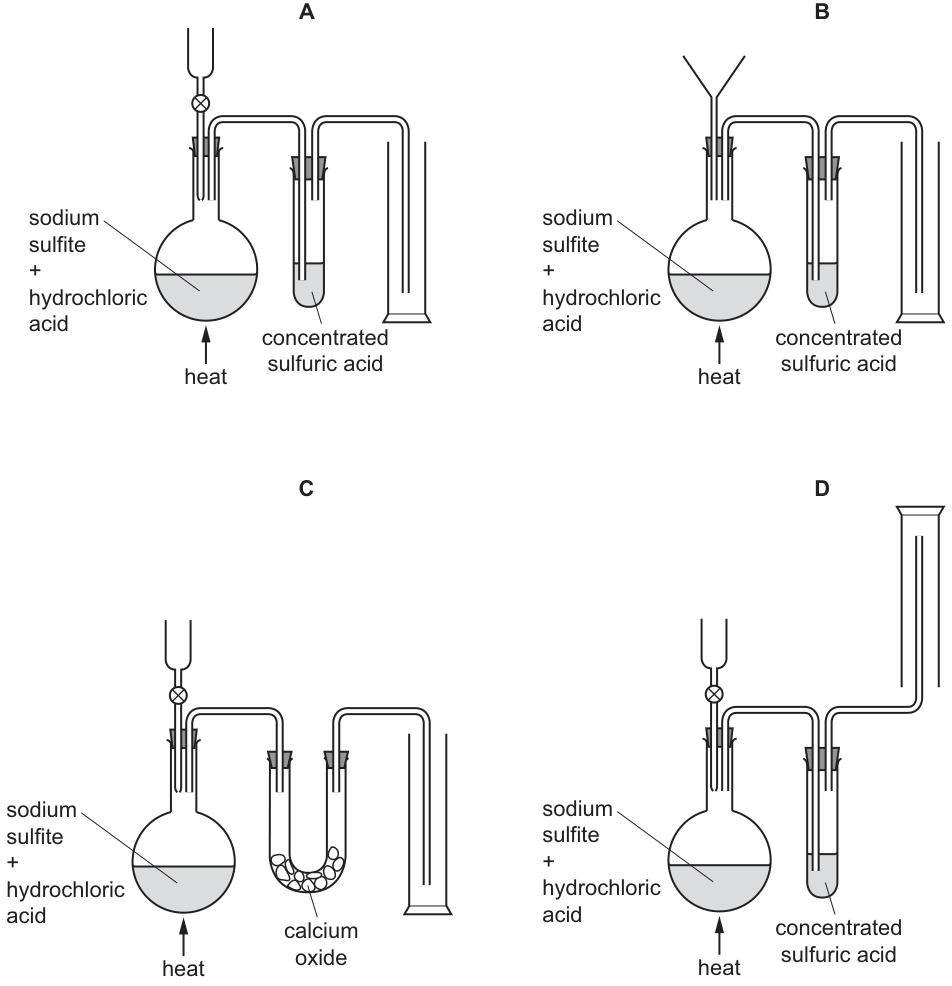
Working
To prepare and collect a dry sample of sulfur dioxide ():
- Apparatus for addition: A dropping funnel with a tap is needed so that the gas generated inside the flask does not escape through the funnel. Option B uses an open funnel without a tap, which allows gas to escape.
- Drying agent: is an acidic gas. It cannot be dried using calcium oxide (), which is a basic oxide, because they would react (). Concentrated sulfuric acid () is acidic and will dry without reacting with it. This rules out Option C.
- Collection method: Sulfur dioxide is denser than air ( compared to the average of air ). It must be collected by downward delivery (upward displacement of air) into an upright gas jar. Option D uses upward delivery (into an inverted gas jar), which is only suitable for gases less dense than air.
Therefore, apparatus A is the only correct setup.
Answer
A
A
Walkthrough
To determine the correct apparatus, we evaluate three separate aspects of the setup:
-
The Reaction Flask Setup:
When producing a gas by heating reactants, a tap funnel (dropping funnel) must be used to add the liquid reagent. In setup B, a simple filter funnel is shown without a tap, allowing the gas to escape out of the top rather than passing through the delivery tube. -
The Choice of Drying Agent:
Sulfur dioxide, , is a non-metal oxide and acidic in nature. A drying agent must not react chemically with the gas being dried.- Calcium oxide () is a basic metal oxide. It reacts readily with acidic gases such as to form calcium sulfite (), so setup C fails because the gas would be absorbed.
- Concentrated sulfuric acid () is an acidic drying agent and does not react with . It is suitable for drying acidic and neutral gases.
-
The Collection Method:
The relative molecular mass () of is . Clean air has an average relative molecular mass of approximately (mostly at and at ). Since is significantly denser than air, it sinks to the bottom of a container. Therefore, it is collected by downward delivery (upward displacement of air) in an upright gas jar with the delivery tube reaching near the bottom (as in A). In D, the gas jar is inverted (upward delivery), which is used for gases less dense than air like ammonia or hydrogen.
Setup A satisfies all three criteria.
Key Takeaways
- Drying gases: Acidic gases (, , , ) are dried using concentrated . Basic gases () are dried using . Neutral gases can be dried with either or with anhydrous .
- Gas collection methods:
- Downward delivery (upward displacement of air): for gases denser than air ().
- Upward delivery (downward displacement of air): for gases less dense than air ().
- Over water: for insoluble or sparingly soluble gases (not suitable for highly soluble gases like , , or ).
Common Mistakes
- Confusing basic and acidic drying agents: choosing to dry acidic gases like or .
- Confusing upward delivery with downward delivery: confusing the direction the delivery tube points with the direction air is displaced.
Things to Be Careful About
- Ensure the inlet delivery tube dips into the liquid drying agent (concentrated ) and the outlet delivery tube is above the liquid surface, as correctly shown in A.
A colourless solution of compound W is tested separately with a few drops of aqueous sodium hydroxide and a few drops of aqueous ammonia.
No precipitate is observed in either of the tests.
What is the cation in W?
Options
A
B
C
D
Working
- reacts with both aqueous and aqueous to give a white precipitate of aluminium hydroxide, .
- reacts with aqueous to give a white precipitate of calcium hydroxide, (and produces no precipitate or only a very faint precipitate with aqueous ).
- forms a light blue precipitate of copper(II) hydroxide, , with both reagents.
- does not form a precipitate with either aqueous or aqueous . It only releases ammonia gas upon heating with aqueous sodium hydroxide.
Therefore, compound contains the ion.
Answer
D
D
Walkthrough
In qualitative analysis, adding aqueous sodium hydroxide, , and aqueous ammonia, , introduces hydroxide ions () into the solution.
Most metal cations form insoluble metal hydroxides when a few drops of these reagents are added:
- Option A (): Forms a white precipitate of aluminium hydroxide with both and .
- Option B (): Forms a white precipitate of calcium hydroxide with .
- Option C (): Forms a light blue precipitate of copper(II) hydroxide with both and (also, solutions containing are blue, not colourless).
- Option D (): Ammonium hydroxide is completely soluble and dissociates in water, so no precipitate forms when or is added. To confirm the presence of , the mixture with aqueous sodium hydroxide must be warmed to liberate ammonia gas (which turns damp red litmus paper blue).
Since no precipitate was observed in either test, the cation present is (Option D).
Key Takeaways
- Metal ions like , , , , , and form insoluble hydroxide precipitates upon adding a few drops of .
- The ammonium ion () does not produce a precipitate with aqueous alkalis at room temperature; warming with sodium hydroxide produces alkaline ammonia gas ().
Common Mistakes
- Confusing the lack of a precipitate in cold with a negative test result for without remembering that heating is required to release gas.
- Confusing and : while gives no precipitate with aqueous ammonia, it definitely gives a white precipitate with aqueous sodium hydroxide.
Things to Be Careful About
- Notice the question specifies "No precipitate is observed in either of the tests". Make sure to evaluate the effect of both reagents on every candidate ion.
Your score so far
Answer a question to start scoring
Your marks add up here as you work through the paper.